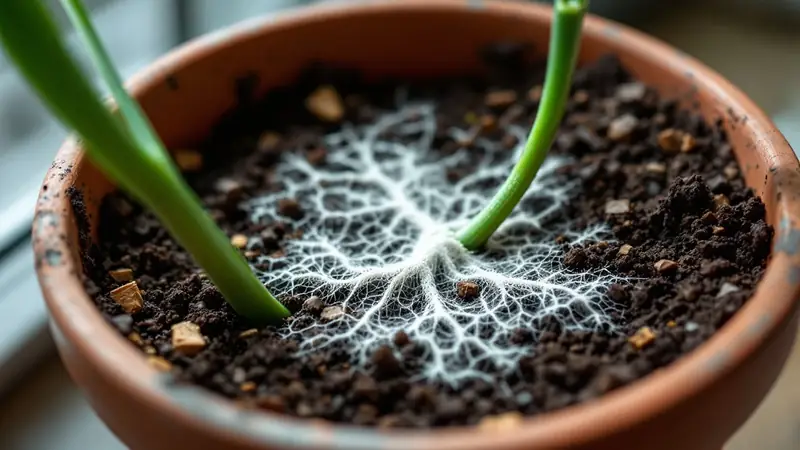
White fungus in soil is usually saprophytic mold feeding on bark, peat or wood in the mix, not on roots. Worry in 3 cases: it is a crunchy crust (salts), wraps a dying stem base with seed-like pellets, or makes the mix shed water.
Most answers about white fungus in soil stop at “it’s harmless.” That is right for the cobweb fuzz on a damp houseplant pot: Iowa State says whitish molds on peat pots and other organic materials “will not harm healthy seedlings” (Iowa State Extension). It is wrong for 3 look-alikes that kill plants and for 1 that is not fungus at all. The table below sorts 13 white things people find in pots, beds, mulch and lawns using 4 checks you can do in a minute, each row tied to an extension or university source.
The fixes point in opposite directions. Fuzz on potting mix wants less water; a salt crust wants more water poured through the pot; a pathogen at the stem base wants the plant and the soil around it bagged and removed. If the mold showed up in a bag you just opened, our page on whether potting soil goes bad in storage covers that case.
What is the white stuff in my soil?
These 4 checks separate all 13 rows in the table below; the first 2 settle most houseplant cases.
- Texture. Fuzzy, cottony or web-like means a fungus or slime mold. Crunchy, crystalline or chalky means salts or mineral deposits. Clemson HGIC draws exactly this line: “white to grey crusty deposits” are salt, not the “mold-like growth of saprophytic soil fungi” (Clemson HGIC).
- Location. Spread over the surface or through bark pieces points to a decomposer. Concentrated on the stem at the soil line, on a plant that is wilting, points to a pathogen.
- Pellets. Look for seed-like bodies in the white growth. Round, tan to brown, 0.5 to 1 mm: southern blight. Black, irregular, about the size of a broken pencil tip: Sclerotinia white mold (NC State; UMN Extension).
- Movement and water. White specks that crawl are animals, not fungus. On a dry sample, water drops that sit more than 5 seconds before soaking in mean the mat is repelling water, the 5 second cutoff used in our hydrophobic soil drop test.
Swipe the table sideways to see every column.
| What you see | Where | What it likely is | Harmful? | What to do | Source |
|---|---|---|---|---|---|
| Thin white or yellowish cobweb fuzz on top of damp mix | Surface of houseplant pots, peat pots, seed trays | Saprophytic mold on peat, bark or compost; Leucocoprinus birnbaumii makes yellowish-white mycelium | No to healthy plants; a sign the mix stays wet | Rake or scrape it off, let the top dry between waterings | Iowa State; UF/IFAS PP377 |
| Dense white mat binding the root ball; water runs off or down the pot wall | Through the whole pot | Saprotrophic mycelial mat (UF found Asperosporus in Boston fern) | Indirectly: the mat blocks water and nutrients and the plant declines | Drop test; soak or repot in fresh mix | UF/IFAS PP377 |
| White threads marbling wood chips or bark pieces | Mulch, bark-heavy mixes | Wood-decay mycelium | No; it is breaking the wood down | Leave it; rake mats that shed water | Ask Extension #135206 |
| White to gray crunchy crust | Soil surface, pot rim, drain holes, clay pot walls | Soluble salts from hard or softened water and fertilizer | Yes, over time: brown leaf tips, wilting | Remove crust and 1/2 to 1 in of mix, then leach | Clemson HGIC; CSU 1339 |
| White fan of threads radiating from a rotting stem, with round tan to brown pellets 0.5 to 1 mm | Stem at the soil line, in 80 to 95°F weather | Athelia (Sclerotium) rolfsii, southern blight | Yes, usually lethal; over 500 hosts | Bag the plant and 3 in of soil 12 in beyond it | NC State; UW PDDC |
| Cottony growth on wilting stems; black pellets inside or on the stem | Stems and nearby soil, in cool wet weather (51 to 68°F) | Sclerotinia sclerotiorum, white mold | Yes; over 400 host species | Remove infected plants; do not home-compost them | UMN Extension; UW PDDC |
| White powdery wax near the stem; slow oval whitish insects 1/16 to 3/16 in long on roots | Outer edge of the root ball | Ground (root) mealybugs | Yes: stunting, yellowing, leaf drop | Discard, or hot-water treat (below) | UC IPM |
| Thin, flat white fans under the bark at the trunk base | Trees and shrubs, often 12 to 18 in below the soil line | Armillaria root rot | Yes, kills trees | Have an arborist confirm; do not replant susceptible species | UC IPM |
| Yellow to white foamy blob that spreads overnight, then dries to a crust | Bark mulch after rain | Fuligo septica slime mold (not a fungus) | No; rarely smothers small plants | Hose it apart or rake it up, or leave it | UNH Extension; Ohio State BYGL |
| Tiny white specks that move when the pot is watered | Surface and drain holes | Springtails or soil mites | Mostly no | See soil mites in potting mix | GIR soil mites guide |
| Hard white grains that crush to grit | Mixed through bagged potting mix | Perlite | No; it is there on purpose | Nothing; see what perlite does in soil | GIR perlite guide |
| “Mycorrhizae” seen as white strands on roots | Roots | Usually not arbuscular mycorrhizae, which are “not generally evident to the naked eye” | Beneficial if present | Nothing | Univ. of Hawaii CTAHR |
| Cottony white web on lawn grass at dawn | Turf in hot, humid weather | A turf disease such as Pythium blight | Yes, to the grass | See our lawn fungus identification guide | GIR lawn fungus guide |
1Is it hard, crunchy or crystalline, on the surface, rim or drain holes?
YesSoluble salts. Remove the crust and 1/2 to 1 in of mix, then leach with at least 3 pot volumes of water (UMD; CSU).
NoGo to the next question
2Does it move when you water, or crush to hard grit?
YesNot fungus: springtails or mites if it moves, perlite if it is gritty.
NoGo to the next question
3Is it centered on a wilting stem at the soil line, with round or black pellets?
YesLikely southern blight (round tan pellets, hot weather) or Sclerotinia white mold (black pellets, cool weather). Bag the plant and the soil around it.
NoGo to the next question
4Is there white powdery wax plus slow oval insects on the roots?
YesGround mealybugs. Discard, or hot-water treat to 115°F inside the root ball (UC IPM).
NoGo to the next question
5Do water drops sit on a dry piece of the mat for more than 5 seconds?
YesWater-repellent mycelial mat. Soak the pot, then repot in fresh mix if it stays repellent (UF/IFAS PP377).
NoHarmless saprophytic mold. Rake it off, let the top dry between waterings and add air movement.
Is white fungus in soil harmful?
In a pot, almost never directly. Mushroom-forming fungi in potting soil are mostly saprotrophs feeding on the bark, wood chips, peat or moss in the blend, and “not necessarily harmful to the plants,” say University of Florida plant pathologists in their 2024 guide to potted-plant fungi (UF/IFAS PP377). Iowa State says the same of the yellow houseplant mushroom, Leucocoprinus birnbaumii: it “does not harm living plants,” and fungicides are generally not effective against it (Iowa State Extension).
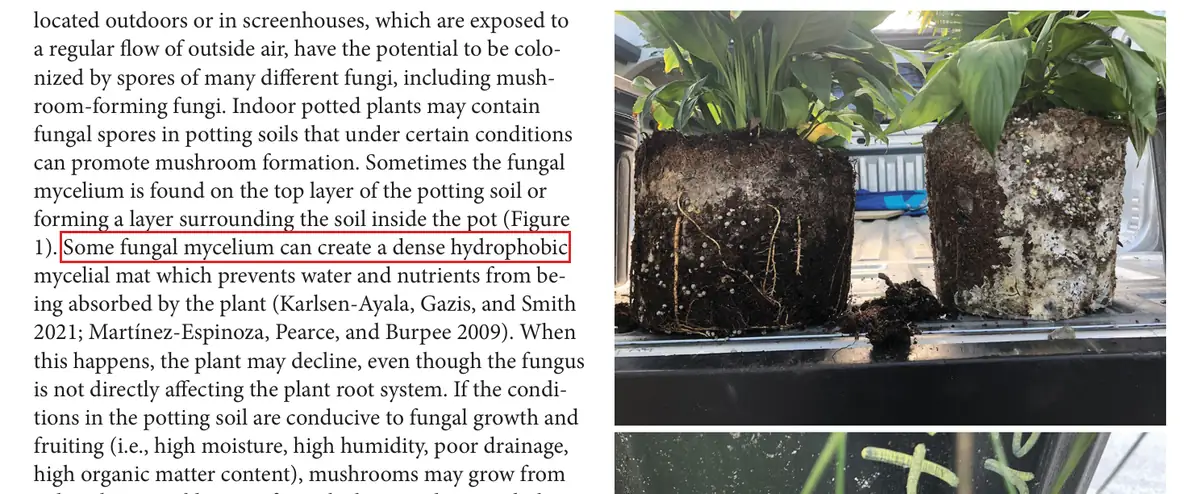
The exception is a mat thick enough to waterproof the pot. UF reports that some saprotrophic mycelium forms “a dense hydrophobic mycelial mat” that keeps water and nutrients from the roots, so the plant declines without ever being infected (UF/IFAS PP377, p. 2). The test is the drop test above: 3 drops of water on a dry piece of the mat, and more than 5 seconds to soak in means it repels water.
One popular correction needs correcting. The third Google result for this query in our November 2026 pull tells readers the white mold in their beds is mycorrhizal fungi. The University of Hawaii manual on arbuscular mycorrhizae, the type most garden plants form, says root colonization “is not generally evident to the naked eye” and is confirmed only under a stereo or compound microscope after the roots are cleared and stained (Habte and Osorio, CTAHR, 2001). A visible white mat on the surface is far more likely a decomposer.
The EPA lists allergic reactions such as sneezing, runny nose and skin rash in sensitive people as the main health effect of mold, and says people with asthma should avoid exposure (EPA, Mold and Health). Scrape the fuzz outdoors if anyone in the house is allergic. Pick off any yellow mushrooms if children or pets are around: Iowa State calls L. birnbaumii poisonous to people and animals.
Fuzz or crust: how do you tell mold from fertilizer salts?
Mold is soft and lifts off in strands; salt is a hard crust that collects where water evaporates: surface, rim and drain holes. University of Maryland Extension traces it to hard water carrying calcium carbonate, sodium and iron, and to soluble fertilizer; the deposits draw moisture away from roots and can burn tissue (UMD Extension). Clemson adds brown leaf tips and margins as the plant-side symptom (Clemson HGIC).
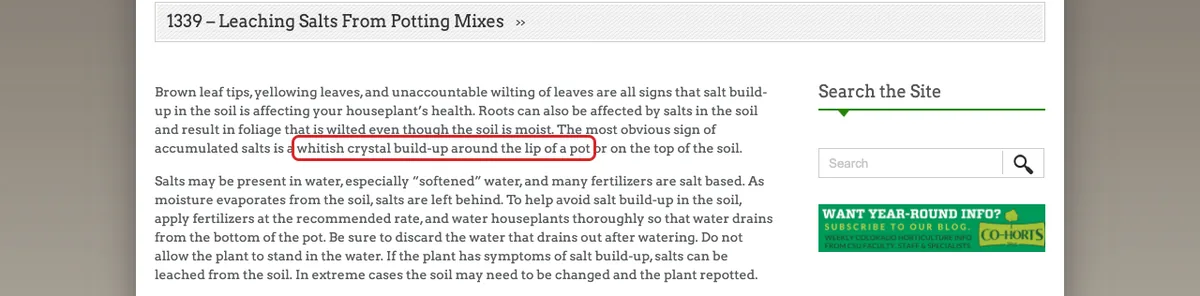
All 4 extension sources below agree on the fix, removing the crust and running clean water through the pot, but they disagree on how much water and how often: every 2 to 3 months in California, every 4 to 6 months in Maryland. Only Maryland gives a measured volume, 3 pot volumes, so that is the figure we use for the worked numbers below.
| Source | How often | How much water | Crust and pot | Link |
|---|---|---|---|---|
| UMD Extension | Every 4 to 6 months | At least 3 times the pot volume, then let it drain completely | Replace a crusted pot, or soak and scrub it before reuse | UMD |
| Colorado State PlantTalk 1339 | When salt symptoms show | Fill the pot to the top “a couple of times,” draining between fills, in a sink with the saucer removed | Remove the crust and 1/2 to 1 in of mix; replace with new mix | CSU |
| UC Cooperative Extension, Stanislaus (Perry) | Every 2 to 3 months | Water thoroughly, wait about 5 minutes, water again | Remove about 1 in of soil; repot if a clay pot is coated | UCANR |
| Clemson HGIC | Periodically | Drench (no volume given); use rainwater; empty the saucer | Remove the crust, add fresh soil, repot periodically | Clemson |
Applied to real containers, 3 pot volumes is more water than most people pour. A true 1 gallon pot needs at least 3 gallons run through it. The most common #5 nursery pot, which holds about 3.58 gallons rather than 5 (see our measured 5 gallon pot volumes), needs about 10.7 gallons: a job for the tub or the yard.
When is white growth in garden soil a disease?
When it sits on a living stem rotting at the soil line, especially with pellets in it. The pellets are sclerotia, survival bodies that UC IPM calls the main diagnostic feature of southern blight (UC IPM). The 2 common culprits split cleanly by weather.
| Sclerotinia white mold | Southern blight | |
|---|---|---|
| Pathogen | Sclerotinia sclerotiorum | Athelia rolfsii (= Sclerotium rolfsii) |
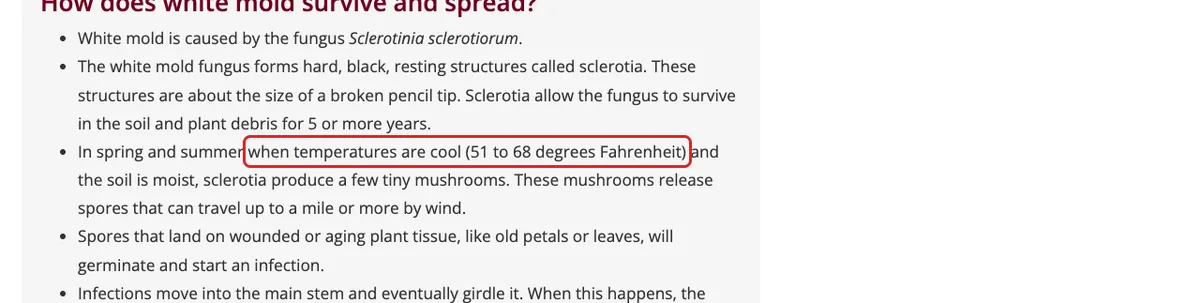
| Weather that favors it | Cool and moist, 51 to 68°F | Warm and humid, about 80 to 95°F; acidic soil below pH 7 |
| White growth | Fluffy, on infected stems or leaves when humid; cottony masses on nearby soil | Mats radiating from the stem lesion onto the soil |
| Pellets (sclerotia) | Black, oblong to irregular, about a broken pencil tip | Round, smooth, 0.5 to 1 mm (0.04 to 0.08 in), tan to dark brown, like mustard seed |
| Hosts | Over 400 species, including petunia, zinnia, tomato, bean, peony | Over 500, including hosta, peony, tomato, pepper, daylily |
| Survival in soil | 5 or more years | Up to 5 years; sclerotia survive down to about 14°F |
| Cleanup | Remove plants without knocking off sclerotia; prune 4 to 5 in below diseased tissue | Remove plants, roots and 3 in of soil to 12 in beyond the patch; turn the rest 8 to 12 in deep |
For southern blight, the University of Wisconsin plan is to bag plants, roots and 3 inches of soil from at least 12 inches beyond the infested area, starting at the edge and working in, send it to a landfill, then grow non-hosts there for 2 to 3 years (UW PDDC). NC State adds that raising soil pH above 7 limits sclerotia germination and that grasses are the only known non-host (NC State). Our guide to raising soil pH with lime gives the rates.
For Sclerotinia, UMN says to burn infected plants or bury them where you will not garden, and to compost them only in a pile that holds 148 to 158°F for at least 21 days (UMN Extension). Pots and mix that held either disease can be heat-treated: UC IPM gives 140°F for 30 minutes for growing media, and our page on how to sterilize soil at home covers oven and solar methods.
Fungicides are a last step, not a first one. NC State says no effective fungicides that prevent southern blight on ornamentals are available to homeowners (NC State); Wisconsin lists labeled actives (UW PDDC) and says they work better as prevention than as a cure. If you use one, the label is the law: confirm the plant, site and disease are on it.
How do you get rid of white mold on potting soil?
For the harmless surface fuzz, dry the mix and remove the food. None of the extension pages we read recommend cinnamon, hydrogen peroxide or a fungicide for it; Iowa State calls fungicides generally ineffective against potting-soil mushrooms, and UF says any chemical should come with changes in watering (UF/IFAS PP377).
- Confirm it is fuzz, not crust, and not centered on a wilting stem (the 4 checks above).
- Rake or scrape the white layer off the top. UF says raking the top of the soil aerates and dries it and helps stop new growth.
- Let the top of the mix dry between waterings. Iowa State links surface mold to excess moisture and says proper watering minimizes it (Iowa State).
- Empty the saucer after watering, so the pot does not sit in water (CSU 1339).
- Move the pot somewhere less humid or cooler, or into more air movement; UF lists high humidity, low light and warm temperatures as the conditions behind fruiting.
- If the mat repels water in the 5 second drop test, soak the pot until bubbles stop, then repot if it stays repellent. Mix that drains freely is described in potting soil vs potting mix and what well-drained soil means.
- If the fuzz keeps coming back in a bark-heavy blend, repot into fresh mix. UF says heavily colonized material should be removed and replaced.
For root mealybugs, UC IPM’s grower guidance is to discard infested plants and the pots near them, or to submerge pots in 120°F water until the inside of the root ball reaches 115°F, a treatment that cleared them from potted Rhapis palms in Hawaii without significant harm (UC IPM).
In mulch beds, white threads and slime mold need nothing. UNH says a slime mold plasmodium can spread 2 feet or more a day yet does not infect plants, and can be hosed apart or raked up (UNH Extension). Mushrooms that follow the threads are covered in how to get rid of mushrooms in mulch, and when to remove old mulch covers matted layers. At the base of a tree, white fans under the bark are a different matter: UC IPM says Armillaria inoculum can persist in old roots for decades, so ask a certified arborist to confirm before you replant (UC IPM).
How we compiled this
We read 18 extension, university and agency documents in November 2026, from Iowa State, UF/IFAS, Clemson, Maryland, Colorado State, UC IPM, NC State, Wisconsin, Minnesota, New Hampshire, Ohio State, Hawaii and the EPA, and the 5 top-ranking pages for this query. Each table row cites the document it came from. We did not grow, inoculate or test any plants or soil.
Frequently asked questions
Is white fungus in soil harmful?
Usually not. Iowa State says whitish molds on peat pots and other organic materials will not harm healthy seedlings, and UF says most potting-soil fungi feed on bark and peat. Act in 3 cases: if it is a crust (salts), wraps a wilting stem with pellets, or makes the mix repel water.
How do you get rid of white fungus in soil?
Scrape or rake off the top layer, let the mix dry between waterings, empty the saucer and add air movement. Repot into fresh mix if it returns or water drops sit on the mat for more than 5 seconds. Iowa State calls fungicides generally ineffective for potting-soil mushrooms.
What is the white stuff in soil called?
Fuzzy white threads are mycelium, the body of a fungus; UF/IFAS says single hyphae are microscopic and become visible only when massed into a mat. A hard white crust is soluble salt from water and fertilizer, which Clemson HGIC says not to confuse with the mold-like growth of saprophytic soil fungi.
Is it okay to use potting soil with white mold?
Yes, if it is fuzz on the mix and the bag does not smell sour. Iowa State says such molds do not harm healthy plants. Loosen the mix and let it air out; if anyone in the house is mold-allergic, do it outdoors, since the EPA lists allergic reactions as the main effect of mold.
What can be mistaken for white mold?
Salt crust, perlite, root mealybug wax, springtails and slime mold. UC IPM says white powdery wax on the soil near the stem can signal ground mealybugs, which are slow, oval insects 1/16 to 3/16 inch long on the roots.
Sources
- Iowa State University Extension and Outreach, Yard and Garden, Will mold on peat pots harm my flower and vegetable seedlings?, FAQ. Accessed November 2026.
- Iowa State University Extension and Outreach, Yard and Garden, Will yellow mushrooms harm my houseplant?, FAQ. Accessed November 2026.
- UF/IFAS Extension (Karlsen-Ayala, Gazis and Smith), A Basic Guide to Mushrooms Commonly Encountered in Potted Plants in Florida, PP377, September 2024. Accessed November 2026.
- Ask Extension (Maryland HGIC), What is white marbling in wood chips? #135206, June 2013. Accessed November 2026.
- Clemson Cooperative Extension HGIC, Houseplant Diseases and Disorders, Current web edition. Accessed November 2026.
- University of Maryland Extension, Mineral and Fertilizer Salt Deposits on Indoor Plants, Current web edition. Accessed November 2026.
- Colorado State University Extension, PlantTalk Colorado, 1339: Leaching Salts From Potting Mixes, Current web edition. Accessed November 2026.
- UC Cooperative Extension Stanislaus County (E. Perry), Leach Your Houseplants to Avoid Salt Problems, Stanislaus Sprout blog. Accessed November 2026.
- NC State Extension, Southern Blight of Herbaceous Ornamentals, Current web edition. Accessed November 2026.
- University of Wisconsin PDDC (Joy and Hudelson), Southern Blight, Current web edition. Accessed November 2026.
- UC Statewide IPM Program, Southern Blight, Floriculture and Ornamental Nurseries Pest Management Guidelines, Current web edition. Accessed November 2026.
- University of Minnesota Extension (M. Grabowski), White mold in the garden, Reviewed 2026. Accessed November 2026.
- University of Wisconsin PDDC (Joy and Hudelson), White Mold, Current web edition. Accessed November 2026.
- UC Statewide IPM Program, Ground (Root) Mealybugs, Floriculture and Ornamental Nurseries, Current web edition. Accessed November 2026.
- UC Statewide IPM Program, Armillaria Root Rot, Home and Landscape, Current web edition. Accessed November 2026.
- UNH Cooperative Extension, Slime Molds, Reviewed July 2001. Accessed November 2026.
- Ohio State University, Buckeye Yard and Garden onLine, What The Yell-Ow… I’ve Been SLIMED!, BYGL. Accessed November 2026.
- University of Hawaii CTAHR (Habte and Osorio), Arbuscular Mycorrhizas: Producing and Applying Arbuscular Mycorrhizal Inoculum, 2001. Accessed November 2026.
- U.S. Environmental Protection Agency, Mold and Health, Current web edition. Accessed November 2026.