Should I remove old mulch before adding new? Usually not. If the old layer is loose and the total stays near 3 inches (4 for coarse chips), rake it and add the difference. Remove it when too deep, matted, diseased or against trunks or siding.
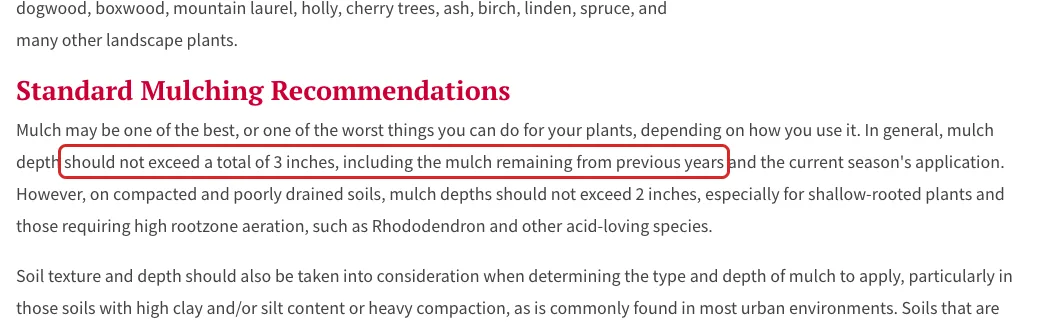
Should I remove old mulch before adding new? Our answer is a measurement, not a habit. Rutgers Cooperative Extension caps mulch at a total of 3 inches, “including the mulch remaining from previous years,” and Penn State Extension warns that new mulch over old in successive years “is the same as applying too deep a layer all at once.” So the old layer stays unless one of the conditions below applies.
We matched 15 conditions to the published rule for each, from 11 extension and university sources, and ran the University of Florida settling data forward 5 years. The result most guides miss: on slow-decaying pine bark, adding 1 inch every spring drifts to about 4.6 inches in 5 years, and 2 inches a year reaches 8.0. The depth target itself is set in our guide to how deep mulch should be for each material; this page decides what happens to the layer already there.
Measure first: is the old layer already deep enough?
Push a trowel straight down to bare soil in 3 or 4 places and average the readings. If the bed measures 2 to 3 inches, it needs no new mulch at all, only raking; University of Maryland Extension says organic mulch should be “replaced as needed to maintain their original depth” and never exceed 3 inches. Maryland describes beds that built up to “five, six, or more inches” from routine yearly additions.
The math explains why. In the UF/IFAS FR052 trial, a 3.5 inch layer of pine bark kept 6 of its 9 cm after 2 years, which works out to about 18 percent of the layer lost per year. A layer that keeps losing that share reaches equilibrium where yearly loss equals the yearly addition: about 5.4 inches if you add 1 inch every spring, 10.9 inches if you add 2.
| Spring habit (pine bark, starting at 3 in) | Year 1 | Year 2 | Year 3 | Year 4 | Year 5 | Where it levels off |
|---|---|---|---|---|---|---|
| Top up the difference only (about 0.55 in a year) | 3.0 | 3.0 | 3.0 | 3.0 | 3.0 | 3.0 in |
| Add 1 in every spring | 3.4 | 3.8 | 4.1 | 4.4 | 4.6 | 5.4 in |
| Add 2 in every spring | 4.4 | 5.6 | 6.6 | 7.4 | 8.0 | 10.9 in |
| Add 3 in every spring (a full new layer) | 5.4 | 7.4 | 9.1 | 10.4 | 11.5 | 16.3 in |
- Top up the difference only
- Add 1 in every spring
- Add 2 in every spring
- Add 3 in every spring
Source: Our model from UF/IFAS FR052 (pine bark kept 6 of 9 cm after 2 years) Assumes the layer keeps 82% of its depth each year. Rutgers FS099 caps the total at 3 inches including old mulch.
Show the numbers
| Top up the difference only | Add 1 in every spring | Add 2 in every spring | Add 3 in every spring | |
|---|---|---|---|---|
| Start | 3 | 3 | 3 | 3 |
| Year 1 | 3 | 3.40 | 4.40 | 5.40 |
| Year 2 | 3 | 3.80 | 5.60 | 7.40 |
| Year 3 | 3 | 4.10 | 6.60 | 9.10 |
| Year 4 | 3 | 4.40 | 7.40 | 10.40 |
| Year 5 | 3 | 4.60 | 8 | 11.50 |
Every habit except topping up the difference crosses Rutgers’ 3 inch total in year 1 and passes 4 inches by year 3 or sooner. Faster-decaying mulch builds up less: arborist and utility chips kept only 5 of 9 cm after 2 years in the same trial, so holding 3 inches takes about 0.8 inch a year. For how many cubic yards a top-up of that size means for your bed, use the mulch quantity calculator.
When should you remove old mulch? 15 conditions and the rule for each
Depth is only the first test. Condition decides the rest, and most of what looks alarming in a mulch bed is harmless: Penn State Extension says slime molds, bird’s nest fungi and mushrooms “are not harmful to landscape plants,” and appear from April through October after rain. The rows below sort each condition into keep, move or remove, with the source for each rule.
Swipe the table sideways to see every column.
| If you find | How to check | Do this | Verdict | Source |
|---|---|---|---|---|
| Loose layer, total 2 to 3 in, no fungus or odor | Trowel to soil in 3 or 4 spots | Keep it. Rake to loosen and add only the difference to your target, often under 1 in | Keep | Penn State; Univ. of Maryland |
| Total already over 3 in, or will be after adding | Same probe; count old plus new | Add nothing. Rake surplus out to about 2 in and spread it on thin beds | Remove some | Rutgers FS099; Univ. of Maryland |
| Old layer decomposed to dark, soil-like crumbs | Crumbles in the hand; no wood pieces | Leave it as soil, or work it in; mulch to target on top | Keep | Univ. of Maryland; Clemson HGIC 1604 |
| Matted or crusted layer that sheds water | Pour a cup of water: it beads and runs off | Break it up with a rake or claw cultivator; water new mulch after spreading | Keep, break up | Clemson HGIC 1604; Rutgers FS099 |
| Fine double-shredded mulch that keeps sealing | Mats again within a season | Thin it to 1 to 2 in; switch to a coarser product | Remove some | Rutgers FS099 |
| Mulch against trunks or stems | Root flare buried; bark wet | Pull back 3 to 5 in on young plants, 8 to 12 in on mature trees; spread a volcano, do not haul it | Move, not remove | Rutgers FS099; Penn State |
| Fine roots growing up into the mulch | Roots in the layer, not the soil | Layer is too deep; take it down gradually toward 3 in | Remove some | Rutgers FS099; Univ. of Maryland |
| Within 12 in of the foundation | Less than 6 in of foundation visible below siding | Keep under 2 in and reopen a 6 in inspection gap | Remove some | UF/IFAS ENY-832 |
| Within 5 ft of the house, wildfire area | Any wood, bark, straw or rubber mulch | Replace with rock, gravel, concrete or pavers | Remove | Nevada SP-11-04 |
| Slime mold, bird’s nest fungus, stinkhorns or mushrooms | Yellow, orange or white blobs; tiny cups; foul-smelling stalks | Harmless to plants. Rake or scoop the growth; keep the mulch | Keep | Penn State; UMass; Univ. of Delaware |
| Artillery fungus: tar-like dots on siding or cars | Cups about 1/10 in wide on mulch; black specks on light walls | Replace foundation mulch with large pine bark nuggets, or cover it with a fresh layer; blend in 40% used mushroom compost | Remove or cover | UMass; Penn State; Clemson |
| Confirmed boxwood blight in the bed | Lab-confirmed diagnosis | Remove leaf litter, double-bag it for the landfill; no compost, no curbside brush; re-mulch about 2 in | Remove | Virginia Tech PPWS-29 |
| Shallow-rooted shrubs such as boxwood | More than 1 in over the roots | Thin to 1 in or less | Remove some | Univ. of Maryland |
| Years of pine bark around non-acid-loving plants | Soil test; pine bark runs pH 3.5 to 4.5 | Keep it, test pH and rotate to a different mulch at the next top-up | Keep, rotate | Rutgers FS099 |
| Faded dyed mulch at a good depth | Color gone, depth still 2 to 3 in | Rake to turn up darker mulch, or add a 1 in color layer | Keep | Univ. of Maryland; Scotts color guarantee |
1Is the bed within 5 feet of the house in a wildfire-prone area?
YesRemove wood, bark, straw or rubber mulch there and use rock, gravel, concrete or pavers (Nevada SP-11-04).
NoGo to the next question
2Has a lab confirmed boxwood blight in the bed?
YesRemove leaf litter and old mulch, double-bag it for the landfill, never compost it, then re-mulch about 2 inches (Virginia Tech PPWS-29).
NoGo to the next question
3Are there tar-like spots on siding or cars near the bed?
YesArtillery fungus: replace or cover the foundation mulch, ideally with large pine bark nuggets (UMass; Penn State).
NoGo to the next question
4Does a trowel find more than 3 inches to soil, or roots growing in the mulch?
YesAdd nothing. Rake the surplus out to about 2 inches and spread it on thinner beds (Rutgers; Maryland).
NoGo to the next question
5Is mulch touching trunks, stems or the siding?
YesPull it back 3 to 12 inches from stems and keep under 2 inches within 12 inches of the foundation (Rutgers; UF/IFAS ENY-832).
NoGo to the next question
6Does water bead on a matted or crusted layer?
YesBreak it up with a rake or claw cultivator, then add only the difference (Clemson).
NoKeep the old mulch. Rake it, scoop any slime mold, and add only the inches needed to reach your target.
Matted, crusted or water-repellent mulch
Matting is a reason to rake, not to replace. Clemson HGIC 1604 explains that fungal threads in dry mulch form a mat that “is hydrophobic (repels water)” and says to “break apart the matted layers with a rake or claw cultivator.” Rutgers adds that fine double-shredded mulch knits tightly and should go down only 1 to 2 inches, and Colorado State notes wood chips in intense sun can turn hydrophobic too.
If water still beads on the soil under the raked mulch, a 5-second drop test tells you whether that soil is water-repellent too, and the bed steps in how to fix hydrophobic soil cover re-wetting it.
Test it with a cup of water before deciding. If the water soaks in after raking, keep the layer. If a fine product seals over again within a season, thin it to 1 to 2 inches and switch to a coarser mulch at the next top-up, the fix Rutgers gives for fine-textured mulch.
Mold, slime mold and artillery fungus
Slime molds, the yellow “dog vomit” masses of Fuligo and Physarum, feed on bacteria in the mulch and dry to a powder; University of Delaware Extension calls them harmless and says to rake them away. Bird’s nest fungi and stinkhorns are also harmless. None of them is a reason to strip a bed, though Clemson suggests replacing heavily wooded hardwood mulch with pine bark or pine needles where stinkhorns keep returning.
When the white growth is in the soil under the mulch or in a pot rather than on the mulch itself, our white fungus in soil identification table uses 4 quick checks to separate decomposers from southern blight and root mealybugs.
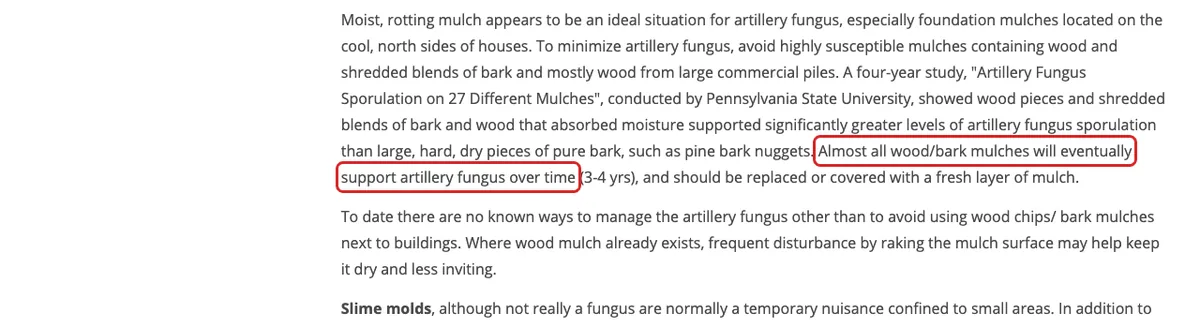
Artillery fungus is the exception. Its cups, about 1/10 inch wide, shoot sticky black spore masses “as high as 6 feet and distances of 12 feet or more” toward light surfaces, UMass Extension reports, and the spots stain when removed. UMass adds that “almost all wood/bark mulches will eventually support artillery fungus over time (3-4 yrs), and should be replaced or covered with a fresh layer.”
For replacement near the house, Penn State tested 27 mulches and found large pine bark nuggets the most resistant, with cypress also good. Penn State researchers also found that blending 40 percent used mushroom compost into the mulch “greatly suppresses” the fungus. Do not scrape spots off the siding onto the bed below: Penn State says those spores are alive and reinfest the mulch.
Diseased beds and pests
Remove mulch when a lab confirms a disease that spreads on fallen leaves. For boxwood blight, Virginia Tech PPWS-29 says to remove leaf litter, double-bag it with the diseased plants for the landfill, bury it 2 feet deep or burn it where allowed, and never compost it or set it out for curbside brush pickup. Then re-mulch to about 2 inches; in research, 2 to 4 inches stopped spores splashing onto lower leaves.
Pests are a placement problem more than an age problem. Maryland says excess mulch hides voles that girdle trunks, and UF/IFAS ENY-832 wants less than 2 inches within 12 inches of the foundation with a 6 inch inspection gap below siding, because layers over 4 to 6 inches hide termite tubes. Thin the foundation strip; the rest of the bed can stay.
Material matters for some pests too: young Asian cockroaches chose rubber mulch 48.3 to 62.5 percent of the time in Auburn lab tests, one of the findings sorted pest by pest in does mulch attract bugs.
How long does mulch last before it needs replacing?
Organic mulch is rarely replaced; it is topped up as it turns into soil. How fast depends on the material, from compost that Morton Arboretum says “may not last a full growing season” to pine needles and bark that Clemson says last 2 to 4 years before more is needed. The third column is our arithmetic: the yearly top-up that holds a layer steady at 3 inches.
| Mulch | How long it lasts (published) | Yearly top-up to hold 3 in | What goes wrong when old | Source |
|---|---|---|---|---|
| Pine straw | Half its depth gone in year 1; about 1 cm of 9 left after 2 years | 1.5 in | Thins fast; rarely needs removal | UF/IFAS FR052 |
| Utility or arborist chips | About 5 of 9 cm left after 2 years; Clemson: chips usually decompose fully within 2 years | 0.8 in | Turns to soil; low buildup risk | UF/IFAS FR052; Clemson |
| Shredded hardwood | May last a full year (Morton); decomposes relatively slowly (Clemson) | Not measured | Mats; feeds artillery fungus near the house | Morton Arboretum; Clemson |
| Pine bark | 6 of 9 cm left after 2 years; bark lasts 2 to 4 years before more is needed (Clemson) | 0.55 in | Builds up fastest; pH drift with years of use | UF/IFAS FR052; Clemson |
| Cypress | 6 of 9 cm left after 2 years | 0.55 in | Builds up like pine bark | UF/IFAS FR052 |
| Melaleuca | Almost 7 of 9 cm left after 2 years | 0.35 in | Slowest to thin of the 6 tested | UF/IFAS FR052 |
| Leaf mold, shredded leaves | 1 to 2 years before it is soil | Not measured | Mats if laid over 2 in | Clemson |
| Fine compost, cocoa shells | May not last one growing season | Not measured | Disappears into soil | Morton Arboretum |
| Dyed wood mulch | Color guaranteed 1 year by one maker; the wood decays like any wood mulch | As its wood | Fades before it thins | Scotts ColorGuard |
| Rubber mulch | Does not decompose; 12-year fade warranty that excludes normal weathering | None | Never becomes soil; remove by hand to change | Rubberific warranty; Clemson |
| Gravel, stone | Rarely needs replenishing | None | Soil and leaves fill the gaps | Clemson |
Read the top-up column against your habit. Pine bark and cypress need only about half an inch a year to hold 3 inches in a hot, wet Florida climate, while pine straw needs 1.5 inches because it halves in year 1. Our pine straw vs mulch cost comparison prices that difference over 5 years, and the cypress mulch decay data shows why cypress sits at the slow end.
Dyed mulch fades long before it thins: Scotts guarantees its ColorGuard color for 1 year. A faded bed at 2 to 3 inches needs raking or a 1 inch color layer, not removal; our mulch color guide covers dyes. Rubber never decomposes, so the only way to change it is to rake it out by hand.
How do you refresh old mulch without removing it?
- Probe to soil in 3 or 4 spots. If the average is at or above your target, add nothing this year.
- Pull mulch off trunks and stems: 3 to 5 inches on young plants, 8 to 12 inches on mature trees (Rutgers). Spread a volcano outward; Penn State‘s example moved it to the drip line and “no mulch was removed from the site.”
- Rake the whole bed to break matted layers and turn darker mulch up. Scoop slime molds and mushrooms into the trash or compost.
- Subtract: inches to add = target minus measured. On pine bark that is often 0.5 to 1 inch.
- Spread the new layer level and water it in; Clemson says new mulch should be watered so it does not dry into a water-repellent mat.
- If the bed has had pine bark for years, check soil pH and rotate to another mulch next time (Rutgers).
For trees, our guide to mulching around trees and fixing a mulch volcano sets ring size and trunk gaps. Spring is the usual time to check; when to mulch by soil temperature gives the dates.
How to remove old mulch and where it goes
When the probe or the table says remove, take the layer down to about 2 inches rather than to bare soil, and rake by hand near trunks so bark and surface roots are not scraped. Maryland says old mulch can be “gently worked into the planting bed to improve the soil or removed and worked into other garden areas,” so surplus from a deep bed often tops up a thin one.
- Old mulch (cubic feet)
- 16.7
- Old mulch (cubic yards)
- 0.62
- 30-gallon yard waste bags
- 5
- 6 cu ft wheelbarrow loads
- 3
Cubic feet = sq ft x inches / 12. A 30-gallon paper yard waste bag holds 4.01 cu ft. Leave about 2 inches of old mulch in place.
| Bed area | Remove 1 in | Remove 2 in | Remove 3 in |
|---|---|---|---|
| 50 sq ft | 4.2 cu ft (2 bags) | 8.3 cu ft (3 bags) | 12.5 cu ft (4 bags) |
| 100 sq ft | 8.3 cu ft (3 bags) | 16.7 cu ft (5 bags) | 25.0 cu ft (7 bags) |
| 200 sq ft | 16.7 cu ft (5 bags) | 33.3 cu ft (9 bags) | 50.0 cu ft (13 bags) |
| 500 sq ft | 41.7 cu ft (11 bags) | 83.3 cu ft (21 bags) | 125.0 cu ft (32 bags) |
Healthy old mulch can go in the compost or out with yard waste. Nationally, EPA estimates 35.4 million tons of yard trimmings were generated in 2018, of which 22.3 million tons, 63 percent, were composted or mulched and about 10.5 million went to landfills. Diseased material is different: Virginia Tech’s boxwood rule is double bags to the landfill, because municipal mulch can spread the fungus.
Whether your city’s yard waste service takes it is another matter: our guide on how to dispose of old mulch compares 9 programs, from Minneapolis, which lists mulch, to Lawrence, Kansas, which refuses it.
Mixing old into the soil is the cheapest disposal, and compost can go under the new layer; our compost vs mulch guide explains the order. If you are leaving organic mulch for stone, our mulch vs rock comparison covers heat and cost.
How we compiled this
In November 2026 we read 17 primary documents: 13 extension and university publications (Rutgers, Penn State x3, Maryland, Clemson, UMass, Delaware, Virginia Tech, UF/IFAS x2, Nevada, Colorado State), the Morton Arboretum, EPA’s yard trimmings data, and 2 maker documents (Scotts, Rubberific). No mulch was measured for this page. The buildup table, chart and top-up column are our arithmetic from the 2-year depths in UF/IFAS FR052, assuming each year loses the same share of the layer.
Frequently asked questions
Can I just put new mulch on top of old mulch?
Yes, if the old layer is loose and the total stays at 3 inches, Rutgers’ cap including past years, or up to 4 for coarse chips. Rake it first. If it already measures 2 to 3 inches, add nothing.
What is the 3-3-3 rule for mulch?
A tree-ring memory aid: 3 feet across, 3 inches deep, 3 inches from the trunk. The depth matches Maryland’s 3 inch cap; Rutgers wants 8 to 12 inches of clearance on mature trees.
What to do before putting new mulch down?
Measure depth at 3 or 4 spots, pull mulch off trunks and siding, rake out mats, pull weeds and remove any mulch from beds with confirmed boxwood blight. Then add only the difference to your target.
How often should mulch be replaced?
Rarely in full. Top up when the layer thins: about 1.5 inches a year for pine straw and about half an inch for pine bark in UF/IFAS settling data. Replace foundation wood mulch every 3 to 4 years where artillery fungus is a problem.
Is moldy mulch bad for plants?
No. Penn State says mushrooms, slime molds and bird’s nest fungi in mulch are not harmful to landscape plants. Rake or scoop them. Artillery fungus is the one to act on, because it stains siding and cars.
What to do with old dyed mulch?
If it is still 2 to 3 inches deep, keep it and rake or add a 1 inch color layer. Surplus can be worked into the bed or bagged for yard waste where your program accepts it.
Sources
- Rutgers Cooperative Extension, Problems With Over-Mulching Trees and Shrubs (FS099), Current page. Accessed November 2026.
- Penn State Extension, Mulching Landscape Trees, Current page. Accessed November 2026.
- Penn State Extension, Artillery Fungus in Mulch, Updated July 16, 2026. Accessed November 2026.
- Penn State Extension (Brantley, Davis and Kuhns), What Is Growing in My Landscape Mulch? Mushrooms, Slime Molds, and Fungus, Updated June 26, 2025. Accessed November 2026.
- University of Maryland Extension, Excess Mulch Problems, Updated March 14, 2023. Accessed November 2026.
- Clemson Cooperative Extension, HGIC, Mulch (HGIC 1604), Current page. Accessed November 2026.
- UMass Extension (T. Smith), Fungi in Mulches and Composts, Rev. Sept. 2011, updated July 2026. Accessed November 2026.
- University of Delaware Cooperative Extension (N. Gregory), Artillery Fungus and Other Things That Grow in Mulch, 2019, reviewed March 2025. Accessed November 2026.
- Virginia Cooperative Extension, Boxwood Blight: A Threat to Ornamental and Native Boxwood (PPWS-29), Current page. Accessed November 2026.
- UF/IFAS Extension (Oi and Wheeler), The Facts About Termites and Mulch (ENY-832), Rev. June 2023. Accessed November 2026.
- University of Nevada Cooperative Extension, The Combustibility of Landscape Mulches (SP-11-04), 2011. Accessed November 2026.
- UF/IFAS Extension (Duryea and Minogue), Landscape Mulches: How Quickly Do They Settle? (FOR 69/FR052), Rev. 2017, reviewed 2024. Accessed November 2026.
- The Morton Arboretum, How to Mulch Trees and Shrubs, Current page. Accessed November 2026.
- Colorado State University Extension, Mulching, Current page. Accessed November 2026.
- U.S. EPA, Yard Trimmings: Material-Specific Data, 2018 data. Accessed November 2026.
- Scotts Miracle-Gro, Scotts Nature Scapes Color Enhanced Mulch product page, Checked November 2026. Accessed November 2026.
- IMC Outdoor Living, Rubberific Mulch 12-year limited warranty, 2012 version. Accessed November 2026.