Why does mulch smell? Good wood mulch smells like cut wood or soil. Vinegar, ammonia, rotten-egg or alcohol odors mean sour mulch: wood that fermented without oxygen deep in a pile, fell to pH 1.8 to 2.5 and can scorch plants within 24 hours.
Why does mulch smell is really two questions: is this smell normal, and will it hurt anything. Most new mulch smells of wood, resin or damp soil, and that fades in days. The smell that matters is sharp and sour, because it comes from acids and gases that University of Arkansas Extension says can kill bedding plants within 24 hours of spreading (UAEX FSA6138). Nearly every result for this question stops at “anaerobic fermentation.” This page goes one step further and matches each smell people report, from vinegar and rotten eggs to manure and chocolate, to the compound behind it, what federal chemical guides say that compound smells like, and what to do about it.
Two numbers decide most cases: how tall the pile was (extension sheets put the safe limit at 4 to 6 feet) and the pH of the mulch (sour hardwood reads 1.8 to 3.6, fresh hardwood bark 4.9 to 5.5). If the problem is spreading depth rather than smell, our guide to how deep mulch should be by material has the limits; if the smell comes with caps, cups or slime, see how to get rid of mushrooms in mulch.
What does each mulch smell mean?
Seven of the 14 smells below trace to one event, sour mulch, and they are the only ones that harm plants. UMass Extension lists vinegar, ammonia, sulfur and silage as sour-mulch odors and says good mulch smells “like freshly cut wood or earthy like soil” (UMass Extension, 2016). The odor descriptions in the second column come from the NIOSH Pocket Guide and PubChem, not from user reports.
Swipe the table sideways to see every column.
| Smell | Likely cause | Hurts plants? | People and pets | What to do | Source |
|---|---|---|---|---|---|
| Vinegar, pickles | Acetic acid from anaerobic fermentation (sour mulch). NIOSH: “sour, vinegar-like odor”; table vinegar is 5 to 8 percent acetic acid | Yes: scorch, bleaching, leaf drop within 24 hours | Irritant; UAEX says usually not harmful to people or pets | Stop spreading; pull it back from plants, spread thin to vent, water heavily | UAEX FSA6138; NIOSH NPG |
| Rotten eggs, sulfur, sewer | Hydrogen sulfide from the oxygen-starved pile core | Yes (sour mulch) | Smell first noticed at 0.01 to 1.5 ppm (OSHA); NIOSH warns the nose fatigues and stops warning you | Spread outdoors in a thin layer; do not work with your face in an opened pile core | UMass 2016; OSHA; NIOSH NPG |
| Ammonia, sharp and stinging | Ammonia gas, from sour mulch or from nitrogen-rich ingredients such as manure or fresh grass (Cornell) | Yes when it comes from sour mulch | NIOSH: “pungent, suffocating odor”; UAEX notes burning eyes while spreading | Air it out; do not add lime to a load that smells of ammonia, it raises the ammonia smell (Cornell) | UAEX; Cornell; NIOSH NPG |
| Alcohol, solvent, sweet | Methanol (wood alcohol) and ethanol: Maryland Extension calls it wood alcohol syndrome | Yes: bleached, scorched or yellowed leaves; small annuals may die | Vapors irritate; not reported as a hazard outdoors | Smell every delivery before spreading; aerate and dry a suspect pile | UMD Extension; NIOSH NPG |
| Rancid butter, vomit, old cheese | Butyric acid (PubChem: “unpleasant, rancid odor”), one of the acids UMass found in fermented wood | Yes (sour mulch) | Irritant | Treat as sour mulch | UMass fact sheet; PubChem CID 264 |
| Sweaty socks, rancid | Propionic acid (NIOSH: “pungent, disagreeable, rancid odor”) | Yes (sour mulch) | Irritant | Treat as sour mulch | UMass fact sheet; NIOSH NPG |
| Silage, fermented hay | Mixed fermentation acids; UMass lists silage as a sour-mulch odor | Yes (sour mulch) | Irritant | Treat as sour mulch | UMass 2016 |
| Manure, barnyard, poop | Either sour-mulch compounds (Cornell: reduced sulfur compounds, volatile fatty acids, amines) or a compost or manure ingredient in a blend | Only if it is sour | Check the bag: MSC guidelines require the product identity on the label | Wood-only and hot or acidic: treat as sour. Compost blend: it fades as the layer dries | Cornell; MSC 2025 standard |
| Chocolate | Cocoa bean shell mulch; 0.19 to 2.98 percent theobromine reported in processed shells | No | Dogs that eat it can vomit, tremble or seize | Keep dogs out of the bed or pick another mulch | AVMA; Poison Control |
| Fresh-cut wood, pine or cedar resin | Normal wood volatiles; UAEX calls a fresh cut woody smell good mulch | No | No hazard reported | Nothing to do | UAEX FSA6138 |
| Earthy, like garden soil | Normal, aerobically aged mulch | No | No hazard reported | Nothing to do | UMass 2016 |
| Musty, moldy | Decomposer fungi and slime molds working on the wood | No; Penn State says they are not harmful to landscape plants | Nuisance only | Rake to dry the layer; water less | Penn State Extension |
| Rotting meat, in one spot | Stinkhorn fungus: a 4 to 8 inch stalk with olive-brown slime that draws flies | No | Not poisonous per UF/IFAS; still bag it | Scoop and bag the stalk and its eggs | Iowa State Extension; UF/IFAS PP345 |
| Smoke, burning | Smoldering mulch; MSC says discarded cigarettes are the typical cause, not heat from a landscape bed | Fire risk | Fire risk | Soak it; call the fire department if it keeps smoking. Mass. rule: no new mulch within 18 in of combustible siding, except homes of 6 or fewer units | MSC FAQ; Mass. DFS |
1Does it smell like smoke, or is the mulch smoking?
YesSmoldering mulch. Soak it and call the fire department if it keeps smoking (MSC: usually a discarded cigarette).
NoGo to the next question
2Vinegar, rotten eggs, ammonia, alcohol, rancid butter or silage, and hot or steaming inside?
YesSour mulch. Stop spreading, pull it back from plants, spread thin, water heavily, wait 3 to 7 days.
NoGo to the next question
3Chocolate?
YesCocoa shell mulch. Harmless to plants; keep dogs from eating it (theobromine).
NoGo to the next question
4Manure or barnyard, and the bag lists compost, manure or a blend?
YesThe ingredient itself. It fades as the layer dries; no action unless it is also hot or acidic.
NoGo to the next question
5Rotting meat from one spot with a slimy stalk?
YesStinkhorn fungus. Bag the stalk and eggs; plants are not harmed.
NoGo to the next question
6Musty or moldy, with caps, cups or slime?
YesDecomposer fungi or slime mold. Rake to dry; water less.
NoFresh-cut wood, pine or cedar resin, or damp soil: normal mulch. Nothing to do.
Source: UAEX FSA6138; UMass Extension; Purdue; Cornell; MSC; Iowa State; Penn State; AVMA
“Smells like poop” is the most searched version of this question, and it has two answers. In a bag or load of plain wood, a manure smell is almost always sour mulch: Cornell’s composting program lists the anaerobic odor family as reduced sulfur compounds such as hydrogen sulfide, volatile fatty acids and amines (Cornell Waste Management Institute). In a product sold as a blend, compost or soil-and-mulch mix, the smell can be the ingredient itself, and the Mulch and Soil Council’s March 2025 standard requires a label that names the product identity and, for blends, the ingredients (MSC standard, 2025). Read the bag before you blame the wood.
Color is not the source. Dyed and undyed mulch sour the same way, since the fermentation happens in the wood, and the colorant chemistry is covered in our guide to mulch colors and dyes. Cedar’s strong scent is the wood’s own oil, and the trade-offs of that species are in cedar mulch pros and cons.
Why does mulch go sour in the pile?
Height and water. When a hardwood pile gets too large or waterlogged, the microbes in its core switch from aerobic to anaerobic, the core heats, and acetic acid, methanol, ammonia and hydrogen sulfide build up (UAEX FSA6138). UMass adds propionic and butyric acid to the list, citing Bollen and Lu (1966), and notes that piled bark, chips and sawdust compact and heat at depth until oxygen is shut out (UMass Extension fact sheet).
| Source | Pile height rule | pH reported | Link |
|---|---|---|---|
| Purdue Extension (Lerner) | No higher than 4 ft; turn taller piles | Sour mulch pH 1.8 to 3.6; normal mulch close to 7.0 | Purdue |
| Univ. of Arkansas FSA6138 (Robbins) | Suppliers should avoid piles over 4 ft | Sour 1.8 to 2.5; hardwood bark 4.9 to 5.5 | UAEX |
| UMass Hort Notes (Bayer, 2016) | No more than 4 to 6 ft, turned often | Sour 1.8 to 2.5; good mulch near neutral | UMass |
| Univ. of Maryland Extension | Problem piles are taller than 6 to 8 ft and stored long | Not given | UMD |
| UMass fact sheet, citing Gouin (1992) | Windrows 4 ft high for best results | Not given | UMass |
| UMass fact sheet, citing Baker (1992) | Piles over 10 ft prone to fermentation; keep under 10 ft and turn | Not given | UMass |
| UMass fact sheet, citing Zoch et al. (1982) | Aspen bark stored in 20 ft piles | Fell from 4.6 to 2.6 to 3.3 | UMass |
The pH numbers show how far a pile can fall. In 20 foot piles of stored aspen bark, pH dropped from 4.6 to between 2.6 and 3.3 (Zoch et al. 1982, cited by UMass), and Purdue gives the full sour range as 1.8 to 3.6 against close to 7.0 for normal mulch (Purdue Extension). For scale, NIOSH notes household vinegar is 5 to 8 percent acetic acid (NIOSH Pocket Guide).
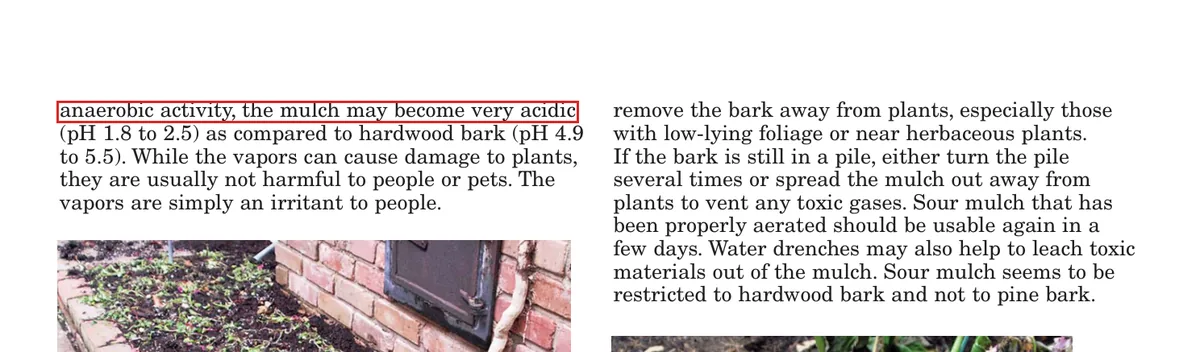
Hardwood is the usual culprit. Arkansas says sour mulch seems restricted to hardwood bark and not pine bark, and Purdue cites reports that pine bark does not sour (UAEX; Purdue). Bagged mulch is not exempt: Maryland Extension says it can sour when bags stay wet for long periods (UMD Extension). Free arborist loads of 4 to 20 cubic yards are the case to watch at home, since one heap left for weeks behaves like a small supply-yard pile; our guide to making your own mulch from leaves and chips covers handling those loads.
How do you check a load before spreading it?
Check every delivery the day it arrives, before any of it touches a plant. Arkansas tells gardeners not to buy, spread or accept mulch “with a foul odor or mulch that is hot” (UAEX FSA6138), and Maryland says to smell bulk mulch before placing it (UMD Extension). Five checks, in order:
- Dig in 6 inches or more. The surface of a pile vents; the sour material is in the core. Pull a handful from the middle of the load and smell it at arm’s length.
- Feel it. Sour mulch can feel very hot to the touch, and Purdue says steam may escape when the pile is finally opened (Purdue).
- Look at it. Arkansas describes sour hardwood as turning exceptionally black and tar-like (UAEX).
- Test the pH. Soak a cup of mulch from the core in a cup of distilled water for 30 minutes and dip a pH strip in the liquid. UMass says a pH test can confirm sour mulch (UMass). A reading of 3.6 or lower on hardwood is inside every published sour range; fresh hardwood bark reads 4.9 to 5.5.
- Decide. If any check fails, stop. Arkansas says application should stop immediately on suspicion, and that there is no need to throw the mulch away (UAEX).
The 3.6 cutoff and the soak method are our reading of the published ranges, not a lab standard: a strip test on a soaked sample is a screen, not a lab result. When the strip and your nose disagree, trust the smell and the heat.
What does sour mulch do to plants?
It burns soft tissue fast. In the UMass case a homeowner spread a Saturday delivery on Sunday, plants began to wilt within half an hour, and by Monday tulip, phlox, astilbe and violet leaves had turned white or tan “as if bleach had been thrown over the plants” (UMass Extension).
| Question | What the sources report | Detail | Source |
|---|---|---|---|
| How fast | Wilting within 30 minutes in the UMass case; leaves bleached white or tan by the next day | Within 24 hours (UAEX); usually within 1 day (Purdue) | UMass; UAEX; Purdue |
| What it looks like | Leaf scorch, bleaching, yellowing or blackening, leaf drop | Mimics drought, fertilizer burn or herbicide drift | UAEX; Purdue |
| Most at risk | Newly planted trees and shrubs, bedding plants, low foliage touching the mulch | Woody plants lose the lower skirt of leaves first | UAEX; UMass |
| Hit in the UMass case | Tulips, phlox, astilbe, violets, adjacent turf | Rhododendrons and daffodils in the same border showed no damage | UMass |
| Recovery | Perennials and turf back within a few weeks; bulbs flowered the next spring | Most woody plants recover (UMD); small annuals may die | UMass; UMD |
| Do not | Fertilize injured plants | Purdue: it can add injury; side-dress nitrogen only in midsummer if vigor stays low | Purdue |
Injury that appears within a day of mulching, on low leaves only, next to mulch that smelled sharp, points to sour mulch rather than drought or herbicide. Damage on woody plants shows first on the lowest skirt of leaves, the ones closest to the bark (UAEX FSA6138).
How do you get rid of the smell, and how long does it last?
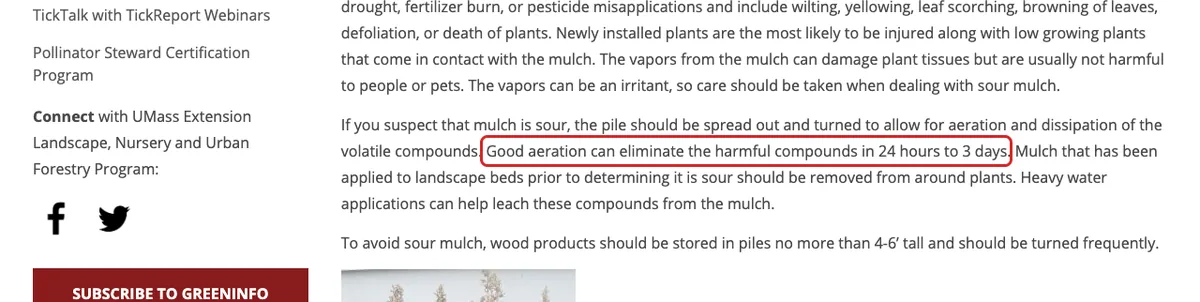
Air and water. UMass says good aeration can eliminate the harmful compounds in 24 hours to 3 days (UMass Extension, 2016); Arkansas says aerated sour mulch should be usable again in a few days (UAEX); Purdue suggests airing a shallow layer for a few days, preferably a week, before it goes near young plants (Purdue).
- Pull it back. If it is already spread, rake it away from plants at once, starting with low foliage and herbaceous plants (UAEX).
- Spread it in a shallow layer away from plants. On a driveway or tarp is fine. If it is still in a pile, turn it several times to vent the gases (UAEX).
- Water heavily. UMass, Purdue and Maryland all recommend drenching to leach the compounds, especially if no rain has fallen (UMD).
- Wait 3 to 7 days, then re-check. Smell a handful and repeat the pH strip. Only put it back around tender plants once the sharp smell is gone.
- Treat the plants. Water injured plants through hot, dry weather and do not fertilize them; cut back damaged annuals and perennials and remove dead ones (Purdue; UMD).
Lime is the one fix sources disagree on. The UMass fact sheet says large amounts of limestone neutralize the acidity (UMass), but Cornell’s composting program notes that raising pH pushes more ammonium into ammonia gas, so adding lime increases an ammonia smell (Cornell). If the load smells of ammonia, air it out first and skip the lime.
A non-sour smell, such as fresh wood or a compost blend, fades on its own as the surface dries. If the bed is old, matted and smells sour at the bottom, the question becomes replacement, and our guide on whether you should remove old mulch sets out when to strip it. Arborist chips and bagged bark compared on cost and decay are in wood chips vs mulch.
Is the smell of mulch dangerous to people or pets?
Usually not. Arkansas and UMass both say sour-mulch vapors can damage plants but are usually not harmful to people or pets, and act as an irritant (UAEX; UMass). Arkansas notes you may feel your eyes burn while spreading it.
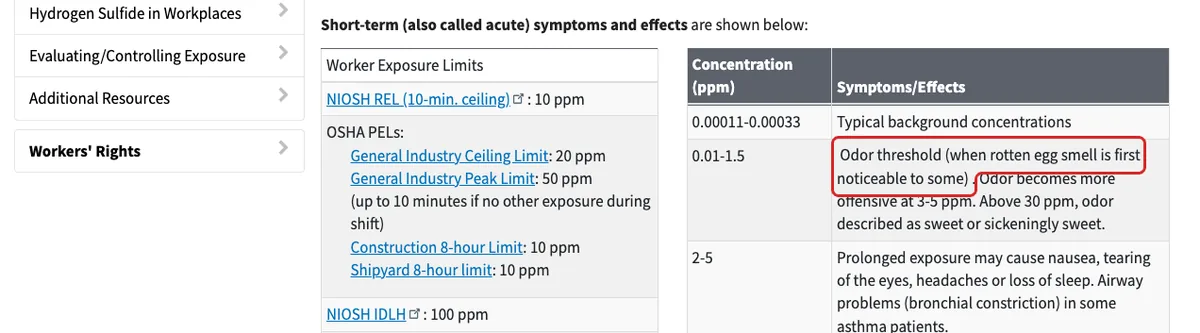
Hydrogen sulfide is the compound to respect in a freshly opened core. OSHA puts the point where the rotten-egg smell is first noticeable at 0.01 to 1.5 ppm, with nausea, headaches or eye irritation possible from prolonged exposure at 2 to 5 ppm (OSHA), and NIOSH warns that the sense of smell fatigues quickly and cannot be relied on to signal continued exposure (NIOSH Pocket Guide). No source we found measured mulch-bed concentrations, so treat a strong smell as a reason to work upwind and open the pile outdoors, not as a measured hazard.
The pet risk is cocoa mulch, and it is about eating it, not smelling it. Processed cocoa bean shell mulch has been reported at 0.19 to 2.98 percent theobromine (AVMA, 2006). In 6 well-documented ASPCA cases from January 2002 to April 2003, 50 percent of the dogs vomited and 33 percent developed tremors (National Capital Poison Center). Other bugs and critters drawn to mulch are covered in whether mulch attracts bugs.
This page is general information, not medical or veterinary advice. If a dog has eaten cocoa mulch, call your veterinarian or ASPCA Animal Poison Control at 888-426-4435 (a fee may apply).
How we compiled this
In November 2026 we read 22 primary documents: sour-mulch publications from the University of Arkansas, UMass (2), Purdue and the University of Maryland; Cornell’s composting odor pages (2); NIOSH Pocket Guide entries for 5 compounds, OSHA’s hydrogen sulfide page and PubChem; the Mulch and Soil Council standard and FAQ; Massachusetts fire services; Iowa State, Penn State and UF/IFAS on mulch fungi; and the AVMA and National Capital Poison Center on cocoa mulch. The smell decoder pairs each reported odor with the compound the extension sheets name and the odor NIOSH or PubChem gives for it. The pH screening cutoff is our arithmetic from the published ranges. We ran no tests. Reddit and Facebook threads were used for question phrasing only.
Frequently asked questions
How long does it take for mulch to stop smelling?
Fresh wood smell fades in days as the surface dries. Sour mulch spread thin and aerated loses its harmful compounds in 24 hours to 3 days, per UMass Extension; Purdue suggests up to a week before using it around young plants.
Why shouldn’t you water mulch for 24 hours?
That advice is about color, not smell. Scotts says to keep its Nature Scapes color-enhanced mulch dry for 24 hours after spreading so the colorant sets, as our mulch color guide notes. Sour mulch is the opposite case: extension sheets say to water it heavily to leach the compounds.
Does mulch have poop in it?
Plain wood or bark mulch does not; the manure smell usually comes from fermentation compounds such as hydrogen sulfide and fatty acids. Blends and compost products can contain manure or other feedstocks, and the Mulch and Soil Council standard requires the product identity on the label.
Why does mulch steam?
Decomposition heats the pile core. Purdue Extension says steam may escape when a souring pile is disturbed, and that the heat itself can injure plants if the mulch is not allowed to cool first.
Is it safe to breathe in mulch smell?
For most people it is an irritant, not a poison: Arkansas Extension says sour-mulch vapors are usually not harmful to people or pets. Open hot piles outdoors and work upwind, since hydrogen sulfide dulls the sense of smell.
Sources
- University of Arkansas Division of Agriculture (J. Robbins), Plant Injury From “Sour” Wood Mulch, FSA6138, PD-10-13RV. Accessed November 2026.
- UMass Extension (A. Bayer), Hort Notes: Beware of Sour Mulch, June 30, 2016. Accessed November 2026.
- UMass Extension (R. Kujawski, D. Swanson), Sour Mulch, fact sheet, revised 09/2011, page updated July 2026. Accessed November 2026.
- Purdue Extension (R. Lerner), Sour mulch can burn tender plants, page modified April 20, 2017. Accessed November 2026.
- University of Maryland Extension, Toxic Mulch Problems, updated February 28, 2023. Accessed November 2026.
- Cornell Waste Management Institute (T. Richard), Odor Management, Cornell Composting, current page. Accessed November 2026.
- Cornell Waste Management Institute (T. Richard), Ammonia odors, Cornell Composting, current page. Accessed November 2026.
- CDC NIOSH, Pocket Guide to Chemical Hazards: Acetic acid, current page. Accessed November 2026.
- CDC NIOSH, Pocket Guide to Chemical Hazards: Hydrogen sulfide, current page. Accessed November 2026.
- CDC NIOSH, Pocket Guide to Chemical Hazards: Ammonia, current page. Accessed November 2026.
- CDC NIOSH, Pocket Guide to Chemical Hazards: Methyl alcohol, current page. Accessed November 2026.
- CDC NIOSH, Pocket Guide to Chemical Hazards: Propionic acid, current page. Accessed November 2026.
- NIH PubChem, Butyric acid, CID 264, current page. Accessed November 2026.
- OSHA, Hydrogen Sulfide: Hazards, current page. Accessed November 2026.
- Mulch and Soil Council, Product Guidelines and Standards for Horticultural Mulch, adopted March 25, 2025. Accessed November 2026.
- Mulch and Soil Council, FAQs (spontaneous combustion, colorants), current page. Accessed November 2026.
- Massachusetts Department of Fire Services, Mulch fire safety, current page. Accessed November 2026.
- Iowa State University Extension, Managing Strange-Looking Fungi in Landscape Mulch and Lawns, current page. Accessed November 2026.
- Penn State Extension, What Is Growing in My Landscape Mulch? Mushrooms, Slime Molds, and Fungus, updated June 2025. Accessed November 2026.
- AVMA, JAVMA News, Danger to dogs from cocoa bean mulch put in perspective, June 1, 2006. Accessed November 2026.
- National Capital Poison Center, Cocoa Bean Mulch Can Poison Dogs, current page. Accessed November 2026.
- UF/IFAS Extension, Stinkhorn Mushrooms, PP345, reviewed November 2024. Accessed November 2026.