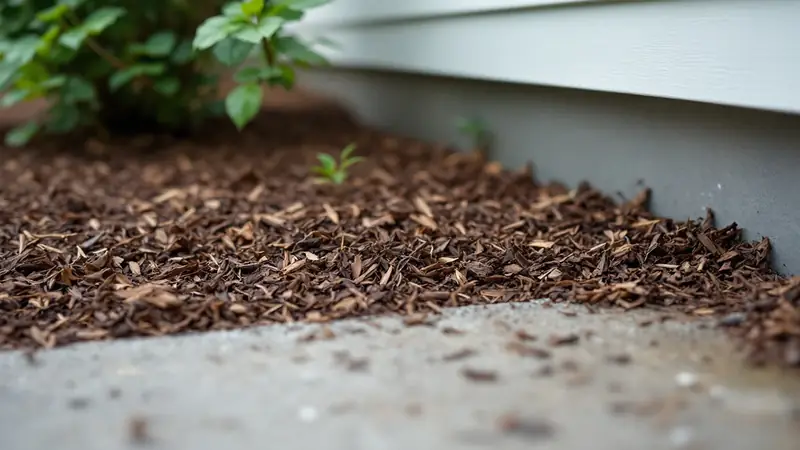
Does mulch attract bugs? Not from a distance: it gives damp cover and food to bugs already in your yard. Termites eat wood mulch in lab tests, yet in Maryland they stayed longer under pea gravel. The strip touching your house matters most.
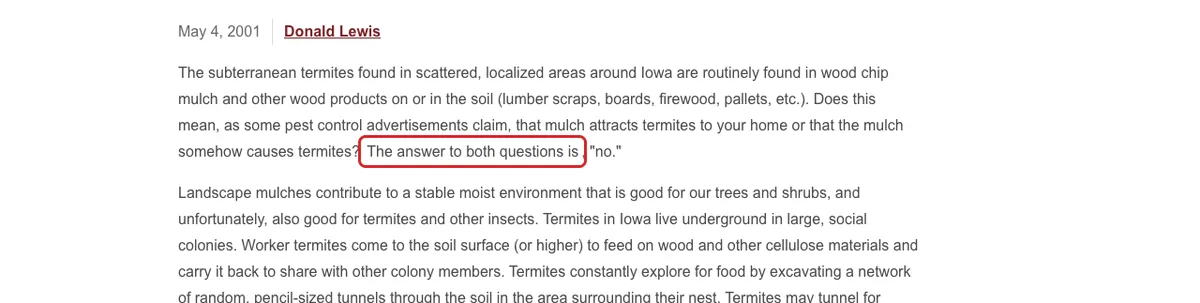
So, does mulch attract bugs, or just give them somewhere to live? Donald Lewis of Iowa State Extension answered the termite version directly in 2001: mulch does not attract termites to a house or cause them, but it keeps soil moist, which helps termites already there (Iowa State Extension). The same holds for most mulch bugs. The table below scores 9 pests on what measured studies and extension entomologists actually report, including a 2013 Auburn University lab test in which young Asian cockroaches chose rubber mulch over every wood and leaf mulch.
Which bugs live in mulch, and which ones matter?
Of the 9 organisms below, only subterranean termites threaten the house itself. Millipedes, pillbugs, earwigs and outdoor cockroaches are moisture-seeking nuisances that wander indoors from a mulched foundation strip, and spiders are predators that mulch multiplies 7 to 14 times in the one replicated garden test (Sunderland and Samu, 2000).
| Pest | Does mulch raise it near you? | Best measured evidence | Risk to the house | What to do | Source |
|---|---|---|---|---|---|
| Subterranean termites | No pull from a distance; moist mulch keeps foragers already on site feeding there | Ate 5 of 6 mulches in 3 week no-choice tests; detected equally under 3 mulches, pea gravel and bare soil in Maryland | High: structural | Under 2 in. of mulch within 12 in. of the foundation; 6 in. inspection gap below siding | Duryea 1999; Iowa State 2001; UF/IFAS ENY-832 |
| Asian cockroach | Yes, depends on material | Nymphs picked rubber 48.3% to 62.5% of the time; cypress 6.3%, topsoil 0% | Nuisance: a peridomestic species that lives around homes | Skip rubber and leaf litter beside doors; cypress was least preferred | Snoddy and Appel 2013 |
| Field, Turkestan and other outdoor cockroaches | Yes, in leaf litter and plant debris | Field cockroach may move indoors when it is hot or dry outside | Nuisance | Clear litter and debris from the foundation strip | UC IPM Pest Notes: Cockroaches |
| Garden millipede | Yes, breeds in mulch and compost | About 1 in. long; mass migrations after heavy spring rain | Nuisance: dies indoors | Remove excess mulch near the house; gravel drains better; water in the morning | Clemson HGIC; NC State Extension |
| Pillbugs and sowbugs | Yes, need damp cover | 1/4 to 5/8 in. long; dry out and die quickly indoors | Nuisance; may nibble seedlings | Remove mulch and litter near entrances; fix drainage at the foundation | Clemson HGIC; Univ. of Kentucky ef439 |
| European earwig | Yes, mulch is a favored daytime hideout | 1/2 to 1 1/4 in. long; hides in dark, moist spots by day | Nuisance; chews some flowers | Keep a clean, dry border at the foundation; gravel works as a barrier; roll-up cardboard traps | Univ. of Wisconsin Extension |
| Spiders (wolf, nursery web and others) | Yes, and that is mostly good | Grass hay mulch raised spider density 7 to 14 times; spiders made 98% of observed predation | Low; a few move indoors | Keep litter off the foundation strip; leave them in beds | Riechert and Bishop 1990 via Sunderland and Samu 2000; UC IPM |
| Ants (Argentine, odorous house) | Shelter only; cedar repelled nesting in lab tests | Avoided aromatic cedar mulch as a nest site in NC State lab tests | Nuisance | Pull mulch back from slab edges and door thresholds | Meissner and Silverman 2001 (summarized on our cedar page) |
| Artillery fungus (not a bug) | Yes, on wood and bark mulch | All mulches Penn State studied supported it after several years; large pine bark nuggets resisted most of 27 | Black specks on siding and cars | Use large pine bark nuggets near light siding | Penn State Extension |
Does mulch attract termites?
No study shows mulch drawing termites in from elsewhere in a yard. Subterranean termites tunnel up to 300 feet from the nest looking for food, Iowa State notes, and when a forager hits damp, sheltered soil it tends to stay and feed (Iowa State, 2001). Mulch is that damp soil. The risk is real only where a colony already forages, which is most of the South and much of the Midwest.
The lab data show termites will eat mulch. In 2 three-week no-choice tests at the University of Florida, eastern and dark southeastern subterranean termites ate 5 of 6 landscape mulches readily, with melaleuca the least preferred in both tests; in the first test they ate utility pruning chips more than pine sapwood, and ate more of mulches higher in nitrogen and phosphorus (r = 0.91 and 0.96) (Duryea, Huffman, English and Osbrink, 1999). Bagged cypress lost 11 percent to termites in 3 weeks, about the same as cypress sapwood at 12 percent.
The field data point the other way on gravel. In the University of Maryland study, termites found cardboard monitors as often under eucalyptus, hardwood and pine bark mulch as under pea gravel and bare soil, sustained activity ran significantly higher under the gravel, and termites fed only on eucalyptus, hardwood or pine bark mulch survived worse than those on birch (Long, Thorne, Breisch and Douglass, 2001, as summarized by Iowa State). Swapping wood for stone does not remove the risk.
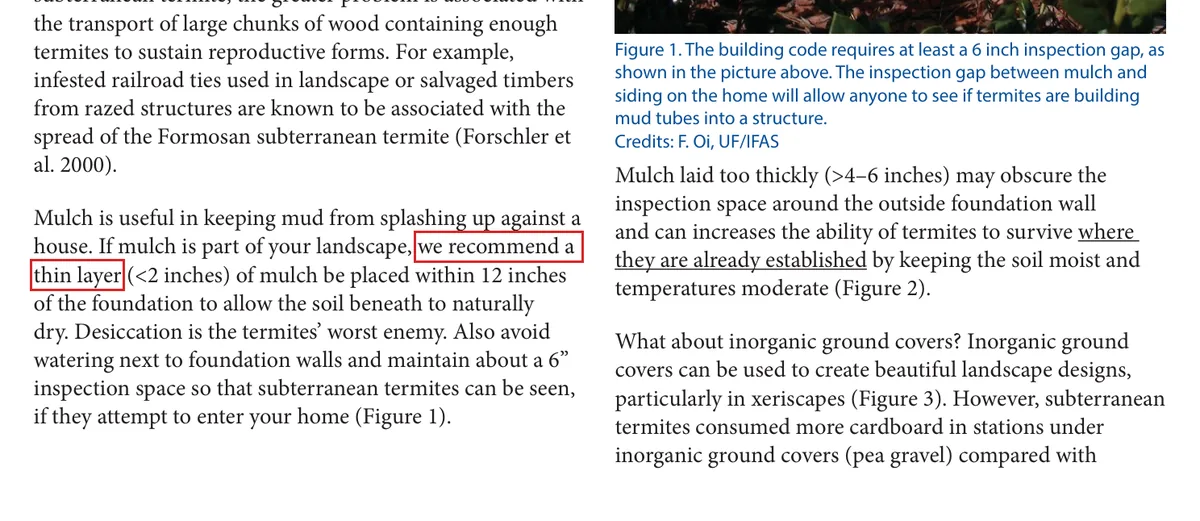
UF/IFAS turns this into a placement rule: under 2 inches of mulch within 12 inches of the foundation, a 6-inch strip of exposed foundation below the siding so mud tubes stay visible, and no sprinklers wetting the wall. UF notes that mulch piled 4 to 6 inches deep hides that inspection space, and that Florida’s building code requires irrigation to sit at least 1 foot from a building sidewall (Oi and Wheeler, UF/IFAS ENY-832). Our mulch depth guide covers the depth for the rest of the bed.
Do cedar, cypress or rubber mulch keep bugs away?
Partly, and only for some bugs. Heartwood of old cypress and cedar does deter termites, but the Florida authors found bagged cypress came from young trees with little or no heartwood (Duryea 1999), and a University of Missouri study found termites picked cedar last of 7 mulches yet still ate it when it was the only food (Pinzon, Houseman and Starbuck, 2006). The wood-by-wood detail is in our cedar mulch research summary and cypress mulch termite data.
| Material | Termites | Asian cockroach (Auburn lab) | Other bug findings | Source |
|---|---|---|---|---|
| Bagged cypress | 11% of the mulch eaten in 3 weeks vs 12% of cypress sapwood | Least preferred: 6.3% of nymphs and adults | Resisted artillery fungus well (Penn State) | Duryea 1999; Snoddy and Appel 2013 |
| Melaleuca | Least preferred of 6 mulches across both tests | Not tested | None measured | Duryea 1999 |
| Utility pruning chips (Gainesville utility) | Eaten more than any other mulch, and more than pine sapwood, in test 1 | Not tested | None measured | Duryea 1999 |
| Pine straw | Eaten in no-choice tests | Preferred by adult males; most toxic to them: 66.7% died within 7 days | None measured | Duryea 1999; Snoddy and Appel 2013 |
| Cedar | Eaten when it was the only food; picked last of 7 mulches with a choice | Not tested | Argentine and odorous house ants avoided it as a nest site in lab tests | Pinzon et al. 2006; our cedar page |
| Rubber | Not food | Nymphs chose it 48.3% to 62.5% of the time | WSU lists attracting insect pests among its drawbacks | Snoddy and Appel 2013; WSU FS163E |
| Pea gravel | Activity sustained longer than under hardwood, pine bark or eucalyptus mulch | Not tested | Suggested for millipede-prone foundations (NC State) and as an earwig barrier (UW) | Long et al. 2001 as reported by Iowa State and UF/IFAS |
| Oak leaf litter | Not tested | Preferred by adult males and females | Litter shelters field cockroaches (UC IPM) | Snoddy and Appel 2013 |
Rubber mulch is the surprise. It is not termite food, but in Auburn University arena tests small and medium Asian cockroach nymphs chose rubber 48.3 to 62.5 percent of the time, adult females favored rubber and oak leaf litter, and every life stage avoided cypress (6.3 percent) and bare topsoil (0 percent) (Snoddy and Appel, J. Econ. Entomol. 106(1), 2013). The authors traced it to rubber’s small, humid gaps. Our rubber mulch pros and cons covers its fire and zinc record.
One correction for anyone reading Washington State University’s rubber mulch fact sheet: FS163E says wood chips were least preferred by the roaches in that study (WSU FS163E). The Auburn test did not include wood chips; its 5 materials were cypress, oak leaf litter, pine straw, rubber and topsoil, and cypress and topsoil were the least chosen.
Why do millipedes, pillbugs and earwigs pile up in mulch?
They need moisture more than food. Pillbugs and sowbugs are crustaceans that dry out and die quickly indoors, so Clemson’s first fix is to remove leaf litter, mulch, lumber and rocks from near the outside of the house (Clemson HGIC). Garden millipedes, about 1 inch long, breed in mulch and compost and migrate in large numbers after heavy spring rain (NC State Extension; Clemson HGIC).
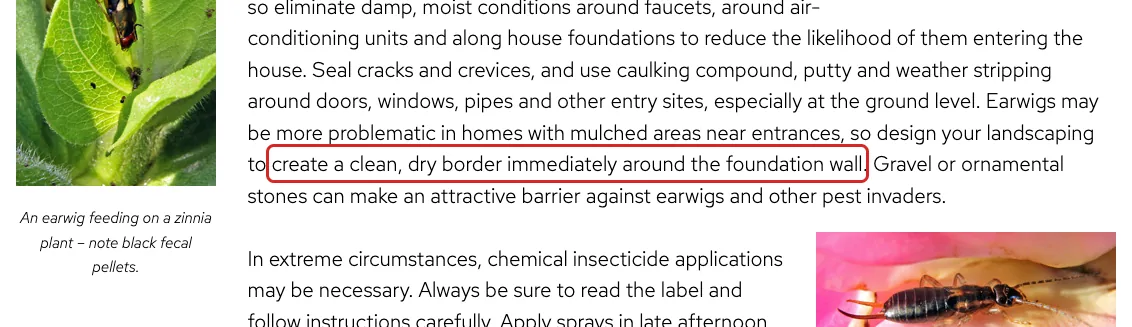
Earwigs, 1/2 to 1 1/4 inches long, hide in mulch by day and come out to feed at night. University of Wisconsin entomologists say earwigs may be more of a problem in homes with mulched areas near entrances and suggest a clean, dry border at the foundation, with gravel or ornamental stone as a barrier (UW Extension). Rolled corrugated cardboard laid in the mulch overnight and shaken into soapy water each morning traps them without spraying.
Outdoor cockroaches follow the same pattern. UC IPM lists the field cockroach in leaf litter and plant debris, moving indoors when it is hot or dry outside, and the Turkestan cockroach in compost piles and leaf litter (UC IPM Pest Notes: Cockroaches). None of these feed on house framing, and the University of Kentucky calls good drainage around the foundation key to keeping isopods out (Kentucky ef439).
Does mulch bring beneficial bugs too?
Yes, and measurably. In Susan Riechert and Leslie Bishop’s mixed vegetable plots, a grass hay mulch raised spider density 7 to 14 fold, spiders accounted for 98 percent of the predation events observed, and removing spiders by hand from mulched plots brought pest damage back to unmulched levels (Sunderland and Samu, Entomol. Exp. Appl. 95, 2000). Across the studies that review covered, spread-out ground cover methods such as mulching, undersowing and reduced tillage raised spider abundance in 80 percent of cases.
The same review notes that mulch feeds spiders indirectly, by increasing springtails, mites and flies that live on decaying material. That is the trade: the detritivores that bother you on the patio are the food base for predators in the bed. UC IPM’s spider advice is to keep the strip next to the foundation clear of leaf litter and heavy vegetation, not to strip the beds (UC IPM Pest Notes: Spiders).
The same decomposer mites turn up in houseplant pots, where WSU Extension says oribatid mites should not damage plants; our guide on how to get rid of soil mites covers the two look-alikes that do, bulb mites and root mealybugs.
How to keep mulch from bringing bugs into the house
- Pull mulch back so 6 inches of foundation shows below the siding, and keep it under 2 inches deep for the first 12 inches out from the wall (UF/IFAS ENY-832).
- Move sprinkler heads and drip emitters at least 1 foot from the wall; UF/IFAS notes that irrigation that wets walls can void termite control warranties.
- Replace rubber mulch and oak leaf litter beside doors and the slab; in the Auburn test, cypress and bare soil drew the fewest Asian cockroaches.
- Rake out matted, soggy layers where millipedes and pillbugs gather; our guide on when to remove old mulch has the depth rules.
- Water beds in the morning so the surface dries by evening, as Clemson advises for millipedes.
- If you see mud tubes on the foundation or winged termites indoors, have a licensed pest control operator inspect before you change the mulch; removing it does not treat a colony.
1Do you see mud tubes on the foundation, or winged termites indoors?
YesTermites. Have a licensed pest control operator inspect; then keep mulch under 2 in. within 12 in. of the wall with 6 in. of foundation showing (UF/IFAS ENY-832).
NoGo to the next question
2Are black specks stuck to siding or cars near the bed?
YesArtillery fungus, not a bug. Switch the foundation strip to large pine bark nuggets (Penn State).
NoGo to the next question
3Are millipedes, pillbugs, earwigs or roaches getting inside?
YesStrip mulch and litter from the band next to the house, water in the morning, and fix drainage at the foundation (Clemson, UW, Kentucky).
NoGo to the next question
4Is the bed rubber mulch or deep leaf litter beside a door?
YesReplace it near doors; Asian cockroach nymphs chose rubber 48.3% to 62.5% of the time in Auburn tests.
NoLeave them. Spiders, pillbugs and beetles inside the bed are normal and spiders eat pests there.
Source: UF/IFAS ENY-832; Penn State; Clemson HGIC; UW Extension; Snoddy and Appel 2013
Gravel or stone for the foundation strip helps with millipedes and earwigs, per NC State and UW, but not with termites, which kept feeding under pea gravel in Maryland. Our mulch vs rock comparison adds the heat and cost trade-offs, and pine straw vs mulch covers the needle option. Large pine bark nuggets also resisted artillery fungus best of 27 mulches at Penn State, a point weighed against shredded wood in mulch vs bark.
This page is general information, not pest control advice. Termite treatment and any insecticide use should follow the product label and your state’s pest control rules; the label is the law.
How we compiled this
We read 16 primary documents in November 2026: 3 peer-reviewed lab and field studies read in full or in abstract (Duryea 1999, Snoddy and Appel 2013, Sunderland and Samu 2000), the Maryland termite study as reported by Iowa State and UF/IFAS, and extension publications from UF/IFAS, Iowa State, UC IPM, Clemson, NC State, Kentucky, Wisconsin, WSU and Penn State. We ran no tests or yard counts. The Missouri cedar finding and the NC State ant finding are summarized from our cedar mulch page, which read those papers.
Frequently asked questions
What type of mulch does not attract bugs?
No organic mulch is bug-free. In lab tests, termites ate melaleuca least of 6 mulches (Duryea 1999), and Asian cockroaches chose cypress only 6.3 percent of the time (Snoddy and Appel 2013). Gravel keeps millipedes and earwigs drier but did not stop termites in Maryland.
Is it bad to have mulch around your house?
Not if you set it back. UF/IFAS advises under 2 inches within 12 inches of the foundation and 6 inches of exposed foundation below the siding so termite tubes stay visible (ENY-832).
Does mulch attract roaches in the house?
It shelters outdoor species that can wander in. Field cockroaches move indoors when it is hot or dry (UC IPM), and Asian cockroach nymphs preferred rubber mulch 48.3 to 62.5 percent of the time in Auburn tests. Clear the strip by doors.
How do I stop mulch from attracting bugs?
Thin it to under 2 inches next to the house, keep 6 inches of foundation showing, move sprinklers 1 foot from walls, water in the morning and rake out matted layers. Leave the rest of the bed alone; it holds spiders that eat pests.
Do termites eat mulch?
Yes. Termites ate 5 of 6 landscape mulches readily when given no other food for 3 weeks, but mulch-fed termites survived worse than those on birch in the Maryland study (Iowa State).
Sources
- UF/IFAS Extension (F.M. Oi, M. Wheeler), ENY-832/IN651, The Facts About Termites and Mulch, Revised June 2023. Accessed November 2026.
- University of Florida (M.L. Duryea, J.B. Huffman, R.J. English, W. Osbrink), Will Subterranean Termites Consume Landscape Mulches? Journal of Arboriculture 25(3):143 to 150, May 1999. Accessed November 2026.
- Iowa State University Extension (D. Lewis), Does landscape mulch lead to termites in your home?, May 4, 2001. Accessed November 2026.
- University of Maryland (C.E. Long, B.L. Thorne, N.L. Breisch, L.W. Douglass), Effect of Organic and Inorganic Landscape Mulches on Subterranean Termite Foraging Activity, Environmental Entomology 30(5):832 to 836, 2001. Accessed November 2026.
- Auburn University (E.T. Snoddy, A.G. Appel), Mulch Preferences of the Asian Cockroach, Journal of Economic Entomology 106(1):322 to 328, February 2013. Accessed November 2026.
- Washington State University (L. Chalker-Scott), FS163E, Rubber Mulch Use in Home Gardens and Landscapes, Undated fact sheet. Accessed November 2026.
- K. Sunderland, F. Samu, Effects of agricultural diversification on the abundance, distribution, and pest control potential of spiders: a review, Entomologia Experimentalis et Applicata 95:1 to 13, 2000. Accessed November 2026.
- University of Missouri (O.P. Pinzon, R.M. Houseman, C.J. Starbuck), Feeding, Weight Change, Survival, and Aggregation of Reticulitermes flavipes in Seven Varieties of Landscape Mulch, J. Environ. Hort. 24(1), 2006. Accessed November 2026.
- UC Statewide IPM Program, Pest Notes: Cockroaches, Current web version. Accessed November 2026.
- UC Statewide IPM Program, Pest Notes: Spiders, Current web version. Accessed November 2026.
- Clemson Cooperative Extension, HGIC, Millipedes, Current web version. Accessed November 2026.
- Clemson Cooperative Extension, HGIC, Sowbugs and Pillbugs, Current web version. Accessed November 2026.
- NC State Extension, Garden Millipede, Current web version. Accessed November 2026.
- University of Kentucky Entomology, ef439, Pillbugs and Sowbugs, Current web version. Accessed November 2026.
- University of Wisconsin Extension (S. Mahr, P. Pellitteri), Earwigs, Current web version. Accessed November 2026.
- Penn State Extension, Artillery Fungus in Mulch, Current web version. Accessed November 2026.