Mulch vs bark: bark is one kind of mulch, at most 15 percent wood. Pine bark nuggets lost about 5 percent of their weight in 2 years against about 16 percent for shredded hardwood, but cost about $20 a yard more and can float.
Mulch vs bark comes down to what is in the pile and how big the pieces are. Under the Mulch & Soil Council product guidelines adopted March 25, 2025, a product sold as pine bark, hemlock bark or hardwood bark mulch may contain no more than 15 percent wood, while a product sold as hardwood mulch can be 100 percent ground wood. That one line explains most of the measured differences below: bark is high in lignin, so it decays slowly, and its coarse grades smother weeds better and float more.
None of the pages ranking for this question in November 2026 prices the two from the same seller or cites a trial. We did both. At 8 supply yards that sell a shredded wood mulch and a bark product side by side, the bark cost a median $19.50 a yard more on Nov. 16, 2026. Trial data says that premium pays back only if the bark saves top-ups for about 4 years. And fine bark is the weak spot most guides miss: in a weed trial, screened pine bark let through 10.36 weeds per plot, closer to bare soil (15.03) than to shredded hardwood (4.20), as summarized in a 2015 HortScience review.
What is the difference between mulch and bark?
Mulch is any material sold to cover soil, and bark is the corky outer layer of the tree. The Mulch & Soil Council (MSC) turns that into label rules that its certified producers must follow, and the name on the bag tells you which rule applies:
| Name on the bag or yard sign | What the MSC guideline requires | Particle size | What it usually looks like |
|---|---|---|---|
| Pine bark nuggets | Genus Pinus, maximum 15% wood | 0.25 to 3.0 in diameter | Reddish-brown chunks; large, medium and mini grades |
| Pine bark mulch, pine fines | Genus Pinus, maximum 15% wood | Not set | Shredded or screened small bark, dark brown |
| Western bark, western bark nuggets | Western conifers (fir, hemlock), maximum 15% wood | Nuggets 0.25 to 3.00 in | Sold as barkdust: fine, medium, nuggets, rock |
| Hardwood bark mulch | Deciduous hardwood trees, maximum 15% wood | Not set | Dark, stringy shreds |
| Hardwood mulch | 100% deciduous hardwood trees or shrubs | Not set | Shredded wood, single to triple ground |
| Mulch blend, wood mulch | More than one genus, or forest products mixed with reprocessed wood; any pallet or construction wood must be on the ingredient statement | Not set | Often colorized |
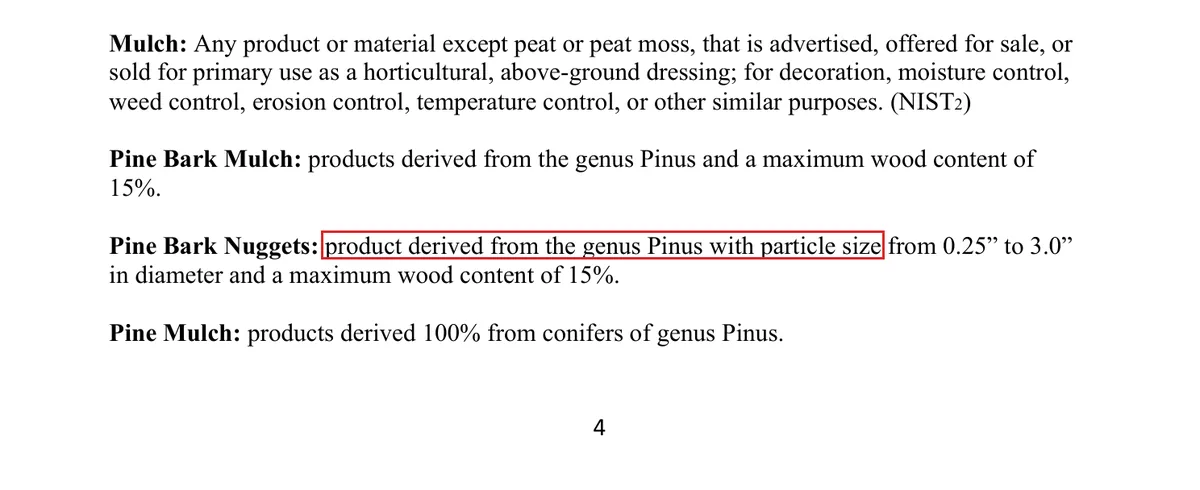
Grade names are the soft spot. Oregon State University Extension EC 1629 says no bark size term has a standard definition, describes nuggets as chunks generally smaller than 2 inches and bark rock as 1.5 to 3 inches, and notes hemlock bark usually costs 25 percent more than comparable Douglas-fir. Ask the yard for the screen size, not the grade name.
Shredded wood is where recycled material hides. Iowa State University Extension calls chips made from lumber or pallets an inferior product that breaks down quickly and says they are sometimes dyed to mask their origin. The MSC bans chromated copper arsenate (CCA) treated wood, and its certification program lab-tests certified mulches for it; colorants themselves are covered in our mulch color guide. Our wood chips vs mulch review covers raw arborist chips, a third product.
Bark vs mulch, side by side
Each row below holds the measured or published figure for one material, with its source. The decay and weed numbers come from different trials in different states, so compare within a column, not across one.
| Material | Size or makeup | Decay measured | Floats or washes? | Weeds per plot (bare soil 15.03) | Median per cu yd, Oct. 2026 | Best fit |
|---|---|---|---|---|---|---|
| Large pine bark nuggets | Only 9% of particles passed a 1/2 in sieve (Maggard) | About 5% of dry weight in 2 years, Okla.; pine bark 3 to 7% in year 1, Fla. | Floats; washes off slopes and drainage paths (Clemson, NCSU) | 1.42 (3 to 4 in pieces) | $47.50 (pine bark, 6 yards) | Flat beds, foundation strips |
| Pine bark fines, shredded pine bark | Screened 0.2 to 0.4 in pieces in the weed trial | No separate figure found | Fine grades seal the surface; cap at 2 to 3 in (OSU) | 10.36 (0.2 to 0.4 in) | $50 to $99 at 2 yards that post both | Thin top dressing, acid-loving beds |
| Fir or hemlock bark | Fine, medium, nuggets under 2 in, rock 1.5 to 3 in | Reapply every 2 to 4 years (OSU rule for bark) | Nuggets float like pine | No trial found | $56.25 (9 yards) | Pacific Northwest default |
| Shredded hardwood (single, double, triple ground) | 73% of particles passed a 1/2 in sieve | About 16% of dry weight in 2 years, Okla. | Does not wash away easily (Clemson) | 4.20 (oak, 0.2 to 3 in) | $40 (natural, 23 yards) | Slopes, edges, high-traffic beds |
| Dyed or recycled wood mulch | Ground wood plus colorant; pallet wood must be on the label | About 23% in 2 years for a red-dyed poplar and maple product | No measurement found | No trial found | $42.50 (24 yards) | Color; buy MSC-certified |
Which lasts longer, bark or mulch?
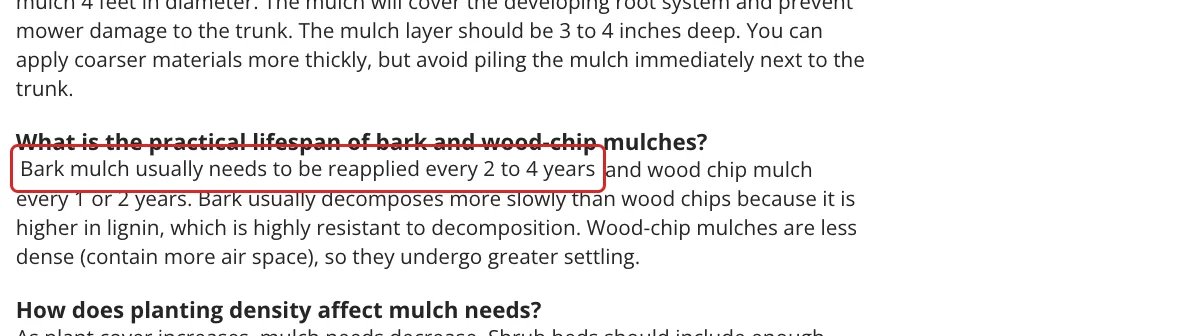
Bark lasts longer, by a measured factor of about 3. In a 2-year Stillwater, Oklahoma trial, mesh bags of pine bark nuggets lost about 5 percent of their dry weight, the same as cypress, while a maple and oak hardwood mulch lost about 16 percent and a red-dyed poplar and maple mulch about 23 percent (Maggard et al., 2012). The authors tie the dyed product’s speed to poplar, a less dense wood than oak.
Florida points the same way. Pine bark lost 3 to 7 percent of its mass in year 1, against 32 percent for utility-pruning chips, and lignin-to-nitrogen ratio predicted decay best (r = -0.88) in Duryea, English and Hermansen (1999). Depth is the number you see: a 3.5 inch layer of pine bark settled to about 6 cm, roughly 2.4 inches, after 2 years in UF/IFAS FR052.
Extension rules of thumb follow the lab data. OSU EC 1629 says bark usually needs reapplying every 2 to 4 years and wood chips every 1 or 2, and Clemson HGIC 1604 gives pine needles and bark 2 to 4 years. Shorter claims, such as one supplier’s 12 to 18 months, describe color fade more than decay. How much to add at each top-up, and when to rake out the old layer instead, is worked out in whether to remove old mulch before adding new.
Does bark stop weeds better than mulch?
Only coarse bark does. In the Billeaud and Zajicek trial reviewed in HortScience 50(6), decorative pine bark nuggets 3 to 4 inches across averaged 1.42 weeds per plot, oak hardwood 4.20, cypress 5.6, screened pine bark of 0.2 to 0.4 inch 10.36 and bare soil 15.03. The fine bark did not differ from no mulch at all. Weed control rose with particle size, not with the word bark.
Large pieces leave dry, dark gaps that seedlings cannot cross; fine particles hold moisture at the surface like soil. OSU adds that fine bark seals over and sheds water, so it caps fine bark at 2 to 3 inches. If weeds are the job, buy nuggets or a single-ground shred and spread 3 inches after settling; depth rules for each texture are in how deep mulch should be, and the full weed evidence is in does mulch prevent weeds.
Do bark nuggets float or wash away?
Yes. Clemson HGIC 1604 says large pine bark nuggets float in water and may not stay in place in heavy rain, while shredded hardwood mulch does not wash away easily. NC State Extension is blunter: on a slope or near a drainage area, nuggets will wash away, and fibrous mulches that knit together are more stable. UNH Extension says the same of pine bark nuggets.
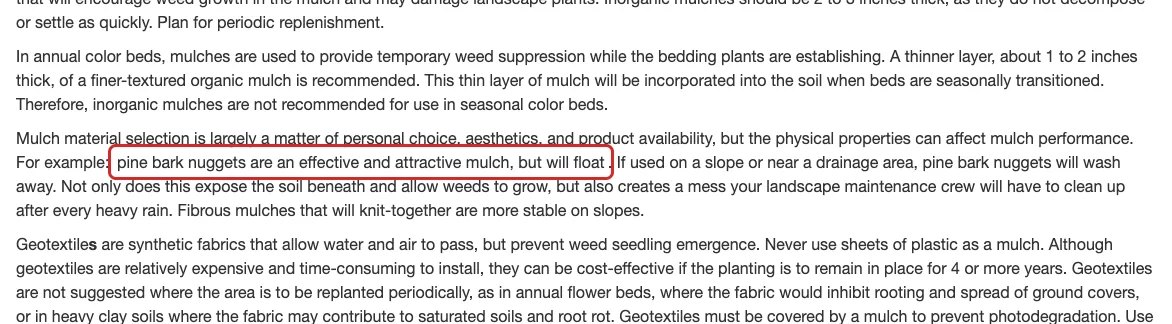
No study we found measured how much rain moves nuggets, so treat these as published observations. The practical rule: nuggets on flat beds bordered by an edge; shredded hardwood, or pine straw, which interlocks on slopes, anywhere runoff crosses the bed. Shredded hardwood stays put because the strands mat, which is the same property that makes double-ground mulch shed water when it crusts.
Does bark change soil pH or tie up nitrogen?
Less than the labels suggest. Bark runs near pH 4 (OSU EC 1629), and Oklahoma measured pine bark nuggets at pH 4.5 against 7.9 for the hardwood mulch. Starting from soil at pH 6.4, the hardwood mulch raised soil pH in year 1 and raised soil potassium, while pine bark lowered pH slightly (Maggard et al., 2012).
In Florida, soil under pine bark went from pH 5.0 to 4.6 in a year, about the same as under cypress and within 0.2 of the other mulches (Duryea et al., 1999). OSU says buffered soil changes little except in the top 2 inches. For blueberries, azaleas and other plants that like acidic soil, pine bark helps a little; it will not acidify a pH 7.5 bed. Our sibling guide to plants that like acidic soil lists the targets.
Nitrogen tie-up happens at the surface, not in the root zone. Washington State University Extension FS160E describes a nitrogen deficiency at the boundary between mulch and soil, which suppresses weed seedlings, and Iowa State names hardwood bark and ground pallets among high carbon-to-nitrogen mulches, with more effect on annuals and new transplants than on established shrubs. Keep both on top: digging 1 inch of either into a vegetable bed is where the shortage shows.
Which is safer next to the house?
Coarse bark, on both fire and fungus counts. In Steward, Sydnor and Bishop (2003), lit cigarettes were dropped on 13 mulches 8 times each; ground recycled pallets ignited 4 times and shredded pine bark 3, while shredded hardwood bark and 1 to 2 inch pine bark nuggets never did:
| Mulch (2003 Ohio trial) | Cigarette ignitions in 8 tries | Propane torch rating, 1 (no flame) to 7 | Note |
|---|---|---|---|
| Pine bark nuggets, 2.5 to 5 cm (1 to 2 in) | 0 | 3.25 | Among the most fire-resistant in every test |
| Pine bark nuggets, 1.3 to 2.5 cm (0.5 to 1 in) | 1 | 3.13 | Not different from never ignited |
| Shredded pine bark | 3 | 2.88 | Lit only after 6 months outdoors |
| Shredded hardwood bark | 0 | 4.13 | Only torch fire above 4; usually died out |
| Ground recycled pallets | 4 | 3.75 | Lit only after 6 months outdoors |
| Shredded cypress bark | 2 | 4.00 | Lit only after 6 months outdoors |
Artillery fungus, which fires tar-like specks onto siding and cars, favors wood. Penn State Extension tested 27 mulches and found large pine bark nuggets the most resistant, because they stay hard and dry; Clemson advises pure bark mulches, especially pine, near houses. For termites, roaches and other pests by material, see does mulch attract bugs.
How much more does bark cost than mulch?
About $19.50 a cubic yard more, or 59 percent, at the median of 8 supply yards that post both on the same page. The spread is wide: $11 at BioGrass in Utah, $61 at Mulch Center in Illinois and Bedrock in Colorado, where the bark is pine fines or medium fir nuggets. Bagged, at 3 sellers, the gap is smaller: 11 to 28 percent.
| Seller | Shredded wood mulch, per cu yd | Bark product, per cu yd | Bark premium |
|---|---|---|---|
| Kirk Allen Landscape Supply, Stanhope, N.J. | Hardwood Mulch: $25.50 | Hemlock Mulch: $47.00 | +$21.50 (+84%) |
| Remington Mulch, Northern Virginia | Wood Mulch: $30.00 | Pine Fines: $50.00 | +$20.00 (+67%) |
| Piedmont Landscape Materials, Concord, N.C. | Double Ground Hardwood: $35.00 | Pine Bark Mini Nuggets: $50.00 | +$15.00 (+43%) |
| Suburban Landscape Supply, Walled Lake, Mich. | Premium Hardwood Mulch: $37.00 | Michigan Pine Bark Mulch: $56.00 | +$19.00 (+51%) |
| Mulch Center, Deerfield, Ill. | Classic Double Ground: $38.00 | Pine Fines: $99.00 | +$61.00 (+161%) |
| T.W. Nickerson, Cape Cod, Mass. | House Natural Brown (aged pine and spruce wood): $40.00 | Hemlock Bark Mulch: $56.25 | +$16.25 (+41%) |
| Bedrock Landscaping Material, Denver area, Colo. | Natural Mulch: $44.00 | Medium Fir Nuggets, 1.5 to 3 in: $105.00 | +$61.00 (+139%) |
| BioGrass, Salt Lake City area, Utah | Natural Forest Mulch: $58.00 | Small Landscaping Bark, 1/2 to 2 in: $69.00 | +$11.00 (+19%) |
| Mr. Mulch, Columbus, Ohio (bags) | Natural Brown Double Shredded Bark Hardwood, 2 cu ft: $5.00 ($67.50/yd) | Pine Bark Nuggets, 2 cu ft: $5.55 ($74.92/yd) | +$7.42 (+11%) |
| Mr. Mulch, Columbus, Ohio (bags) | Natural Brown Double Shredded Bark Hardwood, 2 cu ft: $5.00 ($67.50/yd) | Pine Bark Mini Nuggets, 2 cu ft: $6.40 ($86.40/yd) | +$18.90 (+28%) |
| Bzak Landscaping, Cincinnati, Ohio (bags) | Queen City Gold hardwood bark, 1.5 cu ft: $3.49 ($62.82/yd) | Large Pine Nuggets, 2 cu ft: $5.29 ($71.42/yd) | +$8.60 (+14%) |
| Remington Mulch, Northern Virginia (bags) | Bagged Wood Mulch, 3 cu ft: $7.50 ($67.50/yd) | Bagged Aged Pine Fines, 3 cu ft: $8.50 ($76.50/yd) | +$9.00 (+13%) |
Whether the premium pays back depends on top-ups. The worked example uses a 200 sq ft bed at 3 inches (1.85 cubic yards), the median pair prices above and one assumption: shredded hardwood needs a 1 inch top-up every year and bark every other year, roughly the 3 to 1 decay ratio measured in Oklahoma and OSU’s 1 to 2 versus 2 to 4 year intervals.
| Year | Shredded hardwood spent | Shredded running total | Bark spent | Bark running total |
|---|---|---|---|---|
| Year 1 | $69.44 | $69.44 | $103.94 | $103.94 |
| Year 2 | $23.15 | $92.59 | $0 (no top-up) | $103.94 |
| Year 3 | $23.15 | $115.74 | $34.65 | $138.58 |
| Year 4 | $23.15 | $138.89 | $0 (no top-up) | $138.58 |
| Year 5 | $23.15 | $162.04 | $34.65 | $173.23 |
| Year 6 | $23.15 | $185.19 | $0 (no top-up) | $173.23 |
Bark starts $34.49 behind, pulls level in year 4 and is $11.96 ahead by year 6. If you redo beds every 2 or 3 years, shredded hardwood is the cheaper bed. Delivery fees and yard minimums, which often move a small order more than the material choice, are compared in our mulch cost survey. Enter your own bed below; the calculator prices the first fill at the October 2026 middle-half price for each material.
- Cubic yards
- 1.85
- 2 cu ft bags
- 25
Default: 200 sq ft at 3 in is 1.85 yd or 25 bags; natural shredded hardwood about $57 to $83, pine bark about $80 to $102. Bulk ranges are the middle half of posted prices at 23, 24, 6 and 9 supply yards (Oct. 18, 2026); bag ranges are posted 2 cu ft prices at Mr. Mulch and Bzak (Nov. 16, 2026). Estimate before delivery and tax.
Should you use bark or mulch?
Use coarse bark nuggets on flat beds you will keep for 4 years or more, along foundations and siding, and around acid-loving shrubs. Use shredded hardwood on slopes, beside downspouts and walkways, and where the budget is the first fill. Skip pine fines as a weed barrier: at 10.36 weeds per plot they did about as well as bare ground in the reviewed trial.
1Does runoff cross the bed, or is it on a slope?
YesShredded hardwood: it does not wash away easily (Clemson HGIC 1604); bark nuggets float and wash out (NC State).
NoGo to the next question
2Is the bed against light siding or beside parked cars?
YesLarge pine bark nuggets: most resistant of 27 mulches to artillery fungus (Penn State).
NoGo to the next question
3Is weed control the main job on a flat bed?
YesCoarse bark nuggets, 3 in after settling. Not pine fines: 10.36 weeds per plot against 4.20 for shredded hardwood.
NoGo to the next question
4Will the bed stay as it is for 4 years or more?
YesBark: slower decay repays its median $19.50 a yard premium in about year 4 (our arithmetic).
NoShredded hardwood: lower first cost and the cheaper bed for the first 3 years.
How we compiled this
We read the Mulch & Soil Council’s 2025 product guidelines, 2 decomposition trials (Florida 1999, Oklahoma 2012), the 2003 Ohio ignition study, the 2015 HortScience review that reports the Billeaud and Zajicek weed counts, and 7 extension publications (Oregon State, Clemson, NC State, UNH, Iowa State, Penn State, Washington State). Oklahoma’s decay values are read from the paper’s Figure 9 to about 0.5 point. Prices: we re-read 11 sellers’ posted prices on Nov. 16, 2026, and took per-type medians from our October 2026 survey of 28 supply yards. No field work or product testing of our own.
Frequently asked questions
Is it better to use mulch or bark?
Bark for flat beds kept 4 years or more and next to the house; shredded hardwood mulch for slopes and lower first cost. Pine bark nuggets decayed about a third as fast in Oklahoma, but bark cost a median $19.50 a yard more at 8 supply yards in November 2026.
Can I use bark as mulch?
Yes. Bark is a mulch under the Mulch & Soil Council definitions. Spread nuggets 3 inches deep after settling and fine bark no more than 2 to 3 inches, per Oregon State EC 1629, and keep both a few inches off trunks.
How long will pine bark nuggets last?
Usually 2 to 4 years before a top-up, per Oregon State and Clemson. In Oklahoma, nuggets lost about 5 percent of their dry weight in 2 years; in Florida, a 3.5 inch layer of pine bark settled to about 2.4 inches after 2 years.
What are the disadvantages of pine bark nuggets?
They float and wash off slopes and drainage paths (Clemson, NC State), cost more per yard, and fine grades suppress weeds poorly. Nuggets also tie up a little nitrogen at the soil surface, which matters only if you dig them in.
Will pine bark nuggets attract termites?
No mulch attracts termites from afar, per Iowa State, but termites already nearby can feed in any wood mulch. Keep mulch under 2 inches within 12 inches of the foundation; pest-by-pest findings are in our does mulch attract bugs report.
Sources
- Mulch & Soil Council, Product Guidelines for Certified All-Natural Horticultural Mulches, Adopted March 25, 2025. Accessed November 2026.
- Mulch & Soil Council, Mulch and soil FAQs (CCA), Undated web page. Accessed November 2026.
- Mulch & Soil Council, Product certification program, Undated web page. Accessed November 2026.
- Oklahoma State University (A.O. Maggard and others), Tree-based Mulches Influence Soil Properties and Plant Growth, HortTechnology 22(3):353 to 361, 2012. Accessed November 2026.
- University of Florida (M.L. Duryea, R.J. English, L.A. Hermansen), A Comparison of Landscape Mulches: Chemical, Allelopathic, and Decomposition Properties, J. Arboric. 25(2):88 to 97, 1999. Accessed November 2026.
- UF/IFAS Extension (M.L. Duryea, P.J. Minogue), FOR 69/FR052, Landscape Mulches: How Quickly Do They Settle?, Revised edition. Accessed November 2026.
- B.K. Steward, T.D. Sydnor, B. Bishop, The Ease of Ignition of 13 Landscape Mulches, J. Arboric. 29(6):317 to 321, November 2003. Accessed November 2026.
- S.C. Marble, A.K. Koeser, G. Hasing, A Review of Weed Control Practices in Landscape Planting Beds: Part I, HortScience 50(6):851 to 856 (reports Billeaud and Zajicek 1989), June 2015. Accessed November 2026.
- Oregon State University Extension (N. Bell, D.M. Sullivan, T. Cook), EC 1629, Mulching Woody Ornamentals with Organic Materials, Published March 2009, reviewed 2024. Accessed November 2026.
- Clemson Cooperative Extension, HGIC 1604, Mulch, Web fact sheet. Accessed November 2026.
- NC State Extension, Plan Before You Plant (Commercial Landscape Weed Management), Web publication. Accessed November 2026.
- University of New Hampshire Extension, Garden Mulches fact sheet, Web fact sheet. Accessed November 2026.
- Iowa State University Extension and Outreach, Using Mulch in the Garden, Web article. Accessed November 2026.
- Penn State Extension, Artillery Fungus in Mulch, Web article. Accessed November 2026.
- Washington State University Extension (L. Chalker-Scott), FS160E, Using Arborist Wood Chips as a Landscape Mulch, Fact sheet. Accessed November 2026.
- Kirk Allen Landscape Supply, posted mulch and bark prices, read Nov. 16, 2026.
- Remington Mulch, posted mulch and bark prices, read Nov. 16, 2026.
- Piedmont Landscape Materials, posted mulch and bark prices, read Nov. 16, 2026.
- Suburban Landscape Supply, posted mulch and bark prices, read Nov. 16, 2026.
- Mulch Center, posted mulch and bark prices, read Nov. 16, 2026.
- T.W. Nickerson, posted mulch and bark prices, read Nov. 16, 2026.
- Bedrock Landscaping Material, posted mulch and bark prices, read Nov. 16, 2026.
- BioGrass, posted mulch and bark prices, read Nov. 16, 2026.
- Mr. Mulch, posted mulch and bark prices, read Nov. 16, 2026.
- Bzak Landscaping, posted mulch and bark prices, read Nov. 16, 2026.