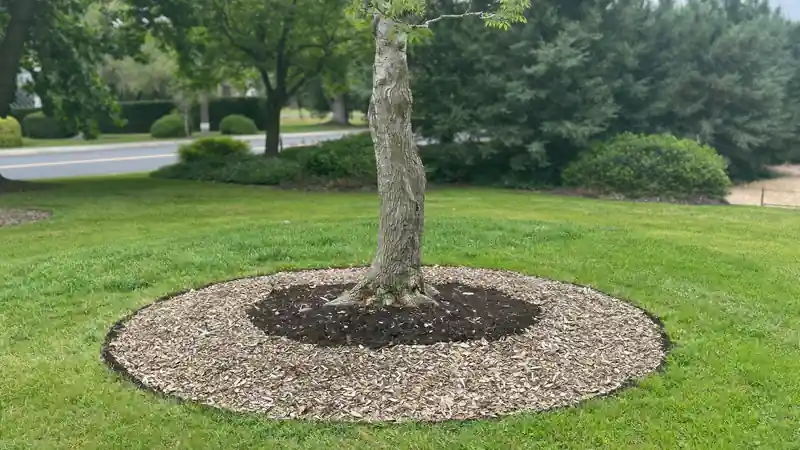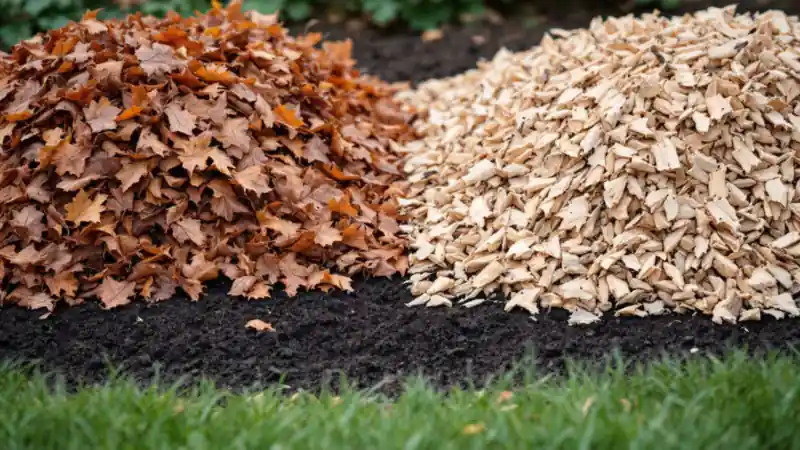
How to make mulch: shred leaves with a mower at its highest setting, chip branches within your chipper’s limit (1.5 in on one 14-amp electric model, 3 in on a 224cc gas unit), or dry clippings, then spread 2 to 3 inches on weeded soil.
How to make mulch is mostly a matter of matching the feedstock to its prep: leaves need shredding, branches need a chipper sized to them, clippings need drying, and straw needs to be seed-free and herbicide-free. Each material also has its own depth, waiting period and lifespan, which is what most homemade-mulch pages leave out. The recipe card below puts all 10 common homemade mulches on one sheet, with the extension source for every number, and a calculator turns bags of leaves into square feet of bed.
The recipe card: 10 homemade mulches by prep, depth and lifespan
Depth is the number that changes least: Clemson Extension HGIC 1604 gives 2 to 3 inches for leaves, pine needles and wood chips, and Iowa State Extension puts the general range at 2 to 4 inches, with coarse chips at the high end and fine materials such as clippings at the low end. What varies is the prep and the wait. The lifespan column uses the UF/IFAS settling trial (FOR 69), the only published measurement we found that tracks a homemade-type mulch, utility prunings, against store mulches.
| Material | How to make it | Particle target | Depth | Wait before use | How long it lasts | Source |
|---|---|---|---|---|---|---|
| Shredded leaves (mower) | Mower at its highest setting; a second pass at 90 degrees for deep layers | Coarse pieces; finely shredded leaves shed water | 2 to 3 in | None: use the day you shred | Leaf mulches settle the most of 15 organic mulches; top up each fall | Clemson HGIC 1604 |
| Shredded leaves (leaf mulcher) | Feed dry leaves into a line-trimmer style mulcher (Worx WG430: 53 gal of leaves a minute) | Rated 11:1 volume reduction on the WG430 | 2 to 3 in | None | Same as mower-shredded leaves | Worx WG430 product page |
| Leaf mold | Moisten leaves, bag them in pierced bags or a wire bin | Crumbly, partly decayed leaves | 2 in or more | Most leaves about 2 years; usable as mulch before 2 years | Breaks down within a season; works more as soil food | RHS, Leafmould |
| Arborist chips (free load) | Request a tree-crew drop; expect leaves and needles mixed in | Mixed chips, twigs and leaves as delivered | 2 to 3 in; coarse mulch up to 4 in | None needed, unless disease is a concern | Utility-pruning mulch: 3.5 in fell to about 2 in after 2 years | UF/IFAS FOR 69 |
| Home-chipped branches | Electric chipper for branches to 1.5 in; 224cc gas chipper to 3 in | Shredder chutes take leaves and twigs only up to 1/2 in | 2 to 3 in | None on the surface; age or compost if mixing into soil | Clemson: wood chips usually fully decomposed within 2 years | Sun Joe CJ601E |
| Composted wood chips | Pile chips and let them heat and break down | Finer than fresh chips | 2 to 3 in | No time given in our sources; use once dark and crumbly | Fine particles make a seedbed for weeds (OSU) | OSU EC 1629 |
| Grass clippings | Dry them first; add thin layers each week as you mow | Short, dry blades; never a fresh mat | Build to 2 in | 4 weeks after any herbicide (CSU) or 2 to 3 mowings after broadleaf herbicide (Iowa State); label governs | Decomposes rapidly; add layers through the season | CSU GardenNotes 245 |
| Pine needles | Rake fallen needles; no processing | Whole needles interlock and stay on slopes | 2 to 3 in | None | Pine straw: 3.5 in fell to about 0.4 in after 2 years | Clemson HGIC 1604 |
| Straw | Seed-free wheat, oat or soybean straw; never hay | Loose flakes pulled from the bale | 2 to 4 in (fine to coarse range) | Ask the grower which herbicides were used: aminopyralid can stay active for years | Short-term: decomposes rapidly | Iowa State |
| Sawdust | Untreated wood only; compost or age it | Very fine; crusts if thick | 1 in or less if fresh | Compost or age 1 year before a thicker layer | Decomposes slowly | Iowa State, Using Mulch in the Garden |
1Do you have dry fallen leaves?
YesMow them at the highest deck setting, 2 passes at 90 degrees, and spread 2 to 3 in of the coarse pieces.
NoGo to the next question
2Do you have branches 3 in or thinner?
YesChip them within the machine's rating: 1.5 in for the Sun Joe CJ601E electric, 3 in for the Champion 224cc gas unit. Spread 2 to 3 in fresh.
NoGo to the next question
3Is the wood, bark or leaf litter from a black walnut?
YesKeep it away from tomatoes, peppers, lilac and rhododendron; compost it for a year first (Ontario OMAFA).
NoGo to the next question
4Do you have grass clippings from a lawn with no herbicide in the past 4 weeks?
YesDry them, then add thin weekly layers up to 2 in.
NoGo to the next question
5Do you have pine needles?
YesRake them on 2 to 3 in deep; top up yearly.
NoRequest a free arborist drop (4 to 20 cu yd) or buy seed-free straw and ask what was sprayed on it.
Source: Clemson HGIC 1604; Illinois Extension; CSU GardenNotes 245; maker spec pages
How do you make mulch from leaves?
Leaves are the largest free supply, and the mower is the cheapest shredder. University of Illinois Extension summarizes Michigan State University research in which a 6-inch layer of maple and oak leaves was mulched into established turf with no apparent harm, and gives the method: mower at its highest setting, then a second pass at a 90-degree angle for deep layers (U. of Illinois Extension, Oct. 2022). To collect the pieces for beds instead, run the same passes with the bagger on.
If the leaves have already landed on a mulched bed, blow them out onto the lawn at the blower’s lowest setting before mowing; our guide on how to remove leaves from mulch gives the settings by model.
- Mow when the leaves are dry. Wet leaves clump in the deck and come out in mats.
- Set the deck to its highest notch and mow the leaves where they lie, or rake them into a row first (Illinois Extension).
- Make a second pass at 90 degrees to the first if the layer was deep.
- Stop at coarse pieces. Clemson HGIC 1604 warns that finely shredded leaves do not let water through, while whole leaves blow away.
- Spread 2 to 3 inches on weeded beds, kept a few inches back from stems and trunks.
- On the lawn itself, leave no more than 2 inches of shredded leaves over winter: University of Wisconsin plots with 4 inches were highly likely to show winter damage (UW-Madison Extension).
A dedicated leaf mulcher is faster than a mower for bagged leaves. The Worx WG430 is rated to process 53 gallons of leaves a minute with an 11:1 mulch ratio, meaning 11 bags in, 1 bag out. Treat that as a best case on dry leaves: it is a maker rating, and we found no independent measurement of real-world reduction for leaf mulchers or for mowers.
How many bags of leaves make how much mulch?
A 39-gallon lawn bag holds 5.21 cubic feet (39 x 0.1337). Divide by the reduction ratio for the shredded volume, then multiply by 6 for the square feet it covers 2 inches deep, or by 4 for 3 inches. For whole-bed quantities by area, our guide on how much mulch you need has the full formula.
- Shredded leaf mulch (cu ft)
- 1.8
- Shredded leaf mulch (cu yd)
- 0.07
- Bed area covered 2 in deep (sq ft)
- 11
- Bed area covered 3 in deep (sq ft)
- 7
Default: 20 bags of 39 gallons at 11:1 give 9.5 cu ft, enough for 57 sq ft at 2 in or 38 sq ft at 3 in. Bags x 0.1337 cu ft per gallon x bag gallons / ratio; 1 cu ft covers 6 sq ft at 2 in and 4 sq ft at 3 in. Only the 11:1 figure is published, and it is a maker rating.
| Leaves in | Loose volume | Reduction | Mulch out | Covers at 2 in | Covers at 3 in |
|---|---|---|---|---|---|
| 20 x 39-gal bags | 104 cu ft | 11:1 (Worx rating) | 9.5 cu ft | 57 sq ft | 38 sq ft |
| 20 x 39-gal bags | 104 cu ft | 8:1 (scenario) | 13.0 cu ft | 78 sq ft | 52 sq ft |
| 20 x 39-gal bags | 104 cu ft | 5:1 (scenario) | 20.8 cu ft | 125 sq ft | 83 sq ft |
| 50 x 30-gal paper bags | 200 cu ft | 11:1 (Worx rating) | 18.2 cu ft | 109 sq ft | 73 sq ft |
The arithmetic explains why one fall of leaves rarely mulches a whole yard: 20 full bags at the rated 11:1 cover about 57 square feet at 2 inches, roughly one 4 by 14 foot bed. If you pay a crew to haul leaves, our leaf removal cost breakdown shows what keeping them on site saves.
How long does it take for leaves to turn into leaf mold?
Leaf mold is a second, slower recipe: leaves left to rot down under fungi rather than shredded and spread. The Royal Horticultural Society says to moisten dry leaves, pack them into bin liners with holes pierced in them, and stack the bags for up to two years, or build a chicken-wire bin and keep it damp. Most leaves take about two years to break down, and conifer needles two to three.
You do not have to wait the full two years for mulch. RHS says leaf mold under two years old works as a mulch at least 2 inches thick, and keeps the older, finer material for seed-sowing mixes. Clemson adds the reverse caution: once leaf mold is well decomposed, it does more good mixed into the soil than left on top (Clemson HGIC 1604).
How to make wood chip mulch: chipper limits and free loads
The branch diameter decides the machine. A 14-amp electric unit such as the Sun Joe CJ601E is listed at a 1.5-inch maximum cutting diameter; the Champion 200905, with a 224cc engine, takes branches up to 3 inches in its chipper chute, but its shredder chute accepts leaves and shrub debris only up to 1/2 inch. Anything thicker is firewood or a job for a tree crew.
| Tool | Feeds | Size limit or throughput | Rated volume reduction | Source |
|---|---|---|---|---|
| Lawn mower (any rotary) | Leaves on the lawn or in rows | Highest deck setting; 2 passes at 90 degrees for deep layers | Not rated | U. of Illinois Extension, 2022 |
| Worx WG430 leaf mulcher (13 amp, corded) | Dry leaves only | 53 gal of leaves a minute | 11:1 (maker rating) | Worx product page |
| Sun Joe CJ601E chipper (14 amp, electric) | Branches | 1.5 in maximum cutting diameter | 16:1 (maker rating) | Sun Joe store listing |
| Champion 200905 chipper shredder (224cc gas) | Branches; shrub and leaf debris in a second chute | 3 in branches; 1/2 in or less in the shredder chute | Not rated | Champion product page |
| Arborist drop (ChipDrop) | Whatever the crew chipped that day | No limit; you get 4 to about 20 cu yd | n/a | ChipDrop help center |
Without a chipper, the cheapest chips come from a tree crew. Through ChipDrop, arborists drop a full truckload of chips for free; its help center says a load runs from as little as 4 to as much as about 20 cubic yards, with no way to choose the size and leaves and pine needles mixed in. The drop site must be at least 8 feet wide and 15 feet long, with about 20 feet of overhead clearance for the raised box (ChipDrop, preparing for a delivery). For how those chips compare with bagged bark, see wood chips vs mulch.
A free load left in one heap for weeks can turn sour in its core, so smell a handful from 6 inches down before spreading; why fresh mulch smells explains which odors mean spread it out and wait.
Do fresh chips need to age first?
Not on the surface. Colorado State University CMG GardenNotes 245 states that wood and bark chips on the surface do not tie up soil nitrogen, though sawdust may, and that wood products need composting only before use as a soil amendment. Oregon State University narrows the risk: when woody mulch does compete for nitrogen, most of it comes from the top 3 to 6 inches of soil, so small plants and fresh transplants may show it while established trees and shrubs generally do not (OSU EC 1629).
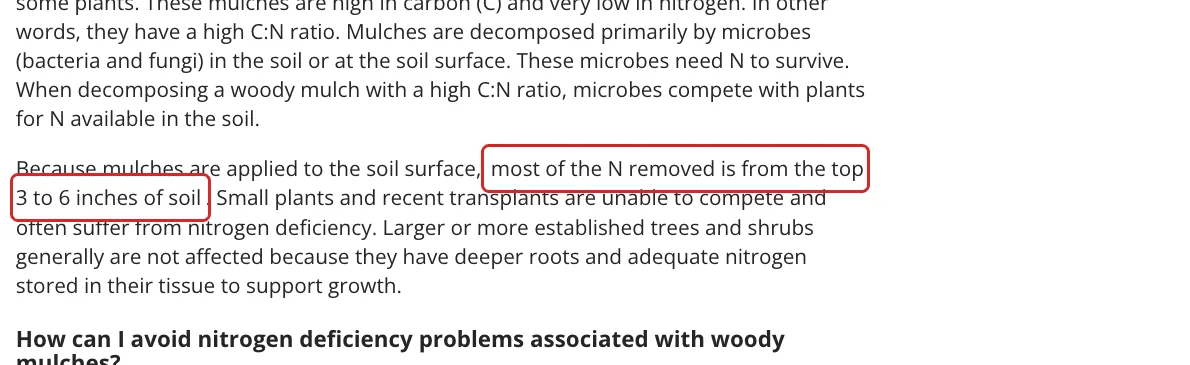
Washington State University horticulturist Linda Chalker-Scott spreads fresh chips by choice and suggests aging them only if disease is a concern; her stated hypothesis is a nitrogen-poor zone at the mulch and soil interface that slows weed seeds but not deep roots, which is why she advises against high C:N mulch in vegetable and annual beds (Chalker-Scott, MasterGardener, Summer 2007). Clemson HGIC 1604 still says small chips draw nitrogen that must be replaced with fertilizer, so the guides disagree; the measured OSU depth is the useful part.
Aged or composted chips trade one problem for another. OSU says composted mulches often grow weeds because they hold more fine particles and nutrients than fresh wood, so they make a seedbed. If you compost chips, use them under a coarse top layer or in beds you hoe. Our page on whether mulch prevents weeds has the trial numbers by depth.
How long homemade chips last
In the Gainesville trial, 3.5 inches (9 cm) of each mulch was laid in rings and measured for two years. The utility-pruning mulch, the same leaves-and-wood mix a tree crew drops, kept about 5 cm; pine bark and cypress kept 6 cm, melaleuca almost 7, and pine straw was almost gone at 1 cm (Duryea and Minogue, UF/IFAS FOR 69).
| Mulch | Start depth | Depth after 2 years | Inches left (converted) |
|---|---|---|---|
| Melaleuca | 9 cm | almost 7 cm | about 2.8 in |
| Pine bark | 9 cm | 6 cm | about 2.4 in |
| Cypress | 9 cm | 6 cm | about 2.4 in |
| Utility prunings (arborist-type chips) | 9 cm | about 5 cm | about 2.0 in |
| Eucalyptus | 9 cm | about 5 cm | about 2.0 in |
| Pine straw | 9 cm | 1 cm | about 0.4 in |
Can you use grass clippings as mulch?
Yes, in thin dry layers. Clemson HGIC 1604 says to build the layer up gradually with dry grass, not fresh clippings, to a 2-inch layer, and CSU GardenNotes 245 says to add a layer each week as you mow, because fresh grass laid thick mats, smells, sheds water and can turn hydrophobic. Clippings from a weedy lawn carry weed seed (Iowa State).
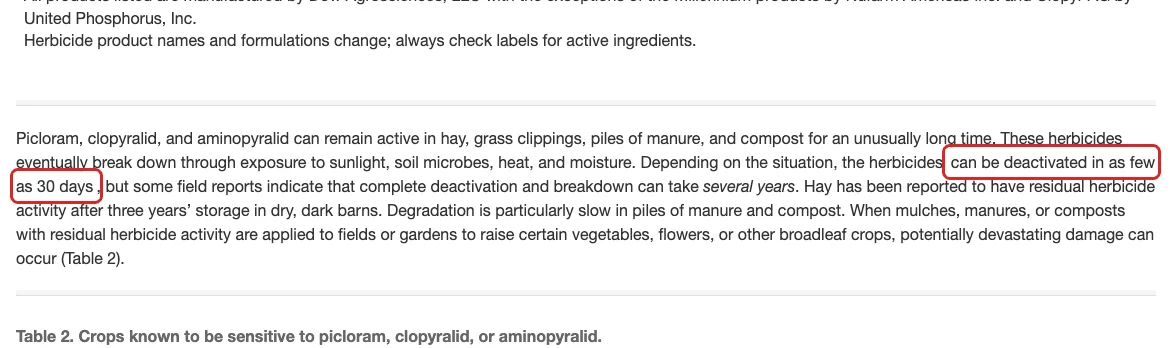
The waiting period after herbicide is where the guides differ. CSU says not to use clippings for at least 4 weeks after a herbicide or other pesticide; Iowa State says to wait two or three mowings after a broadleaf herbicide. Neither covers the pyridine group: NC State Extension AG-727 says aminopyralid, clopyralid and picloram can stay active in clippings, hay, straw and compost, with deactivation in as few as 30 days but field reports of several years. The product label governs; our page on what to do with grass clippings lists label wording for 5 lawn products.
Pine needles and straw
Pine needles need no processing. Clemson recommends a 2- to 3-inch layer and notes that needles interlock and stay put on slopes better than most mulches. They are also the shortest-lived: pine straw fell from 9 cm to 1 cm in two years in the UF/IFAS trial, so plan to top up yearly. For bought bales against bark, see pine straw vs mulch.
For straw, buy wheat, oat or soybean straw sold as seed-free, and use it in vegetable and strawberry beds; Iowa State warns it can shelter mice around trees and shrubs over winter. Clemson says never to use hay, which carries too many weed seeds. Ask the seller what was sprayed on the field: NC State AG-727 reports hay holding residual herbicide activity after 3 years in a dry barn.
What should you not make mulch from?
- Black walnut wood, bark or leaves around sensitive plants. University of Wisconsin Extension says not to mulch with them, though the toxin, juglone, breaks down once fully composted (UW Extension, Landscaping in Spite of Black Walnuts). Ontario’s agriculture ministry says to compost walnut leaves, twigs and husks for one year first (Ontario OMAFA). UW Extension lists tomato, pepper, lilac and rhododendron among sensitive plants.
- Fresh sawdust thicker than 1 inch, or sawdust from treated lumber. Iowa State says to compost or age it for a year first (Iowa State).
- Chipped pallets or lumber. Iowa State calls them an inferior product that breaks down quickly and may contain chemicals.
- Hay, for its weed seed (Clemson), and straw or clippings of unknown herbicide history (NC State AG-727).
- Chips from a diseased tree spread under the same species. A honeylocust canker fungus survived 143 weeks in chips; our chips vs mulch comparison covers the study.
Where homemade mulch is a fire risk
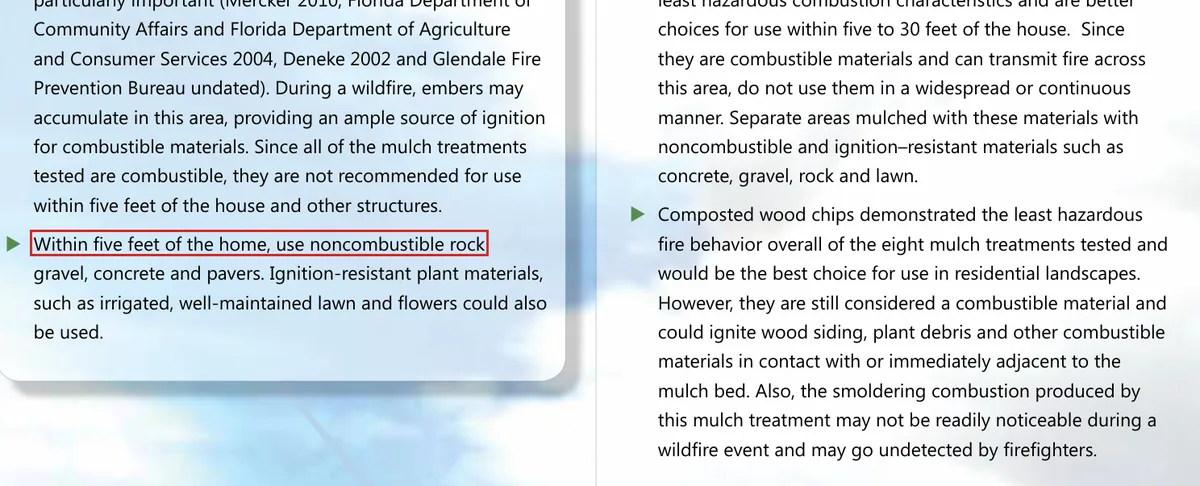
Near the house, any mulch you make is combustible. In 2008 burn tests in Carson City, Nevada, shredded rubber, pine needles and shredded western red cedar behaved worst, and composted wood chips best, smoldering with a spread rate under 0.3 feet a minute (Quarles and Smith, SP-11-04). Because all eight mulches burned, the authors advise none within 5 feet of the house: use rock, gravel, concrete or pavers there.
| Distance from the house | Homemade mulch allowed | Source |
|---|---|---|
| 0 to 5 ft | None: noncombustible rock, gravel, concrete, pavers, or irrigated lawn | Quarles and Smith, SP-11-04 |
| 5 to 30 ft | Composted wood chips, wood chips or medium pine bark nuggets, in patches broken up by gravel, rock or lawn, not a continuous band | Quarles and Smith |
| Over 30 ft | Pine needles and other high-hazard mulches | Quarles and Smith |
Watering is not a substitute for distance: the same report notes drip lines leave dry patches and wildfire weather dries a bed between cycles. For the 3-3-3 spacing around trunks, see our guide on how to mulch around trees.
How we compiled this
We read 13 extension publications and research reports (Clemson, Iowa State, Colorado State, Oregon State, WSU, UF/IFAS, Illinois, Wisconsin, NC State, Nevada and UC, RHS, Ontario) and 4 maker or service pages, all accessed November 2026, and compiled the recipe card from their stated figures. We did not test any equipment or mulch; leaf-mulcher and chipper reduction ratios are maker ratings, and the 8:1 and 5:1 calculator settings are labeled scenarios.
Frequently asked questions
What is the fastest way to turn leaves into mulch?
Mow them dry with the deck at its highest setting, making a second pass at 90 degrees if the layer is deep, per Illinois Extension. With the bagger on, the shredded leaves can go straight onto beds 2 to 3 inches deep.
How long does it take for leaves to turn into mulch?
Shredded leaves are usable the same day. Leaf mold takes longer: the RHS says most leaves need about two years to break down, though leaf mold under two years old already works as a mulch at least 2 inches thick.
What are the downsides of using leaves as mulch?
Whole leaves blow away and finely shredded leaves block water (Clemson), so aim for coarse pieces. On lawns, 4 inches of leaves over winter was highly likely to cause damage in Wisconsin plots; 2 inches of shredded leaves was fine.
What is the 3-3-3 rule for mulch?
A tree ring 3 feet out from the trunk, 3 inches deep and 3 inches clear of the bark. It is a placement rule, not a recipe; our guide on how to mulch around trees covers it.
What is a cheap alternative to mulch?
Your own leaves, pine needles or dried clippings cost nothing, and an arborist drop through ChipDrop is free, delivered in loads of about 4 to 20 cubic yards. Our mulch cost page has bulk and bagged prices to compare.
What are the ingredients in mulch?
Homemade organic mulch is any untreated plant material laid on the soil: wood chips, bark, leaves, pine needles, straw, grass clippings or compost. Clemson and Iowa State list depths for each, from 1 inch for fresh sawdust to 4 inches for coarse chips.
Sources
- Clemson Cooperative Extension, Home & Garden Information Center, Mulch (HGIC 1604), factsheet, current. Accessed November 2026.
- Iowa State University Extension and Outreach, Using Mulch in the Garden, current. Accessed November 2026.
- Colorado State University Extension, CMG GardenNotes 245: Mulching with Wood/Bark Chips, Grass Clippings, and Rock, PDF. Accessed November 2026.
- Oregon State University Extension (Bell, Sullivan and Cook), Mulching Woody Ornamentals with Organic Materials (EC 1629), current. Accessed November 2026.
- L. Chalker-Scott, Washington State University, Wood Chip Mulch: Landscape Boon or Bane? MasterGardener, Summer 2007. Accessed November 2026.
- Duryea and Minogue, UF/IFAS Extension, Landscape Mulches: How Quickly Do They Settle? (FOR 69), reviewed Jan. 2024. Accessed November 2026.
- University of Illinois Extension (T. Cleveland), Instead of Raking Leaves, Try Mulching Them into the Turf, Oct. 8, 2022. Accessed November 2026.
- University of Wisconsin-Madison Division of Extension, Winter Leaf Coverage on Lawns, current. Accessed November 2026.
- Royal Horticultural Society, Leafmould, current. Accessed November 2026.
- NC State Extension, Herbicide Carryover in Hay, Manure, Compost, and Grass Clippings (AG-727), current. Accessed November 2026.
- Quarles and Smith, University of Nevada and UC Cooperative Extension, The Combustibility of Landscape Mulches (SP-11-04), 2011. Accessed November 2026.
- S. Mahr, University of Wisconsin Extension, Landscaping in Spite of Black Walnuts, PDF. Accessed November 2026.
- Ontario Ministry of Agriculture, Food and Agribusiness, Walnut toxicity, current. Accessed November 2026.
- ChipDrop, How big is a ChipDrop delivery? and How to prepare for a ChipDrop delivery, Aug. 2025 and Sept. 2024. Accessed November 2026.
- S. Mahr and UW-Madison Division of Extension, Black walnut toxicity, current. Accessed November 2026.
- ChipDrop, Free Wood Chip Mulch from ChipDrop, home page, checked Nov. 2026. Accessed November 2026.
- Worx, 13 Amp Electric Leaf Mulcher WG430, product page, checked Nov. 2026. Accessed November 2026.
- Snow Joe, Sun Joe CJ601E Electric Wood Chipper listing, checked Nov. 2026. Accessed November 2026.
- Champion Power Equipment, 3-in. Chipper Shredder, Model 200905, checked Nov. 2026. Accessed November 2026.