How to get rid of mushrooms in mulch: pick them out before they ripen, loosen the mulch to dry it and cut irrigation. Iowa State Extension says no spray prevents them. Black siding specks up to 20 feet away mean artillery fungus: change that mulch.
The first step in how to get rid of mushrooms in mulch is naming what came up, because the fix changes by type. Penn State Extension says the fungi in landscape mulch are decomposers that “are not harmful to landscape plants” and show up from April through October after rain (Penn State Extension). Seven things account for nearly every report, and only one of them, the artillery fungus, does damage you pay for: it fires tar-like specks up to 18 to 20 feet onto siding and cars.
Two things on this page are not in the current top results. The first is the field data: Penn State counted spore specks on white target walls for 30 months and found 236.8 on plain oak-hickory chips against 7.2 on spent mushroom compost (Davis, Kuhns and Harpster 2005). The second is a check of the home remedies (vinegar, dish soap, baking soda, salt, fungicide) against what extension services say. If the mushrooms are in grass, not beds, our guide to mushrooms in the lawn covers fairy rings and poisonous lawn species; if your question is the whole layer, start with whether to remove old mulch before adding new.
What is growing in your mulch? Identify it by type
Size, smell and where the residue lands separate the seven. Iowa State lists stinkhorns, slime molds, bird’s nest fungi, artillery fungus, puffballs and inkcaps as the regulars in Midwest mulch (Iowa State Extension), and Rutgers adds the gilled “toadstool” mushrooms, the only group in the table with deadly members (Rutgers Cooperative Extension).
If the whole bed smells of vinegar, ammonia or rotten eggs rather than one spot of rotting meat, the cause is fermented wood, not a fungus; our explainer on why mulch smells bad covers that sour-mulch test.
| What you see | How to tell | Harmful? | What to do | Source |
|---|---|---|---|---|
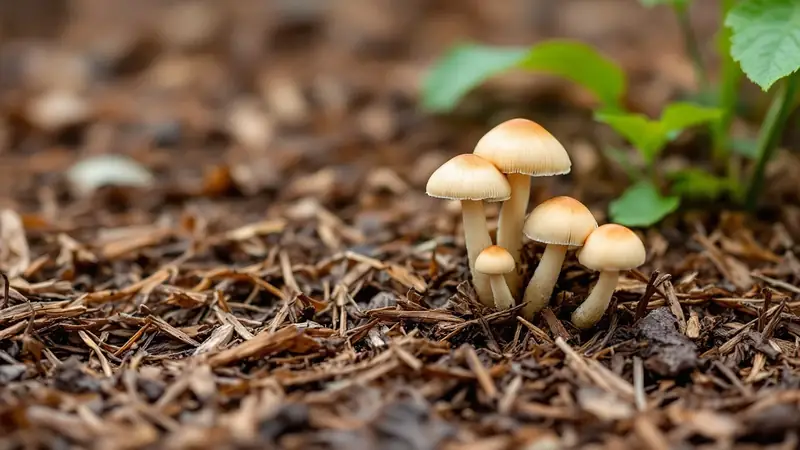
| Gilled mushrooms (toadstools) | Cap and stem, gills under the cap; any color; under 1 inch to several inches tall | Not to plants. Some are poisonous; Rutgers names the death cap, Amanita phalloides | Pick and bag before children or pets reach the bed | Rutgers; Penn State |
| Stinkhorns (Phallus, Mutinus, Clathrus) | White to pink egg in the mulch, then a 4 to 8 inch stalk with olive-brown slime; smells of rotting meat | No. UF/IFAS says stinkhorns are not poisonous | Scoop and bag the stalk and any eggs; flies spread the spores | Iowa State; UF/IFAS PP345 |
| Inkcaps and shaggy mane (Coprinopsis, Coprinellus, Parasola, Coprinus) | Bell-shaped white, gray or tan caps in clusters that melt into black ink within days | No damage to plants | Leave or hand-pull; they fade with drier weather | Iowa State |
| Puffballs (Calvatia, Lycoperdon, Bovista) | Round or pear-shaped, no gills; white and firm, then brown and powdery inside | No damage to plants | Pick up and discard before they release spore clouds | Iowa State |
| Bird’s nest fungi (Cyathus, Crucibulum) | Gray to brown cups 1/4 to 1/2 inch across holding ‘eggs’ | No. Eggs splash 2 to 3 feet and wash off without a stain | Rake or fork the mulch to dry it; fungicides do not control them | Penn State; Rutgers; Iowa State |
| Artillery fungus (Sphaerobolus stellatus) | Cream to orange-brown cups about 1/10 inch with one black egg; matted, bleached-looking mulch; black specks on walls | Yes, cosmetically: specks stick to siding and cars and stain when removed | Change the mulch near the house (see below) | Penn State; UMaine 5103e |
| Dog vomit slime mold (Fuligo septica) | Yellow, orange or white foam several inches to over 2 feet across; dries to a brown or white powder | No. Not a fungus; it eats bacteria in the mulch | Leave it, or scoop and bag it and cut watering | Oregon State; WSU Extension |
1Are there black, tar-like specks on siding, cars or leaves within about 20 feet of the bed?
YesArtillery fungus (cups about 1/10 in). Change the mulch near the house; scrub fresh spots with soapy water.
NoGo to the next question
2Is it a yellow, orange or white foamy blob with no cap or stem?
YesDog vomit slime mold. Harmless; scoop and bag it and water less.
NoGo to the next question
3Does it smell like rotting meat, with a slimy tip on a 4 to 8 inch stalk?
YesStinkhorn. Not poisonous (UF/IFAS); bag stalks and eggs.
NoGo to the next question
4Are there tiny cups up to 1/2 inch holding several 'eggs'?
YesBird's nest fungus. Harmless; rake to dry the mulch.
NoGo to the next question
5Is it round with no gills, puffing dust when pressed?
YesPuffball. Pick up and discard.
NoGo to the next question
6Are the caps melting into black ink?
YesInkcap or shaggy mane. Harmless; fades in days.
NoA gilled mushroom. Some are deadly: pick and bag before children or pets reach it, and call Poison Help (1-800-222-1222) or the ASPCA (888-426-4435) if any is eaten.
Source: Iowa State, Penn State, Rutgers, UF/IFAS, UMaine, Oregon State extension
White threads or a cottony mat in the mulch with no cap at all is the fungus itself (mycelium), not a separate pest; our sibling guide to white fungus in soil and potting mix covers that case. Insects in the same bed are a separate question, answered in whether mulch attracts bugs.
Why are mushrooms growing in my mulch?
Wood and bark are food. Penn State says bacteria and fungi break down the cellulose, lignin and sugars in mulch, and the mushrooms are the visible spore-bearing part of a fungus that is already spread through the layer (Penn State Extension). An Ask Extension expert answering a 2025 question about a bed that sprouted mushrooms after a commercial mulch job put it plainly: wet conditions from rain or “excessive irrigation” speed decay, and that feeds the fungi (Ask Extension #904534).
Four measurable conditions make a flush more likely, all from Rutgers’ review of nuisance fungi (Rutgers Plant and Pest Advisory, 2021): fresh hardwood bark or ground wood ground finer than 3/8 inch, mulch laid 4 inches or deeper, “sour” mulch below pH 5.2, and dry composted mulch spread without soaking (below 35 percent moisture), which lets nuisance fungi colonize first. Iowa State adds the timing: cool, damp weather fruits most species, and flushes stop when it turns warmer and drier (Iowa State Extension).
How to get rid of mushrooms in mulch, step by step
No extension source we found claims a permanent cure while wood remains in the bed. Iowa State says the mushrooms “will disappear permanently when the organic matter they are decomposing has been exhausted” and may return for several years (Iowa State FAQ). The order below goes from minutes of work to a full mulch change.
- Remove the fruiting bodies today. Pick, rake or scoop them into a bag before the caps open, puffballs split or stinkhorns slime over. UW Madison says pulling stinkhorns does not eradicate them because the threads stay in the mulch (UW Madison PDDC), so this is cosmetic and a pet-safety step.
- Loosen the layer with a garden fork or rake. Iowa State says loosening lets mulch dry and should reduce bird’s nest fungi (Iowa State); Rutgers suggests fluffing at least twice a year to break up spore formation (Rutgers).
- Cut the water. Turn off or redirect sprinkler zones that wet the bed; the Ask Extension expert calls drying the chips “helpful in reducing the mushroom growth” (Ask Extension). Drip lines at the plant base wet less of the surface than spray heads.
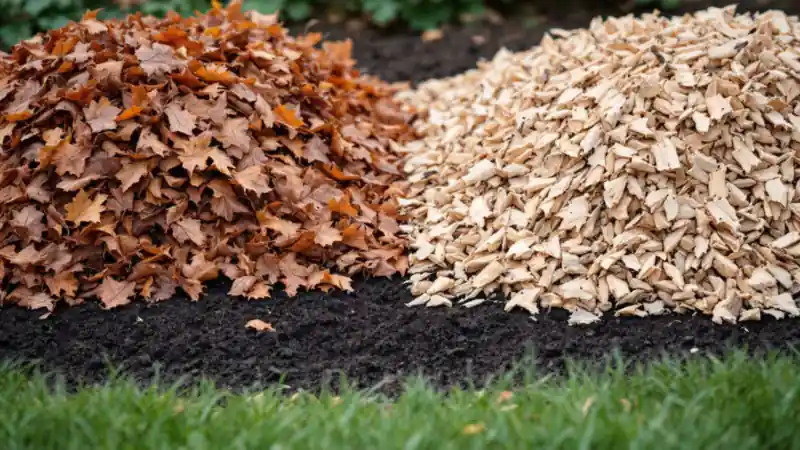
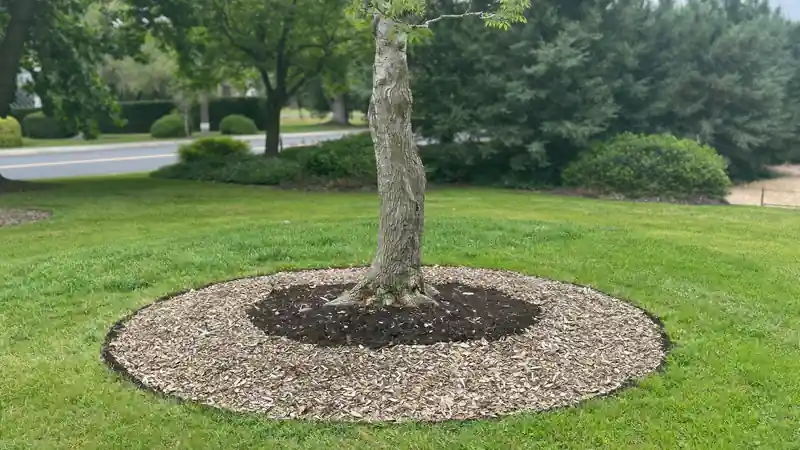
- Thin anything over 3 inches. Rutgers ties deep layers (4 inches or more) to nuisance fungi and keeps coarse mulch to 2 inches; our page on how deep mulch should be gives depths by material and soil.
- If flushes keep coming, turn the mulch under or cook it. Rutgers says topping infested mulch with fresh dry mulch “rarely solves anything”; spade the old layer into the soil and soak it, or pile it, wet it through and let it self-heat to 110 to 140°F, which kills the nuisance fungi (Rutgers).
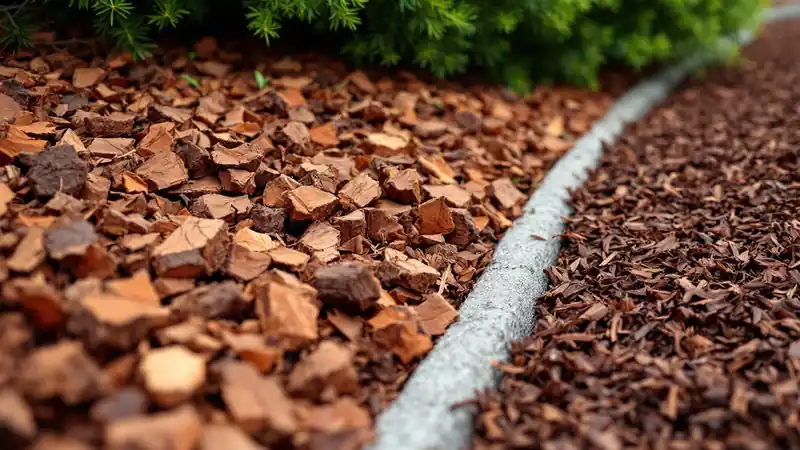
- Change the material as a last step. Coarse softwood bark nuggets over 3/4 inch resist decay longer than shredded hardwood (Rutgers), and stone grows no fungi at all, though Rutgers notes it does nothing for plant health; our mulch vs rock comparison covers heat and weed trade-offs.
The table ranks the 8 fixes by effort and by what the evidence covers.
| Fix | Effort | Works on | Evidence |
|---|---|---|---|
| Pick and bag | Minutes | All seven | Removes spores and pet risk now; fungus stays (UW Madison, Iowa State) |
| Rake or fork to dry | 15 to 30 min per bed | Bird’s nest, artillery, slime mold, mushrooms | Iowa State: reduces bird’s nest fungi; Rutgers: fluff twice a year |
| Cut irrigation | One controller change | All | Ask Extension: drying reduces mushroom growth |
| Thin to 2 to 3 in | 1 to 2 hours | All | Rutgers: problems rise at 4 in or deeper |
| Spade under and soak, or hot-pile | Half a day | Persistent flushes | Rutgers: pile at 110 to 140°F destroys nuisance fungi |
| Replace with pine bark nuggets | A weekend | Artillery, bird’s nest | Penn State 27-mulch trial: large nuggets most resistant |
| Blend in spent mushroom compost | A weekend | Artillery | Penn State: 40 percent blend suppresses; UDel: 40 percent or more |
| Fungicide, vinegar, soap | Not worth it | None | No product registered for artillery fungus (UMaine); none prevents mushrooms (Iowa State) |
Black specks on siding or the car? That is artillery fungus
The artillery fungus is the one growth in mulch that costs money. Its cups are about 1/10 inch wide, aim at bright surfaces such as white siding and parked cars, and shoot a sticky black spore mass that Iowa State measured landing up to 18 feet high and Penn State and UMaine put at up to 20 feet (Iowa State; UMaine 5103e). Penn State’s 1997 release said the specks caused more than $1 million in homeowner damage claims in Pennsylvania in one year (Penn State, 1997).
Timing narrows the search. Penn State found spore masses form at 50 to 68°F, and UMaine says the cups are not produced above 77°F, which is why the specks appear in spring and fall (Penn State; UMaine). Davis and colleagues found the heaviest firing from mulch on the cool, moist north side of a house (J. Environ. Hort. 23(4)).
Which mulch resists artillery fungus?
Penn State inoculated 27 mulches in 1998 and counted spore masses on targets each year until 2002. Large bark nuggets, cypress and 100 percent spent mushroom compost supported the least; shredded bark and wood blends from large piles supported significantly more than anything else (Davis et al., J. Environ. Hort. 22(3), 2004). Every wood or bark mulch eventually supported the fungus after 3 to 4 years outdoors.
| Mulch group | Artillery fungus sporulation | What it means for you | Source |
|---|---|---|---|
| Shredded bark and wood blends from large piles | Highest | Avoid along light siding | Davis et al. 2004 |
| Blends with 5% compost; cedar; ‘bark’ with much wood; dyed chips; plain chips | Intermediate | Usable; refresh or cover regularly | Davis et al. 2004 |
| Cypress | Low | Resists well; Penn State flags sustainability concerns | Penn State FAQ; our cypress mulch report |
| Large pine bark nuggets | Lowest of the wood and bark mulches in one study | First choice next to the house | Penn State FAQ |
| 100% spent mushroom compost | Low | Suppresses; blend instead of using straight | Davis et al. 2004 |
| Stone or rubber | None | Permanent fix; no plant benefit | UMaine 5103e |
Mixing spent mushroom compost into existing mulch is the one fix with field counts behind it. In a second trial, mulch blended with 10 to 40 percent compost averaged 26.4 spore masses per plot after 30 months, against 236.8 for plain oak-hickory chips and 7.2 for straight compost (Davis, Kuhns and Harpster 2005). The authors warn the data were too variable to name an exact percentage; Penn State’s fact sheet and the University of Delaware use 40 percent or more (Penn State; UDel Extension, 2025).
| Mulch treatment (5 in deep) | Mean spore masses per plot after 30 months | Versus plain chips |
|---|---|---|
| Oak-hickory wood chips, 0% compost | 236.8 | Baseline |
| Chips blended with 10, 20 or 40% spent mushroom compost (pooled) | 26.4 | 89% fewer |
| 100% spent mushroom compost | 7.2 | 97% fewer |
The calculator below sizes a 40 percent blend for your bed. Rutgers keeps coarse mulch to 2 inches, and most extension depths for beds top out at 3 inches, so those are the two depths offered; our mulch volume calculator handles other depths and bag counts.
- Total blend (cubic yards)
- 0.62
- Spent mushroom compost (cubic yards)
- 0.25
- Spent mushroom compost (cubic feet)
- 6.7
- Wood or bark mulch (cubic yards)
- 0.37
Default: 100 sq ft at 2 inches = 0.62 cu yd total, 0.25 cu yd (6.7 cu ft) compost, 0.37 cu yd mulch. Area x depth in feet / 27 = cubic yards. Penn State's trial could not fix an exact percentage; 40 percent is the figure its fact sheet and UDel use.
| Bed | Depth | Total blend | Spent mushroom compost (40%) | Wood or bark mulch (60%) |
|---|---|---|---|---|
| 100 sq ft | 2 in | 0.62 cu yd (16.7 cu ft) | 0.25 cu yd (6.7 cu ft) | 0.37 cu yd (10.0 cu ft) |
| 100 sq ft | 3 in | 0.93 cu yd (25.0 cu ft) | 0.37 cu yd (10.0 cu ft) | 0.56 cu yd (15.0 cu ft) |
| 50 ft foundation bed, 4 ft wide (200 sq ft) | 2 in | 1.23 cu yd (33.3 cu ft) | 0.49 cu yd (13.3 cu ft) | 0.74 cu yd (20.0 cu ft) |
How to clean artillery fungus spots off siding
Fresh spots come off more easily than old ones. UDel says soap and water with a scrub brush “can be effective before the material dries” (UDel Extension), and Iowa State says the spots must be soaked with soapy water (Iowa State). Davis and colleagues note power washing “usually does not work” (J. Environ. Hort., 2005), and spore masses stay viable for at least 10 years (Penn State, 1997).
Two mistakes spread the problem. Penn State’s FAQ warns that scraping or sanding spots so they fall into foundation mulch reseeds it with live spores, and painting over them seals them in but leaves a pebbly finish (Penn State Extension, updated July 2026). UMaine adds that pruning off heavily spotted shrub leaves does less harm than scrubbing them (UMaine Extension, 2024).
Slime mold on mulch: leave it or scoop it?
Dog vomit slime mold, Fuligo septica, is not a fungus at all and does not harm plants. Oregon State says it ranges from several inches to more than 2 feet across, can “flow” across mulch for several feet, and shows up after summer rain (Oregon State Extension, 2020). Iowa State says it usually dries within a few days into a white, powdery mass (Iowa State).
Sources split on the hose. Oregon State’s retired horticulturist Neil Bell says you can rake it, compost it or “spray it off with a blast of water,” while WSU’s Stevens County office says spraying “simply spreads the spores” and recommends scooping it into a bag with a shovel or pitchfork, then cutting the water the area gets (WSU Extension, Stevens County). Bagging does both jobs, so we would scoop first.
Do vinegar, dish soap or fungicide kill mushrooms in mulch?
None of the popular sprays has extension support. Iowa State’s answer covers every product at once: “there is nothing that can be applied to the ground that will prevent them from coming up” (Iowa State Extension). The table checks the specific claims ranking for this query in November 2026.
| Claim | Where it appears | What the primary sources say | Source |
|---|---|---|---|
| 1 part vinegar to 4 parts water, sprayed on the mushrooms | Tree-service blog in the top 10 | No extension source we found supports it; the fungus lives through the whole layer, not in the cap | Iowa State |
| Dish soap drench | People Also Ask | No extension support; soapy water is advised only for scrubbing artillery spots off siding | Iowa State |
| 2 tbsp baking soda per gallon of water | Garden columnist, top 3 | No extension source we found tests it on mulch fungi | Iowa State |
| 1 cup rock salt per gallon of hot water | Reddit thread, top 3 | No extension source we found recommends it for mulch fungi; salt builds up in soil and injures the plants in the bed, as our page on salt as a weed killer documents | Iowa State |
| Fungicide | Common advice | No fungicide is registered for artillery fungus; none controls bird’s nest fungi or prevents stinkhorns | UMaine; Iowa State; UW Madison |
| 4 parts mushroom compost to 10 parts mulch | Garden columnist, top 3 | That is about 29 percent; Penn State’s figure is 40 percent | Penn State |
Are mushrooms in mulch poisonous to dogs and kids?
Most are not, but you cannot tell the dangerous ones by eye. The North American Mycological Association says 99 percent of mushrooms have little or no toxicity and 1 percent can kill pets; amatoxin species, including the Galerina marginata group that grows on decaying wood, cause 6 to 12 or more hours of delay before vomiting starts (NAMA). The ASPCA advises walking the yard daily to remove mushrooms before letting pets out (ASPCA).
If a pet eats one, call your veterinarian or ASPCA Animal Poison Control at (888) 426-4435 and bag a sample in paper, not plastic, for identification. For a person, call Poison Help at 1-800-222-1222 at once rather than waiting for symptoms; our lawn mushroom guide covers the green-spored parasol and the full poisoning response.
How we compiled this
In November 2026 we read 18 primary documents: extension pages and PDFs from Penn State (3), Iowa State (2), Rutgers, UW Madison, UF/IFAS, UMaine (2), the University of Delaware, Oregon State and WSU; 2 Ask Extension answers; 2 peer-reviewed Penn State field studies in the Journal of Environmental Horticulture; and the ASPCA and NAMA pet poisoning pages. Counts and distances are as published; percent reductions and blend volumes are our arithmetic. We ran no trials. Forum and Facebook threads were used for question phrasing only.
Frequently asked questions
Should I remove mushrooms from my mulch?
Only if children or pets use the bed, or you dislike the look. Iowa State Extension says most cause no damage, so no action is required; bag them before the caps open if you do pull them.
Is it normal for mushrooms to grow in mulch?
Yes. Penn State Extension calls mulch fungi natural decomposers that appear from April through October after rain, and they fade when weather turns warmer and drier.
Will vinegar and water kill mushrooms?
No extension source we found recommends it. The fungus runs through the whole mulch layer, and Iowa State Extension says nothing applied to the ground prevents mushrooms from coming back.
What type of mulch is resistant to artillery fungus?
Large pine bark nuggets resisted best of 27 mulches in Penn State’s field study, with cypress and spent mushroom compost also low. Stone and rubber support none.
Is artillery fungus harmful to humans?
No. Penn State researchers said that apart from cosmetic damage to siding and cars, the fungus is not a hazard in any way.
Sources
- Penn State Extension (Brantley, Davis, Kuhns), What Is Growing in My Landscape Mulch? Mushrooms, Slime Molds, and Fungus, updated June 2025. Accessed November 2026.
- Penn State Extension, Artillery Fungus in Mulch (FAQ), updated July 2026. Accessed November 2026.
- Penn State University, Artillery Fungus Threatens Homeowners, Mulch Industry, news release, July 1997. Accessed November 2026.
- Davis, Kuhns, Akina and Harpster, Artillery Fungus Sporulation on 27 Different Mulches: A Field Study, J. Environ. Hort. 22(3):117, September 2004. Accessed November 2026.
- Davis, Kuhns and Harpster, Use of Mushroom Compost to Suppress Artillery Fungi, J. Environ. Hort. 23(4):212 to 215, December 2005. Accessed November 2026.
- Iowa State University Extension, Managing Strange-Looking Fungi in Landscape Mulch and Lawns, current page. Accessed November 2026.
- Iowa State University Extension, How do I get rid of mushrooms in my yard or garden bed?, current page. Accessed November 2026.
- Rutgers Cooperative Extension (S. Rettke), Control of Nuisance Fungi in Landscape Mulch, March 2021. Accessed November 2026.
- University of Wisconsin PDDC (M. Keller-Pearson), Stinkhorns, current page. Accessed November 2026.
- UF/IFAS Extension (Phillips, Gillett-Kaufman, Smith), Stinkhorn Mushrooms, PP345, reviewed November 2024. Accessed November 2026.
- University of Maine Cooperative Extension (Smart, Watt, Novak), Artillery Fungus, Fact Sheet 5103e, updated August 2021. Accessed November 2026.
- University of Maine Cooperative Extension, Ask the Expert, How do I kill off artillery fungus?, October 2024. Accessed November 2026.
- University of Delaware Cooperative Extension (N. Gregory), Artillery Fungus and Other Things that Grow in Mulch, reviewed March 2025. Accessed November 2026.
- Oregon State University Extension, Slime mold blobs look scary in mulch but leave your plants alone, July 2020. Accessed November 2026.
- WSU Extension, Stevens County, Dog vomit slime mold: Fuligo septica, current page. Accessed November 2026.
- Ask Extension, Exuberant Mushroom Growth after new mulch applied to Garden, #904534, June 2025. Accessed November 2026.
- ASPCA Animal Poison Control, The Fungus Among Us: Mushroom Toxicosis, current page. Accessed November 2026.
- North American Mycological Association, Mushroom Poisonings in Dogs and Cats, current page. Accessed November 2026.