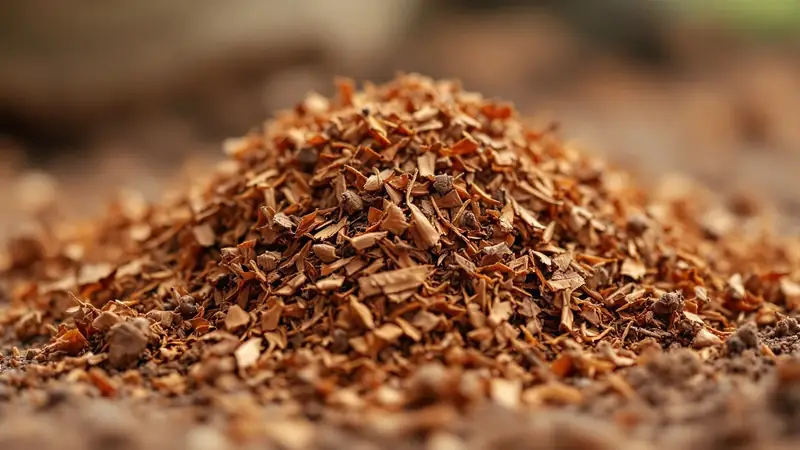
What is soil conditioner: any material mixed into soil to improve its structure, drainage, aeration or water holding rather than to feed plants. State law files it as a soil amendment, and most bags sold under the name are pine bark, compost or manure.
Ask what is soil conditioner at a garden center and you can walk out with pine bark, a manure-and-guano blend, kiln-fired slate, gypsum or lime, because all five are sold under that name. The label term comes from state fertilizer law, where a soil conditioner is a soil amendment: something that changes how soil behaves, not something that feeds plants. Finished compost is the best-known kind; our page on compost vs mulch, with application depths covers it in detail. On a skid steer, “soil conditioner” is also the name of a ground-preparation attachment, a different product that this page does not cover.
On Nov. 16, 2026 we read the maker or retailer pages for 9 products sold as soil conditioner and priced them. Not one of the 9 pages showed a guaranteed analysis, and the price ran from $2.59 a cubic foot for bulk pine bark to about $35 for a cubic foot of expanded slate. The bags labeled humus tell the same story, as our page on what humus soil is and what humus bags contain found for 6 of them.
What soil conditioner means on a label
In U.S. labeling rules, “soil conditioner” has no definition of its own. The Mulch & Soil Council’s Uniform Product Guidelines, which certified bag makers follow, list it as “Soil Conditioner: (See Soil Amendment)” and then quote the Association of American Plant Food Control Officials (AAPFCO): a soil amendment is “any substance or mixture of substances which is intended to improve the physical, biochemical, biological or other characteristics of the soil, except fertilizers, agricultural liming materials, unmanipulated animal manures, unmanipulated vegetable manures, pesticides and other materials exempted by regulation” (MSC Uniform Product Guidelines, rev. September 2026, p. 8).
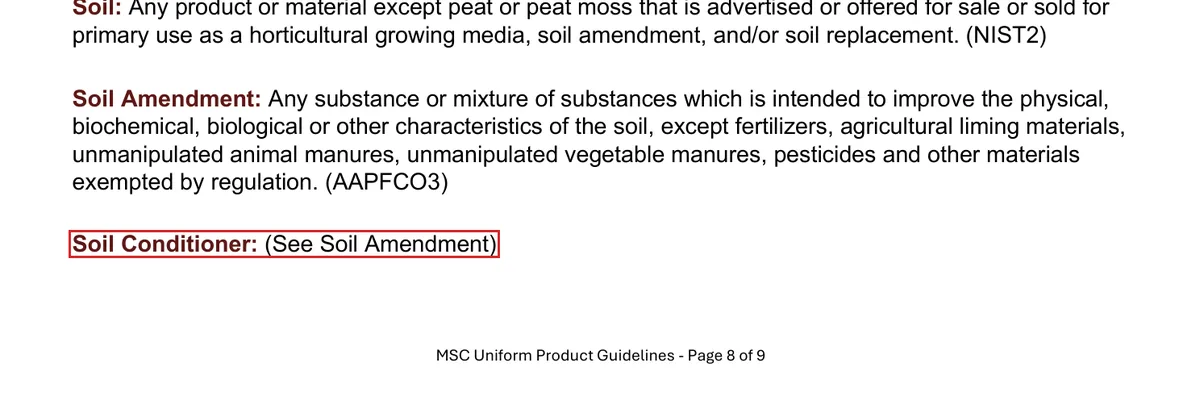
Two things follow from that wording. A product sold only as a soil conditioner promises a change in the soil, not plant food, so it carries no nitrogen, phosphate or potash guarantee unless it is also registered as a fertilizer. And the exclusions mean plain manure and agricultural lime fall outside the soil-amendment rules even when the bag says “soil conditioner.” States that adopted the AAPFCO model register these products one by one; Colorado leaves bagged amendments unregulated, and Colorado State University warns that “there are no regulations about the quality of the product, salt content, or other beneficial or harmful qualities of bagged products” (CSU Extension fact sheet 7.235).
| Rule maker | Term it uses | What it covers | Registration or guarantee | Source |
|---|---|---|---|---|
| AAPFCO model definition | Soil amendment; “Soil Conditioner: (See Soil Amendment)” | Improves physical, biochemical, biological or other soil characteristics; excludes fertilizers, liming materials, unmanipulated manures, pesticides | Model language that states copy | MSC UPG p. 8, citing AAPFCO |
| Mulch & Soil Council (voluntary) | Landscape soil and soil amendments | Products sold “for primary use as an in-ground soil amendment or conditioner” from soils, bark, coir, digestate, forest products, peat, humus, compost or manure | Certification for member brands; may include fertilizer | MSC UPG pp. 2 and 6 |
| Virginia | Soil amendment | Physical, chemical, biochemical, biological or other characteristics; exempts fertilizer, raw or composted manures, growing media, liming materials, unmixed mulch and unmixed peat | $100 per product name each year, due July 1; application lists the guaranteed analysis; label follows the AAPFCO Uniform Soil Amendment Bill | § 3.2-3600; § 3.2-3607; § 3.2-3611 |
| California | Beneficial substance (includes plant biostimulants) | Non-nutrient substances “that can be demonstrated by scientific research to be beneficial to one or more species of plants, soil, or media” | Defined inside the fertilizing-materials chapter; wording amended effective Jan. 1, 2026 | Cal. Food & Agric. Code § 14513 |
| Colorado | Soil amendment | Any material added to improve physical properties | No quality or salt rules for bagged amendments; compost regulated only by source material (6 CCR 1007-2) | CSU 7.235 |
The practical upshot: “soil conditioner” on a bag tells you what the maker intends, not what is inside. Read the ingredient line, look for a guaranteed analysis box, and in a registering state such as Virginia, where each brand pays a separate $100 a year, expect the label to follow the AAPFCO soil amendment bill (Va. Code § 3.2-3611). The same chapter, read for lime, explains why our lawn lime guide quotes calcium carbonate equivalents rather than “conditioning” claims.
What is in a bag of soil conditioner?
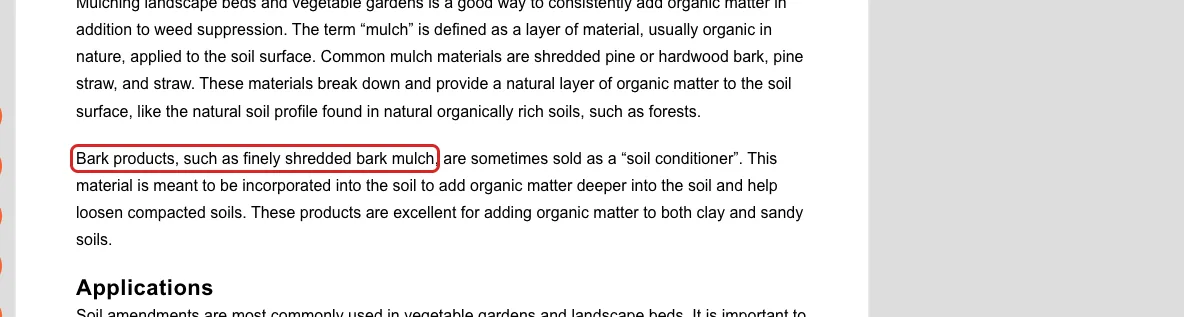
Mostly pine bark, by the makers’ own descriptions. Clemson Extension says finely shredded bark mulch is “sometimes sold as a ‘soil conditioner’” and is “meant to be incorporated into the soil to add organic matter deeper into the soil and help loosen compacted soils” (Clemson HGIC 1655, revised Dec. 2023). In the Southeast the bulk-yard version is often called pine fines or pine bark fines; batch-15 page mulch vs bark covers the coarser grades.
| Product | Type | Contents as stated | Guaranteed analysis shown? | Size | Price checked | Unit price | Source |
|---|---|---|---|---|---|---|---|
| Pine bark soil conditioner, bulk (Suburban Lawn & Garden, Kansas City) | Organic: bark | “Fine chips of pine bark” | No | 1 cu yd | $69.99 | $2.59/cu ft | maker or retailer page; price: Retailer page |
| Just Natural Soil Conditioner (Jolly Gardener) | Organic: bark | “Aged bark fines” that “break down to help aerate heavy, clay-like soils” | No | 1.5 cu ft | $4.69 (Cofers) | $3.13/cu ft | maker or retailer page; price: Google Shopping |
| Unbranded “Soil Conditioner” bags, 4 garden-center listings | Not stated | Listing titles only; one sells it as “Soil Conditioner Mulch” | No | 1.5 cu ft | $3.60 to $12.99 | $2.40 to $8.66/cu ft | Google Shopping listings; price: Google Shopping |
| Timberline Soil Conditioner (50055100) | Not stated | Maker page names no ingredient; lists “Helps Retain Moisture, Helps Control Weed Growth, Helps Insulate Soil” | No | 1.5 cu ft | $599 per pallet of 65 (Home Depot) | $6.14/cu ft | maker or retailer page; price: Google Shopping |
| G&B Organics Soil Building Conditioner | Organic: bark blend | Forest products, bark fines, chicken and poultry manure, gypsum, dolomite and oyster shell lime, feather meal, bat guano, worm castings, kelp, mycorrhizae | No (OMRI listed, CDFA organic input) | 3 cu ft | $19.99 (Watson’s Greenhouse) | $6.66/cu ft | maker or retailer page; price: Google Shopping |
| FoxFarm Happy Frog Soil Conditioner | Organic: forest products blend | Aged forest products, earthworm castings, bat guano, soil microbes, humic acids | No | 1.5 cu ft | $14.99 (CountryMax) to $17.99 (Rainbow Gardens) | $9.99 to $11.99/cu ft | maker or retailer page; price: Retailer page; Google Shopping |
| Espoma Soil Perfector | Mineral: kiln-fired slate | “100% Expanded Slate Aggregate” | No | 30 lb (covers 12 sq ft at 1 in) | $34.99 (My Garden Pool) | About $35/cu ft placed | maker or retailer page; price: Google Shopping |
| Espoma Organic Garden Gypsum | Mineral: calcium sulfate | Gypsum, pelletized; maker says it “helps loosen clay soils” | Not on maker page | 36 lb | $26.99 (CountryMax listing titled “Soil Conditioner”) | $0.75/lb | maker or retailer page; price: Google Shopping |
| Landscapers Select Soil Conditioner (903072) | Mineral: lime | Sold as “Soil Conditioner, Lime”; retailer says it helps “correct acidic soils” | Not on retailer page | 30 lb | $15.49 (McCoy’s) to $34.99 (Ridout Lumber) | $0.52 to $1.17/lb | maker or retailer page; price: Retailer page; Google Shopping |
Three groups show up in that table. Bark products (rows 1 to 4) are the classic Southern “soil conditioner” and the cheapest, $2.40 to $8.66 a cubic foot. Blends such as G&B and FoxFarm add manures, bat guano and worm castings, cost $6.66 to $11.99, and supply some nutrients without guaranteeing any. Mineral products do something different: Espoma says Soil Perfector is slate “kiln-fired at temperatures in excess of 2000° F” and should be worked 1 inch deep into the top 6 inches (Espoma product page), and the gypsum and lime bags change soil chemistry, not organic matter.
Read the lime row twice. Landscapers Select 903072 is sold as “Soil Conditioner, Lime,” and the retailer copy says it helps “correct acidic soils” (Ridout Lumber listing), a job you size from a soil test, not from the word conditioner. Gypsum is the same case: Espoma’s label rate for lawns is 36 lb per 1,000 sq ft (Espoma Garden Gypsum page), and whether it loosens clay at all is answered in our guide to improving clay soil; Clemson calls its structural effect “often short-lived” (HGIC 1655).
Soil conditioner vs compost, topsoil and fertilizer
The four answer different problems, and only fertilizer is sold on a legally binding number. Compost is one kind of soil conditioner; topsoil is a growing layer you build grade with; fertilizer is sold on its nitrogen, phosphate and potash guarantee. Colorado State notes that compost “is not regulated for nutrient content” and is “not a fertilizer in a legal sense” (CSU 7.235), which is the same position a bag of soil conditioner is in.
| Criterion | Soil conditioner (bark, blends, minerals) | Finished compost | Topsoil (bagged) | Fertilizer | Source |
|---|---|---|---|---|---|
| Job | Change structure, drainage, aeration or water holding | Add organic matter and some slow nutrients | Fill and level, build grade | Supply N, P, K and other nutrients | CSU 7.235 |
| Nutrient guarantee | None on the 9 pages we read | Not required; CSU looks for 40 to 60% organic matter | None | Required (guaranteed analysis) | CSU 7.235; Va. § 3.2-3600 |
| How applied | Mixed in: 3 in for FoxFarm beds; 1 part to 2 parts soil for G&B | 1 to 2 in into 6 in for lawns; 3 to 4 in into 8 to 12 in for new beds | Spread and mixed to avoid a layer | Label rate per 1,000 sq ft | FoxFarm; G&B; CSU Table 1 |
| Main risk | Fresh bark ties up nitrogen; manure blends can be salty | Salts in manure-based compost | Weed seed, wrong pH | Burn, runoff | CSU 7.235 |
| Typical price we found | $2.40 to $11.99 per cu ft (organic types) | See our compost vs mulch page | $4.36 to $5.85 per cu ft (bagged, Nov. 8) | Priced per lb of nitrogen | topsoil vs garden soil |
For the bagged topsoil and garden soil labels, see our side-by-side read of topsoil vs garden soil bag labels; for the mineral fraction that a conditioner works on, batch-15 page what loam soil is sets out the sand, silt and clay shares. Colorado State flags one more trap: fresh wood products “can tie up nitrogen in the soil,” worst with sawdust, so bark conditioners should be aged or composted before you mix them in (CSU 7.235).
Do liquid soil conditioners work?
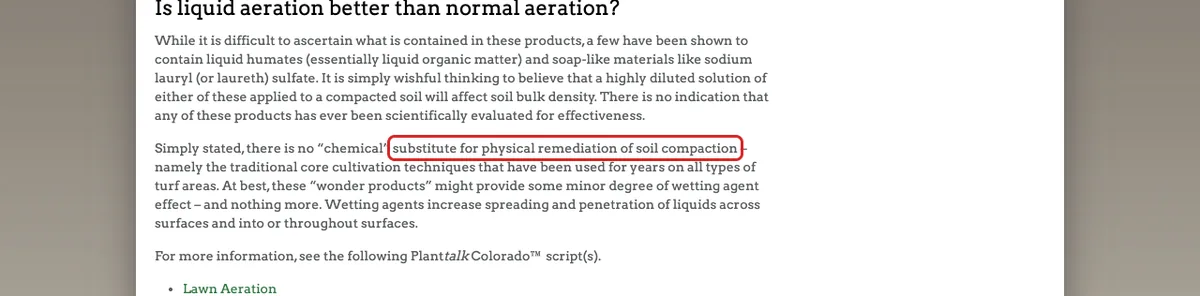
Mostly no, if the claim is that a spray replaces aeration or compost. Colorado State University Extension found that the liquid aeration products it could identify contained liquid humates and “soap-like materials like sodium lauryl (or laureth) sulfate,” says “there is no ‘chemical’ substitute for physical remediation of soil compaction,” and puts their best case at “some minor degree of wetting agent effect” (PlantTalk Colorado 1545).
The one turf field trial we found agrees. In a 2020 to 2022 University of Georgia study on TifTuf bermudagrass over Cecil clay loam, monthly humic and fulvic acid sprays left penetration resistance no different from untreated turf, while sequential hollow-tine core aeration lowered it and raised long-term water infiltration; the authors conclude that “liquid aeration does not substitute hollow-tine cultivation” (Henry et al., Agronomy Journal 117, 2025). The sprays did raise soil moisture and rooting against untreated plots, so they are not inert.
| Claim on liquid or humate conditioners | What the research found | Source |
|---|---|---|
| Replaces core aeration | Penetration resistance unchanged after monthly humic/fulvic sprays, 2020 to 2022; only sequential hollow-tine coring lowered it | Henry et al. 2025, Univ. of Georgia |
| Loosens compacted soil | “Wishful thinking to believe that a highly diluted solution” will change bulk density; at best a wetting agent effect | CSU PlantTalk 1545 |
| Humic acid boosts nutrient uptake and yield | 5 commercial humic acid products; field rates of 1.1 and 3.4 kg/ha in 2008 and 2009 tomato trials raised neither nutrient uptake, plant mass nor yield | Hartz and Bottoms, HortScience 45:906, 2010 |
| Humates improve soil structure and water holding | Review found “a surprising lack of solid evidence for their on-farm effectiveness”; products often applied “at unrealistically low levels” | Lyons and Genc, Agronomy 6:50, 2016 |
| Wetting agents fix dry spots | Help water-repellent soil; little benefit where soil is not repellent | our hydrophobic soil guide |
Lyons and Genc note that commercial humates are “used widely in agriculture today as ‘soil conditioners’” (Agronomy 6:50), so the word on a jug signals the humate category, not a tested result. Hartz and Bottoms concluded that “at typical commercial application rates in representative field soils, HA is unlikely to significantly improve vegetable crop nutrient uptake or productivity” (HortScience 45:906). If the real problem is compaction, our core aeration how-to gives the hole spacing and timing.
How to use soil conditioner, and how much to buy
Mix it in; do not leave it on top. Colorado State says an amendment “must be thoroughly mixed into the soil,” because a buried or surface layer can “interfere with both water and air movement and root growth,” and it sets compost rates by job: 1 to 2 inches worked 6 inches deep for a one-time lawn preparation, 3 to 4 inches worked 8 to 12 inches deep for new beds, and 0.25 inch a year for existing beds (CSU 7.235, Table 1). Three cubic yards covers 1,000 sq ft about 1 inch deep.
1Is your soil test pH below the target for your grass or plants?
YesLime, at the soil test rate. A bag called soil conditioner may be lime (Landscapers Select 903072); buy by calcium carbonate equivalent, not by name.
NoGo to the next question
2Is the problem a compacted lawn?
YesCore aeration. Liquid humate sprays did not lower penetration resistance in a 2020 to 2022 Georgia trial (Henry et al. 2025).
NoGo to the next question
3Do water drops sit on dry soil for more than 5 seconds?
YesWater-repellent soil: a labeled wetting agent and compost. See our hydrophobic soil guide.
NoGo to the next question
4Is it heavy clay or fast-draining sand in a bed you are about to plant?
YesOrganic conditioner mixed in: pine bark fines or compost, 3 to 4 inches into 8 to 12 inches (CSU 7.235).
NoGo to the next question
5Is it a small bed or container where you want a permanent change?
YesExpanded slate or shale: 1 inch worked into the top 6 inches (Espoma Soil Perfector directions); costs about $35 per cu ft placed.
NoYour soil may not need a conditioner. Topdress existing beds with 0.25 inch of compost a year (CSU 7.235).
Source: CSU 7.235; Henry et al. 2025; Espoma; Ridout Lumber listing
- Test first. A routine soil test shows whether the limit is pH (lime or sulfur), nutrients (fertilizer) or structure (a conditioner). CSU says most landscape soils do well at 4 to 5 percent organic matter.
- Pick the type for the problem: bark or compost for clay and sand structure; expanded slate for a permanent mineral change in a small bed; lime only below the pH target on a test.
- Measure the depth: 3 inches for FoxFarm in vegetable beds each spring; 1 inch of Soil Perfector into 6 inches (2 inches for severely compacted soil); 1 part G&B to 2 parts native soil.
- Spread evenly, then work it into the top 6 to 8 inches with a spade or tiller so no separate layer is left; tilling depths by job are in our guide on how to till soil.
- Water thoroughly after mixing, as the FoxFarm directions say, and plant or seed once the bed has settled.
| Step | Value | How |
|---|---|---|
| Bed area | 100 sq ft | 10 ft x 10 ft |
| Depth of conditioner before mixing | 3 in (0.25 ft) | FoxFarm bed rate; CSU new-bed compost rate is 3 to 4 in |
| Volume needed | 25 cu ft (0.93 cu yd) | 100 x 0.25 |
| 1.5 cu ft bags | 17 bags | 25 / 1.5 = 16.7, rounded up |
| Cost: bulk pine bark at $2.59/cu ft | $64.75 plus delivery | 25 x 2.59 |
| Cost: Just Natural at $4.69 a bag | $79.73 | 17 x 4.69 |
| Cost: FoxFarm Happy Frog at $14.99 a bag | $254.83 | 17 x 14.99 |
| Cost: Soil Perfector at 1 in instead | $314.91 (9 bags) | 100 sq ft / 12 sq ft per bag = 8.3, rounded to 9 x 34.99 |
- Cubic feet
- 25.0
- Cubic yards
- 0.93
- 1.5 cu ft bags
- 17
Area x depth x price per cu ft from our table (prices captured Nov. 16, 2026). Default: 100 sq ft at 3 in = 25 cu ft, 0.93 cu yd, 17 bags. Soil Perfector is sold in 30 lb bags that cover 12 sq ft at 1 in.
The calculator multiplies area by depth by the per-cubic-foot range for each product type in our table. Above about 1 cubic yard, bulk usually beats bags: in the example, 25 cubic feet of bulk pine bark costs less than the bagged bark even before you count the 17 trips with a bag, though delivery fees vary by yard.
How we compiled this
On Nov. 16, 2026 we read the Mulch & Soil Council Uniform Product Guidelines (rev. September 2026), 3 sections of the Virginia fertilizer law, California Food and Agricultural Code § 14513, 3 extension publications (Colorado State 7.235 and PlantTalk 1545, Clemson HGIC 1655), 3 peer-reviewed papers (Henry et al. 2025; Hartz and Bottoms 2010; Lyons and Genc 2016, abstracts via Crossref) and 8 maker or retailer product pages, then captured prices from Google Shopping and 2 retailer pages. We did not buy, test or grow anything; unit prices are our arithmetic.
Frequently asked questions
What are examples of soil conditioners?
Pine bark fines, compost, aged manure blends, worm castings, expanded slate or shale, gypsum and lime are all sold under the name. In our 9-product sample, 4 were bark, 2 were bark-and-manure blends and 3 were minerals.
What’s the difference between compost and soil conditioner?
Compost is one kind of soil conditioner. Bagged “soil conditioner” in the Southeast is more often pine bark fines, which Clemson says are mixed in to add organic matter and loosen compacted soil; compost decomposes faster and carries more nutrients.
What’s the difference between soil conditioner and fertilizer?
A fertilizer is sold on a guaranteed analysis of nutrients; a soil conditioner is a soil amendment, which the AAPFCO definition excludes from fertilizers. None of the 9 conditioner pages we read showed a nutrient guarantee.
When should you use soil conditioner?
Before planting, when a soil test or a dig shows heavy clay, compaction or fast-draining sand. Colorado State gives 1 to 2 inches into 6 inches for a new lawn and 3 to 4 inches into 8 to 12 inches for new beds.
Can you put soil conditioner on top of soil?
It works best mixed in. Colorado State says an amendment left on top can interfere with water and air movement and root growth. Some bark conditioners double as mulch: G&B lists a 2 to 3 inch top layer as a second use.
Does liquid soil conditioner actually work?
Not as a replacement for aeration. A 2020 to 2022 Georgia trial found humic and fulvic acid sprays did not lower soil penetration resistance; core aeration did. Colorado State expects at most a mild wetting-agent effect.
Sources
- Mulch & Soil Council, Uniform Product Guidelines for Horticultural Mulches, Growing Media & Landscape Soils (Soil Amendment, Soil Conditioner and Landscape Soil definitions), Revised September 2026. Accessed November 2026.
- Code of Virginia, § 3.2-3600, Definitions (soil amendment), Read Nov. 16, 2026. Accessed November 2026.
- Code of Virginia, § 3.2-3607, Product registration and label requirements, Read Nov. 16, 2026. Accessed November 2026.
- Code of Virginia, § 3.2-3611, Labeling, Read Nov. 16, 2026. Accessed November 2026.
- California Legislative Information, Food and Agricultural Code § 14513, Beneficial substance, Amended by Stats. 2025, Ch. 67, effective Jan. 1, 2026. Accessed November 2026.
- Colorado State University Extension, Choosing a Soil Amendment, fact sheet 7.235, Read Nov. 16, 2026. Accessed November 2026.
- Colorado State University Extension, PlantTalk Colorado, 1545, Liquid Lawn Aeration, Read Nov. 16, 2026. Accessed November 2026.
- Clemson Cooperative Extension, Home & Garden Information Center, HGIC 1655, Soil Conditioning: Establishing a Successful Gardening Foundation, Revised Dec. 1, 2023. Accessed November 2026.
- G. M. Henry, C. J. Wang, E. G. Begitschke and K. A. Tucker, Agronomy Journal 117, Hybrid bermudagrass and soil response to liquid aeration compared with hollow-tine cultivation, 2025. Accessed November 2026.
- T. K. Hartz and T. G. Bottoms, HortScience 45(6):906 to 910, Humic Substances Generally Ineffective in Improving Vegetable Crop Nutrient Uptake or Productivity, June 2010. Accessed November 2026.
- G. Lyons and Y. Genc, Agronomy 6(4):50, Commercial Humates in Agriculture: Real Substance or Smoke and Mirrors?, October 2016. Accessed November 2026.
- Suburban Lawn & Garden (KC Mulch), Pine Bark Soil Conditioner, bulk, product page and price, Price checked Nov. 16, 2026. Accessed November 2026.
- Jolly Gardener, Just Natural Organics product line (Just Natural Soil Conditioner), Read Nov. 16, 2026. Accessed November 2026.
- Timberline (Oldcastle), Soil Conditioner product page, Read Nov. 16, 2026. Accessed November 2026.
- Kellogg Garden Products, G&B Organics Soil Building Conditioner product page (ingredients, rates), Read Nov. 16, 2026. Accessed November 2026.
- FoxFarm Soil & Fertilizer Co., Happy Frog Soil Conditioner product page (contents, directions), Read Nov. 16, 2026. Accessed November 2026.
- CountryMax, FoxFarm Happy Frog Soil Conditioner 1.5 cu ft listing and price, Price checked Nov. 16, 2026. Accessed November 2026.
- Espoma, Soil Perfector product page (ingredient, coverage, directions), Read Nov. 16, 2026. Accessed November 2026.
- Espoma, Organic Garden Gypsum product page (rates), Read Nov. 16, 2026. Accessed November 2026.
- Ridout Lumber, Landscapers Select 903072 Soil Conditioner, Lime, 30 lb listing and price, Price checked Nov. 16, 2026. Accessed November 2026.