When to prune oak trees: in the dormant season, roughly November through February. Skip April through July in the Upper Midwest and February through June in Texas, when sap beetles carry oak wilt spores to fresh cuts.
When to prune oak trees is set by one disease, oak wilt, and the dates differ by state. Texas A&M Forest Service says to avoid pruning oaks from Feb. 1 to June 30 (Texas Oak Wilt flyer); Michigan’s DNR names April 15 to July 15 (Michigan DNR, Nov. 2024); the University of Minnesota says April through July (UMN Extension, reviewed 2026). The table below lists 12 state and city rules with their sources.
The dates track the spring flight of 2 sap beetles, Colopterus truncatus and Carpophilus sayi, counted in a Wisconsin trapping study of 15,980 beetles (Jagemann et al., Environmental Entomology, 2018). That data explains why a warm January day is low risk, why late summer is not zero risk, and why a storm-broken oak needs paint within minutes. For prices, see our tree trimming prices by tree height; the timing below decides when to book.
Oak pruning windows by state
Agencies disagree on the edges of the window because beetle flight starts earlier in the South and in warm springs. Read your own state’s row, then check the city: Lakeway, Texas and Ann Arbor, Michigan make the rule law, and Ann Arbor’s July 2026 ordinance bans oak pruning from March 1 to Dec. 1, 9 months against the 3 in Michigan’s state guidance (City of Ann Arbor, ORD 26-22).
Swipe the table sideways to see every column.
| State or rule | Avoid pruning or wounding oaks | Safest time to prune | If you must cut in the risk season | Source |
|---|---|---|---|---|
| Texas (statewide) | Feb. 1 to June 30 | October to January; July and August if it cannot wait | Paint every oak wound immediately, any month, with any type of paint | Texas A&M Forest Service / Texas Oak Wilt Partnership flyer |
| Lakeway, Texas (city ordinance) | Feb. 1 to June 30 (prohibited) | Nov., Dec. and early Jan.; then July and August | Pruning seal on all oak cuts within 10 minutes, in any month | City of Lakeway Oak Pruning Schedule |
| Missouri | Mid-March through June | Not stated; outside mid-March to June | Commercial wound dressing immediately on spring wounds | Missouri Department of Conservation |
| Ohio | April 15 to July 1 (minimum); April 15 to Oct. 1 (stricter) | Oct. 1 to April 15 under the stricter rule | Latex paint if pruning is unavoidable in the growing season | Ohio State University, Ohioline PLPATH-TREE-02 |
| Pennsylvania | Warm months | December through March | Wound dressing as quickly as possible on warm-month cuts | Penn State Extension, updated Oct. 27, 2025 |
| Illinois | Not stated beyond “oak wilt season” | November through February | Not stated on the page | Illinois Extension forestry specialist, Ask Extension |
| Iowa | Spring and early summer | December through February | Latex house paint within 15 minutes on spring or summer cuts | Iowa State University Extension, reviewed Jan. 2023 |
| Michigan | April 15 to July 15 | Winter | Tree wound paint or latex-based paint immediately | Michigan DNR / Invasive Species Program, Nov. 13, 2024 |
| Ann Arbor, Mich. (city ordinance) | March 1 to Dec. 1 (prohibited) | Winter | Certain wounds treated immediately, no later than 24 hours | City of Ann Arbor, ORD 26-22, July 2026 |
| Wisconsin | April through July; to Oct. 1 to be very cautious | Winter, while dormant | Wound sealer or tree paint, within 15 minutes if possible | Wisconsin DNR release, March 30, 2022 |
| Minnesota | April through July | November through March | Latex-based paint or shellac immediately | University of Minnesota Extension, reviewed 2026 |
| New York | March through September | Dormant season (DEC’s 2017 bulletin: October to February) | Water-based spray paint or wound dressing immediately | NYS DEC oak wilt page, 2026 |
| Lake States, federal guidance | April 15 to July 1, longer to the south | Dormant season | Paint not needed on dormant-season wounds in the North | USDA Forest Service NA-FR-01-11, 2011 |
| Missouri to Texas, federal guidance | Texas: February through June | Dormant season | Paint immediately after any wound, any time of year | USDA Forest Service NA-FR-01-11, 2011 |
Start dates run from Feb. 1 in Texas to April 15 in Michigan and Ohio; end dates spread from June 30 in Texas to Oct. 1 in the cautious Ohio and Wisconsin versions, and New York’s DEC uses March through September (NYS DEC). For an unlisted state, the USDA Forest Service fallback is April 15 to July 1 in the Lake States and “a correspondingly longer period” to the south (USDA Forest Service NA-FR-01-11).
1Is a broken or hanging limb a danger to people, a house or a line right now?
YesCut only the hazard, then coat every cut within 15 minutes with latex paint or wound dressing (Iowa State, Wisconsin DNR). Call the utility for anything touching a line.
NoGo to the next question
2Are you in Texas, or anywhere from Missouri south to Texas?
YesAvoid Feb. 1 to June 30, and paint every oak cut immediately in any month (Texas A&M Forest Service; USDA Forest Service).
NoGo to the next question
3Is today inside your state's window in the table (for example April through July in Minnesota and Wisconsin, April 15 to July 15 in Michigan)?
YesWait. Book the work for November through February, and check your city: Ann Arbor bans oak pruning March 1 to Dec. 1.
NoGo to the next question
4Is it late summer or early fall (mid-July to Oct. 1)?
YesLower risk but not zero: Ohio and Wisconsin's cautious rule runs to Oct. 1. Prune only if it can't wait for winter, and paint the cuts.
NoYou are in the dormant season: prune now, remove no more than 25 percent of the crown, cut just outside the branch collar. No paint is needed on dormant-season cuts in the North.
Why can’t you trim oak trees in spring and summer?
A fresh cut leaks sap, and the sap draws beetles. Oaks killed by oak wilt the year before grow spore mats under their bark in spring; the mats smell fruity, sap beetles feed on them, pick up spores of the fungus Bretziella fagacearum, then fly to the next fresh wound they smell (Iowa State Extension). Wisconsin DNR’s forest health specialist puts the arrival time at “as little as 15 minutes” after a tree is wounded (Wisconsin DNR, 2022), and Penn State Extension says 15 to 20 minutes (Penn State Extension, 2025).
Timing also matters inside the tree. University of Minnesota Extension notes that from April through July oaks are building large spring-wood vessels that are “particularly susceptible” to infection, the same months the spore mats on red oaks that wilted the previous year do the most spreading (UMN Extension). Spores, beetles and an open door all line up for about 4 months, which is why the Upper Midwest windows cluster on April through July.
What the beetle trap data show
Wisconsin’s trapping study converted beetle catches into degree-days, a running total of heat since Jan. 1 (base 5 degrees C, or 41 degrees F). Colopterus truncatus, the early flier, reaches 5 percent of its season’s flight at 128 Celsius degree-days, about 231 Fahrenheit degree-days, and 50 percent at 354 (Jagemann et al. 2018, Table 4). Carpophilus sayi starts later and flies longer: 5 percent at 340 Celsius degree-days and 95 percent only at 2,344.
| Share of adult flight | C. truncatus, degree-days (C) | C. truncatus, degree-days (F) | C. sayi, degree-days (C) | C. sayi, degree-days (F) |
|---|---|---|---|---|
| 5% | 128.3 | 231 | 339.6 | 611 |
| 10% | 157.4 | 283 | 412.5 | 743 |
| 25% | 215.8 | 388 | 550.9 | 992 |
| 50% | 354.2 | 638 | 1,170.3 | 2,107 |
| 75% | 507.2 | 913 | 1,461.8 | 2,631 |
| 90% | 995.4 | 1,792 | 1,789.7 | 3,222 |
| 95% | 1,206.7 | 2,172 | 2,343.5 | 4,218 |
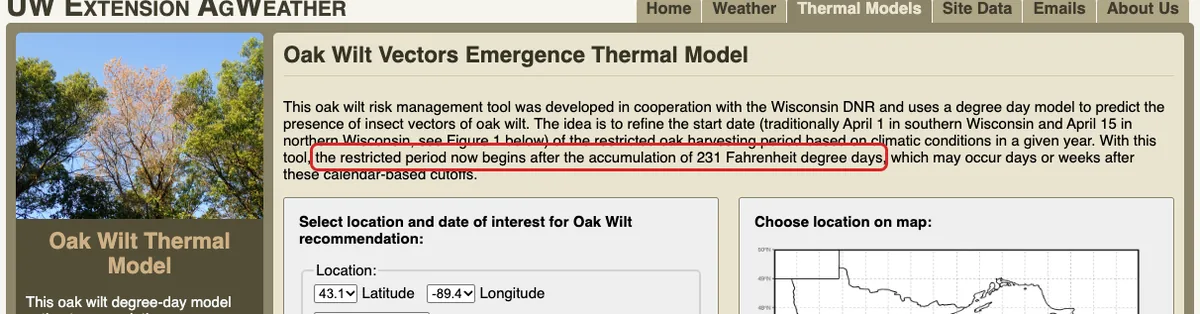
That 231 figure is now a live tool. The University of Wisconsin’s oak wilt thermal model starts the restricted period once 231 Fahrenheit degree-days build up at your location, “which may occur days or weeks after” the calendar start of April 1 in southern Wisconsin and April 15 in the north (UW Extension AgWeather). Its recommendations are approved for Wisconsin, Minnesota and Iowa, and UMN Extension points owners to it.
The same data explain the summer question. In 2016, 98 percent of C. truncatus were caught from April 1 to July 15, yet across the study 26.7 percent of the 1,588 C. sayi trapped in southern Wisconsin flew after the July 15 no-cut cutoff (Jagemann et al. 2018). Earlier Minnesota work cited there found that beetles visiting fresh oak wounds from early July to mid-October were mostly 3 other species, and only 2 of 387 of those carried viable fungus. Late-summer pruning is low risk, not no risk, which is why Ohio’s and Wisconsin’s cautious versions run to Oct. 1.
A warm week in January does not reopen the window. Michigan Technological University researchers told a Michigan NotMISpecies webinar that sap beetles become interested in oak sap “just after buds begin to open”, and that overland spread is “unlikely to occur during winter months” even though winter weather is sometimes warm (Michigan DNR, Nov. 2024). Oaks also stop being an easy target after a few days: Wisconsin DNR says wounds are not susceptible after 72 hours, and Ohio State says beetles find wounds attractive for up to 3 days (Ohioline PLPATH-TREE-02).
Red oak or white oak: how much is at stake?
All oaks can get oak wilt, but how fast it kills depends on the group. Red oaks have pointed leaf lobes; white oaks have rounded ones (Michigan DNR). Oaks are the second most common trees in U.S. forests, about 38.8 billion of them, according to our count of the most common tree species, so most yards in oak wilt states have at least one.
| Oak group and examples | Susceptibility | Time from symptoms or infection to death | What it means for pruning |
|---|---|---|---|
| Red oak group: northern red, northern pin, black, pin oak | Highly susceptible | As little as 4 weeks after branch infection (UMN); about 2 months (Minnesota DNR); 4 to 6 weeks in Texas (TFS flyer) | Avoid every listed window; red oaks also grow the spore mats that start new infections |
| White oak group: white, bur, swamp white, chinkapin | Less susceptible | Bur oak 1 to 7 years, white oak 1 to over 20 years (Minnesota DNR); some recover (Wisconsin DNR) | Same windows; slower death still ends in loss and root-graft spread |
| Texas live oak | Intermediate | Defoliate and die in 3 to 6 months (TFS flyer) | Paint every wound year-round; the fungus can move through roots as fast as 75 feet a year |
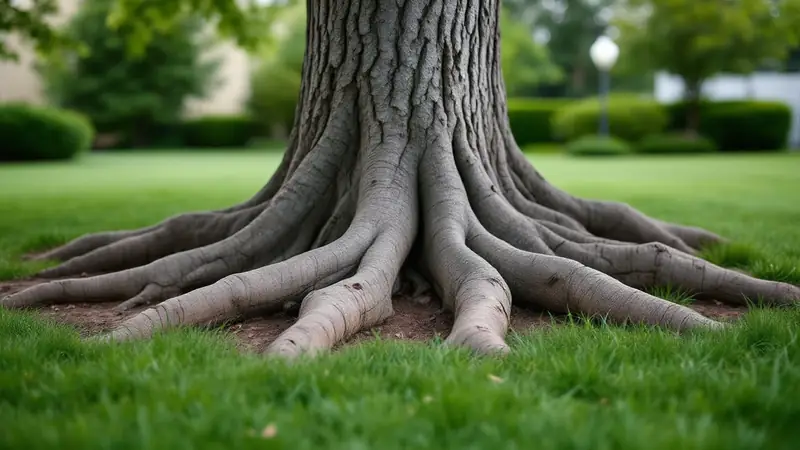
Root grafts are why one cut can cost a neighborhood. Ohio State estimates 90 percent of new infections pass between neighbors through grafted roots (Ohioline PLPATH-TREE-02), mostly within 30 feet in a Twin Cities study (UMN Extension). Cut roots count as wounds: Wisconsin DNR says to cut torn oak roots clean, paint them and cover them with soil in the risk season, so plan any cutting of tree roots that surface in a lawn under an oak for winter.
What to do when an oak can’t wait: paint within minutes
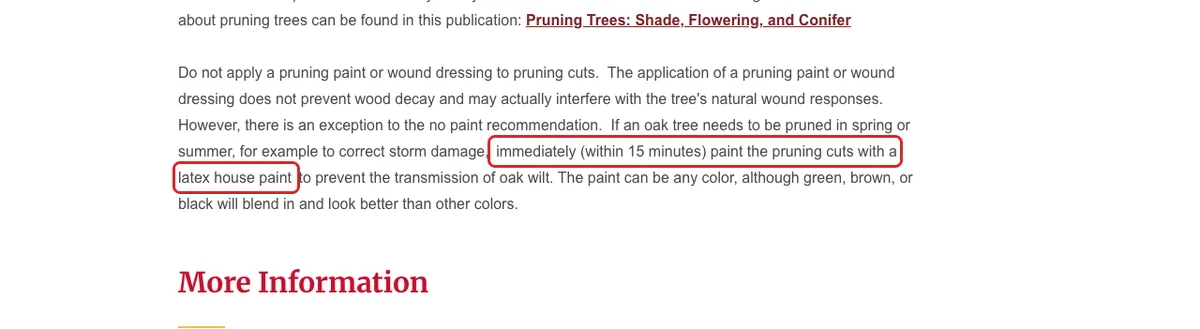
Wound paint is normally wasted effort. ISA says research shows dressings “do not reduce decay or speed up wound closure” (ISA, Pruning Mature Trees), and Iowa State warns paint can interfere with the tree’s own wound response. Oaks in the risk season are the one exception every agency in our table makes, because the paint is not treating the wound; it is hiding the sap from beetles.
- Cut only what is broken, hanging or dangerous. Texas A&M Forest Service says spring oak pruning “should only be considered if there are immediate safety concerns” (TFS, March 2021).
- Have the paint open before the saw starts. Any color works; Iowa State suggests green, brown or black so it blends in (Iowa State).
- Make the final cut just outside the branch collar. On limbs over 1.5 inches, Iowa State’s 3-cut method: undercut one-third through at 6 to 12 inches out, top cut 1 to 2 inches beyond it, then remove the stub.
- Coat every cut surface within 15 minutes (Iowa State, Wisconsin DNR); Lakeway’s ordinance allows 10. Paint the stump too if a whole oak comes down (USDA Forest Service).
- Clean tools before moving to the next oak. Illinois Extension’s method: rubbing alcohol left on for about 1 minute, or a 1 part bleach to 9 parts water dip (Illinois Extension).
| What to apply | How fast | Source |
|---|---|---|
| Latex house paint | Within 15 minutes | Iowa State Extension |
| Latex-based paint or shellac | Immediately | UMN Extension |
| Tree wound paint or latex-based paint | Immediately | Michigan DNR |
| Pruning sealer, tree paint or wound dressing | Within 15 minutes if possible; wounds safe after 72 hours | Wisconsin DNR |
| Water-based spray paint or wound dressing | Immediately | NYS DEC |
| Any type of paint | Immediately, every oak wound, every month | Texas A&M Forest Service |
| Pruning seal (required by ordinance) | Within 10 minutes | City of Lakeway, Texas |
| Treatment of certain wounds (required by ordinance) | Immediately, no later than 24 hours | City of Ann Arbor ORD 26-22 |
Storm damage on an oak
Wisconsin DNR says storm-broken branches expose living tissue exactly like a pruning cut. Paint the torn surface right away, then square up ragged stubs and paint those cuts too. After the 2021 ice storm, Texas A&M Forest Service said wounds already days old “are no longer fresh and do not need to be painted”, but new cleanup cuts must be painted immediately (TFS, March 2021). If the oak is on a house or a line, see our guide to emergency tree removal after a storm.
How much of an oak tree can you trim at once?
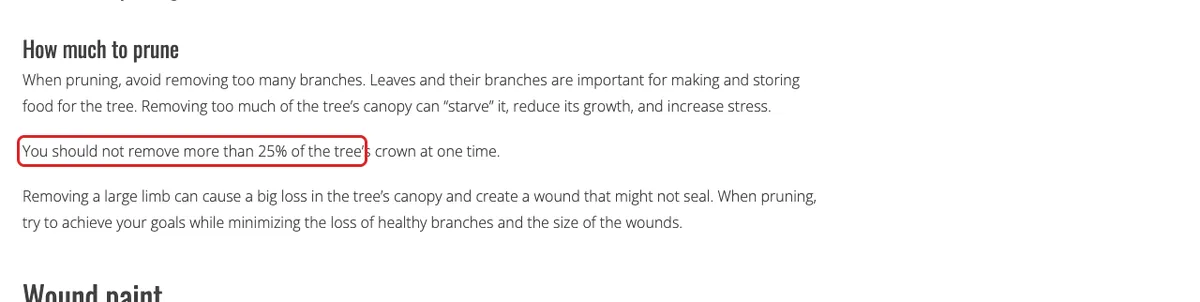
Less than most quotes propose. Texas A&M Forest Service and ISA both cap a single pruning at 25 percent of the crown, and ISA says less on mature trees (TFS, Pruning Mature Trees; ISA). For shortening a limb rather than removing it, TFS says to cut back to a side branch at least one-third the diameter of the limb removed. A quote that names the ANSI A300 objective and the percentage of crown, as described in our explainer on what an ISA Certified Arborist and ANSI A300 cover, can be checked after the crew leaves.
Dead branches are a partial exception. TFS says dead or weak branches can come off any time of year, yet still says not to prune oaks from February through June (TFS), because the cut at a dead limb’s collar can expose living tissue. On oaks, take dead wood in winter or paint the cut. Unsure whether the whole tree is gone? Run the scratch and bud tests in how to tell if a tree is dead.
When to prune oaks where oak wilt is not a problem
Oak wilt is a disease of the Midwest, the Northeast and Texas (Ohioline; Jagemann et al. 2018), and California’s extension advice on oak pruning turns on other fungi. UC Marin Master Gardeners say to prune evergreen oaks such as coast live oak “only during dry weather when open cut wounds are less susceptible to infection” and deciduous oaks when dormant in winter (UC Marin Master Gardeners). UC’s oak program answers an Orange County question the same way: prune coast live oak in summer after new foliage has matured if powdery mildew or cankers are a problem (UC Oaks FAQ).
Elsewhere, treat winter as the default even without a recorded case: NYS DEC confirmed oak wilt in the Town of Greece, Monroe County, in July 2026 (NYS DEC), and ISA says growth and wound closure are maximized by pruning before the spring flush. Other trees run on other calendars; see when to prune crape myrtles.
This page is general information. City ordinances such as Lakeway’s and Ann Arbor’s carry penalties and permit rules; confirm the current dates with your city forester or state forestry agency before you prune or hire.
How we compiled this
We read the oak wilt pages of 10 state forestry agencies and extension services, 2 city ordinance pages and the USDA Forest Service guide NA-FR-01-11, and recorded each date range as written, in November 2026. Beetle flight figures come from the peer-reviewed Wisconsin trapping study (Jagemann et al. 2018, Table 4); we converted its Celsius degree-days to Fahrenheit. We did no field work. Where a page was undated or older than 2024, the table says so.
Frequently asked questions
What is the best month to trim an oak tree?
In most oak wilt states, December, January or February. Iowa State names December through February, Illinois Extension November through February and Penn State December through March. In Texas, Lakeway’s city forester lists November, December and early January as safest, with July and August second (City of Lakeway).
What months should you not trim oak trees?
April through July in Minnesota and Wisconsin, April 15 to July 15 in Michigan, mid-March through June in Missouri and Feb. 1 to June 30 in Texas. New York’s DEC says March through September. Check your state’s row in the table above, then your city.
Can you kill an oak tree by trimming it?
Yes, indirectly. A spring cut can let sap beetles bring in oak wilt, and a red oak infected through a branch can wilt and die in as little as 4 weeks (UMN Extension). Removing more than 25 percent of the crown at once also stresses the tree (TFS).
Should I cut the lower branches of an oak tree?
Only for a reason, such as clearance over a walk, drive or roof. ISA calls this crown raising and caps any one pruning at 25 percent of the crown, less on mature trees (ISA). On an oak, schedule it for winter, and cut just outside the branch collar.
Can a tree recover from oak wilt?
Red oaks do not; once crown wilt is extensive the tree will die (Missouri Department of Conservation). White and bur oaks can live for years and sometimes recover (Wisconsin DNR). Diagnosis needs a lab; an arborist can inject propiconazole to protect high-value oaks nearby (TFS flyer).
Sources
- Texas A&M Forest Service / Texas Oak Wilt Partnership, Oak Wilt in Texas (flyer, pruning calendar), county map as of Dec. 2022. Accessed November 2026.
- Texas A&M Forest Service, Pruning Mature Trees, undated web page. Accessed November 2026.
- Texas A&M Forest Service, Prevent the spread of oak wilt in Texas this spring, March 10, 2021. Accessed November 2026.
- City of Lakeway, Texas, Oak Pruning Schedule, web page, current Nov. 2026. Accessed November 2026.
- Missouri Department of Conservation, Oak Wilt, web page. Accessed November 2026.
- Ohio State University Extension (Bonello), Oak Wilt, Ohioline PLPATH-TREE-02, fact sheet, undated. Accessed November 2026.
- Penn State Extension (Kinley), Prune Oaks in Winter to Avoid Oak Wilt Disease, updated Oct. 27, 2025. Accessed November 2026.
- Illinois Extension (Hayek), Best Time of Year to Prune Oak Trees?, Ask Extension, forum answer, undated. Accessed November 2026.
- Iowa State University Extension and Outreach (Jauron), Pruning Oak Trees to Avoid Oak Wilt, last reviewed Jan. 2023. Accessed November 2026.
- Michigan Invasive Species Program / Michigan DNR, Protect your oak trees; prune before spring, Nov. 13, 2024. Accessed November 2026.
- City of Ann Arbor Forestry, Oak trees and oak wilt (ORD 26-22), ordinance adopted July 2026. Accessed November 2026.
- Wisconsin DNR, Help Protect Oak Trees From Oak Wilt: Hold Off On Pruning Until After July, March 30, 2022. Accessed November 2026.
- Wisconsin DNR, Oak Wilt, web page, current Nov. 2026. Accessed November 2026.
- University of Wisconsin Extension AgWeather, Oak Wilt Thermal Model, web tool, current Nov. 2026. Accessed November 2026.
- University of Minnesota Extension (Sagor, Juzwik, Schwingle, Russell), Oak wilt in Minnesota, reviewed 2026. Accessed November 2026.
- Minnesota DNR, Oak wilt, web page (archived Aug. 2026). Accessed November 2026.
- New York State DEC, Oak Wilt, web page (archived Oct. 2026). Accessed November 2026.
- USDA Forest Service (O’Brien, Mielke, Starkey, Juzwik), How To Identify, Prevent, and Control Oak Wilt, NA-FR-01-11, 2011. Accessed November 2026.
- Jagemann, Juzwik, Tobin and Raffa, Seasonal and Regional Distributions, Degree-Day Models, and Phoresy Rates of the Major Sap Beetle Vectors of the Oak Wilt Fungus in Wisconsin, Environmental Entomology 47(5):1152, 2018. Accessed November 2026.
- International Society of Arboriculture, Pruning Mature Trees (TreesAreGood brochure), undated. Accessed November 2026.
- UC Marin Master Gardeners, Under Oaks, web page. Accessed November 2026.
- University of California Oak Woodland Conservation Workgroup, UC Oaks FAQ, web page. Accessed November 2026.