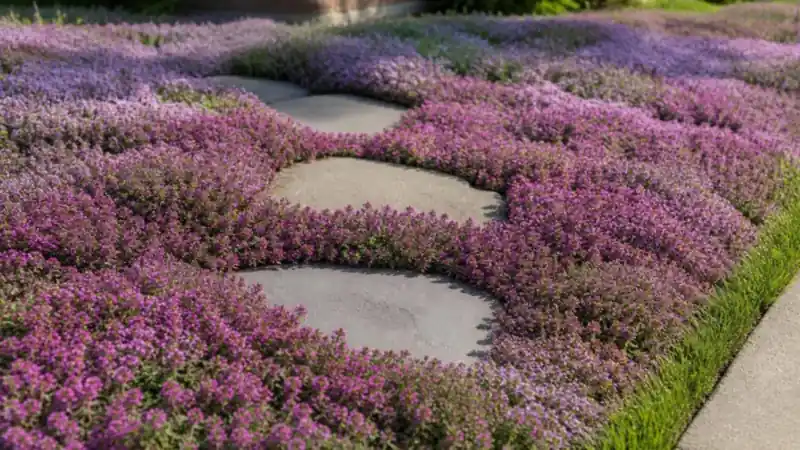
A creeping thyme lawn suits small, sunny, well-drained yards with light foot traffic: set 1 to 4 plugs per square foot, allow one to several seasons to fill, and expect a third or less of a grass lawn’s water.
Key takeaways
- The U.S. Thymus serpyllum is a naming muddle: USDA PLANTS treats the name as misapplied and files the plant under Thymus praecox ssp. arcticus, an introduced species with no noxious-weed listing (USDA PLANTS, THSE), and the red Coccineus Group is sold under both names (Missouri Botanical Garden).
- Aaron Steil, answering an Iowa homeowner on Ask Extension, sets plugs on 8 to 18 inch centers and says the whole planting will likely take several years to fill (Ask Extension #757912); Richters, an herb nursery, recommends 6-inch centers, 4 plants per sq ft, to close gaps in the first year (Richters).
- Draper City’s conservation garden in Utah rates red creeping thyme Low, 1/2 inch of water every 10 to 14 days once established (Draper City); Purdue Extension says most lawns need 1 to 1 1/2 inches a week (Purdue AY-7). Per 1,000 sq ft that is about 156 to 218 gallons a week against 623 to 935.
- At 12-inch spacing a 500 sq ft thyme lawn takes 500 plants: $360 to $500 as unrooted cuttings, $585 to $860 from 128-cell plug trays and $2,975 to $4,995 in 2.5 to 3 inch pots at October 2026 prices (thyme lawn data).
- University of Minnesota researchers collected 3,507 bees on Minneapolis park lawns over three years and found 60 species on lawns seeded with clover, self-heal and creeping thyme (UMN Turfgrass Science). UMN Extension has since dropped thyme from its bee lawn mix (UMN Extension).
- We found no published trial measuring how much trampling a thyme lawn takes. In the one thyme trampling experiment located, on a Chinese species, light trampling recovered in 4 to 7 days and severe trampling did not recover within a year (Wang et al., Pratacultural Science, 2014).
| Creeping thyme number | Value | Source |
|---|---|---|
| Mat height | 1/2 inch (woolly thyme) to 3 inches (T. serpyllum) | Missouri Botanical Garden |
| Hardiness | Zones 4 to 8 (MoBot); 4a to 9b for T. serpyllum (NC State) | NC State Plant Toolbox |
| Sun | Full sun, 6 or more hours of direct light | NC State Plant Toolbox |
| Spacing | 6 to 18 inches; 4 plants per sq ft at 6 in, 1 at 12 in | Illinois Extension; Ask Extension (Iowa); Richters |
| Water once established | 1/2 inch every 10 to 14 days | Draper City conservation garden |
| Grass lawn, for comparison | 1 to 1 1/2 inches a week | Purdue AY-7 |
| Plant prices | $0.72 (unrooted cutting) to $18.99 (quart pot) | Seller pages, Oct. 30, 2026 |
| Seed rates printed by sellers | 25 to 288 seeds per sq ft | Eartheasy, Outsidepride, Eden Brothers |
| Bee species on UMN thyme, clover and self-heal lawns | 60 | UMN Turfgrass Science |
What is a creeping thyme lawn, and which thyme should you plant?
A creeping thyme lawn is a mat of low, woody-based thymes planted in place of turf. The plants sold for it, Thymus serpyllum, T. praecox and the red Coccineus Group, form mats 1/2 to 3 inches tall and need no regular mowing, according to the Missouri Botanical Garden. None is native: USDA PLANTS lists the U.S. creeping thyme as introduced in the lower 48 states.
The names on nursery tags are a tangle. USDA PLANTS treats the plant Americans call Thymus serpyllum as a misapplied name for Thymus praecox ssp. arcticus (USDA PLANTS). The Missouri Botanical Garden says the Coccineus Group, sold as red creeping thyme, is often listed as a cultivar of T. praecox or T. praecox subsp. arcticus (MoBot, Coccineus Group), and that the tiny ‘Minus’ is sold under at least five names (MoBot, Minus). Buy by cultivar name, height and photo, not by species label.
Height and speed decide which one fits. NC State rates the T. serpyllum species as rapid-growing at 2 to 3 inches (NC State), ‘Elfin’ as slow at 1 to 3 inches (NC State, Elfin), and woolly thyme as medium; the Missouri Botanical Garden puts woolly thyme at often no more than 1/2 inch with sparse pale pink bloom (MoBot, woolly thyme). For flowers, the Coccineus Group blooms deep pink from June to August.
| Plant (as sold) | Botanical name used by the source | Height | Spread | Zones | Bloom | Foot traffic listed | Source |
|---|---|---|---|---|---|---|---|
| Creeping thyme, mother of thyme | Thymus serpyllum (USDA: T. praecox ssp. arcticus) | 2 to 3 in | 12 to 18 in | 4 to 8 (MoBot); 4a to 9b (NC State) | Deep pink, June to July | Not listed | MoBot; NC State |
| Red creeping thyme | Thymus Coccineus Group, sold as T. praecox ‘Coccineus’ | 2 to 3 in | To 12 in | 5 to 8 | Deep pink, June to August | Not listed | MoBot |
| ‘Elfin’ | Thymus serpyllum ‘Elfin’ | 1 to 3 in | 12 to 18 in | 4 to 8 | Lavender pink, June to July | Yes; growth slow | NC State; MoBot |
| Woolly thyme | Thymus pseudolanuginosus | Often 1/2 in or less | To 12 in | 5 to 8; not reliably hardy throughout zone 5 | Pale pink, sparse, June to July | Yes | MoBot; NC State |
| ‘Pink Chintz’ | Thymus serpyllum ‘Pink Chintz’ | About 3 in | To 12 in | 5 to 8 | Salmon pink, June to July | Not listed | MoBot |
| Mother of thyme species | Thymus praecox | 2 to 6 in (MoBot); 3 to 6 in (NC State) | 3 to 12 in | 5 to 8 | Whitish to rose purple, June to September | Yes, “moderate” | NC State; MoBot |
| Miniature thyme | Thymus praecox ‘Minus’ | 1 to 2 in | 3 to 6 in | 4 to 8 | Lilac pink, June to July | Not listed | MoBot |
Mixing types needs a plan. Richters warns that aggressive creeping thyme will crowd out slower ones such as lemon carpet thyme, so it separates varieties with plant-free paths (Richters Q&A). High Country Gardens says its red mother-of-thyme is not as xeric as other thymes and needs regular moisture (High Country Gardens).
Can you walk on a creeping thyme lawn?
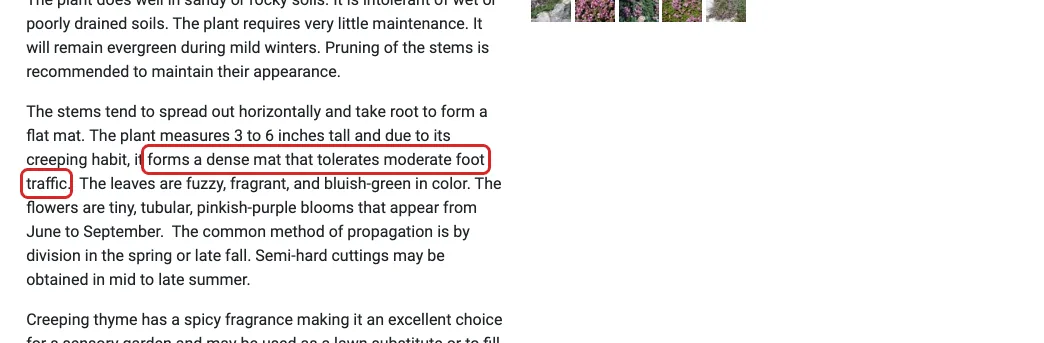
Yes, lightly. NC State lists foot traffic among the challenges Thymus praecox, ‘Elfin’ and woolly thyme resist, and calls T. praecox a mat that tolerates moderate foot traffic. We found no published trial counting how many passes a thyme lawn survives, so treat daily routes, play areas and dog runs as places for stepping stones or turf.
The closest measured evidence is on a different species. Wang and colleagues ran a trampling device over Thymus mandschuricus plots introduced by Northeast Forestry University in China: lightly trampled plots matched untrampled ones and recovered within 4 to 7 days, moderate trampling took 30 days, and severely trampled branches did not recover within one year (Pratacultural Science, 2014, DOI 10.11829/j.issn.1001-0629.2014-0106). The species differs from the lawn thymes sold in the U.S., so the numbers show the pattern, not a rating.
Sellers and extension services agree on the limit. High Country Gardens says thyme lawns tolerate some foot traffic but are not suitable for a kids’ play area, and are best on areas up to a few hundred square feet. The University of Minnesota notes that few plants besides turfgrass tolerate being mowed short and stepped on, and that where heavy traffic has compacted soil so grass will not grow, bee lawn flowers probably will not either unless the compaction is fixed and the traffic controlled (UMN Extension).
| Common claim in lawn-alternative articles | What first-hand sources publish | Source |
|---|---|---|
| Bounces back after kids play on it | Tolerates some foot traffic; not suitable for a kids’ play area | High Country Gardens planting guide |
| Fills in within a season | 8 to 18 inch centers will likely take several years to fill | Ask Extension, Iowa answer |
| Needs much less water than grass | Low, 1/2 in every 10 to 14 days, vs 1 to 1 1/2 in a week for lawns | Draper City; Purdue AY-7 |
| Ideal for a bee lawn | No longer recommended in UMN bee lawn mixes after long-term observations | UMN Extension |
| Red creeping thyme is Thymus serpyllum | Coccineus Group, often sold as T. praecox; USDA files U.S. T. serpyllum under T. praecox ssp. arcticus | MoBot; USDA |
| Smothers weeds on its own | Aggressive types soon need only minimal weeding; slower growers need weeding much longer | Richters |
How much water does a creeping thyme lawn need compared with grass?
Once rooted, a third or less of what a grass lawn takes. Draper City’s conservation garden in Utah rates red creeping thyme Low, 1/2 inch every 10 to 14 days, while Purdue Extension says most lawns need 1 to 1 1/2 inches a week. Per 1,000 sq ft that is roughly 156 to 218 gallons a week for thyme against 623 to 935 for grass.
| Planting | Rating or guidance | Inches per week | Gallons per 1,000 sq ft per week | Source |
|---|---|---|---|---|
| Red creeping thyme, 1/2 in every 14 days | Low | 0.25 | 156 | Draper City |
| Red creeping thyme, 1/2 in every 10 days | Low | 0.35 | 218 | Draper City |
| Grass lawn, low end | 1 in a week | 1.0 | 623 | Purdue AY-7 |
| Grass lawn, high end | 1 1/2 in a week | 1.5 | 935 | Purdue AY-7 |
Salt Lake City Public Utilities puts a typical Kentucky bluegrass lawn at 24 to 30 inches of water over the growing season (Salt Lake City Public Utilities). Those figures come from a dry Utah climate; where summer rain is regular, the gap between thyme and grass shrinks because rain covers more of both.
New plantings need more. High Country Gardens tells buyers to give a thyme lawn a good soaking once or twice a week for the first two to three weeks, then once every 7 to 10 days. Too much water is the larger risk: NC State says creeping thyme rots if overwatered or in poorly drained soil (NC State). Our guide to the best time to water a lawn covers timing; a thyme planting on drip irrigation needs an emitter at each plant, as a Colorado Master Gardener answer notes (Ask Extension #552876).
How many creeping thyme plugs do you need, and how far apart?
Plant 6 to 12 inches apart for a lawn: that is 4 plants per square foot at 6 inches and 1 at 12 inches on a square grid. Illinois Extension says 8 to 12 inches, an Iowa Ask Extension answer 8 to 18, and Richters 6 inches to close the gaps in the first year. Wider spacing saves plants and adds a season or more of weeding.
| Spacing (on center) | Plants per sq ft | Per 100 sq ft | Per 500 sq ft | Per 1,000 sq ft | Who recommends it |
|---|---|---|---|---|---|
| 6 in | 4.00 | 400 | 2,000 | 4,000 | Richters; Johnny’s (6 to 8 in) |
| 8 in | 2.25 | 225 | 1,125 | 2,250 | Illinois Extension (8 to 12 in); Iowa Ask Extension answer (8 to 18 in) |
| 9 in | 1.78 | 178 | 889 | 1,778 | Illinois Extension range |
| 10 in | 1.44 | 144 | 720 | 1,440 | Illinois Extension range |
| 12 in | 1.00 | 100 | 500 | 1,000 | Illinois Extension; High Country Gardens (12 to 15 in) |
| 15 in | 0.64 | 64 | 320 | 640 | High Country Gardens |
| 18 in | 0.44 | 44 | 222 | 444 | Ask Extension (Iowa); Mountain Valley Growers (12 to 18 in) |
Richters works the same arithmetic for a buyer’s 200 sq ft slope: 1,800 plants at 10 cm (about 4 inches), 800 at 15 cm and 450 at 20 cm (Richters Q&A). Its reason for 6-inch centers in a woolly thyme lawn is labor: wider gaps make the weeding between plugs too much (Richters, woolly thyme lawn).
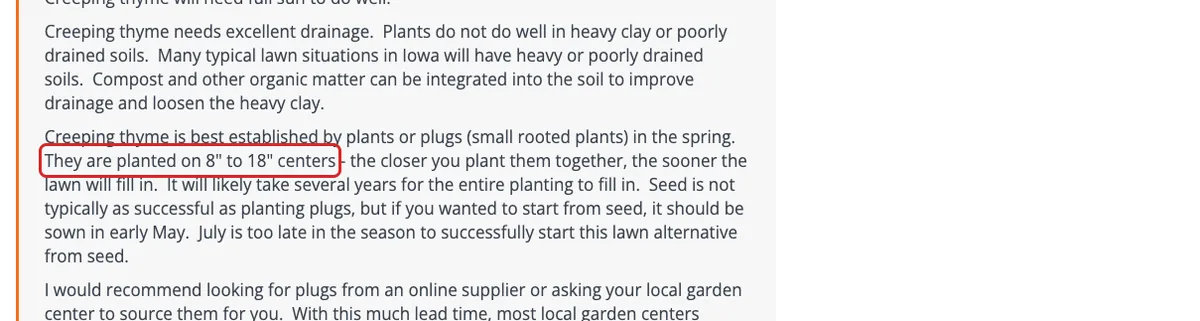
Fill-in time follows spacing. The Ask Extension answer for Black Hawk County, Iowa, puts plugs on 8 to 18 inch centers and expects several years to full cover; a Colorado Master Gardener gives 8 inches for quick cover and 18 for slower, cheaper cover (Ask Extension #552876). Mountain Valley Growers spaces flagstone-filler thymes 4 to 6 inches apart and larger ground-cover thymes 12 to 18 (Mountain Valley Growers).
| How it was planted | Spacing | Fill-in time stated | Source |
|---|---|---|---|
| Plugs | 6 in centers | Grown in after the first year | Richters |
| Plugs or small plants | 8 to 18 in centers | Likely several years | Ask Extension, Iowa answer |
| 2.5 in pots | 12 to 15 in grid | 4 to 5 months (seller claim) | High Country Gardens |
| Unrooted cuttings, 40 to 50 per flat | Not printed | 1 to 2 seasons (seller claim) | Plants Express |
| Seed | Overseeded at 25 seeds per sq ft | 2 to 3 years to full size; blooms in year 2 | Eartheasy |
Should you start a thyme lawn from seed or plugs?
Plugs, for most yards. An Iowa Ask Extension answer says seed is not typically as successful as plugs and should go down in early May, with July too late. Thyme seed needs light to germinate, takes 14 to 21 days at 65 to 70°F per Johnny’s Selected Seeds, and Eartheasy expects only about half of it to sprout in year one.
| Seller and species as listed | Seeds per oz | Printed rate | Seeds per sq ft (our math) | Price checked Oct. 30, 2026 |
|---|---|---|---|---|
| Outsidepride, Thymus serpyllum | About 169,000 (2.7 million per lb) | 1/8 lb per 5,000 sq ft | 67 | $24.99 per oz |
| Outsidepride, wild thyme (T. pulegioides) | About 169,000 | 1/8 lb per 5,000 sq ft | 67 | $14.99 per oz |
| Eartheasy seed pouch, T. serpyllum | Not printed | 25,000 seeds per 1,000 sq ft (overseeding); 2 to 5 times that on bare soil | 25 (50 to 125 bare) | $47.99 per 1,000 sq ft pouch |
| Eden Brothers, T. serpyllum | 180,000 | 1 oz covers up to 625 sq ft | 288 | $49.99 per oz |
| Johnny’s Selected Seeds, T. serpyllum | 210,000 | Transplants 6 to 8 in apart | n/a | $49.70 per oz (backordered) |
Johnny’s recommends starting thyme indoors 8 to 10 weeks before the last frost and transplanting (Johnny’s). University of Minnesota Extension calls creeping thyme trickier to establish from seed and notes plugs can be hard to find and only suit small sites because of cost (UMN Extension). At the Outsidepride rate, 500 sq ft takes 0.2 oz, so 1 oz of seed at $14.99 to $24.99 covers it.
How much does a creeping thyme lawn cost?
Plants alone run $0.72 to $18.99 each at October 2026 prices, so cost per square foot equals the plant price at 12-inch spacing and four times it at 6 inches. A 500 sq ft lawn at 12 inches costs $360 to $860 in cuttings or plug trays, $2,975 to $4,995 in small pots, before soil prep and labor.
| Seller | Product as listed | Size | Price | Per plant | Status Oct. 30, 2026 |
|---|---|---|---|---|---|
| Plants Express | Creeping Thyme, T. serpyllum (T. praecox arcticus) | Ground-cover flat, 40 to 50 unrooted cuttings | $39.95 per flat; 4 flats $143.84 | $0.72 to $1.00 | Listed; California truck delivery only |
| Mountain Valley Growers | Woolly, Hall’s Woolly; Pink Chintz, Elfin | 128-cell plug tray | $150 (woolly); $220 (Pink Chintz, Elfin) | $1.17 to $1.72 | Listed |
| Great Garden Plants | Red Creeping Thyme, T. praecox ‘Coccineus’ | 32 landscape plugs | $124.99 | $3.91 | Sold out |
| Mountain Valley Growers | Thymus, several | 3 in pot | $5.95 | $5.95 | Listed |
| American Meadows | Woolly Thyme, T. pseudolanuginosus | 3 in pot | $7.49 sale ($9.99 regular); 64 for $432.00 | $6.75 to $9.99 | Sold out for the season |
| High Country Gardens | Red Mother-of-Thyme, T. serpyllum ‘Coccineum’ | 2.5 in pot | $8.99; 64 for $518.40 | $8.10 to $8.99 | In stock, ships in fall |
| High Country Gardens | Elfin Creeping Thyme | 2.5 in pot | $9.99; 64 for $576.00 | $9.00 to $9.99 | Out of stock |
| Great Garden Plants | Red Creeping Thyme | Quart | $15.99 | $15.99 | Sold out |
| Garden Crossings | ‘Coccineus’ Red Creeping Thyme | Quart | $18.99 | $18.99 | Sold out |
- Plants needed
- 500
- 128-cell plug trays
- 4
Plants = area x plants per sq ft (144 / spacing squared, square grid; offset rows need about 15 percent more). Prices from seller pages checked Oct. 30, 2026. Default: 500 sq ft of plug trays at 12 inches = 500 plants, $585 to $860.
The worked example below prices 500 sq ft three ways. For scale, sodding the same area over an old lawn runs $825 to $1,125 by our sod installation cost estimate ($1.65 to $2.25 per sq ft), and installed artificial grass $2,700 to $4,900 ($5.40 to $9.80) per our artificial turf vs real grass analysis. Those include labor; the thyme figures are plants only.
| 500 sq ft, plants only | 6 in (2,000 plants) | 8 in (1,125 plants) | 12 in (500 plants) |
|---|---|---|---|
| Unrooted cuttings, $0.72 to $1.00 | $1,440 to $2,000 | $810 to $1,125 | $360 to $500 |
| 128-cell plug trays, $1.17 to $1.72 | $2,340 to $3,440 | $1,316 to $1,935 | $585 to $860 |
| 32-plug packs, $3.91 | $7,820 | $4,399 | $1,955 |
| 2.5 to 3 in pots, $5.95 to $9.99 | $11,900 to $19,980 | $6,694 to $11,239 | $2,975 to $4,995 |
| Quart pots, $15.99 to $18.99 | $31,980 to $37,980 | $17,989 to $21,364 | $7,995 to $9,495 |
| Seed instead, 1 oz at $14.99 to $24.99 | n/a | n/a | $14.99 to $24.99 (0.2 oz needed) |
Prep adds to every option. High Country Gardens calls for 1/2 to 1 cubic yard of compost per 100 sq ft, which is 2.5 to 5 cubic yards for 500 sq ft, and a sod cutter or a month under clear plastic to clear the grass first. Converting one area at a time, as UMN Extension suggests, keeps the bill down: a 200 sq ft strip at 12-inch spacing in 3-inch pots costs $1,190 to $1,998.
How do you replace a grass lawn with creeping thyme?
Kill or strip every bit of turf, loosen and amend the soil for drainage, plant plugs in spring at 6 to 12 inches, water twice a week for two to three weeks, then mulch and hand-weed the gaps until the mat closes. A Colorado Master Gardener answer is blunt on step one: Kentucky bluegrass left in place will spread by rhizomes and take over the thyme.
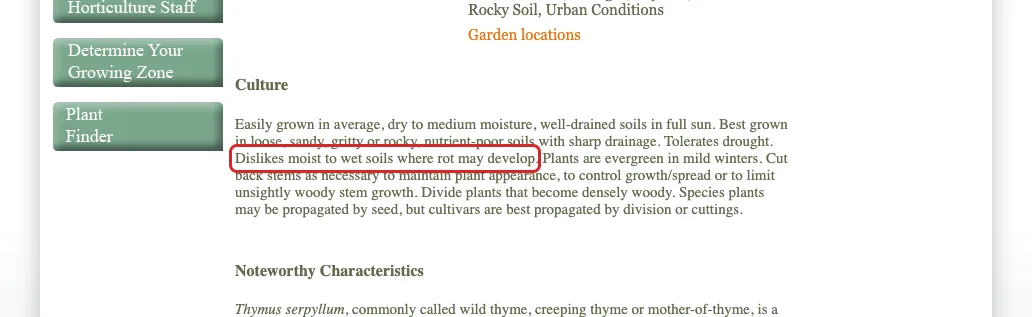
- Check sun and drainage. NC State lists full sun, 6 or more hours of direct light, for T. serpyllum and T. praecox; ‘Elfin’ is also listed for 2 to 6 hours. Eartheasy’s rule of thumb: if the ground stays wet more than 24 hours after rain, thyme will not grow well there. A soil test gives pH; NC State lists T. serpyllum for neutral to alkaline soil, pH 6.0 and up.
- Remove the grass. UMN Extension gives three ways: clear plastic for about a month in July and August heat, a sod cutter at any time in the growing season, or an herbicide, which works best between 65 and 85°F (UMN Extension). Richters adds that thyme will not displace grass on its own.
- Loosen and amend. Spread 1/2 to 1 cubic yard of compost per 100 sq ft (High Country Gardens), about 1.6 to 3.2 inches deep. On heavy clay, the Iowa Ask Extension answer says thyme does poorly unless compost and organic matter loosen it; our guide on improving clay soil has the rates.
- Plant in spring. Set plugs at the spacing from the table above, in offset rows, with the root ball level with the soil; Richters cuts a hole for a 1-inch root ball. The Iowa Ask Extension answer names spring as the time for plugs and early May for seed.
- Water in, then taper. Soak once or twice a week for the first two to three weeks, then every 7 to 10 days (High Country Gardens), moving to 1/2 inch every 10 to 14 days once established (Draper City).
- Mulch the gaps and edge the bed. A Colorado Master Gardener notes wood mulch will tie up nitrogen as it breaks down and gravel adds heat (Ask Extension #552876); UMN suggests sidewalks or edging to keep creeping plants out of the neighbor’s lawn.
How do you keep weeds out while thyme fills in?
Mostly by hand. Thyme is a broadleaf in the mint family, so broadleaf lawn herbicides would injure it, and none of the eight EPA-accepted ornamental herbicide labels we checked in October 2026 lists thyme as a tolerant plant. Close spacing, mulch between plugs and weekly pulling carry a thyme lawn through its first one to three seasons.
Richters’ case for 6-inch spacing is weeding labor: aggressive thymes close the gaps and soon need only minimal weeding, while slower growers need weeding much longer (Richters). Pull weeds while small, keep fine mulch or gravel between plugs, and water the plugs rather than the gaps. Our lawn weed killer guide explains why selective broadleaf products cannot tell thyme from clover.
| Product and active ingredient | EPA Reg. No. | What the label says about thyme or ground covers | Label |
|---|---|---|---|
| Fusilade II Turf and Ornamental (fluazifop-P-butyl 24.5%) | 100-1084 | Grass killer for ground covers; thyme not in its plant-safety tables; for unlisted plants “the user should determine” safety before use | Label, July 2026 |
| Ortho Grass-B-Gon Garden Grass Killer (fluazifop-P-butyl 0.48%) | 239-2620 | Thyme not on the tolerant ground-cover list; spray the weed grass directly and wash off an unlisted plant if contacted | Label, Oct. 2024 |
| Envoy Plus master label (clethodim 12.6%) | 59639-132 | Thyme appears only as a food-crop herb (Subgroup 19A) with a small-area test; not on the ornamental ground-cover list | Label, April 2026 |
| Preen Garden Weed Preventer (trifluralin 1.47%) | 961-280 | Thyme not listed; “Do not use with crops other than those listed”; not for use on flower seeds | Label, June 2026 |
| Snapshot 2.5 TG (trifluralin 2%, isoxaben 0.5%) | 62719-175 | Thyme not listed; no application to ground covers until established and well rooted; unlisted species tested on a few plants for 30 to 60 days | Label, Aug. 2023 |
| Gallery 75 Dry Flowable (isoxaben 75%) | 62719-145 | Thyme not listed; same ground-cover and 30 to 60 day test language; use untreated fill when planting into ground treated in the past 8 months | Label, July 2023 |
| FreeHand 1.75G (dimethenamid-P 0.75%, pendimethalin 1%) | 7969-273 | Thyme not listed; injury observed on dead nettle and creeping phlox; user tests unlisted plants | Label, Jan. 2025 |
| Barricade 4FL (prodiamine 40.7%) | 100-1139 | Thyme not listed; treated areas go only to listed species for 1 year without a test strip | Label, Feb. 2024 |
Converting a treated lawn needs one more check. The Barricade 4FL label (prodiamine, EPA Reg. No. 100-1139), a common crabgrass preventer, says treated areas should be rotated only to listed ornamental species for 1 year unless test strips of wheat, sorghum or corn grow normally to 12 inches (EPA-accepted label, Feb. 2024). Thyme is not on that list, and preemergent labels such as Preen and Gallery stop seeds from sprouting, including thyme seed.
This page is general information, not pesticide or legal advice. Herbicide labels change; follow the current label on the container and your state’s pesticide rules.
Will a creeping thyme lawn bring bees, and will they sting?
It brings bees from June into late summer, bumble bees and wild bees rather than honey bees. University of Minnesota sampling found no honey bees on creeping thyme or self-heal, and UMN’s Kristine Moncada calls a sting from a bee lawn unlikely, though not impossible, in a 2024 article citing Extension entomologist Elaine Evans.
| University of Minnesota finding | Number | Source |
|---|---|---|
| Bees collected on Minneapolis park lawns, three-year survey from 2016 | 3,507 | UMN Turfgrass Science (Wolfin) |
| Bee species on clover-only lawns | 57 | UMN Turfgrass Science |
| Bee species on lawns seeded with clover, self-heal and creeping thyme | 60 | UMN Turfgrass Science |
| Bee species recorded in Minnesota | 508 | UMN Turfgrass Science, 2024 |
| Honey bees found on creeping thyme or self-heal | None (bumble bees present) | UMN Turfgrass Science, 2024 |
| Creeping thyme in UMN’s recommended bee lawn mix | No longer recommended | UMN Extension |
UMN Extension dropped thyme from its bee lawn seed rates, now 4 lb fine fescue, 1.1 oz Dutch white clover and 1.2 oz self-heal per 1,000 sq ft, citing long-term observations and seed supply. A June 2026 Ask Extension reply from Minnesota explains: over time creeping thyme gets very assertive, takes over most of the lawn, turns woody and stops blooming at mowed heights (Ask Extension #935650). Clover-based bee lawns are covered in our clover lawn pros and cons guide.

UMN’s sting advice is practical: keep pollinator plantings away from where an allergic family member gathers, do not walk barefoot during high bloom, and mow just before an outdoor event to cut the flower count for a while. The author reports two stings in 15 years, both from yellowjacket nests in garden beds, not bees on lawn flowers.
Do you mow a creeping thyme lawn, and how do you care for it?
A pure thyme lawn needs no regular mowing: the mats stay 1/2 to 3 inches tall, with flower stems rising 2 to 4 inches in summer. Trim the spent flower stems after bloom, cut back woody stems and divide densely woody plants, as the Missouri Botanical Garden advises, and skip lawn fertilizer.
- Trim after flowering. MoBot’s broad-leaved thyme entry says to trim immediately after flowering and warns that plants in rich soils turn leggy (MoBot, T. pulegioides).
- In a mixed bee lawn, mow at 3 inches or higher every 2 to 3 weeks and hold off while flowers are in full bloom (UMN Extension).
- Winter look: MoBot says the mats stay evergreen in mild winters; NC State calls T. serpyllum semi-evergreen. In dry, snowless winters a Colorado Master Gardener notes stems can desiccate and die back.
- Pests: NC State reports no serious problems but lists spider mites in hot, dry summers and slugs on T. praecox; root rot follows wet soil.
- Feeding: the Missouri Botanical Garden lists tolerance of poor soils and low fertility, and rich soil makes thyme leggy, so leave thyme out of the lawn fertilizer program.
Can your HOA stop you from planting a creeping thyme lawn?
In at least nine states, an HOA cannot flatly ban drought-tolerant or low-water landscaping: Texas, Florida, Maryland, Maine, Colorado, Utah, California, Nevada and Washington. Most still let the association review your plan and set design rules. None of the statutes names creeping thyme, so describe it in your application as a drought-tolerant, low-water ground cover.
| State and law | What the HOA cannot do | What it can still require | Statute |
|---|---|---|---|
| Texas, Prop. Code §202.007 | Prohibit or restrict drought-resistant landscaping or water-conserving natural turf | A plan for review; it may not unreasonably deny approval (one large-development carve-out) | Tex. Prop. Code 202.007 |
| Florida, Stat. §720.3075(4)(b) and §373.185(3)(b) | Prohibit Florida-friendly landscaping | Statute sets no approval process | Fla. Stat. 720.3075 |
| Maryland, Real Prop. §2-125 (HB 322, 2021) | Impose unreasonable limits on low-impact landscaping, including requiring turf grass | Reasonable design rules on type, number and location; owner must maintain it | Md. Real Prop. 2-125 |
| Maine, 33 M.R.S. §1451 (LD 649, 2023) | Impose unreasonable limits on low-impact landscaping in condominiums and commonly owned communities, including requiring turf grass | Reasonable design rules on type, number and location; owner must maintain it | 33 M.R.S. 1451 |
| Colorado, C.R.S. 38-33.3-106.5 (SB 23-178) | Prohibit drought-tolerant landscapes on single-family detached lots | Design rules, but must allow an option of at least 80 percent drought-tolerant plants and preapprove at least 3 water-wise front-yard designs | Colorado SB 23-178 |
| Utah, Code §57-8a-231 | Prohibit water wise landscaping on a detached lot, or require lawn in strips under 8 feet wide | Site plan review, healthy upkeep, water wise design rules | Utah Code 57-8a-231 |
| California, Civ. Code §4735 | Prohibit low water-using plants as a group or as a replacement of existing turf | Landscaping rules that conform to the statute | Cal. Civ. Code 4735 |
| Nevada, NRS 116.330 | Prohibit drought tolerant landscaping in a yard the owner uses exclusively | Architectural review; compatible with community style; no unreasonable denial | NRS 116.330 |
| Washington, RCW 64.38.057 | Prohibit drought resistant landscaping or pollinator habitat | Reasonable placement and appearance rules that do not make it unreasonably costly or infeasible | RCW 64.38.057 |
Two near misses: Minnesota’s 2023 law on managed natural landscapes, Minn. Stat. §412.925, binds cities, not HOAs (Minn. Stat. 412.925), and Arizona’s A.R.S. §33-1819 protects artificial turf, not living plants (A.R.S. 33-1819). Ask your HOA for its architectural review form and submit a plant list with heights, spacing and a maintenance plan.
This section is general information, not legal advice. Statutes and HOA documents change; confirm the current text and your association’s rules before you remove turf.
Is a creeping thyme lawn right for your yard?
It fits a sunny, dry, lightly used patch of a few hundred square feet where you will hand-weed for one to three seasons. It fails in shade under 6 hours of sun, on soil that stays wet a day after rain, under daily foot traffic and play, and as a flowering herb inside a mowed grass lawn. The table and flowchart below hold the same rules.
| If your situation is | Do this | Why (source) |
|---|---|---|
| Under 6 hours of direct sun | Skip thyme; keep turf or choose a shade ground cover | NC State lists full sun, 6+ hours |
| Water stands or soil stays wet 24 hours after rain | Fix drainage first or plant elsewhere | MoBot: rots in moist to wet soils; Eartheasy 24-hour rule |
| Heavy clay | Amend with compost first, or choose turf | Ask Extension, Iowa answer |
| Kids’ play area, dog run or daily path | Keep turf there; add stepping stones through thyme | High Country Gardens; UMN; NC State “moderate” |
| Zone 3 or colder, or zone 10 and warmer | Pick another ground cover | NC State 4a to 9b (T. serpyllum); MoBot 4 to 8 |
| You want a flowering lawn you still mow | Plant a clover and self-heal bee lawn instead | UMN no longer recommends thyme in bee lawns |
| Gaps between pavers or flagstone | Woolly thyme or ‘Elfin’ at 4 to 6 in | MoBot; Mountain Valley Growers |
| Sunny, sandy or gravelly, light traffic, under 500 sq ft | Plant plugs 6 to 12 in apart in spring | Illinois Extension; Richters; Ask Extension (Iowa) |
| HOA in TX, FL, MD, ME, CO, UT, CA, NV or WA | Submit a plan citing the state statute | State statutes above |
1Does the spot get less than 6 hours of direct sun?
YesSkip thyme; keep turf or choose a shade ground cover (NC State).
NoGo to the next question
2Does water stand, or the soil stay wet a day after rain?
YesFix drainage first or plant elsewhere; thyme rots in wet soil (MoBot).
NoGo to the next question
3Is it a play area, dog run or daily path?
YesKeep turf there, or lay stepping stones through the thyme (High Country Gardens; UMN).
NoGo to the next question
4Do you want a flowering lawn you will keep mowing?
YesPlant a clover and self-heal bee lawn; UMN no longer recommends thyme in them.
NoGo to the next question
5Is the area more than a few hundred square feet?
YesConvert one section at a time (UMN); plants cost $0.72 to $9.99 per sq ft at 12-inch spacing.
NoPlant plugs 6 to 12 inches apart in spring, water twice a week for 2 to 3 weeks, then every 10 to 14 days, and hand-weed until the mat closes (Illinois Extension; Iowa Ask Extension answer; Draper City).
If the answer is no, the alternatives live elsewhere on this site: our guide to types of lawn grass covers low-water turf such as buffalograss and fine fescue, and the Turf and Trees hub lists every lawn and plant guide.
How we compiled this
In October 2026 we read plant profiles from the Missouri Botanical Garden, NC State, Illinois Extension and USDA PLANTS, UMN bee lawn pages, three Ask Extension answers, Utah water-use ratings, Purdue AY-7, nine state statutes, eight EPA herbicide labels, one trampling study and 11 seller pages (prices checked October 30). Counts, gallons and costs are our arithmetic; we grew and tested no thyme.
| Recap | Number | Source |
|---|---|---|
| Spacing for a thyme lawn | 6 to 12 in (1 to 4 plants per sq ft) | Illinois Extension; Richters |
| Fill-in time at 8 to 18 in | Likely several years | Ask Extension (Iowa) |
| Water once established | 1/2 in every 10 to 14 days | Draper City |
| 500 sq ft at 12 in, plants only | $360 (cuttings) to $4,995 (small pots) | Seller pages, Oct. 2026 |
| Seed rates printed | 25 to 288 seeds per sq ft | Seller pages |
| States limiting HOA bans | 9 | State statutes |
Frequently asked questions
Can you walk on a creeping thyme lawn?
Yes, for light use. NC State lists foot traffic among the challenges Thymus praecox, ‘Elfin’ and woolly thyme tolerate, and describes T. praecox as handling moderate traffic. High Country Gardens says thyme lawns are not suitable for a kids’ play area. Put stepping stones on any path you use every day and keep turf where children and dogs play.
How long does it take creeping thyme to fill in?
It depends on spacing. Richters expects plugs on 6-inch centers to grow in after the first year, while an Iowa Ask Extension answer says plugs on 8 to 18 inch centers will likely take several years to fill. From seed, Eartheasy describes small plants in year one and full size after two to three years. Closer spacing costs more plants but cuts the weeding period.
Can you plant creeping thyme over existing grass?
Not if you want a thyme lawn. A Colorado Master Gardener answer says all turf must be removed first because Kentucky bluegrass spreads by rhizomes and will take over the thyme, and Richters says thyme will not displace grass on its own. UMN Extension lists solarizing under clear plastic for about a month, a sod cutter or an herbicide to clear the old lawn.
How far apart do you plant creeping thyme plugs?
Six to 12 inches for a lawn. Illinois Extension says 8 to 12 inches, an Iowa Ask Extension answer 8 to 18, and Richters 6 inches, which is 4 plants per square foot. At 12 inches you need 1 plant per square foot, or 500 plants for 500 sq ft. Offset rows at the same spacing take about 15 percent more plants.
Is red creeping thyme the same as Thymus serpyllum?
Not exactly. The Missouri Botanical Garden files red creeping thyme under the Coccineus Group and says nurseries often sell it as a cultivar of Thymus praecox or T. praecox subsp. arcticus. USDA PLANTS treats the U.S. plant called T. serpyllum as T. praecox ssp. arcticus. Buy by cultivar name and listed height rather than species label.
Is creeping thyme invasive?
USDA PLANTS lists creeping thyme, Thymus praecox ssp. arcticus, as introduced in the lower 48 states with no noxious-weed status. It does spread: a June 2026 Ask Extension reply from Minnesota says it gets very assertive in bee lawns, taking over most of the lawn. UMN Extension suggests sidewalks or edging to keep creeping plants out of neighboring lawns.
Does creeping thyme stay green in winter?
Mostly, in mild winters. The Missouri Botanical Garden says the mats are evergreen in mild winters, and NC State rates Thymus serpyllum as semi-evergreen. Where winters are dry and snowless, a Colorado Master Gardener answer notes the woody stems can desiccate and die back, so expect some brown patches to trim out in spring.
Do you have to mow creeping thyme?
No. A pure thyme lawn stays 1/2 to 3 inches tall and only needs the spent flower stems trimmed after bloom and woody stems cut back. If thyme is mixed into a grass bee lawn, UMN Extension advises mowing at 3 inches or higher every 2 to 3 weeks, and a Minnesota Ask Extension reply says thyme stops blooming at mowed heights.
Sources
- USDA NRCS, PLANTS Database profile THSE: Thymus praecox ssp. arcticus (creeping thyme), Current database. Accessed October 2026.
- Missouri Botanical Garden, Plant Finder: Thymus serpyllum, Current page. Accessed October 2026.
- Missouri Botanical Garden, Plant Finder: Thymus (Coccineus Group), Current page. Accessed October 2026.
- Missouri Botanical Garden, Plant Finder: Thymus serpyllum ‘Elfin’, Current page. Accessed October 2026.
- Missouri Botanical Garden, Plant Finder: Thymus pseudolanuginosus, Current page. Accessed October 2026.
- Missouri Botanical Garden, Plant Finder: Thymus serpyllum ‘Pink Chintz’, Current page. Accessed October 2026.
- Missouri Botanical Garden, Plant Finder: Thymus praecox, Current page. Accessed October 2026.
- Missouri Botanical Garden, Plant Finder: Thymus praecox ‘Minus’, Current page. Accessed October 2026.
- Missouri Botanical Garden, Plant Finder: Thymus pulegioides ‘Foxley’, Current page. Accessed October 2026.
- NC State Extension, Plant Toolbox: Thymus serpyllum, Current page. Accessed October 2026.
- NC State Extension, Plant Toolbox: Thymus praecox, Current page. Accessed October 2026.
- NC State Extension, Plant Toolbox: Thymus serpyllum ‘Elfin’, Current page. Accessed October 2026.
- NC State Extension, Plant Toolbox: Thymus pseudolanuginosus, Current page. Accessed October 2026.
- University of Illinois Extension, Ground covers: Creeping Thyme, Current page. Accessed October 2026.
- Ask Extension (Aaron Steil, Iowa), #757912 Planting Red Creeping Thyme as a lawn replacement, June 24, 2021. Accessed October 2026.
- Ask Extension (Colorado Master Gardener, Denver County), #552876 Creeping Thyme to replace a lawn, April 14, 2019. Accessed October 2026.
- Ask Extension (Minnesota), #935650 Creeping thyme bee lawn, June 15, 2026. Accessed October 2026.
- Richters Herbs, Thymus Plugs (Q&A), Q&A dated 1998, reposted 2025. Accessed October 2026.
- Richters Herbs, How Many Plugs of Creeping Thyme Do I Need? (Q&A), Q&A dated 2005, reposted 2025. Accessed October 2026.
- Richters Herbs, Woolly Thyme as Lawn in Zone 6 (Q&A), Q&A dated 2011, reposted 2025. Accessed October 2026.
- Draper City, Utah, Conservation Garden, Red Creeping Thyme, Current page. Accessed October 2026.
- Purdue Extension (Throssell and Reicher), AY-7: Irrigation Practices for Homelawns, Current PDF. Accessed October 2026.
- Jordan Valley Water Conservancy District, Conservation Garden Park, Creeping Thyme and Kentucky Bluegrass plant profiles (conservationgardenpark.jvwcd.gov, plants 607 and 159; site did not respond to our link checker), Current pages. Accessed October 2026.
- Salt Lake City Public Utilities, SLC Turf Trade, Current page. Accessed October 2026.
- University of Minnesota Extension, Planting and maintaining a bee lawn, Current page. Accessed October 2026.
- University of Minnesota Turfgrass Science (Kristine Moncada), Will you get stung by your bee lawn?, 2024. Accessed October 2026.
- University of Minnesota Turfgrass Science (James Wolfin), If you build it, who will come? Evaluating the diversity of bees on flowering lawns, Current page. Accessed October 2026.
- Urban Ecosystems (Wolfin et al.), Floral enhancement of turfgrass lawns benefits wild bees and honey bees (Apis mellifera), 2023. Accessed October 2026.
- Pratacultural Science (Wang, Liu, Zhu, Yan), Effects of different trample intensities on quantitative characteristics and physiology indices of Thymus mandschuricus, DOI 10.11829/j.issn.1001-0629.2014-0106, 2014, 8(9):1659 to 1665. Accessed October 2026.
- Texas Legislature, Property Code §202.007, Current statute. Accessed October 2026.
- Florida Legislature, Florida Statutes §720.3075 (2026), 2026. Accessed October 2026.
- Maryland General Assembly, Real Property §2-125, Current statute. Accessed October 2026.
- Colorado General Assembly, SB 23-178 Water-wise Landscaping In HOA Communities, Signed May 17, 2023. Accessed October 2026.
- Maine Legislature, 33 M.R.S. §1451 Protection of low-impact landscaping, Current statute. Accessed October 2026.
- Utah Legislature, Utah Code §57-8a-231 Water wise landscaping, Current statute, 2025 version. Accessed October 2026.
- California Legislative Information, Civil Code §4735, Current statute. Accessed October 2026.
- Nevada Legislature, NRS 116.330, Current statute. Accessed October 2026.
- Washington State Legislature, RCW 64.38.057, Current statute. Accessed October 2026.
- Minnesota Revisor of Statutes, Minn. Stat. §412.925 Native landscapes, Current statute. Accessed October 2026.
- Arizona Legislature, A.R.S. §33-1819 Artificial turf, Current statute. Accessed October 2026.
- U.S. EPA Pesticide Product Label System, Fusilade II Turf and Ornamental Herbicide, EPA Reg. No. 100-1084, Label accepted July 15, 2026. Accessed October 2026.
- U.S. EPA Pesticide Product Label System, Grass-B-Gon Grass Killer Formula II (Ortho Grass-B-Gon Garden Grass Killer), EPA Reg. No. 239-2620, Label dated Oct. 28, 2024. Accessed October 2026.
- U.S. EPA Pesticide Product Label System, V-10137 1 EC Herbicide (Envoy Plus, Select Max), EPA Reg. No. 59639-132, Label accepted April 6, 2026. Accessed October 2026.
- U.S. EPA Pesticide Product Label System, Preen the Weed Preventer (Preen Garden Weed Preventer), EPA Reg. No. 961-280, Label dated June 16, 2026. Accessed October 2026.
- U.S. EPA Pesticide Product Label System, Snapshot 2.5 TG, EPA Reg. No. 62719-175, Label accepted Aug. 11, 2023. Accessed October 2026.
- U.S. EPA Pesticide Product Label System, Gallery 75 Dry Flowable, EPA Reg. No. 62719-145, Label accepted July 12, 2023. Accessed October 2026.
- U.S. EPA Pesticide Product Label System, FreeHand 1.75G Herbicide, EPA Reg. No. 7969-273, Label dated Jan. 28, 2025. Accessed October 2026.
- U.S. EPA Pesticide Product Label System, Barricade 4FL, EPA Reg. No. 100-1139, Label accepted Feb. 21, 2024. Accessed October 2026.
- Plants Express, Creeping Thyme ground-cover flat, Price checked Oct. 30, 2026. Accessed October 2026.
- Mountain Valley Growers, Thymus plants and plug trays, Price checked Oct. 30, 2026. Accessed October 2026.
- Mountain Valley Growers, Groundcover thymes (spacing), Current page. Accessed October 2026.
- Great Garden Plants, Red Creeping Thyme, Price checked Oct. 30, 2026. Accessed October 2026.
- American Meadows, Woolly Thyme, Price checked Oct. 30, 2026. Accessed October 2026.
- High Country Gardens, Red Mother-of-Thyme, Price checked Oct. 30, 2026. Accessed October 2026.
- High Country Gardens, Elfin Creeping Thyme, Price checked Oct. 30, 2026. Accessed October 2026.
- Garden Crossings, ‘Coccineus’ Red Creeping Thyme, Price checked Oct. 30, 2026. Accessed October 2026.
- Outsidepride, Creeping Thyme Seeds, Serpyllum, Price checked Oct. 30, 2026. Accessed October 2026.
- Outsidepride, Creeping Thyme Seeds, Wild, Price checked Oct. 30, 2026. Accessed October 2026.
- Johnny’s Selected Seeds, Creeping Thyme Seed (938), Price checked Oct. 30, 2026. Accessed October 2026.
- Eartheasy, Creeping Thyme Flowering Lawn and Groundcover Seed Pouch, Price checked Oct. 30, 2026. Accessed October 2026.
- Eden Brothers, Creeping Thyme Seeds, Price checked Oct. 30, 2026. Accessed October 2026.