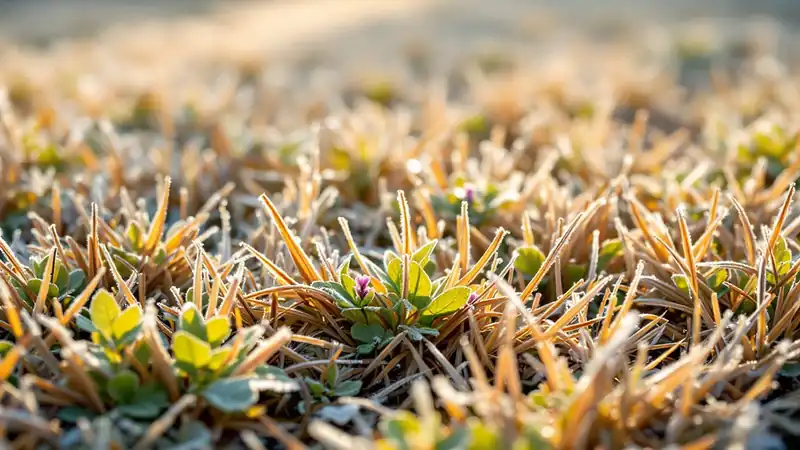
Do weeds die in the winter? Only summer annuals such as crabgrass, spurge and purslane do, at the first killing frost, and they leave seed behind. Winter annuals like henbit and chickweed grow through winter; perennials such as dandelion survive on their roots.
Do weeds die in the winter? The answer splits by life cycle, and the split decides what you do this month. The National Weather Service defines a hard freeze as air at 28°F or lower for an extended period, cold enough to kill most vegetation, and that is what ends crabgrass and spurge. Henbit, chickweed and annual bluegrass do the opposite: annual bluegrass starts germinating as soil cools below 70°F and keeps germinating all winter (UC IPM). Dandelion, clover, nutsedge and ground ivy lose their leaves or stop growing, but their roots, runners and tubers live through it.
The top results for this question are a Reddit thread, a YouTube clip, lawn-company blogs and a Facebook group; none names a source per weed or says what temperature a winter spray needs. The table below gives 17 common lawn weeds a row each: life cycle, what winter does to it, what survives and when to act, with the extension page behind every row. If you do not know which weed you have, match it first in our 20-weed lawn weed identification chart; for why the same weeds come back every spring, see where weeds come from and how long their seed lasts in soil.
Which weeds die in the winter? 17 lawn weeds by life cycle
Four life cycles cover nearly every lawn weed. Summer annuals sprout in spring and die at frost; winter annuals sprout in late summer and fall, live through winter and die as temperatures rise in early summer; perennials grow for 2 or more years from tubers, bulbs, rhizomes or stolons (Missouri Botanical Garden; UGA B-978). Biennials sit between: a rosette the first year, flowers and death the second.
Swipe the table sideways to see every column.
| Weed | Life cycle | What winter does to it | What survives | When to act | Source |
|---|---|---|---|---|---|
| Crabgrass (large and smooth) | Summer annual | Dies at the first frost; in mild coastal California with no killing frost it can overwinter | Seed, viable at least 3 years; over 100,000 per large plant | Spring preemergent before soil holds 55°F | UC IPM |
| Spotted and prostrate spurge | Summer annual | Freezes in fall; K-State says it needs no herbicide | Seed, dormant over winter; several thousand per plant | Spring preemergent; pull before seed | K-State; UC IPM |
| Common purslane | Summer annual | Dies by autumn | Seed; up to 240,000 per plant, can sprout after 5 to 40 years | Bag pulled plants: hoed plants left on soil can reroot | UC IPM; UMD |
| Giant foxtail | Summer annual | Dies after setting seed in late summer and fall | Seed; average 900 per plant | Already dead; next crop comes from seed in spring | MSU |
| Henbit | Winter annual | Sprouts in fall until sustained cold stops it; resumes in late winter; dies in hot weather | Living plant, plus seed viable up to 5 years | Fall preemergent; spray on days above 50°F | K-State; Wisconsin |
| Purple deadnettle | Winter annual | Emerges in fall, sets seed from early spring, dies late May and June | Living plant; 27,000 seeds per plant without competition | Fall or early spring spray | MSU |
| Common chickweed | Winter annual | Emerges late summer, dormant over winter, seeds in spring | Living plant; average 25,000 seeds per plant | Fall or early spring, while plants are small | MSU |
| Annual bluegrass (Poa annua) | Winter annual | Germinates as soil falls below 70°F and keeps germinating all winter | Living plant; about 100 seeds in as few as 8 weeks | Preemergent before soil drops below 70°F | UC IPM |
| Hairy bittercress | Winter annual | Germinates in autumn, overwinters, blooms February to April in Maryland | Living plant; pods fling seed nearly 10 feet | Pull with the taproot while soil is moist, before pods form | UMD |
| Wild garlic and wild onion | Winter perennial | Emerge in late fall from bulbs and grow through warm spells | Bulbs and aerial bulblets | 2,4-D + MCPP + dicamba in late November or December above 50°F, again in February | NC State; UGA B-978 |
| Bull thistle | Biennial | Overwinters as a rosette, bolts the second year | Rosette and fleshy taproot | Treat or dig rosettes in fall or spring | UNR |
| Wild carrot | Biennial or short-lived perennial | Rosette the first year, flower stalk the second | Rosette; 1,000 to 40,000 seeds per plant | Clip at flowering; one July clipping stopped seed | MSU |
| Dandelion | Simple perennial | Taproot persists over winter | Taproot; average 15,000 seeds per plant | Fall spray, mid-October to early November in Kansas | MSU; K-State |
| White clover | Perennial | Dormant; leaves die, usually not evergreen | Stolons | Fall spray while leaves are green | UMD; University of Missouri |
| Ground ivy (creeping Charlie) | Perennial | Creeping stems rooted at the nodes carry it through | Stolons and roots | 2 sprays, late September to early November | Iowa State |
| Yellow nutsedge | Perennial | Leaves and rhizomes die at a killing frost | Tubers, viable up to 3.5 years | Nothing to spray after frost; shoots return from tubers | MSU |
| Bermudagrass (as a weed in cool-season lawns) | Warm-season perennial | Dormant; foliage turns brown | Stolons and rhizomes | Nothing to spray while brown; it greens up in spring | UMD |
Only 4 of the 17 rows actually die in winter, and all 4 are annuals whose next generation is already in the soil as seed. Five are winter annuals that are alive and growing right now, 2 are biennials sitting as rosettes, and 6 come back from roots, runners, bulbs or tubers. That is why a lawn that looked clean in January can be purple with henbit by March.
1Did it come up in late spring or summer, with no thick root, runners or bulbs (crabgrass, spurge, purslane, foxtail)?
YesSummer annual: it dies at the first hard freeze (28°F). Do not spray it now; plan a spring preemergent before soil holds 55°F (UC IPM).
NoGo to the next question
2Did it appear in fall, and is it green or flowering between November and April (henbit, chickweed, deadnettle, annual bluegrass, bittercress)?
YesWinter annual: it lives all winter and seeds in spring. Pull it before it flowers, or spray on a day above 50°F with a product labeled for your grass (UGA B-978).
NoGo to the next question
3Is it a flat rosette of spiny or lacy leaves that has not flowered yet (bull thistle, wild carrot)?
YesBiennial: the rosette survives winter and flowers next year. Dig or treat the rosette in fall or spring (UNR; MSU).
NoGo to the next question
4Does it have a taproot, creeping stems, bulbs or tubers (dandelion, clover, ground ivy, wild garlic, nutsedge)?
YesPerennial: the top may brown but the roots survive. Spray while leaves are green, late September to early November; after that, wait for spring regrowth (K-State; Iowa State).
NoNot sure: note the month it flowers and match it in our 20-weed identification chart before spraying anything.
Source: UC IPM, UGA B-978, UNR, MSU, K-State, Iowa State, National Weather Service
Summer annuals: frost kills the plant, not the seed
Crabgrass, spurge, purslane and foxtail are finished by the first hard freeze. UC IPM says both crabgrass species typically die with the first frost in fall, and that in mild parts of California with no killing frost the plants can live into the next spring. Kansas State goes further for prostrate spurge: it will freeze in the coming weeks and will not require any herbicide treatment. Spraying a summer annual in October or November spends money on a plant that has days left.
What frost leaves behind is the problem. The seed numbers below come from extension weed profiles; even giant foxtail, the lightest seeder here, averages 900 seeds a plant. Crabgrass seed stays viable for at least 3 years (UC IPM), purslane seed can sprout after 5 to 40 years (UC IPM), and spurge seed produced in late fall lies dormant until spring (UC IPM).
| Weed | Life cycle | Seeds per plant (as published) | Type of figure | Source |
|---|---|---|---|---|
| Common purslane | Summer annual | 240,000 | Maximum (“may produce”) | UC IPM |
| Large crabgrass | Summer annual | More than 100,000 | Large plant (“can exceed”) | UC IPM |
| Purple deadnettle | Winter annual | 27,000 | Without competition | MSU |
| Common chickweed | Winter annual | 25,000 (range 750 to 30,400) | Average | MSU |
| Dandelion | Perennial | 15,000 (150 to 200 per flower, up to 10 flowers) | Average | MSU |
| Giant foxtail | Summer annual | 900 (range 500 to 2,500) | Average | MSU |
| Henbit | Winter annual | 40 to 200 | Range | Wisconsin |
So the winter job for summer annuals is nothing, and the spring job is a preemergent. Crabgrass starts germinating once soil holds 55°F for several consecutive days (UC IPM); in Georgia that puts the application in late February to mid-March (UGA Extension, Forsyth County). Our crabgrass prevention dates for 21 cities give the spring window by city.
Winter annuals: the weeds that grow while the lawn is dormant
Winter annuals are why the question feels wrong to anyone in the South. UC IPM says annual bluegrass starts germinating in late summer or fall as soil temperatures fall below 70°F and keeps germinating through winter, in several flushes. K-State says henbit sprouts in fall until sustained cold stops emergence, then resumes in late winter to mid-spring and dies back when hot weather arrives. In Michigan, common chickweed sits dormant over winter, can flower within a month and sets seed within 2 to 3 months (MSU).
For henbit, the purple-flowered winter annual behind most of those March lawns, our guide on how to get rid of henbit lays out a month-by-month plan with the EPA registration number for each preemergent and spray.
For annual bluegrass in particular, our guide on how to get rid of Poa annua sorts the winter sprays and the late-summer preemergent by lawn grass, with the EPA registration number for each product.
Hairy bittercress shows how fast the cycle runs: each generation takes about 3 months from sprouting to seed, its pods fling seed nearly 10 feet, and Maryland bloom peaks from February through April (University of Maryland Extension). Clemson notes that purple deadnettle appears in dormant lawns in early spring (Clemson HGIC 2310); with warm-season grass brown and not growing, winter annuals face no competition, which is why they show up as green or purple patches in tan turf.
Prevention is a late-summer preemergent. UGA Bulletin 978 says to apply it when nights drop to 65 to 70°F: Aug. 15 to Sept. 15 in north Georgia and Sept. 1 to 15 in south Georgia. Missouri Botanical Garden gives the same late-summer or early-fall timing in the Midwest, and adds that hand-pulled winter weeds should come out in winter or spring before they flower. Seeding and preemergents conflict, so check the label’s reseeding interval before you put down either.
Chickweed splits that plan by species: common chickweed is a winter annual that a late-summer preemergent or a fall spray handles, while hairy mouseear chickweed is a perennial that lasts into summer, and our guide on how to get rid of chickweed sorts 9 product labels by species and lawn grass.
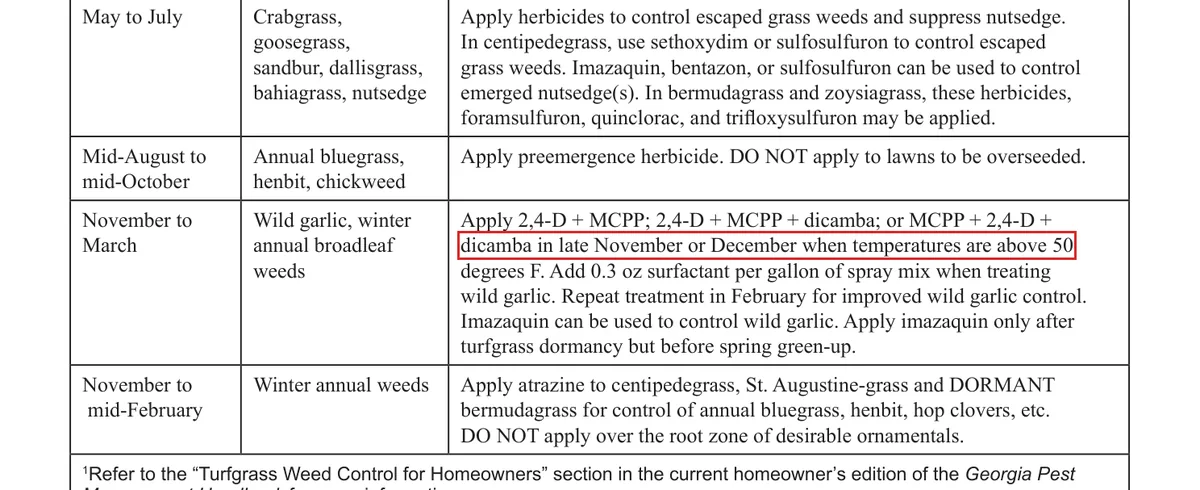
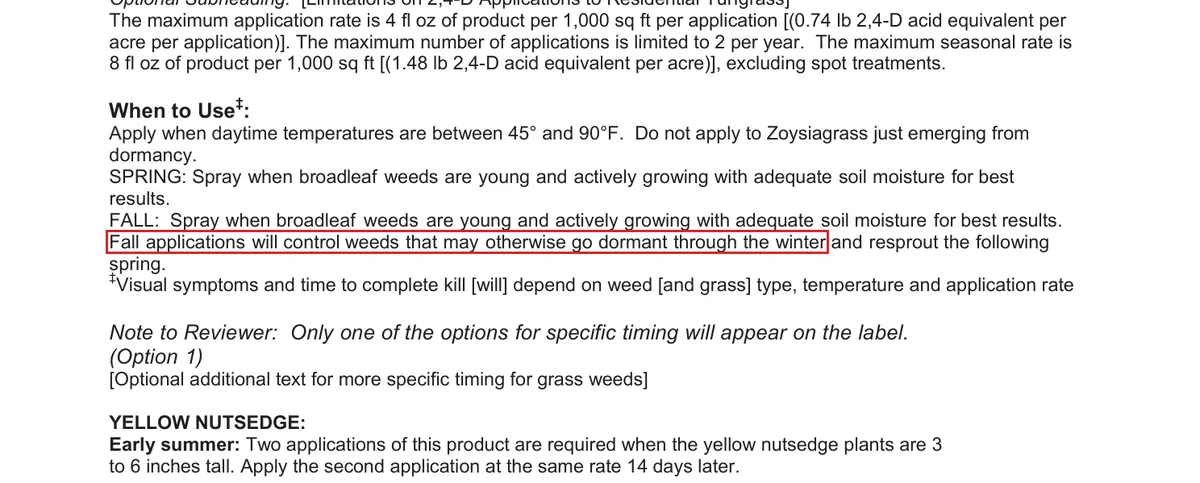
Once they are up, UGA’s calendar lists winter annual broadleaf weeds and wild garlic for a 2,4-D + MCPP + dicamba spray in late November or December when temperatures are above 50°F, with a repeat in February for wild garlic (UGA B-978, p. 11). On centipede, St. Augustine and dormant bermudagrass, atrazine runs November to mid-February; the Drexel atrazine 4% label says it may be applied in both dormant and growing seasons on St. Augustine and centipede (EPA Reg. No. 19713-567). NC State’s Alexander County agent adds a pollinator step: if winter weeds are already in flower, mow off the blooms and spray a day or two later (NC State Extension).
That 3-way spray burns wild garlic down fast but can fade: in a 2019 Mississippi State trial one went from 88 to 51 percent control between day 20 and day 49, which is why our guide on how to get rid of wild onions in a lawn plans November and February sprays for 2 to 3 years.
Can you spray weeds in winter? The temperatures that decide it
Yes, on the right day. Systemic herbicides have to be absorbed and moved inside a growing plant, and cold slows both. Rutgers weed scientists put the ideal air temperature for most postemergence herbicides at 65 to 85°F and say to avoid spraying when nights fall below 40°F or days stay under 55°F (Rutgers). Labels set their own floors, and the label is the law: the table lists what 5 lawn labels and 4 extension sources say.
| Product or source | Cold-weather rule | What it covers | Source |
|---|---|---|---|
| Chemsico Lawn Weed Killer Concentrate, a Spectracide-brand label (2,4-D, mecoprop-p, dicamba) | Apply when daytime temperatures are 45 to 90°F | Lawn broadleaf weeds | EPA Reg. No. 9688-342 |
| PBI-Gordon EH-1573 Herbicide | St. Augustine: not below 50°F, not when going dormant, not if below 40°F is expected within 10 days | May be applied to dormant bermudagrass, zoysiagrass and bahiagrass | EPA Reg. No. 2217-1010 |
| Gordon’s BL 8000 Lawn Weed Killer (also sold as Trimec Lawn Weed Killer) | Air temperatures 60 to 90°F, good soil moisture | Lawn broadleaf weeds | EPA Reg. No. 2217-539 |
| WBG 553 Concentrate (Ortho Weed B Gon lawn concentrates) | Spray during the growing season when weeds are growing actively; no lower figure printed | Lawn broadleaf weeds | EPA Reg. No. 239-2744 |
| Drexel atrazine 4% (Auguzine) | Dormant and growing seasons on St. Augustine and centipede; below 90°F | Annual bluegrass, henbit and other winter weeds | EPA Reg. No. 19713-567 |
| UGA Bulletin 978 | Above 50°F, late November or December | Winter annual broadleaf weeds, wild garlic | UGA B-978, p. 11 |
| NC State, Alexander County | At least 55°F | Winter annuals in lawns | NC State |
| Rutgers | Avoid below 40°F at night or 55°F by day; ideal 65 to 85°F | Postemergence herbicides generally | Rutgers |
| NC State TurfFiles | At least 60°F, 70°F better | Glyphosate on dormant bermudagrass | NC State TurfFiles |
The best measured example comes from NC State. Glyphosate sprayed on tall fescue at a deliberately low rate gave 0 percent control in the 50s, 59 percent in the 60s and 92 percent in the 70s (NC State TurfFiles). Same rate, same grass: only the air temperature changed. Rutgers describes the same slowdown for systemic herbicides in general, which is why a sunny 62°F afternoon in January can do more than a 48°F one in late November.
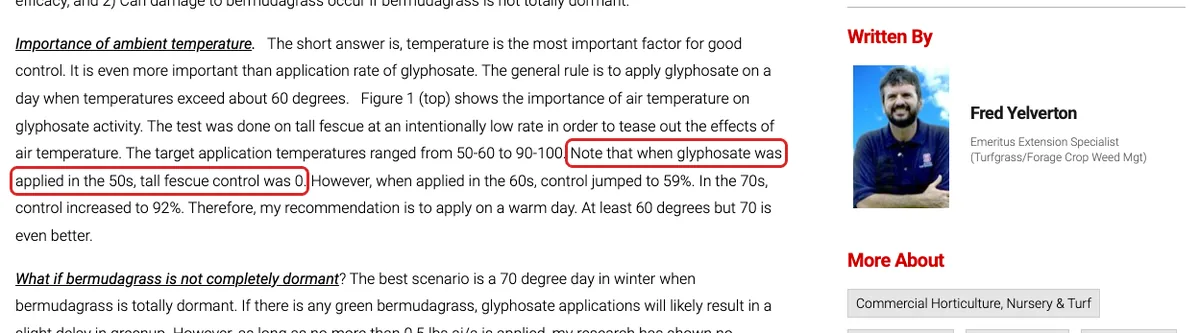
Winter also changes how you read the result: Rutgers notes that control is slower at low temperatures, especially with systemic herbicides (Rutgers), so a winter spray takes longer to show than a summer one. Which product fits which weed and grass, and the rain-free time each label prints, are laid out in our lawn weed killer comparison by EPA label.
Dormant bermudagrass lawns: the one winter use for glyphosate
A fully dormant bermudagrass lawn is the exception where a non-selective spray goes over the whole yard. NC State calls glyphosate on dormant bermudagrass excellent for general weed control, Poa annua included, at the labeled 0.5 lb active ingredient per acre, 1 pint per acre of a 4 lb per gallon product, on a day of at least 60°F (NC State TurfFiles). Mississippi State says up to 16 oz per acre will not kill semi-dormant bermudagrass but may delay spring green-up (Mississippi State). This works only where the whole lawn is brown and dormant: in a tall fescue or St. Augustine lawn, the green grass dies with the weeds.
Perennials and biennials: the tops die back, the roots do not
Perennial weeds look dead in January and are not. Michigan State describes the dandelion taproot as persisting over winter (MSU); white clover’s leaves die and are replaced in spring while its stolons survive (University of Maryland Extension); yellow nutsedge leaves and rhizomes die at a killing frost, but its tubers survive and stay viable for up to 3.5 years (MSU). Bull thistle overwinters as a rosette and sends up a 2 to 5 foot spiny stem the next year (University of Nevada, Reno Extension).
Fall, before winter, is when these weeds are easiest to kill, because they are moving sugars down into roots for winter and carry a systemic herbicide with them (University of Missouri; Ohio State). K-State says a fall treatment on dandelions often gives over 90 percent control the following spring, against 50 percent or less from a single spring or summer treatment, and recommends mid-October to early November on a day of at least 50°F (K-State). Ohio State times it to the last mowing of the year, October to early November in the Midwest, with air in the 40s and 50s and soil still in the 50s (Ohio State).
Ohio State’s cue is grass that has stopped growing but is still green (Ohio State); a perennial whose leaves have already browned has nothing left to take up a spray, so it waits for spring regrowth. Weed-specific timing is in our guides on killing dandelions without hurting the grass, fall trial results for creeping Charlie and nutsedge control and tuber depletion.
A winter weed calendar
The dates below come from Georgia, Kansas, Ohio and Iowa extension calendars. Where you live, go by the temperature cue in each row rather than the month.
| When | Weeds | What to do | Temperature cue | Source |
|---|---|---|---|---|
| Aug. 15 to Sept. 15 (north Ga.); Sept. 1 to 15 (south Ga.) | Annual bluegrass, henbit, chickweed | Preemergent | Nights 65 to 70°F; soil below 70°F | UGA B-978, p. 4; UC IPM |
| Late September to early November | Ground ivy, dandelion, clover | Systemic broadleaf spray; ground ivy twice | Day at least 50°F; soil in the 50s | Iowa State; K-State; Ohio State |
| First hard freeze | Crabgrass, spurge, purslane, foxtail | Nothing: they die | 28°F or lower | National Weather Service |
| Late November to December, repeat in February | Winter annual broadleaf weeds, wild garlic | 2,4-D + MCPP + dicamba | Above 50°F | UGA B-978, p. 11 |
| November to mid-February | Winter annuals in centipede, St. Augustine, dormant bermudagrass | Atrazine | Label: below 90°F | UGA B-978, p. 11; EPA Reg. No. 19713-567 |
| Winter, fully dormant bermudagrass only | Poa annua and most winter weeds | Glyphosate at labeled rate | At least 60°F, 70°F better | NC State TurfFiles |
| Late February to mid-March (Ga.) | Crabgrass, spurge | Spring preemergent | Soil 55°F | UGA Forsyth County; UC IPM |
The weeds run on their own clock, but the lawn sets how much room they get: for when your grass itself goes dormant, see the temperatures and dates when grass stops growing in 36 cities.
This page is general information, not pesticide advice. The label is the law: read the full label of the product you use, including grass restrictions, rates and reseeding intervals, and follow your state’s rules.
How we compiled this
We read 34 primary documents in November 2026: 20 weed profiles and fact sheets from Michigan State (6), UC IPM (4), the University of Maryland (4), Wisconsin, Iowa State, Nevada, Clemson, UGA and the Missouri Botanical Garden; timing guidance from UGA Bulletin 978, K-State, Ohio State, the University of Missouri, Rutgers, NC State (2) and Mississippi State; 5 herbicide labels from EPA’s Pesticide Product Label System; and the National Weather Service glossary. We did not test any product or count any seeds; every figure is the source’s own, and where sources give different kinds of figures (maximum, average, range) the table says which.
Frequently asked questions
Will weeds come back after winter?
Yes. Summer annuals return from seed: crabgrass seed lasts at least 3 years in soil (UC IPM). Perennials such as dandelion regrow from taproots that persist through winter (MSU), and winter annuals never left.
Should you remove weeds in winter?
Pull winter annuals such as henbit, chickweed and hairy bittercress in winter or early spring, before they flower and drop seed (Missouri Botanical Garden). Pull bittercress with its taproot while the soil is moist (UMD). Leave frost-killed crabgrass and spurge; they are already dead.
What kills weeds in cold weather?
A labeled broadleaf herbicide on a mild day: UGA uses above 50°F for winter sprays, and labels set floors of 45°F (a Spectracide-brand 2,4-D concentrate), 50°F on St. Augustine (PBI-Gordon EH-1573) and 60°F (Gordon’s Trimec). In NC State’s trial, glyphosate gave 0 percent control in the 50s and 92 percent in the 70s (NC State TurfFiles).
Do dandelions die in the winter?
No. The leaves may brown, but the taproot persists over winter and regrows in spring (MSU). A fall spray from mid-October to early November gave over 90 percent control the next spring in K-State’s account (K-State).
Does clover die in the winter?
White clover goes dormant: its leaves die and are replaced in spring, but the stolons survive (UMD). Spray it in fall while the leaves are green. Our guide to getting rid of clover in the lawn lists products by grass type.
What month is best to kill weeds?
It depends on the life cycle: late September to early November for perennials such as dandelion and ground ivy (K-State; Iowa State), Aug. 15 to Sept. 15 for a preemergent against winter annuals in north Georgia (UGA B-978), and late February to mid-March for a crabgrass preemergent there (UGA Forsyth County).
Sources
- National Weather Service, Glossary: Hard Freeze, current page. Accessed November 2026.
- UC IPM, University of California, Pest Notes: Crabgrass (Publication 7456), current page. Accessed November 2026.
- UC IPM, University of California, Pest Notes: Spotted Spurge and Other Spurges, current page. Accessed November 2026.
- UC IPM, University of California, Pest Notes: Common Purslane, PDF, undated. Accessed November 2026.
- UC IPM, University of California, Pest Notes: Annual Bluegrass, current page. Accessed November 2026.
- Michigan State University, Weed profiles: giant foxtail, purple deadnettle, common chickweed, wild carrot, dandelion, yellow nutsedge, current pages. Accessed November 2026.
- University of Wisconsin-Madison Extension, Henbit, Lamium amplexicaule, current page. Accessed November 2026.
- University of Maryland Extension, Hairy Bittercress: Identification and Management, current page. Accessed November 2026.
- University of Maryland Extension, White Clover: Identification and Management, current page. Accessed November 2026.
- University of Maryland Extension, Common Purslane: Identification and Management, current page. Accessed November 2026.
- Clemson Cooperative Extension, Home & Garden Information Center, HGIC 2310, Managing Weeds in Warm Season Lawns, updated July 13, 2022. Accessed November 2026.
- University of Maryland Extension, Bermudagrass (Wiregrass), current page. Accessed November 2026.
- Iowa State University Extension, Control of Ground Ivy (Creeping Charlie), current page. Accessed November 2026.
- University of Nevada, Reno Extension, Identification and Management of Bull Thistle, current page. Accessed November 2026.
- Missouri Botanical Garden, Winter Annual Weeds, current page. Accessed November 2026.
- K-State Research and Extension, Wild West District, Fall is the Best Time to Control Dandelions and Perennial Weeds, October 2021. Accessed November 2026.
- University of Missouri IPM, Fall is the time to control perennial broadleaf weeds, September 2011. Accessed November 2026.
- Ohio State University, Buckeye Turf, Wait Until Late October to Control Perennial Broadleaf Weeds, current page. Accessed November 2026.
- University of Georgia Extension (P. McCullough, C. Waltz), Bulletin 978, Weed Control in Home Lawns, pp. 4 and 11, reviewed July 2024. Accessed November 2026.
- UGA Extension, Forsyth County, Winter Weed Identification and Control, current page. Accessed November 2026.
- NC State Extension, Alexander County, Managing Winter Weeds, current page. Accessed November 2026.
- NC State TurfFiles, Winter Glyphosate Applications to Bermudagrass, current page. Accessed November 2026.
- Mississippi State University Extension, Spraying glyphosate on dormant bermudagrass lawns, Jan. 15, 2007. Accessed November 2026.
- Rutgers Plant and Pest Advisory, Weather Conditions and Herbicide Performances, current page. Accessed November 2026.
- Chemsico (United Industries), EPA Reg. No. 9688-342, Chemsico Lawn Weed Killer Concentrate (Spectracide brand) label, p. 5, June 29, 2021. Accessed November 2026.
- PBI-Gordon, EPA Reg. No. 2217-1010, EH-1573 Herbicide label, June 14, 2024. Accessed November 2026.
- PBI-Gordon, EPA Reg. No. 2217-539, Gordon’s BL 8000 Lawn Weed Killer (Trimec) label, Aug. 6, 2021. Accessed November 2026.
- The Scotts Company, EPA Reg. No. 239-2744, WBG 553 Concentrate (Ortho Weed B Gon Weed Killer for Lawns) label, Aug. 23, 2023. Accessed November 2026.
- Drexel Chemical, EPA Reg. No. 19713-567, Drexel Auguzine (atrazine 4%) label, Nov. 10, 2021. Accessed November 2026.