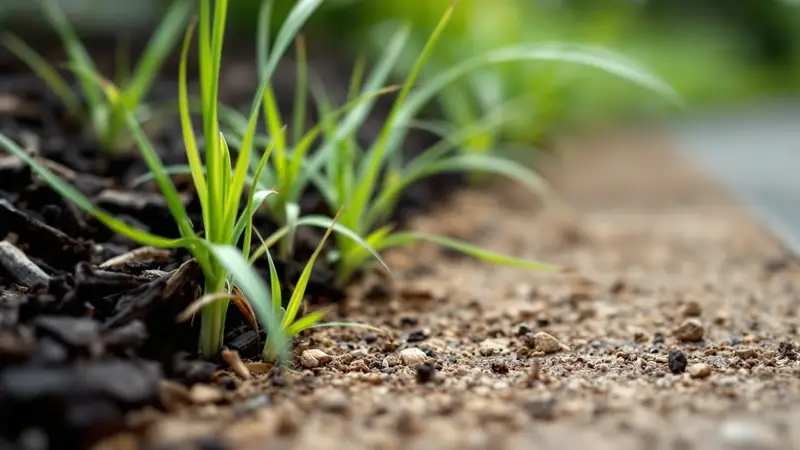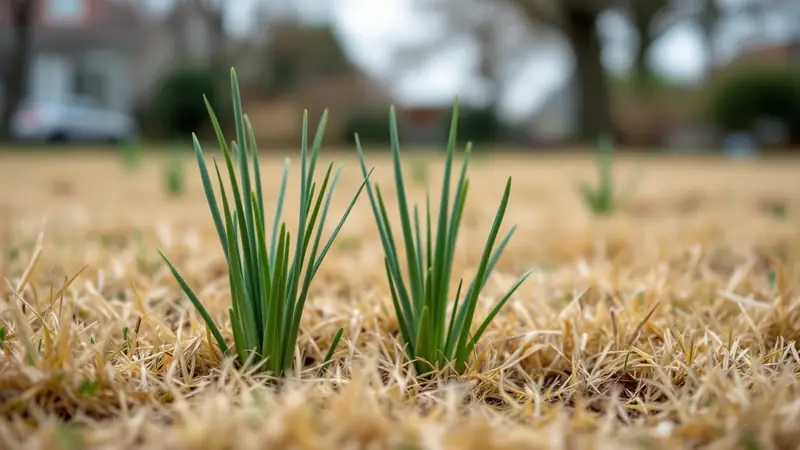
How to get rid of wild onions in lawn turf: spray emerged clumps in November and again in February, then repeat for 2 to 3 years. On bermuda, zoysia or centipede use metsulfuron or imazaquin; on fescue or bluegrass, a 2,4-D, MCPP and dicamba mix.
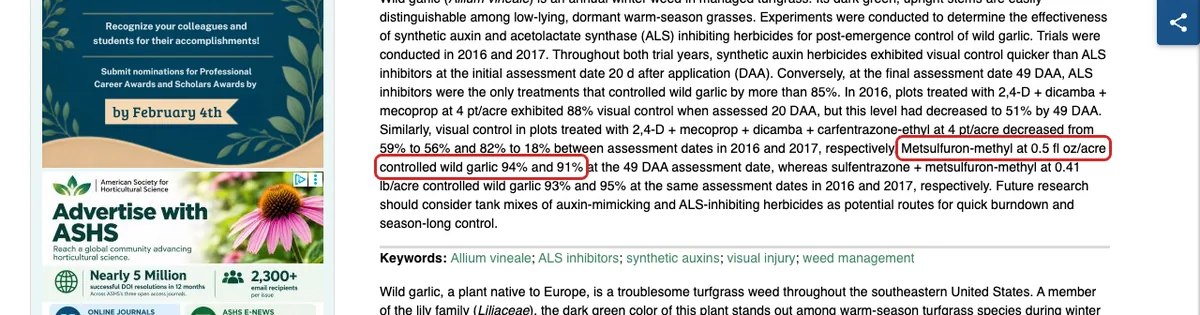
How to get rid of wild onions in lawn grass is a bulb problem, not a leaf problem. In a Mississippi State trial published in HortTechnology in 2019, a 2,4-D + dicamba + mecoprop mix (Trimec Classic) gave 88 percent visual control of wild garlic 20 days after a Feb. 26, 2016 spray but only 51 percent by day 49, as plants regrew. Metsulfuron (MSM Turf) was slower to show but held 94 percent in 2016 and 91 percent in 2017 at day 49.
The regrowth comes from below ground. Cornell weed scientists write that wild garlic’s hard offset bulbs can stay dormant for 5 years or more, though all but a few sprout within 2 to 4 years, and that dormant bulbs are essentially immune to anything except digging. A spray kills only bulbs that have leaves up, so the plan below is built around that calendar. If you are not sure the clumps are onion or garlic, compare them with other winter weeds in our lawn weed identification guide.
This page summarizes EPA labels and university research; it is not a product endorsement. The label is the law: read the current label of the exact product you buy, and check whether your state requires a pesticide applicator license before anyone treats a lawn for pay.
Wild garlic or wild onion: which one is in your lawn?
Snap a leaf and look at the cut end. Missouri Botanical Garden puts it in one line: wild garlic (Allium vineale) has hollow leaves, wild onion (Allium canadense) has solid, flat leaves, and control is the same for both. Both smell of onion when crushed. The rows below matter for two reasons: wild garlic carries the long-dormant bulbs, and two lookalikes do not smell at all.
| Feature | Wild garlic (Allium vineale) | Wild onion (Allium canadense) | Source |
|---|---|---|---|
| Leaf | Round, hollow, 6 to 24 in long and 0.1 to 0.4 in wide | Flat, solid, 6 to 12 in, faint keel along the midvein | Cornell; NC State |
| Bulb coat | Brittle, papery; bulb 2/5 to 4/5 in wide | Fibrous, matted outer coat | Ohio State |
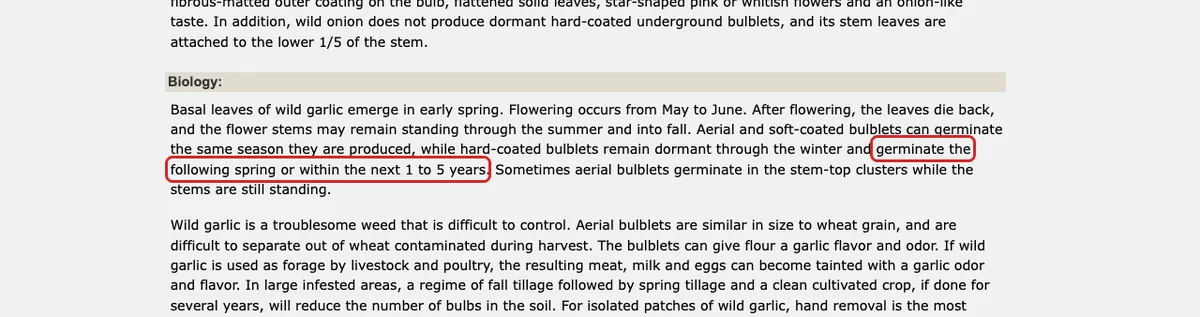
| Dormant hard offsets | Yes: 1 to 4 per flowering plant; sprout next spring or within 1 to 5 years | None; bulbs do not become hard when dormant | Ohio State; Cornell |
| Top of the stalk | Mostly aerial bulblets 1/8 to 1/5 in long, few purplish or greenish flowers | Star-shaped pink or white flowers, sometimes bulblets | Ohio State; NC State |
| Origin | Europe; arrived in ship ballast soil | Native to the eastern U.S. | Ohio State; NC State |
| Where it dominates | Far more common than wild onion in Tennessee; predominant in South Carolina | Less common in both states, per the same sources | UT W212; Clemson |
| Lookalike: star-of-Bethlehem | White midrib down each leaf, no odor when crushed | Same | UT W212 |
| Lookalike: death camas | V-shaped leaves, not hollow; poisonous alkaloids in bulb and mature leaves | Same | Colorado State |
Because wild onion makes no hard-coated dormant bulblets (Ohio State), a pure wild onion patch should thin faster under the same program; that is our reading, not a trial result.
Why do wild onions come back every year?
Because a spray or a mower only reaches the plants that are up. Clemson HGIC gives the cycle: shoots emerge from bulbs in late fall, grow through winter, form aerial bulblets in late spring and die back in early summer, while bulbs persist in the soil for several years. Cornell adds that bulbs sprout from August until the ground freezes and some shoots wait until spring, which is why our page on which weeds die in winter files them as winter perennials.
| Bulb type | Where it forms | When it sprouts | How long it can wait | Source |
|---|---|---|---|---|
| Terminal bulb | Base of a plant too young to flower | The fall after it forms | Usually dies if it does not sprout that autumn | Cornell |
| Soft offset | Base of a flowering plant; white, teardrop, 1/3 to 2/3 in | The first autumn | Usually dies if it does not sprout that autumn | Ohio State; Cornell |
| Hard offset | Outer leaf axils, 1 to 4 per flowering plant; light brown, about 1/2 in | A year or later; sprouting was best at 50°F | 5 years or more; all but a few sprout within 2 to 4 years | Cornell |
| Aerial bulblet | Top of the stalk; 75 to 141 per plant in 4 Swedish populations | Fall; most land within 14 in of the parent | 4 to 5 percent survive past 1 year, none longer | Cornell |
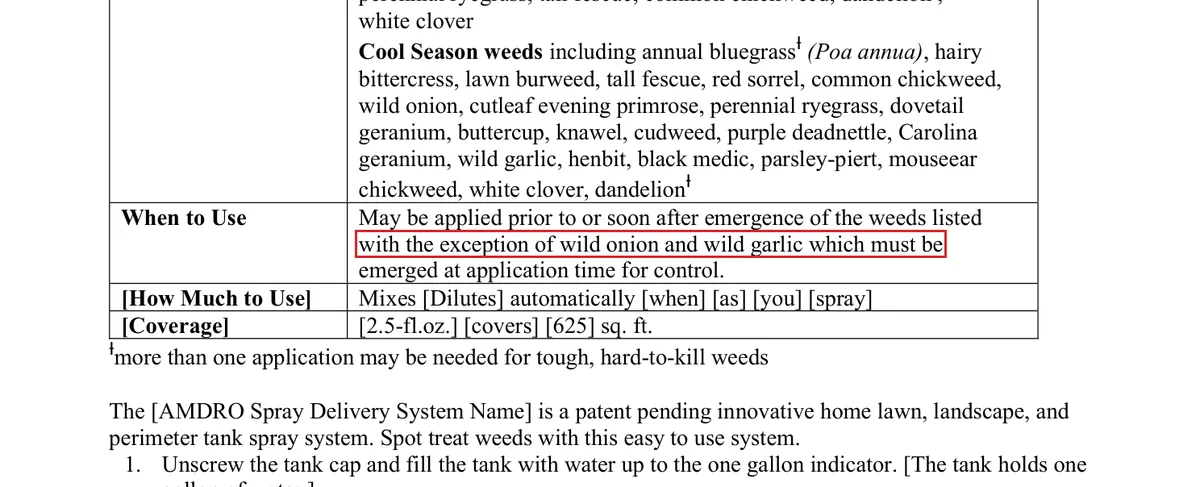
Two rules follow. First, nothing works before emergence: Clemson and Penn State both say no preemergent herbicide controls these weeds, and the Image label (EPA Reg. No. 73342-4) says wild onion and wild garlic must be emerged at application time. Second, mowing alone does not kill them. Clemson says regular mowing weakens plants and stops bulblets, but Cornell notes that cutting the flower stalk as it forms can triple the size of the offset bulbs underground.
What the trials show: fast burndown or bulbs that stay dead
The Mississippi State study (Small, McCurdy, Begitschke and Richard, HortTechnology 29(6):838 to 841) sprayed 9 lawn herbicides near Starkville on Feb. 26, 2016 and Jan. 13, 2017, all with 0.25 percent nonionic surfactant, in plots left unmown, and rated visual control at 20 and 49 days. The auxin mixes looked best early; the ALS inhibitors were the only treatments above 85 percent at day 49.
| Product in the trial | Active ingredients | Year | Control at 20 days | Control at 49 days |
|---|---|---|---|---|
| Trimec Classic, 4 pt/acre | 2,4-D + dicamba + mecoprop | 2016 | 88% | 51% |
| SpeedZone Southern, 4 pt/acre | 2,4-D + mecoprop + dicamba + carfentrazone | 2016 | 59% | 56% |
| SpeedZone Southern, 4 pt/acre | 2,4-D + mecoprop + dicamba + carfentrazone | 2017 | 82% | 18% |
| MSM Turf, 0.5 fl oz/acre (as published) | metsulfuron | 2016 | 50% or more (all products) | 94% |
| MSM Turf, 0.5 fl oz/acre (as published) | metsulfuron | 2017 | No better than untreated | 91% |
| Blindside, 0.41 lb/acre | sulfentrazone + metsulfuron | 2016 / 2017 | Slower than auxins | 93% / 95% |
| Monument | trifloxysulfuron | 2017 | No better than untreated | 98% |
| Image, Certainty | imazaquin; sulfosulfuron | 2017 | No better than untreated | Image above 91%; Certainty not reported separately |
The authors note the unmown plots may have helped auxin-treated garlic recover, and repeat 3-way sprays were not tested. University of Arkansas turf specialists agree on direction: 3-ways are the least effective option and need three sprays (November, March, the next November), while metsulfuron on a day of at least 50°F in late February or early March is very effective.
Which product fits your lawn grass?
The lawn grass decides the product. Mississippi State Extension (Publication 3511) rates metsulfuron, imazaquin, sulfosulfuron and Celsius excellent on wild garlic and the 3-way mixes good, then marks which grasses tolerate each. We read the current EPA-stamped label for 7 products that list wild onion or wild garlic and pulled the rate, the grasses and the yearly cap. One caveat: the Celsius WG label (432-1507) says it is intended for application by licensed commercial applicators, so on a home lawn it is a lawn-service product.
| Product (EPA Reg. No.) | Active ingredient | Label rate for wild onion or garlic | Amount per 1,000 sq ft | Lawn grasses on the label | Limits that shape the plan | Label |
|---|---|---|---|---|---|---|
| Manor (228-373) | metsulfuron 60% | 0.33 to 0.5 oz product per acre | 0.21 to 0.33 g (our conversion) | Kentucky bluegrass, fine fescue, bermuda, St. Augustine, buffalo, Meyer and Emerald zoysia, centipede; not bahia | Bluegrass and fine fescue: no more than 0.5 oz per acre in 9 months; overseed 8 weeks after; 0.25% nonionic surfactant | May 10, 2019 |
| Martin’s Dollarweed Killer, alt. TopShot (53883-345) | metsulfuron, 2.15 lb per gal | 1 ampule (1.8 mL) per 2,500 sq ft | 0.72 mL; about 0.29 oz metsulfuron per acre (our math) | Kentucky bluegrass, fine fescue, bermuda, centipede, Meyer and Emerald zoysia, St. Augustine | Not over roots of desirable trees | Apr. 9, 2014 |
| Image Consumer Concentrate (73342-4) | imazaquin 3.3% | 4 fl oz per 1,000 sq ft, after the first killing frost | 4 fl oz (118 mL) | Bermuda, St. Augustine, buffalo, centipede, zoysia; may injure tall fescue | No winter weed use on St. Augustine; second spray 6 weeks later; 8 fl oz per 1,000 a year; reseed after 6 weeks | Aug. 30, 2024 |
| Certainty (59639-226) | sulfosulfuron | 1.25 to 2.0 oz per acre (wild garlic only) | 0.8 to 1.3 g (our conversion) | Bermuda, bahia, buffalo, centipede, kikuyu, St. Augustine, seashore paspalum, zoysia | 2 sprays a year, 4 or more weeks apart; test St. Augustine first | Nov. 7, 2024 |
| Celsius WG (432-1507) | thiencarbazone + iodosulfuron + dicamba | Wild onion 0.057 oz; wild garlic 0.085 oz per 1,000 sq ft | 1.6 g; 2.4 g | St. Augustine, bermuda, centipede, zoysia | 0.17 oz (4.8 g) per 1,000 sq ft a year | Sept. 1, 2021 |
| Trimec Classic (2217-543) | 2,4-D + mecoprop-p + dicamba | 3.25 to 4.0 pt per acre | 1.2 to 1.5 fl oz; 0.75 to 1.5 on hybrid bermuda | Cool-season grasses, bermuda, bahia, zoysia; spot only on St. Augustine and centipede; not Floratam | 2 broadcasts a year, 30 days apart; reseed after 3 to 4 weeks | Apr. 2, 2014 |
| BioAdvanced Southern Weed Killer for Lawns Concentrate (92564-4) | 2,4-D + mecoprop-p + dicamba | 2 fl oz per 500 sq ft; 1 fl oz on bahia, centipede, St. Augustine | 4 fl oz; 2 fl oz | Fescue, bluegrass, ryegrass, bermuda, buffalo, zoysia, bahia, centipede, St. Augustine; not Floratam | 2 sprays a year, 30 days apart | June 25, 2026 |
The homeowner ampule and the professional rate meet in the middle. One 1.8 mL TopShot ampule per 2,500 sq ft delivers about 0.29 oz of metsulfuron per acre by our arithmetic, and Manor’s 0.33 to 0.5 oz of 60 percent product delivers 0.2 to 0.3 oz. Image is the one most often bought for sedges; our nutsedge control guide covers its summer use on the same label.
Warm-season lawns need one extra rule: do not spray during spring green-up. Clemson says centipede and St. Augustine are most easily injured as they come out of dormancy and recommends reduced 3-way rates on both; our centipede grass care guide covers the rest of that lawn’s weed calendar. The Trimec Classic label bars St. Augustine during green-up and bars Floratam outright.
1Only a few dozen clumps, or clumps in a flower bed?
YesDig 6 in deep with a thin trowel when the soil is moist and bag the soil; in beds, mop glyphosate on bruised leaves (Missouri Botanical Garden) and expect a second year.
NoGo to the next question
2Is the lawn St. Augustine or centipede?
YesMetsulfuron (Manor at 0.25 to 0.5 oz/acre on centipede, or a TopShot ampule per 2,500 sq ft) or Celsius WG at 2.4 g per 1,000 sq ft, applied by a licensed lawn service; never during spring green-up. Image is not labeled for winter weeds on St. Augustine.
NoGo to the next question
3Is the lawn bermuda or zoysia?
YesMetsulfuron, Image (4 fl oz per 1,000 sq ft) or, through a licensed lawn service, Celsius in November after the first killing frost, again in February; metsulfuron and imazaquin held 91% or more at 49 days in Mississippi (Celsius was not in that trial).
NoGo to the next question
4Is the lawn tall fescue?
YesA 3-way 2,4-D + MCPP + dicamba mix (Trimec Classic at 1.2 to 1.5 fl oz per 1,000 sq ft), mow first, then November, March and the next November (Arkansas). Manor does not list tall fescue and Image may injure it.
NoKentucky bluegrass or fine fescue: a 3-way mix, or metsulfuron at no more than 0.5 oz Manor per acre in 9 months, sprayed in November and February for 2 to 3 years.
- Product per spray (mL)
- 118.3
- Product per spray (teaspoons)
- 24.0
- Product per spray (fl oz)
- 4.00
Default: 1,000 sq ft at the Image rate takes 118.3 mL (4 fl oz). Worked example: 2,500 sq ft at the TopShot rate takes 1.8 mL, one ampule. Rates from the EPA labels on this page, read Nov. 21, 2026. Dry products (Manor, Certainty, Celsius) are weighed in grams; see the product table.
When to spray: a 2-year bulb calendar
Time each spray to shoots that are up and bulbs that have not yet formed. The steps below combine Clemson, Tennessee (W212) and the labels above; Mississippi State says most labels favor 55 to 80°F, with control slowed below 55°F and injury raised above 85°F.
- November, after new shoots are up and after the first hard frost (UT W212; the Image label says to follow the first killing frost). Metsulfuron and Celsius work best on a day above 50 to 60°F with moist soil (Arkansas; Clemson).
- Mow or step on the clumps just before spraying. Clemson says mowing immediately before may improve uptake through the waxy leaf; Missouri Botanical Garden suggests bruising leaves by stepping on them. Add a nonionic surfactant at 0.25 percent (1 quart per 100 gallons, about 2 teaspoons per gallon) where the label allows it.
- Leave the clumps unmown for 10 to 14 days (UT W212) or 2 weeks (Clemson). Check our page on spraying weeds before or after rain for the rain-free window your product needs.
- February or early March: spray again before new bulbs form (Clemson). On 3-way products, the label caps you at 2 broadcast sprays a year, 30 days apart.
- Skip warm-season lawns while they green up in spring, and skip summer: the tops are gone by early summer and dormant bulbs take up nothing.
- Next November and February: inspect and repeat. Missouri Botanical Garden says complete control may take 3 years of treating.
Digging them out without leaving bulblets
Digging is the only method that reaches dormant bulbs. Pulling fails: Penn State says the foliage breaks and the bulblet stays behind. Cornell found the largest bulbs in old sod sit about 2.75 in deep, offsets emerge best from the top 4 in, and the biggest bulbs can push up from 8 to 10 in.
- Dig when the soil is moist, in winter or early spring while the leaves still mark each clump (Clemson).
- Lift the whole clump as a plug 6 in deep with a thin trowel or soil knife; Scotts says clumps can sit at least 6 in down.
- Bag the whole plug, soil included. Iowa State says any small bulb left behind will regrow, and Missouri Botanical Garden suggests replacing the shovelful with clean soil.
- Fill the hole with topsoil and reseed in the next seeding window; our overseeding guide gives rates by grass. Wait 6 weeks after Image and 8 weeks after metsulfuron before seeding (labels above).
In beds, where no selective spray is allowed, Missouri Botanical Garden suggests mopping glyphosate onto bruised leaves. It also warns dormant bulbs may survive glyphosate, so expect a second year. Our page on whether Roundup kills grass covers what happens if it drifts onto the lawn, and the same bulb logic applies to dollarweed, which Martin’s metsulfuron label also lists.
Can you eat them, and are they toxic to dogs?
Both are edible if you are sure of the plant: NC State Extension says wild garlic can be used like chives, and its wild onion record warns not to harvest where herbicides were used. A clump with no onion smell is not one of these two; death camas has V-shaped leaves, and Colorado State reports sheep poisoned by about 1/2 lb of it. The ASPCA lists onion as toxic to dogs, cats and horses, with hemolytic anemia among the signs.
How we compiled this
On Nov. 21, 2026 we read 7 EPA-stamped product labels from the EPA Pesticide Product and Label System, 1 peer-reviewed trial (Mississippi State, HortTechnology 2019), and 13 extension, university, veterinary and pesticide-information pages (Clemson, Cornell, Ohio State, Tennessee, Mississippi State, Arkansas, Penn State, Iowa State, NC State, Missouri Botanical Garden, Colorado State, ASPCA, National Pesticide Information Center). Per-1,000 sq ft amounts and the TopShot dose per acre are our arithmetic from label rates and concentrations. We did not test any product or dig any plots.
Frequently asked questions
What will kill wild onions in the lawn?
An herbicide whose label lists wild onion and your grass, sprayed on emerged shoots. In Mississippi State’s trial, metsulfuron held 91 to 94 percent control at 49 days and imazaquin above 91 percent in 2017, while 3-way mixes faded to 18 to 56 percent. Expect 2 to 3 years of fall and late-winter sprays.
How do you get rid of wild onions without killing grass?
Match the product to the grass. Metsulfuron, imazaquin, sulfosulfuron or Celsius (a licensed-applicator product) suit bermuda, zoysia and centipede; Image is barred for winter use on St. Augustine. Tall fescue and bluegrass lawns rely on 3-way 2,4-D mixes such as Trimec Classic at 1.2 to 1.5 fl oz per 1,000 sq ft.
Why do I have so many wild onions in my yard?
Bulbs you cannot see. One flowering wild garlic plant makes 1 to 4 hard offsets that can wait 5 years or more, plus dozens of aerial bulblets, so a lawn sprayed once looks clear and fills again from bulbs that were dormant during the spray (Cornell).
Will vinegar kill wild onions?
It browns the tops but not the bulbs. The National Pesticide Information Center classes acetic acid as a contact herbicide that does not move to the roots, so bulbed perennials regrow. Our vinegar weed killer test summary shows the same result for other perennials.
Do wild onions come back every year?
Yes. Both are winter perennials: they emerge from bulbs in late fall, grow through winter, die back in early summer and regrow from the same bulbs the next fall (Clemson). Spraying in November and February for 2 to 3 seasons runs down the dormant bulbs.
Sources
- Small, McCurdy, Begitschke and Richard, Mississippi State University, Herbicides for Control of Wild Garlic in Turfgrass, HortTechnology 29(6): 838 to 841, 2019. Accessed November 2026.
- Mississippi State University Extension (McCurdy), Controlling Wild Garlic in Mississippi Lawns, Publication 3511, POD-09-23. Accessed November 2026.
- Clemson Cooperative Extension HGIC, Wild Garlic and Wild Onion, Dec. 16, 2022. Accessed November 2026.
- Cornell CALS Weed Science, Wild garlic weed profile, Current page. Accessed November 2026.
- Ohio State University, Ohio Perennial and Biennial Weed Guide: Wild Garlic, Current page. Accessed November 2026.
- University of Tennessee Extension (Breeden and Brosnan), Wild Garlic (Allium vineale), W 212, Current PDF. Accessed November 2026.
- University of Arkansas Division of Agriculture, Turfgrass weed ID: Wild Garlic, Current page. Accessed November 2026.
- Missouri Botanical Garden, Wild Garlic and Wild Onion, Current page. Accessed November 2026.
- Penn State Extension, Wild Onion and Wild Garlic, Current page. Accessed November 2026.
- Iowa State University Extension, How do I control onion grass in my lawn?, Current page. Accessed November 2026.
- NC State Extension Gardener Plant Toolbox, Allium canadense, Current page. Accessed November 2026.
- NC State Extension Gardener Plant Toolbox, Allium vineale, Current page. Accessed November 2026.
- Colorado State University, Guide to Poisonous Plants: Death Camas, Current page. Accessed November 2026.
- ASPCA Animal Poison Control, Onion, Current page. Accessed November 2026.
- National Pesticide Information Center, Vinegar (acetic acid) as an herbicide, Current page. Accessed November 2026.
- U.S. EPA PPLS (Nufarm), Manor Selective Herbicide label, EPA Reg. No. 228-373, May 10, 2019. Accessed November 2026.
- U.S. EPA PPLS (Control Solutions), Martin’s Dollarweed Killer / TopShot label, EPA Reg. No. 53883-345, Apr. 9, 2014. Accessed November 2026.
- U.S. EPA PPLS (Central Garden and Pet), Image Herbicide Consumer Concentrate label, EPA Reg. No. 73342-4, Aug. 30, 2024. Accessed November 2026.
- U.S. EPA PPLS (Bayer), Certainty Turf Herbicide label, EPA Reg. No. 59639-226, Nov. 7, 2024. Accessed November 2026.
- U.S. EPA PPLS (Bayer), Celsius WG Herbicide label, EPA Reg. No. 432-1507, Sept. 1, 2021. Accessed November 2026.
- U.S. EPA PPLS (PBI-Gordon), Trimec Classic Broadleaf Herbicide label, EPA Reg. No. 2217-543, Apr. 2, 2014. Accessed November 2026.
- U.S. EPA PPLS (SBM Life Science), BioAdvanced Southern Weed Killer for Lawns Concentrate label, EPA Reg. No. 92564-4, June 25, 2026. Accessed November 2026.
- Scotts Miracle-Gro, How to Kill Wild Onion and Garlic in the Lawn (advice checked, not a data source), Current page. Accessed November 2026.