How to get rid of stickers in yard grass: name the plant first. Sandburs need a preemergent before soil hits 52°F; lawn burweed needs a December to February spray; puncturevine gets pulled before it flowers; khakiweed needs repeat spring sprays.
Most advice on how to get rid of stickers in yard grass treats every bur as one weed, so people spray in the wrong month and the burs come back. At least 4 unrelated plants make them: sandburs (a grass), lawn burweed (a winter broadleaf), puncturevine or goathead (a summer broadleaf) and khakiweed (a perennial). Mississippi State Extension lists sticker weed, spurweed, bindi weed and jo-jo weed as other names for lawn burweed alone, and our common lawn weeds chart by region lists it among Florida’s regular lawn weeds.
The spray window is where the 4 split. Burweed sprouts in fall and Clemson Extension wants it sprayed in December, January and February, before the spines form; sandburs sprout when soil reaches 52°F and peak at about 72°F, so a fall herbicide never touches them. Below, each sticker is matched to the label-listed active ingredients with their EPA registration numbers and a month-by-month calendar. We also flag MSMA, which one top-ranking guide still recommends although EPA cancelled its residential lawn uses in 2009.
Which sticker is in your yard?
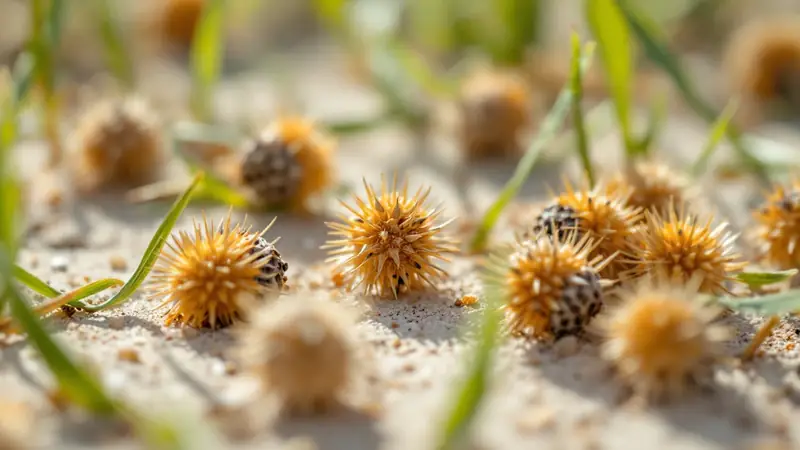
Pull one plant and look at where the burs sit and what the leaves look like. A bur on a grass stem is a sandbur; spines tucked into a low, parsley-leaved rosette in spring are burweed; a woody bur that splits into 5 spiked pieces under a summer mat is puncturevine. Cornell adds a seedling tell for sandbur: the bur it sprouted from often stays attached at the base of the plant.
| Sticker (scientific name) | Plant type and life cycle | How to tell it | The bur | Burs present | Source |
|---|---|---|---|---|---|
| Field sandbur (Cenchrus spinifex) and longspine sandbur (C. longispinus) | Grass; summer annual, a perennial in mild South Texas winters | Flat, rough blades; ligule a fringe of hairs; burs in a narrow spike at the stem tip | Field: 8 to 45 spines; longspine: 45 to 75 spines, 0.13 to 0.25 in long | Summer to first hard frost | Cornell; Texas A&M |
| Southern sandbur, sandspur (C. echinatus) | Grass; annual, Maryland to Texas and the Southwest | Stems 9 to 36 in; spikes of 5 to 50 burs | Ring of flexible spines at the base; 1 to 3 seeds per bur | All year in the South; summer and fall farther north | Cornell; UF/IFAS SS-AGR-364; Texas A&M |
| Lawn burweed, spurweed (Soliva sessilis) | Broadleaf; winter annual, sprouts October to December | Rosette about 6 in across and 3 to 4 in tall; leaves twice divided like parsley, 0.5 to 1.5 in long | 3.5 to 5.5 mm, flat, one spine, in the leaf joints | March to May; stays sharp after the plant dies | Clemson HGIC 2323; UC IPM; MSU P4180 |
| Puncturevine, goathead (Tribulus terrestris) | Broadleaf; summer annual, killed by freezing | Flat mat 2 to 5 ft across; 4 to 8 pairs of hairy leaflets; 5-petal yellow flowers up to 0.5 in | Woody pod that splits into 5 burs; one spike always points up | Late May to frost; common by July | UC IPM; Utah State |
| Khakiweed (Alternanthera pungens) | Broadleaf; perennial, regrows from roots and stem pieces | Reddish, hairy stems rooting at the nodes; glossy, waxy oval leaves; small white flowers mid to late summer | Prickly burs that cling to fur and clothes | Fall | Texas A&M SCS-2018-10 |
1Are the burs on a grass plant, packed in a narrow spike at the tip of a stem with flat, rough blades?
YesSandbur (field, longspine or southern). Summer annual grass: preemergent before soil reaches 52°F; imazaquin on young plants.
NoGo to the next question
2Is it a low rosette of finely divided, parsley-like leaves seen from late fall to spring, with spines in the leaf joints?
YesLawn burweed. Spray December to February, before the spines harden; isoxaben in late September next year.
NoGo to the next question
3Is it a flat summer mat with 4 to 8 pairs of hairy leaflets, small 5-petal yellow flowers and woody burs that split into 5 spiked pieces?
YesPuncturevine (goathead). Pull or hoe before it flowers; 2,4-D or dicamba on young plants in lawns.
NoGo to the next question
4Is it a mat of reddish, hairy stems with glossy, waxy oval leaves and small white flowers in late summer?
YesKhakiweed. Perennial: spray small plants in spring, then again about 4 weeks later.
NoNone of these: compare it in our common lawn weeds chart, or take a sample to your county extension office.
Source: Cornell CALS; Clemson HGIC 2323; UC IPM; Texas A&M SCS-2018-10
When to act: the sticker calendar
Each sticker has one month band where the treatment works and another where nothing will, because the burs are already hard. Clemson puts it bluntly for burweed: “Dead or alive, lawn burweed poses a painful problem” once spines form, and Mississippi State calls control at that stage futile. Read your row, then find the month you are in.
| Months | Sandburs | Lawn burweed | Puncturevine | Khakiweed |
|---|---|---|---|---|
| Dec to Feb | South Texas plants may overwinter: pull them | Main postemergent window: weeds small, no spines yet | No plants (killed by freezing) | No sprays: Texas A&M times them from spring |
| Late Feb to Mar | Preemergent down by Mar 1 (south Texas), Mar 15 (central), Apr 1 (north) | Last sprays; most products not during lawn green-up | Partial preemergent, late winter to midspring | Plan spring sprays |
| Apr to May | Peak emergence at about 72°F soil; second preemergent per label | Burs form; plants die as air reaches 90°F; collect burs | Seedlings emerge; pull or hoe every 2 to 3 weeks | First spray while plants are small |
| Jun to Aug | Imazaquin on young plants; bag clippings while sandbur flowers | Gone | Flowers 3 weeks after emerging; remove before burs | Follow-up spray about 4 weeks after the first |
| Sep to Oct | Burs on plants until first hard frost | Isoxaben preemergent late Sept to early Oct | Burs on ground; Colorado weevils ship in Sept | Burs form on plants |
| Nov | Plants killed by freeze, burs remain | Sprouts Oct to Dec; atrazine in Nov (centipede, St. Augustine) | Killed by freeze | Burs still present |
How do you get rid of sandburs (grass burs)?
Stop the seed before it sprouts, because few store-shelf sprays kill emerged sandbur. Texas A&M AgriLife turfgrass specialist Pablo Agustin Boeri says seed can start germinating at 52°F soil, peaks at about 72°F in April and May, and that plants emerging at the peak make the most burs (AgriLife Today, 2024). He names 4 preemergent actives: dithiopyr, indaziflam, oryzalin and pendimethalin, with a second application timed by the product label. Our soil temperature guide shows how to measure the 52°F trigger at seed depth instead of guessing from the air.
The seed bank explains why one season is not enough. Each bur holds 2 seed types with different dormancy, so germination stretches over 3 years or more, and seed can survive up to 8 years in soil (AgriLife, Aug. 2026). An archived Texas A&M turf sheet recommended repeating the preemergent every 6 weeks through September on heavily infested lawns (McAfee, archived); today, the repeat interval and yearly maximum on your product’s label govern instead.
Timing also changes how many burs a plant makes. In Boydston’s eastern Washington study summarized by Cornell, a well-watered longspine sandbur sown in May produced about 133,000 seeds, one sown in June 49,000, July 5,000 and August 40. A preemergent that misses the spring flush misses the plants that matter most.
Sprays for sandburs already up
For homeowners, AgriLife Today names imazaquin as “the most homeowner-friendly post-emergent for sandburs” (AgriLife, 2024). The Image Herbicide Consumer Concentrate label (EPA Reg. No. 73342-4) lists field sandbur among its summer weeds at 4 fl oz per 1,000 sq ft, allows no more than 8 fl oz per 1,000 sq ft a year, warns it may injure tall fescue, and says not to spray during spring green-up. It is labeled for bermuda, St. Augustine, buffalograss, centipede and zoysia.
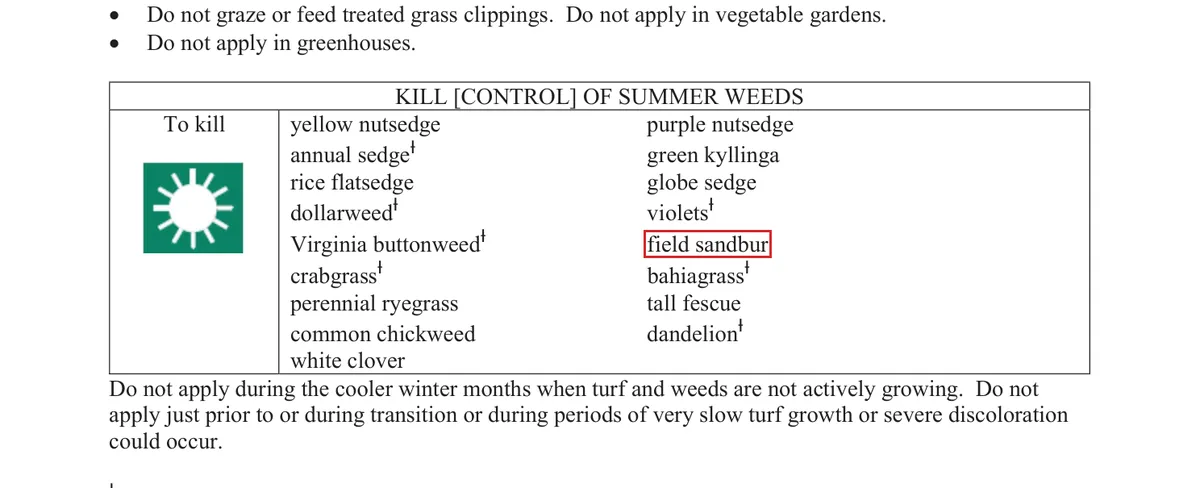
Two professional mixes also list sandbur. Celsius WG (EPA Reg. No. 432-1507) lists field sandbur at 0.085 oz (2.4 g) of product per 1,000 sq ft, bars bahiagrass and every cool-season grass, and states it is intended for licensed commercial applicators. Flazasulfuron is limited to bermuda and zoysia, per AgriLife. In Kansas State ratings, fenoxaprop, MSMA and topramezone gave 90 percent or better sandbur control; sulfentrazone plus imazethapyr gave 75 to 90 percent; atrazine and simazine 50 to 75 percent. Which of those grass herbicides your lawn tolerates is sorted by grass type in our crabgrass killer by lawn type table.
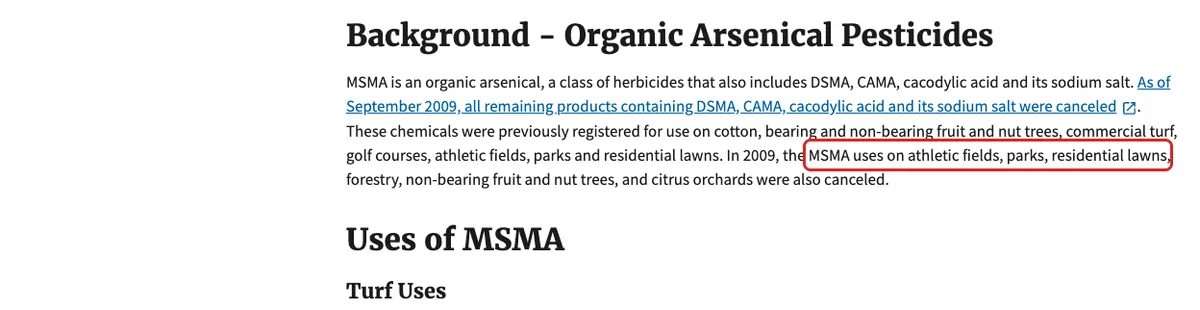
MSMA is the one to cross off. EPA cancelled MSMA use on athletic fields, parks and residential lawns in 2009 and now allows it only on cotton, sod farms, golf courses and highway rights-of-way, with golf use capped at 100 sq ft spot treatments (EPA). Older extension sheets and at least one retailer blog still list it for lawns.
Make the lawn a poor home for sandbur
Sandburs are shade intolerant, prefer sandy soil and root at their nodes (Cornell), and AgriLife says they thrive in poor soil and exploit open spots in thin turf. Start with a lab soil test and feed to its numbers, since sandy lawns lose nitrogen fast, as our page on growing grass in sand works out. Mow at the top of your grass’s range, never scalp, and bag clippings while sandbur is flowering so seed leaves the yard. Liming alone is not a fix: UF/IFAS found no evidence that raising soil pH prevents sandbur.
How do you kill lawn burweed before the spines form?
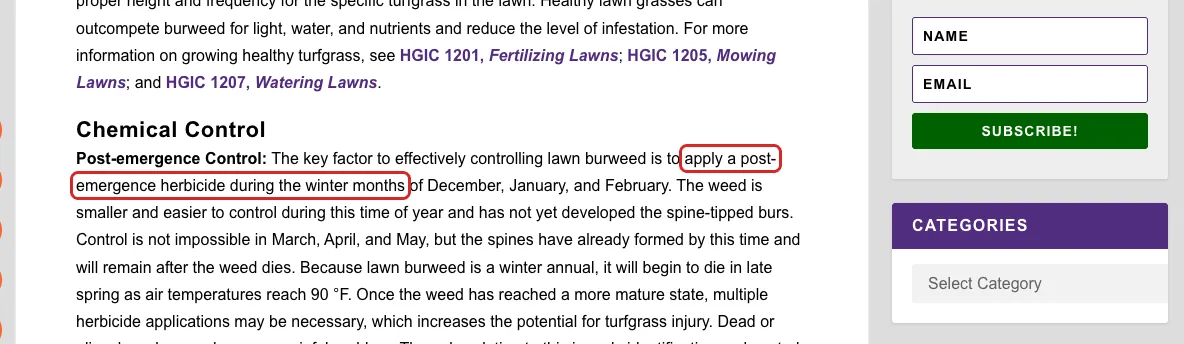
Spray it in winter while it is small and soft. Clemson HGIC 2323 calls a December to February postemergent spray the key factor; by March to May the spines have formed and stay after the weed dies. Burweed dies on its own in late spring as air temperatures reach 90°F, so a May spray buys nothing but dead, sharp burs.
Clemson’s options by grass:
- Three-way broadleaf mix (2,4-D, dicamba and mecoprop): bermuda, zoysia, centipede, St. Augustine and tall fescue. Mixes higher in dicamba and mecoprop work better; 2,4-D alone is weaker on burweed. Use the reduced rate on St. Augustine and centipede.
- Atrazine in November: centipede and St. Augustine only. It kills new seedlings and stops the rest from sprouting. Not near hardwood trees (2 times the drip-line width) or a high water table.
- Thiencarbazone, iodosulfuron and dicamba (Celsius WG): all 4 common warm-season grasses, not fescue. The label lists lawn burweed at its lowest rate, 0.057 oz (1.6 g) per 1,000 sq ft, with a second spray 2 to 4 weeks later; Clemson notes it is safe during spring green-up.
- Metsulfuron (professional): bermuda, centipede, St. Augustine and zoysia. Needs a nonionic surfactant at 2 teaspoons per gallon; skip it above 85°F, near trees, or within 8 weeks of ryegrass overseeding.
- Imazaquin (Image, 73342-4): the label lists lawn burweed among winter weeds, applied after the first killing frost on dormant turf, and never on St. Augustine in winter.
For next year, prevent it. Clemson recommends isoxaben in late September to early October, before winter weeds sprout, at 4.6 to 5.7 lb of 0.38 percent granules per 1,000 sq ft, watered in with 0.5 inch of rain or irrigation as soon as possible, with a repeat 8 weeks later on heavy infestations and no reseeding for 60 days. LSU AgCenter adds simazine for pre and early postemergent control. How three-way mixes treat each lawn grass is covered in our check of whether 2,4-D kills grass.
How do you get rid of puncturevine (goatheads)?
Pull or hoe it before it flowers, which can happen 3 weeks after it sprouts (UC IPM). One plant makes 200 to 5,000 seeds, and seed stays viable for up to 5 years (UC IPM); Utah State puts the average at 7. Mowing does nothing because the mat lies flat. Cut through the taproot, and on large plants gather the branches into a ball so attached burs come out with it.
- Hand-pull or hoe seedlings every 2 to 3 weeks from late spring through summer (Utah State).
- On bare ground, till no deeper than about 1 inch; deeper tillage buries seed that can sprout for years (UC IPM).
- In beds, use at least 3 inches of organic mulch or a light-blocking fabric (UC IPM).
- In lawns, spray young plants with 2,4-D or dicamba, which UC IPM says can be applied to lawns without injuring the grass; glyphosate only as a spot spray, since it kills turf too.
- Before the next season, oryzalin, benefin or trifluralin give partial preemergent control if down in late winter to midspring (UC IPM).
- Keep the lawn dense and mowed at 2.5 to 3 inches; Utah State says short, sparse lawns let puncturevine in.
Two weevils, Microlarinus lareynii (seed) and M. lypriformis (stem), were released in the U.S. in 1961 and work best together (UC IPM). Colorado residents can order them through the state’s Request-A-Bug program for $30, shipped in September; the service is Colorado-only. UC IPM advises against buying weevils from other regions, since they may not survive, and Utah State says they have not been documented overwintering in cold areas such as the Wasatch Front. Puncturevine is also a Class B noxious weed in Washington and Oregon and Class III in Utah, so your county may require control (WSU Hortsense; Utah State). Where goatheads come up through gravel or cracks, our guide to killing weeds in gravel covers the non-lawn options.
What kills khakiweed?
Khakiweed is a perennial, so expect 2 sprays a season. Texas A&M’s SCS-2018-10 says no preemergent is labeled for it; isoxaben may help if down when soil is 60 to 70°F and watered in with 0.5 to 1 inch. Post-emergence actives with activity include 2,4-D, MCPP, MCPA, dicamba, triclopyr, fluroxypyr, carfentrazone and metsulfuron, and sequential metsulfuron sprays about 4 weeks apart gave the most consistent season-long control. Add a nonionic surfactant per the label because of the waxy leaf, and avoid spraying during spring green-up, when St. Augustine is especially sensitive.
Active ingredients for each sticker, by label and extension source
The table pairs each sticker with the actives an EPA label or extension specialist names for it, the timing, and the lawn limits. It holds 21 rows; download the CSV dataset. Brand-by-brand comparisons of store products live in our lawn weed killer guide.
Swipe the table sideways to see every column.
| Sticker | Active ingredient | Type | When | Rate or threshold | Lawn limits | Source |
|---|---|---|---|---|---|---|
| Sandburs | Dithiopyr | Preemergent | Before soil reaches 52°F; repeat per label | Per product label | Product label sets grasses | Texas A&M AgriLife 2026 |
| Sandburs | Indaziflam | Preemergent | Before soil reaches 52°F | Per product label | Product label sets grasses | Texas A&M AgriLife 2026 |
| Sandburs | Oryzalin | Preemergent | Before soil reaches 52°F | Per product label | Product label sets grasses | Texas A&M AgriLife 2026 |
| Sandburs | Pendimethalin | Preemergent | Before soil reaches 52°F | Per product label | Product label sets grasses | Texas A&M AgriLife 2026 |
| Sandburs | Imazaquin (Image Consumer Concentrate, EPA 73342-4) | Postemergent | Summer, turf and weeds actively growing; not during green-up | 4 fl oz per 1,000 sq ft; max 8 per year | Bermuda, St. Augustine, buffalo, centipede, zoysia; may injure tall fescue | EPA label 73342-4 |
| Sandburs | Thiencarbazone + iodosulfuron + dicamba (Celsius WG, EPA 432-1507) | Postemergent | Actively growing weeds; faster above 65°F soil | 0.085 oz per 1,000 sq ft (2.4 g) | Warm-season grasses only; no bahia or cool-season; label intends licensed applicators | EPA label 432-1507 |
| Sandburs | Flazasulfuron | Postemergent | Emerged plants | Per product label | Bermuda and zoysia only; commercial applicators | Texas A&M AgriLife 2026 |
| Sandburs | Fenoxaprop or topramezone | Postemergent | Escapes after a missed preemergent | 90 % control or better (K-State rating) | Professional products; check grass on label | Kansas State 2019 |
| Sandburs | MSMA | Not allowed | None on home lawns | Per product label | Residential lawn use cancelled 2009 | U.S. EPA |
| Lawn burweed | Isoxaben | Preemergent | Late Sept to early Oct; repeat 8 weeks later if heavy | 4.6 to 5.7 lb of 0.38% granules per 1,000 sq ft | Bermuda, centipede, St. Augustine, zoysia, tall fescue; no reseeding 60 days | Clemson HGIC 2323 |
| Lawn burweed | Atrazine | Pre and early post | November | Per product label | Centipede and St. Augustine only; not near hardwoods or high water table | Clemson HGIC 2323 |
| Lawn burweed | 2,4-D + dicamba + mecoprop | Postemergent | Dec to Feb, before spines | Per product label | Reduced rate on St. Augustine and centipede | Clemson HGIC 2323 |
| Lawn burweed | Thiencarbazone + iodosulfuron + dicamba (Celsius WG) | Postemergent | Actively growing; repeat in 2 to 4 weeks; OK at green-up | 0.057 oz per 1,000 sq ft (1.6 g) | Warm-season grasses only | EPA label 432-1507 |
| Lawn burweed | Metsulfuron | Postemergent | Winter; not above 85°F | 2 tsp nonionic surfactant per gallon | Bermuda, centipede, St. Augustine, zoysia; professional | Clemson HGIC 2323 |
| Lawn burweed | Imazaquin (Image, EPA 73342-4) | Pre and post | After first killing frost, dormant turf | 4 fl oz per 1,000 sq ft | Not on St. Augustine for winter weeds | EPA label 73342-4 |
| Lawn burweed | Simazine | Pre and early post | Before and as seedlings emerge | Per product label | Follow label grasses | LSU AgCenter |
| Puncturevine | Oryzalin, benefin or trifluralin | Preemergent (partial) | Late winter to midspring | Per product label | Label sets sites | UC IPM |
| Puncturevine | 2,4-D or dicamba | Postemergent | Young plants | Per product label | Lawn-safe when kept off ornamentals | UC IPM |
| Puncturevine | Glyphosate | Postemergent spot | Young plants | Per product label | Kills grass too; spot only | UC IPM |
| Khakiweed | Isoxaben | Preemergent (not labeled for khakiweed) | Soil 60 to 70°F | 0.5 to 1 inch water to activate | Label sets grasses | Texas A&M SCS-2018-10 |
| Khakiweed | Metsulfuron (also 2,4-D, MCPP, MCPA, dicamba, triclopyr, fluroxypyr, carfentrazone) | Postemergent | Spring, small plants; repeat about 4 weeks later | 4 weeks between sprays | Avoid green-up; St. Augustine sensitive; metsulfuron harms trees | Texas A&M SCS-2018-10 |
How much product for your lawn?
Enter the area you will treat. The answer is the label rate times your square footage; for Image the label also caps you at 8 fl oz per 1,000 sq ft a year, and for Celsius WG at 4.8 g per 1,000 sq ft a year.
- Product per application (fl oz, g or lb, the unit in your choice)
- 20.0
Label rates from EPA 73342-4 and 432-1507 and Clemson HGIC 2323. Yearly caps: Image 8 fl oz per 1,000 sq ft; Celsius WG 4.8 g per 1,000 sq ft. Celsius packets hold 6.4 g. Read the label on the product you buy.
| Product and rate (5,000 sq ft lawn) | Per 1,000 sq ft | Amount for 5,000 sq ft | Source |
|---|---|---|---|
| Image Consumer Concentrate (imazaquin) | 4 fl oz | 20 fl oz, under one 24 fl oz bottle (rated for 6,000 sq ft) | EPA 73342-4 |
| Celsius WG, lawn burweed rate | 1.6 g | 8 g, 1.25 of the 6.4 g packets | EPA 432-1507 |
| Celsius WG, field sandbur rate | 2.4 g | 12 g, just under 2 packets | EPA 432-1507 |
| Isoxaben 0.38% granules (burweed preemergent) | 4.6 to 5.7 lb | 23 to 28.5 lb | Clemson HGIC 2323 |
How do you get the burs off the lawn now?
Killing the plant does not remove its burs, so pick them up. Utah State suggests dragging an old carpet or rolling old pumpkins across the area, and calls vacuuming highly effective on small sites (Utah State); UC IPM says even patting the ground with carpet collects puncturevine burs (UC IPM). Rake or sweep paths and patios, bag the burs rather than composting them, and clean shoes and mower wheels before leaving an infested patch. Wear shoes on the lawn until the collection is done.
How we compiled this
In November 2026 we read 19 sources: 2 EPA-accepted product labels (Image Consumer Concentrate, 73342-4; Celsius WG, 432-1507), EPA’s MSMA status page, 15 extension and university publications (Texas A&M 4, UC IPM 2, UF/IFAS 2, and 1 each from Clemson, Mississippi State, LSU, Utah State, Washington State, Cornell and Kansas State) and Colorado’s Request-A-Bug price list. We did not test any product. Where a source is archived or dated, the text says so; rates come from the labels, and your product’s label overrides them.
This page is general information, not pesticide advice. The label is the law: products and registrations change, and some actives named here are sold only to licensed applicators. Check your state’s rules before hiring anyone to spray, as our applicator license guide explains.
Frequently asked questions
What kills stickers in your yard?
It depends on which sticker. Imazaquin (Image, 73342-4) and preemergents such as dithiopyr or pendimethalin handle sandburs; a three-way 2,4-D, dicamba and mecoprop spray from December to February handles lawn burweed; hand removal plus 2,4-D or dicamba on young plants handles puncturevine (AgriLife; Clemson; UC IPM).
How do you get rid of stickers without killing grass?
Match a selective active to your grass. Image is labeled for bermuda, St. Augustine, buffalograss, centipede and zoysia but may injure tall fescue; Celsius WG is for warm-season grasses only; three-way mixes need the reduced rate on St. Augustine and centipede (EPA 73342-4; EPA 432-1507; Clemson). Never spray during spring green-up unless the label allows it.
Will vinegar kill sticker weeds?
Only the leaves it wets. Vinegar is a contact burn with no soil activity, kills lawn grass too, and does nothing to burs already formed; UF/IFAS found 8-week-old weeds fully recovered within 4 weeks (UF/IFAS EP580). Our vinegar weed killer tests show where it works.
Why is my yard full of stickers?
Thin turf and an old seed bank. Sandburs favor sandy, poor soil and open, sunny turf, and their seed lives up to 8 years (AgriLife; Cornell). Burweed fills thin turf in fall (Clemson), and puncturevine takes bare, compacted ground (Utah State).
Will 2,4-D kill stickers?
It kills the broadleaf ones: lawn burweed (better in a mix with dicamba and mecoprop, per Clemson) and young puncturevine (UC IPM). It does not kill sandburs, which are grasses.
Are burrs and stickers the same thing?
In lawns, yes: “sticker” is a common name for any spiny bur, whether from sandbur, lawn burweed, puncturevine or khakiweed. The plants are unrelated, so the bur’s shape is the fastest way to tell which one you have.
Sources
- Texas A&M AgriLife Today, How to get rid of sandburs and grass stickers for good (P. A. Boeri), Aug. 18, 2026. Accessed November 2026.
- Texas A&M AgriLife Today, Four tips to prevent and remove grass stickers (P. A. Boeri), Aug. 13, 2024. Accessed November 2026.
- Texas A&M AgriLife Extension (archived), Controlling Field Sandbur (Grassbur) in Turfgrass (J. A. McAfee), undated archive. Accessed November 2026.
- Texas A&M AgriLife Extension, SCS-2018-10, Khakiweed Management in Turfgrass, 2018. Accessed November 2026.
- Kansas State University, Sandbur Control for Turfgrass Professionals (J. Hoyle), May 2019. Accessed November 2026.
- Cornell CALS, Weed profile: Sandburs, current page. Accessed November 2026.
- UF/IFAS Extension, SS-AGR-364, Identification and Control of Southern Sandbur in Hayfields, current edition. Accessed November 2026.
- Clemson Cooperative Extension, HGIC 2323, Lawn Burweed, updated Aug. 20, 2021. Accessed November 2026.
- Mississippi State University Extension, P4180, Lawn Burweed (Soliva sessilis) Control in Turfgrass, current edition. Accessed November 2026.
- LSU AgCenter, Lawn burweed, current page. Accessed November 2026.
- UC Statewide IPM Program, Lawn Burweed (Spurweed), weed identification gallery, current page. Accessed November 2026.
- UC Statewide IPM Program, Puncturevine, Pest Notes (C. A. Wilen), current page. Accessed November 2026.
- Utah State University Extension, Puncturevine Identification and Management for Gardens, Lawn, and Pasture, Oct. 2019. Accessed November 2026.
- Washington State University Hortsense, Weeds: Puncturevine, current page. Accessed November 2026.
- Colorado Department of Agriculture, Palisade Insectary, Request-A-Bug, 2026 price list. Accessed November 2026.
- U.S. EPA, Image Herbicide Consumer Concentrate label, EPA Reg. No. 73342-4, accepted Feb. 10, 2022. Accessed November 2026.
- U.S. EPA, Celsius WG Herbicide label, EPA Reg. No. 432-1507, accepted Sept. 1, 2021. Accessed November 2026.
- U.S. EPA, Monosodium Methanearsonate (MSMA), an Organic Arsenical, current page. Accessed November 2026.
- UF/IFAS Extension, EP580, Use of Glyphosate and Herbicide Alternatives for Weed Control in Florida Landscape Planting Beds, Jan. 22, 2020. Accessed November 2026.