How to get rid of torpedo grass depends on what it grows in: quinclorac 3 times, 14 to 21 days apart, in bermuda or zoysia; fluazifop over bed shrubs; glyphosate spot sprays and new sod in St. Augustine, centipede or bahia. Expect 2 seasons.
Working out how to get rid of torpedo grass starts underground. In untreated Florida golf roughs, 87 percent of torpedograss (Panicum repens) dry weight was rhizome and 13 percent was leaf (Busey 2003, Weed Technology), and UF/IFAS says the rhizomes grow up to 20 feet long, mostly in the top 24 inches of soil (UF/IFAS ENH1351).
We matched each lawn grass and site to its current EPA label and the field trials behind it. That corrects a claim in top-ranking guides that nothing selective touches torpedograss in St. Augustinegrass: the Recognition label EPA accepted Feb. 16, 2024 (EPA Reg. No. 100-1658) lists a fluazifop tank mix that suppresses it in St. Augustine and zoysia (Recognition label). Suppression is not a kill, but it is a labeled step short of resodding.
Our guide to common lawn weeds covers the shorter grassy weeds; torpedograss follows the rhizome logic of johnsongrass control by lawn type: repeat sprays before regrowth rebuilds the rhizomes, for 2 seasons.
First, confirm it is torpedograss
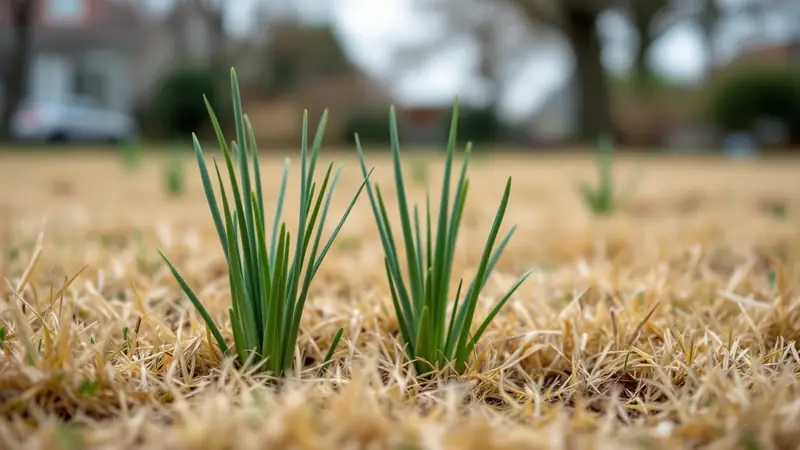
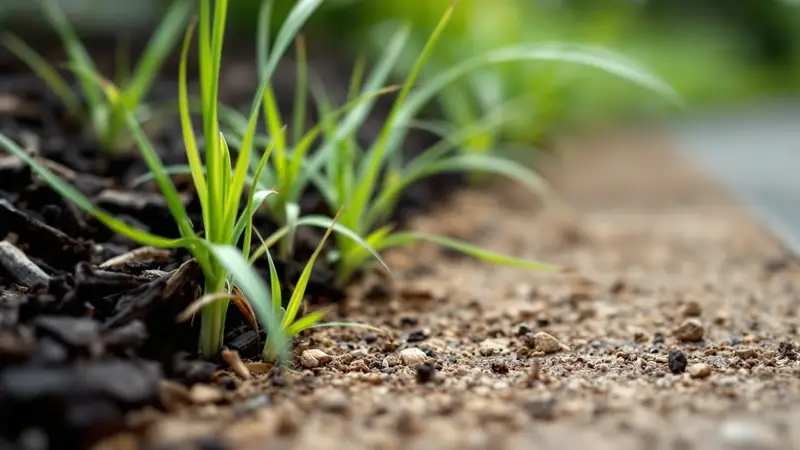
Dig a shoot before you buy anything. The name comes from rigid rhizomes with sharp, torpedo-like tips, 0.1 to 0.2 inch thick, with brownish-to-white scales and swollen nodes that store carbohydrates (UF/IFAS ENH1351). Above ground, check 4 traits:
- Stiff, waxy, gray-green blades about 0.1 inch wide flat and 0.2 inch folded (UF/IFAS), held at about 45 degrees from the stem (Mississippi State P3735-34).
- Hairy leaf sheaths and a short membranous ligule fringed with hairs. Among south Florida warm-season lawn grasses, only bahiagrass also has a membranous ligule; a 10x hand lens shows it (UF/IFAS Collier County, Jan. 2024).
- An open seedhead 3 to 9 inches long, flowering May to November in Florida. The seed is largely nonviable, so new plants come from rhizome and stem pieces (UF/IFAS).
- Unmowed shoots 15 to 40 inches tall, often thickest where soil stays wet (UF/IFAS).
Two lookalikes change the plan. Maidencane (Panicum hemitomon), a native Florida wetland grass, has no torpedo-shaped rhizomes (UF/IFAS), so check before spraying a pond margin. Dallisgrass grows in clumps and has its own 2-season program in our guide on how to kill dallisgrass.
Torpedo grass control by lawn grass and site
The lawn grass decides the herbicide, because torpedograss is in the same family as every southern turfgrass. The table pairs 15 site and product combinations with the current label and the best published trial. Suppression is the label’s word for significant activity short of commercial control (Monument 75WG label, EPA Reg. No. 100-1134).
Swipe the table sideways to see every column.
| Where it grows | Active ingredient | Product (EPA Reg. No.) | Label status for torpedograss | Label rate | Best published result | Source |
|---|---|---|---|---|---|---|
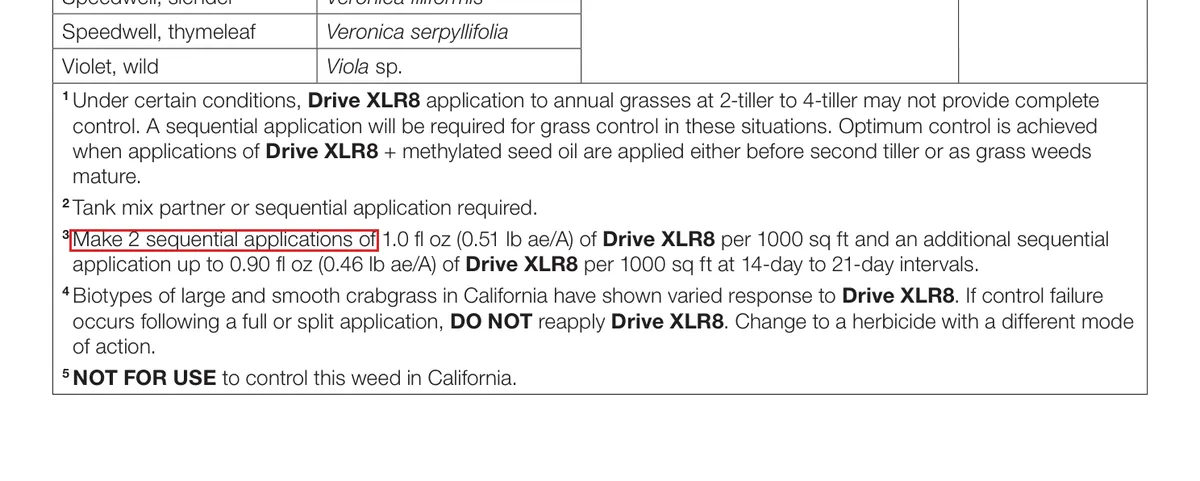
| Bermudagrass or zoysiagrass lawn | quinclorac | Drive XLR8 (7969-272) | Listed: control | 2 passes at 1.0 fl oz/1,000 sq ft, a 3rd up to 0.90 fl oz, 14 to 21 days apart; 2.9 fl oz/1,000 sq ft/yr cap | 88% control from 3 passes of 0.6 kg/ha, 21 days apart, in bermudagrass (Brecke 2001) | Drive XLR8 label; Brecke 2001 |
| Bermudagrass or zoysiagrass lawn | trifloxysulfuron | Monument 75WG (100-1134) | Listed: suppression | 0.53 oz/acre; repeat in 4 to 6 weeks, at least 28 days apart; 1.7 oz/acre/yr cap | 87% control 15 weeks after sequential sprays in 1999 to 2000; no treatment above 45% in the rainy 2002 to 2003 seasons (Stephenson 2006) | Monument 75WG label; Stephenson 2006 |
| Bermudagrass or zoysiagrass lawn | trifloxysulfuron + quinclorac | Recognition (100-1658) + quinclorac | Tank mix listed for enhanced control | Quinclorac at 0.5 lb active/acre with Recognition; not on centipede, buffalo or kikuyu | No trial of this exact mix found | Recognition label |
| St. Augustinegrass lawn | trifloxysulfuron + fluazifop-P-butyl | Recognition (100-1658) + Fusilade II (100-1084) | Tank mix listed: suppression | 0.045 oz + 0.28 to 0.55 fl oz/1,000 sq ft; not on ProVista or Captiva unless injury is acceptable | No published trial found | Recognition label |
| St. Augustinegrass lawn | quinclorac | Drive XLR8 (7969-272) | Lawn grass listed as susceptible: do not use | None | LSU AgCenter: no selective option in St. Augustinegrass | Drive XLR8 label; LSU AgCenter |
| St. Augustinegrass, centipede or bahia lawn | glyphosate, spot spray | A glyphosate product labeled for lawn spot use | Check the bottle | UF/IFAS: 2 to 3% v/v; repeat as shoots return | Kills turf too: remove the dead patch and resod (LSU AgCenter) | UF/IFAS ENH1351; LSU AgCenter 2013 |
| Centipedegrass lawn | sethoxydim | Segment II (7969-398) | Torpedograss not listed; centipede is a labeled site | Mature centipede: up to 1.5 pt/acre per spray, 3.0 pt/acre/season | 84% less torpedograss cover after 3 sprays every 4 weeks; regrowth within weeks (Taverner 2011) | Segment II label; Taverner 2011 |
| Centipedegrass lawn | quinclorac | Drive XLR8 (7969-272) | Label bars centipedegrass | None | More than 25% centipede injury in trials (Taverner 2011) | Drive XLR8 label; Taverner 2011 |
| Bahiagrass lawn | quinclorac | Drive XLR8 (7969-272) | Lawn grass listed as susceptible: do not use | None | UF/IFAS Collier: no herbicide without severe turf damage | Drive XLR8 label; UF/IFAS Collier |
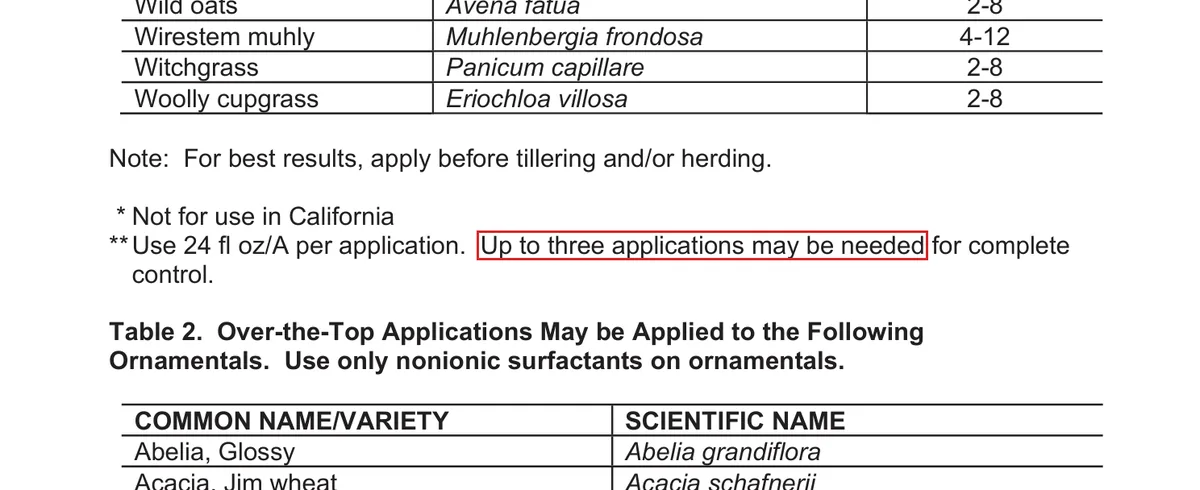
| Planting bed, over broadleaf shrubs | fluazifop-P-butyl | Fusilade II (100-1084) | Listed at 3 to 10 in. tall | 24 fl oz/acre (about 0.55 fl oz/1,000 sq ft) per spray; up to 3 sprays | Less effective than glyphosate; multiple sprays usually needed (UF/IFAS) | Fusilade II label; UF/IFAS ENH1351 |
| Planting bed, directed spray | glyphosate | A glyphosate product labeled for landscape beds | Check the bottle | UF/IFAS: 2 to 3% v/v, kept off ornamentals | Repeat sprays often needed (UF/IFAS) | UF/IFAS ENH1351 |
| Pond edge or ditch | glyphosate, aquatic label | Glyphosate 5.4 (81927-8) | Listed: partial control | 6 to 7.5 pt/acre broadcast; higher rate on floating mats | Mississippi State: 1.0 oz per gallon plus 1.3 oz surfactant; 8 weeks between treatments | Glyphosate 5.4 label; Mississippi State |
| Pond edge or ditch | imazapyr | Habitat (241-426) | Listed | See label; not for landscape beds (UF/IFAS) | Mississippi State: 2.0 oz of a 2 lb product per gallon | Habitat label; Mississippi State |
| Any warm-season lawn | thiencarbazone + iodosulfuron + dicamba | Celsius WG (432-1507) | Torpedograss not listed | None for torpedograss | No trial found | Celsius WG label |
| Any lawn | 2,4-D, dicamba, penoxsulam, sulfentrazone or quinclorac blends | Roundup For Lawns (2217-917, 2217-1009, 2217-1010) | Torpedograss not listed on any of the 3 | None for torpedograss | No trial found | 2217-917; 2217-1009; 2217-1010 |
1Is the torpedograss in or at the edge of a pond, lake, canal or ditch?
YesUse only an aquatic-labeled glyphosate or imazapyr product, repeat 8 weeks apart, and in Florida check Rule 68F-20.0035 for a permit exemption first.
NoGo to the next question
2Is it growing up through shrubs or flowers in a planting bed?
YesSpray fluazifop over plants listed on the label (Fusilade II: 24 fl oz per acre, up to 3 sprays) or a directed 2 to 3 percent glyphosate where it can stay off the plants.
NoGo to the next question
3Is the lawn bermudagrass or zoysiagrass?
YesQuinclorac in 3 passes 14 to 21 days apart (Drive XLR8: 1.0, 1.0 and up to 0.90 fl oz per 1,000 sq ft), for 2 seasons.
NoGo to the next question
4Is the lawn centipedegrass?
YesSethoxydim sprays about 4 weeks apart within Segment II's 3.0 pint per acre season cap; expect suppression and regrowth, or spot-kill and resod.
NoGo to the next question
5Is the lawn St. Augustinegrass other than ProVista or Captiva?
YesSuppress with the Recognition plus fluazifop tank mix on the Feb. 2024 label, or spot-kill patches with glyphosate and resod.
NoBahiagrass, ProVista or Captiva St. Augustine, or a mixed lawn: spot-kill with glyphosate, remove the dead patch and resod; renovate if torpedograss covers most of the lawn.
Source: EPA labels 7969-272, 100-1084, 100-1658, 7969-398, 81927-8; UF/IFAS ENH1351; LSU AgCenter
Whatever the site, the program runs on the same 5 steps:
- Spray only actively growing torpedograss, late spring through summer. The Drive XLR8 label bars drought-stressed weeds, and Mississippi State waits for water of at least 60°F at pond edges.
- Repeat on the label interval: 14 to 21 days for Drive XLR8, and 4 to 6 weeks, never under 28 days, for Monument 75WG.
- Judge regrowth from the rhizomes, not the canopy: Busey found visual canopy ratings too optimistic because torpedograss regrew from rhizomes.
- Start again the next season. Brecke and colleagues expect quinclorac programs to run more than 1 season, and sethoxydim may need more than 1 year (Taverner 2011).
- Thicken the lawn grass into the gaps. LSU AgCenter lists up to 3 lb of nitrogen per 1,000 sq ft a year for bermudagrass and St. Augustinegrass and up to 2 lb for zoysiagrass and centipedegrass.
Bermudagrass and zoysiagrass: three quinclorac passes
Quinclorac is the one turf herbicide with a full control claim. Drive XLR8 (EPA Reg. No. 7969-272) lists torpedograss in Table 3, footnote 3: two applications of 1.0 fl oz per 1,000 sq ft, then a third of up to 0.90 fl oz, 14 to 21 days apart, with methylated seed oil at 0.55 fl oz per 1,000 sq ft (Drive XLR8 label, Nov. 2019). The 3 passes total 2.9 fl oz, the label’s full yearly allowance.
The label program tracks the research. In 1998 to 2000 trials in bermudagrass, three quinclorac applications of 0.6 kg/ha, 21 days apart, gave 88 percent torpedograss control, against 69 percent for two applications of 0.8 kg/ha or one of 1.7 kg/ha (Brecke 2001). That 0.6 kg/ha is close to the label’s 0.51 lb per acre first pass.
Trifloxysulfuron is the second tool. Sequential sprays gave 87 percent control 15 weeks after the first in a 1999 to 2000 trial, but in the rainy 2002 to 2003 seasons no treatment beat 45 percent (Stephenson 2006). Monument 75WG labels it for suppression only, at 0.53 oz per acre, at least 28 days apart, with no more than 1.7 oz per acre a year.
Drive XLR8 rates common bermudagrass and zoysiagrass highly tolerant and hybrid bermudagrass moderately tolerant. Mow bermuda at 1 to 2 inches and zoysia at 1 to 2.5 inches so the turf closes over treated spots (LSU AgCenter); our zoysia grass lawn guide lists the other weeds quinclorac covers there.
The calculator converts label rates to one patch; its 500 sq ft default is worked below.
- Product per application, fl oz
- 0.50
- Product per application, mL
- 14.8
- Product per application, teaspoons
- 3.0
Default: 500 sq ft x 1.0 fl oz per 1,000 sq ft = 0.5 fl oz (14.8 mL) of Drive XLR8 for pass 1. Per-acre rates divided by 43.56. Check the label on your container; rates and limits change.
| Pass (Drive XLR8, 500 sq ft) | Label rate per 1,000 sq ft | Product for 500 sq ft | Methylated seed oil for 500 sq ft |
|---|---|---|---|
| 1, day 0 | 1.0 fl oz | 0.5 fl oz (14.8 mL) | 0.28 fl oz (8.1 mL) |
| 2, day 14 to 21 | 1.0 fl oz | 0.5 fl oz (14.8 mL) | 0.28 fl oz (8.1 mL) |
| 3, day 28 to 42 | Up to 0.90 fl oz | 0.45 fl oz (13.3 mL) | 0.28 fl oz (8.1 mL) |
| Season total | 2.9 fl oz (yearly cap) | 1.45 fl oz (42.9 mL) | 0.83 fl oz (24.4 mL) |
Why does it take two seasons?
A 2-year trial in Florida bermudagrass roughs shows the timetable. Quinclorac split 4 ways (0.42 kg/ha, 4 times a year) for 2 years cut torpedograss canopy to 10 percent and dry weight to 1,570 kg/ha. The then-labeled program, 0.84 kg/ha twice a year, left 45 percent canopy and 4,640 kg/ha; untreated plots held 86 percent and 8,010 kg/ha (Busey 2003).
| Quinclorac program, 2 years | Torpedograss canopy | Torpedograss dry weight |
|---|---|---|
| Untreated | 86% | 8,010 kg/ha |
| 0.84 kg/ha, 2 times a year | 45% | 4,640 kg/ha |
| 0.42 kg/ha, 4 times a year | 10% | 1,570 kg/ha |
The split logic carries into today’s 3-pass Drive XLR8 directions. An earlier bermudagrass study found follow-up sprays 3 weeks after the first beat those delayed to 4 weeks, and needed more than 2.2 kg/ha in total for 80 percent control (McCarty 1993).
St. Augustinegrass: suppress it, or spot-kill and resod
The Drive XLR8 label lists St. Augustinegrass as susceptible, so quinclorac is out. LSU AgCenter says there are no selective herbicide options for torpedograss in St. Augustine, and a January 2024 UF/IFAS Collier County article says no herbicide controls it without severely damaging the turf (UF/IFAS Collier County).
The exception is narrow. The Feb. 2024 Recognition label lists Recognition at 1.95 oz per acre (0.045 oz per 1,000 sq ft) plus fluazifop-P-butyl as Fusilade II (EPA Reg. No. 100-1084) at 12 to 24 fl oz per acre (0.28 to 0.55 fl oz per 1,000 sq ft) on St. Augustinegrass to suppress torpedograss, with a nonionic surfactant at 0.25 to 0.5 percent. It warns against ProVista and Captiva St. Augustinegrass unless injury can be tolerated. We found no published trial measuring this mix on torpedograss, so expect regrowth control, not removal.
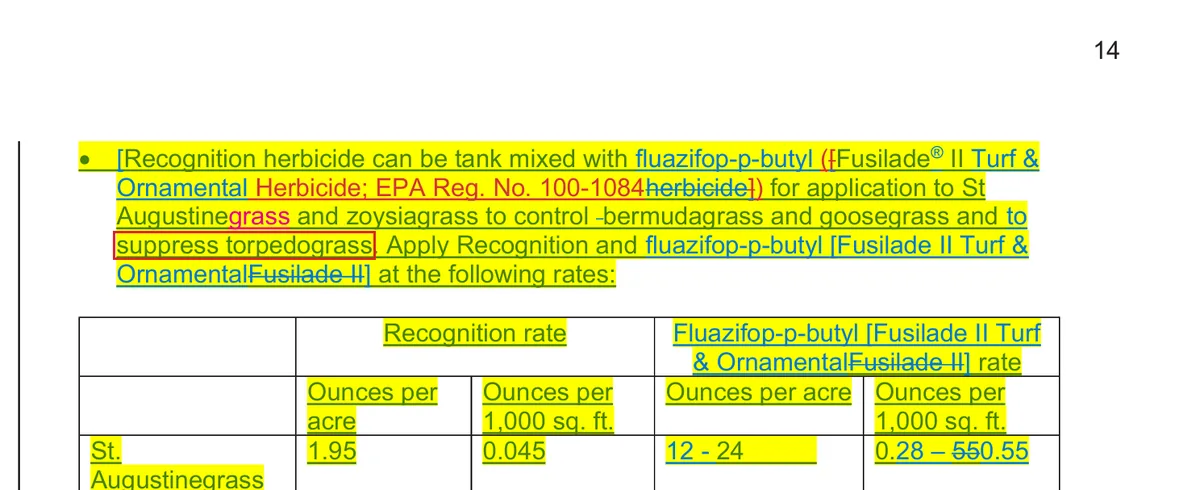
Recognition allows no more than 3 applications and 6.26 oz per acre a year. The paragraph is printed in brackets on the EPA-stamped master label, which marks wording a registrant may choose to print, so confirm it appears on the label of the bag you buy (EPA Reg. No. 100-1658).
For patches, LSU horticulturist Dan Gill describes the dependable route: kill the torpedograss and the St. Augustine with it using glyphosate, remove the brown patch, lay sod, and repeat when shoots return (LSU AgCenter, July 2013). For a lawn mostly lost to torpedograss, he suggests renovating to zoysia or bermudagrass so quinclorac becomes usable. Our St. Augustine grass care guide covers mowing and feeding for the replacement sod.
Centipedegrass and bahiagrass
Centipedegrass tolerates sethoxydim, which suppresses torpedograss without eradicating it. In Louisiana trials, 3 sethoxydim sprays 4 weeks apart cut torpedograss cover 84 percent and clethodim 87 percent at 12 weeks, yet regrowth began within weeks of the last spray, and repeated quinclorac injured centipedegrass more than 25 percent (Taverner 2011). LSU AgCenter says sethoxydim only temporarily suppresses it.
Check the label math before planning 3 sprays. Segment II (EPA Reg. No. 7969-398) does not list torpedograss, and it caps mature centipedegrass at 1.5 pints per acre per spray and 3.0 pints per season, so a 3-spray season means 3 sprays of 1.0 pint or less (Segment II label, Sept. 2024). Our centipede grass lawn guide lists the other herbicides labeled for that grass.
Bahiagrass has no selective option: Drive XLR8 lists it as susceptible, and UF/IFAS Collier County groups it with St. Augustinegrass for patch kills before resodding, at the 2 to 3 percent v/v glyphosate UF/IFAS uses for directed sprays. Which retail Roundup bottles hold glyphosate is sorted in our page on which Roundup products kill lawn grass.
Flower beds and shrub plantings
In beds, UF/IFAS recommends a directed 2 to 3 percent v/v glyphosate solution where it can stay off the ornamentals, with repeat sprays. Where torpedograss grows up through shrubs, it names fluazifop (Fusilade II) or sethoxydim over the top, both less effective than glyphosate and usually needing multiple sprays (UF/IFAS ENH1351).
The July 2026 Fusilade II label lists torpedograss at 3 to 10 inches tall and sets 24 fl oz per acre, about 0.55 fl oz per 1,000 sq ft, per application, noting up to 3 applications may be needed for complete control (Fusilade II label, July 2026). Its Table 2 names the ornamentals cleared for over-the-top sprays, ixora and dwarf Burford holly among them.
Barriers and preemergents do little. Gill says the hard rhizome tips punch through landscape fabric, and UF/IFAS says preemergence herbicides are not effective because torpedograss spreads by rhizomes. Our flower bed weed control guide compares 6 grass-killer labels plant by plant.
Ponds, lake edges and ditches
Torpedograss is a Category I invasive on the Florida Invasive Species Council list updated April 2026, and UF/IFAS cites a 1992 survey placing it in more than 70 percent of Florida’s public waters. At the waterline, use only aquatic-labeled products. Glyphosate 5.4 (EPA Reg. No. 81927-8) lists torpedograss at 6 to 7.5 pints per acre broadcast or a 0.75 to 1.5 percent hand-held solution for partial control, higher on floating mats, and says repeat treatments will be required (Glyphosate 5.4 label, Aug. 2024).
Mississippi State’s aquatic fact sheet mixes 1.0 oz of a 5.4 lb glyphosate with 1.3 oz of nonionic surfactant per gallon, or 2.0 oz of a 2 lb imazapyr, and leaves 8 weeks between treatments (Mississippi State P3735-34). Imazapyr products such as Habitat (EPA Reg. No. 241-426) list torpedo grass (Habitat label), but UF/IFAS warns imazapyr is not labeled for landscapes and can kill ornamentals.
In Florida, herbicide work in waters of the state needs an FWC aquatic plant management permit unless Rule 68F-20.0035 exempts the water: those wholly surrounded by one private owner, artificial waters and non-public waters under 160 acres qualify unless directly connected to Waters of Special Concern or a manatee aggregation site. Exempt ponds still follow the label and the rule’s public notice requirement (Fla. Admin. Code R. 68F-20.0035).
Why pulling, tilling, vinegar and baking soda fail
UF/IFAS rates mechanical control only moderately effective: tilling, digging and mowing cut rhizomes into fragments that sprout, and up to 60 percent of rhizome fresh weight tolerates drying, so dug pieces left on the surface can survive. Digging works only in a small, confined bed, and every piece has to leave the site (UF/IFAS ENH1351).
Vinegar and baking soda burn only what they touch. Our vinegar weed killer tests show grasses and perennial roots usually regrow, and we found no trial of either on torpedograss. With 87 percent of the plant underground (Busey 2003), a leaf burn leaves the rhizomes intact.
Prevention is the cheapest control. UF/IFAS advises buying soil, mulch and hay from certified sources and cleaning mowers between properties, and LSU AgCenter traces many lawn infestations to contaminated soil brought in for beds and renovation.
How we compiled this
In November 2026 we downloaded the newest EPA-accepted labels for 11 registrations from the EPA Pesticide Product and Label System and read each one’s weed table, turf tolerance table, rates and yearly limits. We added 5 peer-reviewed field trials (abstracts in Weed Technology), 5 extension publications from UF/IFAS, LSU AgCenter and Mississippi State, the April 2026 FISC list and Florida Rule 68F-20.0035. We ran no field trials ourselves. The full table is in how-to-get-rid-of-torpedo-grass-2026.csv.
This page is general information, not pesticide advice. The label is the law: read the full label on the product you buy, follow its rates, site list and state restrictions, and check with your state pesticide agency or county extension office before treating water.
Frequently asked questions
Will Roundup kill torpedo grass?
Glyphosate Roundup products can, with repeat sprays at the 2 to 3 percent solution UF/IFAS uses. Roundup For Lawns cannot: none of its 3 labels we checked (2217-917, 2217-1009, 2217-1010) lists torpedograss.
Will vinegar kill torpedo grass?
Not permanently. Vinegar is a contact burn, and torpedograss keeps 87 percent of its dry weight in rhizomes that regrow (Busey 2003).
Will baking soda kill torpedo grass?
We found no trial showing it does. Baking soda scorches leaves it lands on, and it never reaches rhizomes that UF/IFAS says run up to 20 feet long.
Will quinclorac hurt bermuda grass?
Usually only briefly. Drive XLR8 rates common bermudagrass highly tolerant and hybrid moderately tolerant, and McCarty 1993 saw Tifway injured 4 to 10 weeks after high-rate programs, then recover.
What is the best herbicide to kill torpedo grass?
Glyphosate and imazapyr are the most effective, per UF/IFAS, but both kill lawn grass. In bermuda or zoysia, quinclorac at 3 split passes is the best selective option, with 88 percent control in one Florida trial (Brecke 2001).
Sources
- UF/IFAS EDIS, Biology and Management of Torpedograss (Panicum repens) in Ornamental Landscape Planting Beds, ENH1351 (Khamare, Prince, Marble), 2021. Accessed November 2026.
- Weed Technology, Busey, Reduction of Torpedograss Canopy and Rhizomes by Quinclorac Split Applications, 17(1):190 to 194, 2003. Accessed November 2026.
- Weed Technology, Brecke et al., Torpedograss Control with Quinclorac in Bermudagrass, 15(4):732 to 736, 2001. Accessed November 2026.
- Weed Technology, Stephenson et al., Control of Torpedograss with Trifloxysulfuron-Sodium in Bermudagrass Turf, 2006. Accessed November 2026.
- Weed Technology, McCarty, Higgins and Colvin, Selective Torpedograss Control in Bermudagrass Turf, 7:911 to 915, 1993. Accessed November 2026.
- Weed Technology, Taverner et al., Selective Postemergence Herbicide Control of Torpedograss in Centipedegrass, 2011. Accessed November 2026.
- LSU AgCenter, Torpedograss (turfgrass weeds), current page. Accessed November 2026.
- LSU AgCenter, Gill, Torpedograss: one of the most difficult weeds to control, July 2013. Accessed November 2026.
- UF/IFAS Extension Collier County, Torpedograss in Collier County Lawns, Jan. 10, 2024. Accessed November 2026.
- Mississippi State University Extension, Torpedograss, Publication 3735-34, 2023. Accessed November 2026.
- Florida Invasive Species Council, FISC Plant List, Category I and II, April 2026. Accessed November 2026.
- Florida Administrative Code via Cornell LII, Rule 68F-20.0035, Waters or Activities Exempt from Permitting, amended Nov. 20, 2018. Accessed November 2026.
- U.S. EPA PPLS, Drive XLR8 Herbicide, EPA Reg. No. 7969-272, Nov. 1, 2019. Accessed November 2026.
- U.S. EPA PPLS, Fusilade II Turf and Ornamental Herbicide, EPA Reg. No. 100-1084, July 15, 2026. Accessed November 2026.
- U.S. EPA PPLS, Recognition, EPA Reg. No. 100-1658, Feb. 16, 2024. Accessed November 2026.
- U.S. EPA PPLS, Monument 75WG Herbicide, EPA Reg. No. 100-1134, Nov. 21, 2024. Accessed November 2026.
- U.S. EPA PPLS, Segment II Herbicide, EPA Reg. No. 7969-398, Sept. 12, 2024. Accessed November 2026.
- U.S. EPA PPLS, Glyphosate 5.4, EPA Reg. No. 81927-8, Aug. 5, 2024. Accessed November 2026.
- U.S. EPA PPLS, Habitat Herbicide, EPA Reg. No. 241-426, Aug. 17, 2011. Accessed November 2026.
- U.S. EPA PPLS, Celsius WG, EPA Reg. No. 432-1507, Sept. 1, 2021. Accessed November 2026.
- U.S. EPA PPLS, EH-1462 Herbicide (Roundup For Lawns1, Northern), EPA Reg. No. 2217-917, Sept. 10, 2025. Accessed November 2026.
- U.S. EPA PPLS, EH-1574 Herbicide (Roundup For Lawns4, Southern), EPA Reg. No. 2217-1009, Apr. 26, 2024. Accessed November 2026.
- U.S. EPA PPLS, EH-1573 Herbicide (Roundup For Lawns6, Southern), EPA Reg. No. 2217-1010, June 14, 2024. Accessed November 2026.