Can you walk on frosted grass? A single crossing usually does little harm: in Oregon State trials, foot traffic on frosted greens caused no injury. Keep mowers, carts and daily paths off until frost melts and soil thaws, or footprint-shaped brown patches follow.
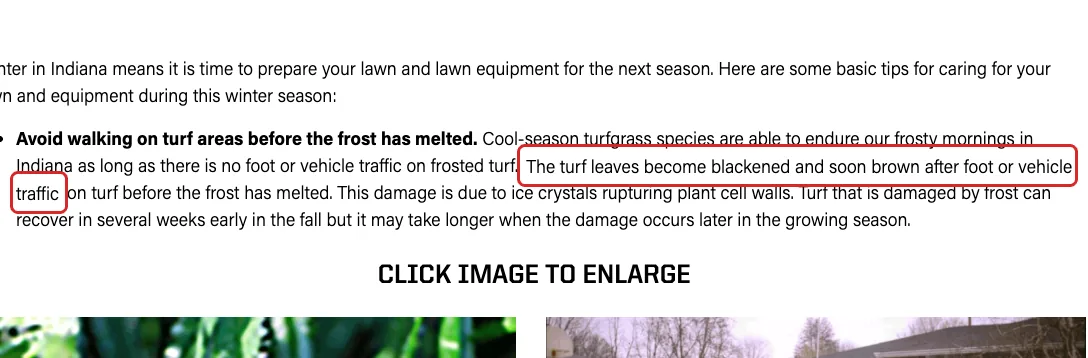
Can you walk on frosted grass without leaving dead footprints? Purdue Extension says no: trodden frosted leaves turn black, then brown, because ice crystals rupture the cells, and healing takes several weeks in early fall and longer later. That holds for wheels and daily paths. For one walk, newer research is milder.
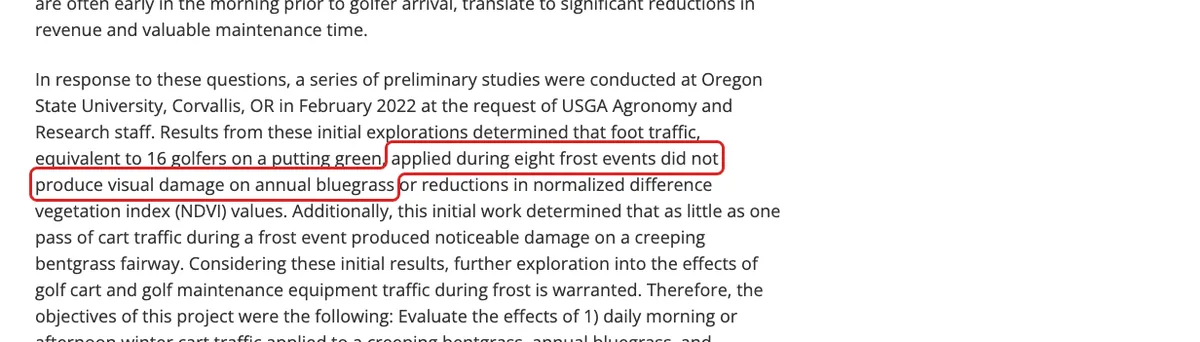
From 2022 to 2025, Oregon State University ran the only controlled frost-traffic trials we found, for the USGA. Foot traffic equal to 16 golfers on 8 frost mornings did not injure an annual bluegrass green; one golf-cart pass on a frosted bentgrass fairway did (USGA Green Section Record, 2024). None of the top-ranking answers cites them. The table below turns those trials, Purdue, LSU and the National Weather Service into a call for 10 situations, including where perennial ryegrass behaved differently.
Walk, wait or stay off: 10 frosty-lawn situations
| Situation | Walk on it? | Mow, drive or wheel? | What happens | Source |
|---|---|---|---|---|
| White frost on a cool-season lawn that is still growing (Oct. to Nov.) | Wait for the melt if you can; one crossing is low risk | No | Trodden leaves blacken, then brown; recovery takes several weeks early in fall | Purdue PPDL; Oregon State |
| Frost on a dormant lawn (Dec. to Feb.) | Avoid repeat trips | No | No regrowth until spring; footprints show as dead spots at green-up | Nebraska Extension |
| Frost gone, but soil froze overnight (below 32°F) | Yes, once | No, even in the afternoon | Cart and roller injury tracked morning soil below 32°F, at 8 a.m. and at 1 p.m. | USGA / Oregon State, 2024 |
| Frost gone, soil thawed, blades dry | Yes | Yes, at your usual height | Normal wear | Purdue PPDL |
| Hard freeze, 28°F or lower for hours, turf frozen stiff | No | No | Leaf and shoot cells rupture when squashed; dead areas shaped like footprints or tire tracks | LSU AgCenter; NWS |
| Ice storm, or lawn watered and then frozen | No | No | Same rupture damage as frozen turf | LSU AgCenter |
| Frosted perennial ryegrass, morning at or below 35°F | Keep it light | No | Cart injury at morning temperatures of 35°F or less; foot traffic cut NDVI in 2025 only | USGA; Oregon State |
| Dormant bermudagrass in the South | Yes, lightly | Limit wheels | Carts 4 times a week shredded 22 to 28% of leaf blades and cut spring emergence about 10% | USGA, Dec. 2024 |
| Frosted annual bluegrass putting green | Foot traffic of 16 golfers on 8 frost mornings did no harm | No rolling or mowing | Rolling on frost mornings reduced turf quality | USGA / Oregon State |
| Light frost, air above 32°F, and you must cross now | Water a strip first | No | A light irrigation melts frost so use can resume | LSU AgCenter; NC State |
The third and last rows matter most at home. Morning soil temperature, not visible frost, predicted cart and roller injury: below 32°F, wheels hurt turf at 8 a.m. and again at 1 p.m., after the frost was gone (USGA, 2024). To cross a light frost while the air is above freezing, LSU AgCenter says a light watering melts it first.
1Is there white frost or stiff, crunchy grass anywhere on your route, including shaded and north-facing spots?
YesWait for the melt or use pavement. If you must cross and the air is above 32°F, water a strip lightly first to melt the frost (LSU AgCenter). One careful crossing is low risk; avoid repeat trips.
NoGo to the next question
2Will anything with wheels go on the grass today: mower, wheelbarrow, car, golf cart?
YesIf the soil froze overnight, wait for a day when it has not: Oregon State trials found cart and roller injury at 8 a.m. and at 1 p.m. whenever morning soil was below 32°F.
NoGo to the next question
3Is this a route you use every day, such as the mailbox path or the dog's run?
YesVary the route or lay 3 or 4 stepping stones: repeated trips on frozen turf can kill those strips, and a dormant lawn cannot regrow until spring (Nebraska Extension).
NoWalk normally: the frost is gone, the soil is thawed and the traffic is occasional.
Why frozen grass blades break
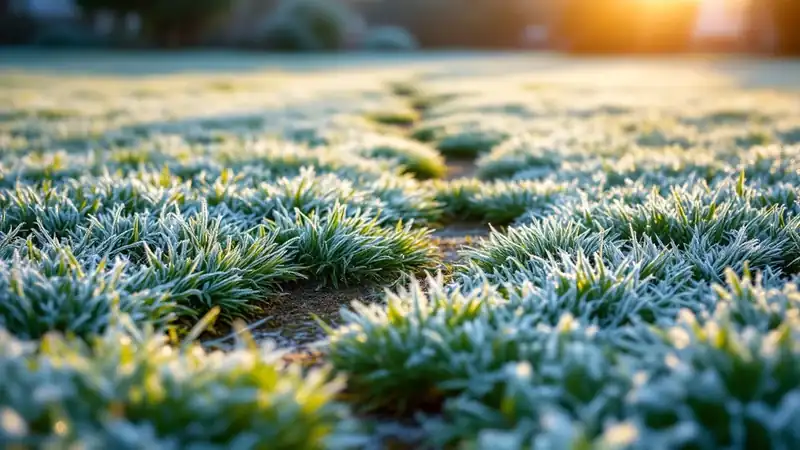
Frost is ice on a surface at or below 32°F. The National Weather Service separates feathery white frost, where vapor turns straight to ice, from frozen dew, which looks slicker. Grass frosts before pavement because blades shed heat fast and give off moisture, while concrete holds the day’s warmth.
A frosted blade is stiff. LSU AgCenter says frosted blades break off because ice crystals fracture inside the leaves, and hard-frozen turf ruptures its leaf and shoot cells when squashed. What decides recovery is the crown, the growing point at the soil line: NC State TurfFiles warns that traffic on frozen crowns can kill the plant, and puts the freezing point of the water between cells of hardened turf at 14 to 23°F.
What the frost-traffic trials actually found
| When | Turf | Traffic | Result | Source |
|---|---|---|---|---|
| Feb. 2022 | Annual bluegrass putting greens, sand and native soil, cut at 0.140 in | Foot traffic equal to 16 golfers, work boots or golf shoes, 8 frost mornings | No injury: every rating 1.0 on a 1 to 3 scale; NDVI 0.78 to 0.85, same as untrodden plots | USGA GSR 62(5) |
| Feb. 12 to 13, 2022 | Creeping bentgrass fairway, native soil | 1 or 7 golf cart passes on frost | 1 pass left noticeable damage; both treatments lasted more than 2 weeks; 7 passes hurt even without frost | USGA GSR 62(5) |
| Jan. 2 to Feb. 28, 2023 | Bentgrass, annual bluegrass and ryegrass fairways | Daily cart, 8 a.m. or 1 p.m. | Quality fell after frost events at both times; morning soil below 32°F was the best predictor | USGA GSR 62(5) |
| Jan. 2 to Feb. 28, 2023 | Perennial ryegrass fairway | Daily cart | Unacceptable injury at morning temperatures of 35°F or less; lowest quality rating of the study, 4.0 | USGA GSR 62(5) |
| Jan. 2 to Feb. 28, 2023 | Annual bluegrass green | Daily 48-in greens roller | Unacceptable injury at morning temperatures of 32°F or less | USGA GSR 62(5) |
| Early 2024 (preliminary) | Bentgrass and ryegrass fairways | Foot traffic, morning and afternoon, on freezing-soil days | Slight damage to bentgrass, none to ryegrass | USGA GSR 62(5) |
| 2023 to 2025 | Creeping bentgrass fairway | Foot traffic | Not affected in 2023, 2024 or 2025 | Kowalewski et al., UMN Winter Turf |
| 2025 | Perennial ryegrass fairway | Foot traffic | NDVI reduced in 2025 only; morning walking hurt more than afternoon | Kowalewski et al., UMN Winter Turf |
| 2023 to 2025 | Greens and fairways | Roller and cart | Regularly reduced NDVI, morning more than afternoon; risk of killing turf “likely lower than current guidance suggest” | Kowalewski et al., UMN Winter Turf |
Read the trials with their limits. The plots were golf turf in Corvallis, Ore., greens cut at 0.140 inch, in a mild winter; a Minnesota lawn mowed at 3 inches, the floor Purdue sets for home lawn cut heights, faces deeper soil frost. The authors say the foot-traffic result “applies only to foot traffic and only to annual bluegrass putting greens” (USGA, 2024). Their final summary still finds cart and roller traffic in freezing conditions harmful, with the risk of killing turf likely lower than current guidance suggests (UMN Winter Turf).
For a lawn the split is feet versus wheels, and once versus daily. A walk to the shed is unlikely to leave lasting marks; a mower, a car parked on the grass or a dog run used 10 times a day is on the side every source agrees hurts.
How long after sunrise until it is safe?
No source gives minutes, because frost clears by temperature and shade, not the clock. The USGA notes that north-facing slopes, low spots and sheltered areas hold frost long after open ground thaws, and shade from a few trees can keep a course closed. Check the shady side of the house first.
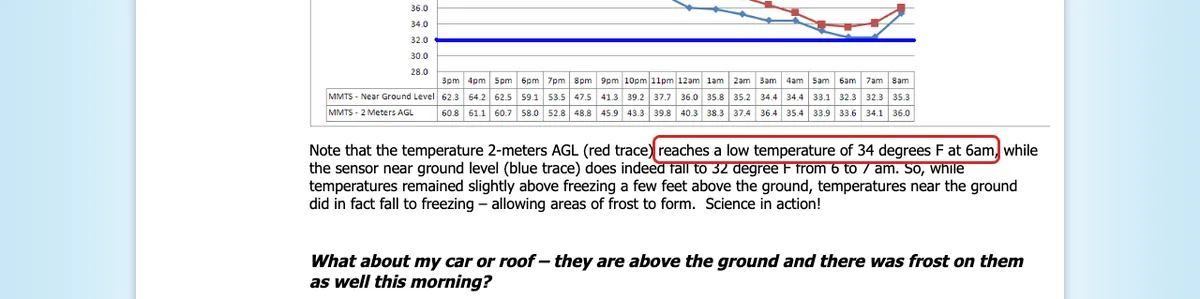
Your thermometer can mislead you. Official readings are taken 4 to 5 feet up, and on clear, calm nights cold air pools at grass level, so frost forms while the reading sits in the upper 30s (NWS). In a 2008 test by NWS Aberdeen, the 2-meter sensor bottomed at 34°F at 6 a.m. while a ground-level sensor read 32°F.
After a heavy frost on warm-season turf, LSU AgCenter says keep traffic off until temperatures reach the mid to upper 30s. For wheels the Oregon State rule is stricter: if the soil froze that morning, wait for a day with thawed soil (Oregon State final report).
| Term or threshold | Temperature | What it means for walking on grass | Source |
|---|---|---|---|
| Frost on surfaces | Surface at or below 32°F | Blades can frost while a thermometer 4 to 5 ft up reads in the upper 30s | NWS Houston/Galveston |
| Aberdeen, S.D. test, Oct. 2, 2008 | 34°F at 2 m, 32°F at ground | A 2°F gap was enough for frost at ground level | NWS Aberdeen |
| Wind that stops widespread frost | 3 to 5 mph | Breezy nights rarely leave a frosted lawn | NWS Aberdeen |
| Frost range used by Nebraska Extension | 32 to 36°F | Expect frost on the lawn on calm nights in this range | Nebraska Extension |
| Freeze warning | Below 32°F for a long period | If the soil freezes, wheels injure turf that whole day (Oregon State) | NWS |
| Hard freeze | 28°F or lower, extended | Kills most vegetation; turf frozen stiff | NWS glossary |
| Water between cells of hardened turf freezes | 14 to 23°F | Tissue itself frozen; crowns easily damaged by traffic | NC State TurfFiles |
| Sudden drop that can kill warm-season turf | Below 20 to 23°F | Permanent damage possible before anyone walks on it | UF/IFAS; NC State |
What frost footprints look like, and how fast they heal
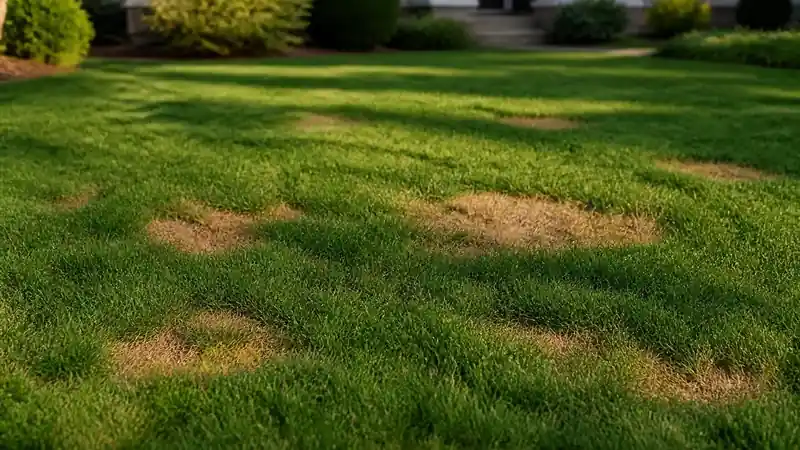
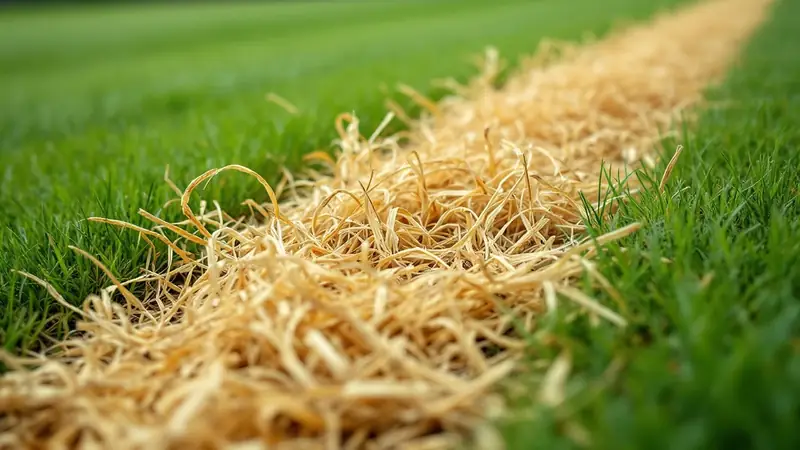
Damage is not visible while you walk. Purdue describes leaves that turn black and soon brown; LSU describes dead footprint and tire-track shapes. On a dormant lawn the marks can hide until spring: Nebraska Extension says they appear as the rest of the lawn greens. Golf-course notices often say 48 to 72 hours, but no university source we read gives a number.
Recovery runs from 2 weeks to a full season. Oregon State’s cart damage lasted more than 2 weeks, the USGA says frost damage can take more than a month, and Purdue says several weeks early in fall, longer later. A dormant lawn repairs nothing until spring, so December damage stays until April or May.
- Wait for spring green-up before acting. Brown blades on a dormant lawn are normal; our guide to telling dormant grass from dead grass has the crown test.
- If footprints are still brown 3 to 4 weeks after the rest of the lawn greens, loosen the compacted strip: Nebraska Extension says frozen and wet soils compact under traffic, and core aeration is the fix in our lawn aeration guide.
- Reseed bare spots in mid to late April in Nebraska-type climates (Nebraska Extension), sized patch by patch with our patchy grass repair guide.
- Skip prodiamine or pendimethalin crabgrass preventers on reseeded spots that spring; Nebraska Extension names mesotrione or topramezone products as the alternatives, and the product label is the law on rate and timing.
Mowing, cars and dormant warm-season lawns
Do not mow frosted grass. Purdue says to avoid mowing, leaf removal and other maintenance on frost-covered or frozen turf, and the Oregon State roller and cart results show why wheels are worse than feet. Once frost melts the blades are wet, so our rules for mowing wet grass apply next.
Late-fall frosts usually arrive near the last mow anyway: cool-season grass stops growing once daytime highs stay below 50°F (Iowa State Extension), which our dates for when grass stops growing put between late October and December in most U.S. cities.
Dormant warm-season grass is not immune. In a Texas A&M study summarized by the USGA, golf carts driven 4 times a week over dormant bermudagrass shredded 22 to 28 percent of leaf blades and cut spring green-up by about 10 percent. Tan bermudagrass can take a walk in January; it should not be a parking spot.
Dogs, kids and the path to the mailbox
Repetition does the damage. Nebraska Extension says walking the same route to the mailbox or with the dog each frozen morning repeats the injury on turf that cannot regrow until spring, sometimes killing those strips. Vary the route, keep to pavement, or lay 3 or 4 stepping stones, which cost less than reseeding a 20-foot trail in April. An afternoon of kids sledding on a frozen lawn is the same concentrated traffic.
How we compiled this
In November 2026 we read 17 primary documents: three reports on the USGA-funded Oregon State frost-traffic trials (2022 to 2025), two other USGA articles, eight extension pages from Purdue, Nebraska, LSU, NC State, UF/IFAS and Iowa State, and four National Weather Service pages. We did not walk on or test any turf. The situation table is our synthesis of those sources; where they disagree, both results are shown. We also read the top 5 Google results for the question, which cite none of the trials.
Frequently asked questions
What happens if you walk on frosty grass?
Frozen blades can crack and the cells rupture, so footprints may turn black, then brown, and take several weeks to heal (Purdue). One crossing on light frost often leaves no mark: Oregon State saw no injury from foot traffic on frosted greens over 8 frost mornings. Repeated trips and frozen soil raise the risk.
Does driving on frosted grass kill it?
It injures it. One golf-cart pass on a frosted bentgrass fairway left noticeable damage that lasted more than 2 weeks in Oregon State trials, and carts hurt turf even in the afternoon when morning soil was below 32°F. Park on pavement until the soil thaws.
At what temperature can frost form on grass?
Grass frosts when its surface reaches 32°F, which can happen while a thermometer 4 to 5 feet up reads in the upper 30s on clear, calm nights (NWS). A breeze of 3 to 5 mph is usually enough to prevent widespread frost (NWS Aberdeen).
Will grass still grow after a frost?
Cool-season grass keeps growing until daytime highs stay below 50°F (Iowa State), often weeks after the first frost. Warm-season grasses such as bermudagrass turn tan and go dormant after the first heavy frost and green up again in spring.
Can you mow grass when it’s frosted?
No. Purdue says to avoid mowing and other maintenance on frost-covered or frozen turf, and Oregon State found carts and rollers injured turf whenever morning soil was below 32°F. Wait until the frost has melted, the blades have dried and the soil has thawed.
Sources
- USGA Green Section Record (Kowalewski, Schmid and Starchvick, Oregon State University), The Effects of Traffic on Turf During Frost and Freezing Conditions, Vol. 62, Issue 5, 2024. Accessed November 2026.
- University of Minnesota Winter Turf (Kowalewski, Schmid, McDonald and Starchvick), Effects of equipment traffic on turfgrass during frost conditions, Results through 2025. Accessed November 2026.
- Western Canada Turfgrass Association (Kowalewski et al.), Effects of Equipment Traffic on Turfgrass During Frost and Freezing Conditions: Final Report, Current page. Accessed November 2026.
- USGA, What Every Golfer Should Know About Frost Delays (Golf Journal), Feb. 2023. Accessed November 2026.
- USGA Green Section Record (Whitlark), The Impacts of Golf Cart Traffic on Dormant Bermudagrass, Vol. 62, Issue 22, Dec. 2024. Accessed November 2026.
- Purdue Plant and Pest Diagnostic Laboratory (Orick), Winter Lawn Care Tips, 2021. Accessed November 2026.
- Purdue Plant and Pest Diagnostic Laboratory (Orick), Mowing and Leaf Removal, 2021. Accessed November 2026.
- Nebraska Extension, Nebraska Water, Avoid Traffic on Frozen Turf, Current page. Accessed November 2026.
- Nebraska Extension in Lancaster County, Spring Cold Snaps: How to Handle Your Yard Before and After a Late Frost, Current page. Accessed November 2026.
- LSU AgCenter, Cold damages turfgrass, Dec. 2015. Accessed November 2026.
- NC State TurfFiles, Winter kill and responding to it now, Jan. 2010. Accessed November 2026.
- UF/IFAS Gardening Solutions, Cold Damage to Turf, Current page. Accessed November 2026.
- Iowa State University Extension and Outreach, When can I stop mowing the lawn in the fall?, Current page. Accessed November 2026.
- National Weather Service Houston/Galveston, Dew and Frost (training page), Current page. Accessed November 2026.
- National Weather Service Aberdeen, S.D., NWS Science Corner: How does Frost Form with Low Temps Warmer than 32F?, Test dated Oct. 2, 2008. Accessed November 2026.
- National Weather Service, Glossary: Freeze, Hard Freeze, Current page. Accessed November 2026.
- National Weather Service, Understanding Cold Weather Alerts (Freeze Warning, Frost Advisory), Current page. Accessed November 2026.