How much grass seed do I need? Divide square feet by 1,000 and multiply by the rate: 6 to 8 lb of tall fescue or 2 to 3 lb of Kentucky bluegrass per 1,000 sq ft for a new lawn. Overseed at about half.
The honest answer to how much grass seed do I need is that it swings 40-fold by species: centipedegrass goes down at 0.25 to 0.5 lb per 1,000 sq ft (NC State Extension, Table 9-4) and bahiagrass at 5 to 10 lb (UF/IFAS LH013). The free calculators that rank for this question list one unsourced number per grass. This page ties each rate to the extension table it came from, shows where those tables disagree, corrects the pounds for the pure live seed printed on your seed tag, and checks 5 retail bags against the extension figures.
Seeding rates by grass: new lawn vs overseeding
Use the new-lawn column for bare soil and the overseeding column for a thin lawn you are thickening. Kansas State puts tall fescue at 6 to 8 lb per 1,000 sq ft for new areas and “about half as much for overseeding or seeding areas in the shade,” and Kentucky bluegrass at 2 to 3 lb new and half that over an existing lawn (K-State Research and Extension). Where several extension services publish different ranges, the table shows the most common one and lists the others, so you can pick your own state’s figure.
| Grass | New lawn (lb per 1,000 sq ft) | Overseeding (lb per 1,000 sq ft) | Other published ranges | Source |
|---|---|---|---|---|
| Tall fescue, turf-type | 6 to 8 | 3 to 4 | UT 5 to 8; NC State 6; Purdue 6 to 9 | Penn State; K-State; UMD |
| Kentucky bluegrass | 2 to 3 | 1 to 1.5 | UT and Purdue 1.5 to 2; NC State 1 to 2 | Penn State; K-State; UMD |
| Perennial ryegrass | 4 to 6 | 4 to 6 (renovation) | Penn State 4 to 5 for a new lawn in sun | UT W160-B; Penn State |
| Fine fescues (red, chewings, sheep) | 3 to 5 | Not given | Penn State 4 to 5; UMD 4 to 6 | UT W160-B |
| Rough bluegrass (full shade) | 2 to 3 | Not given | Only Penn State lists it | Penn State Table 1 |
| Kentucky bluegrass + perennial ryegrass (80 to 90% bluegrass) | 2 to 3 | Not given | Purdue 3 to 4 at 85 to 90% bluegrass; NC State 2.5 at 60% bluegrass | Penn State Table 1 |
| Shade mix: fine fescues + bluegrass + 10% ryegrass | 4 | Not given | Only Penn State lists it | Penn State Table 1 |
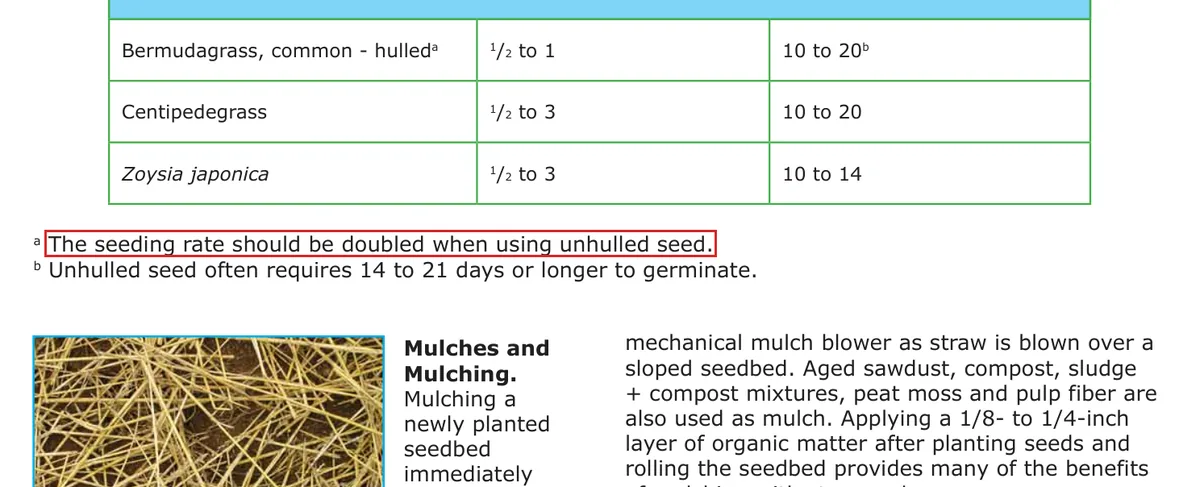
| Bermudagrass, hulled, raw | 1 to 2 | Not given | UT 0.5 to 1; UF/IFAS 1 to 4; double it for unhulled (UT) or coated (NC State) seed | NC State Table 9-4 |
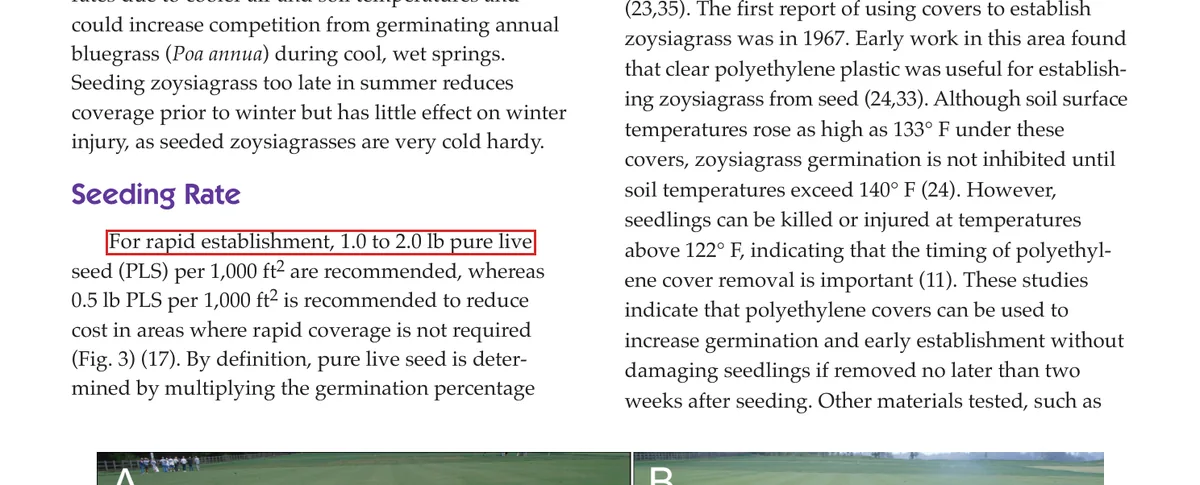
| Zoysiagrass, seeded cultivars (Zenith, Compadre) | 1 to 2 | Not given | UMD 1; UT 0.5 to 3; Arkansas 1 to 2 lb of pure live seed for fast cover, 0.5 lb on a budget | NC State Table 9-4 |
| Centipedegrass | 0.25 to 0.5 | Not given | UF/IFAS 0.25 to 1; UT 0.5 to 3 | NC State Table 9-4 |
| Bahiagrass | 5 to 10 | Not given | NC State 5 | UF/IFAS LH013 |
| St. Augustinegrass | No seed sold | No seed sold | Plant sod, plugs or sprigs | NC State |
Two rows need a warning. St. Augustinegrass: NC State says “Seed is unavailable, so cultivars must be vegetatively planted” (NC State Extension Gardener Handbook, ch. 9), yet several online seed calculators still offer it at 2 lb per 1,000 sq ft. Plan sod, plugs or sprigs instead; our St. Augustine grass guide covers all three.
Centipedegrass is where the sources split widest: 0.25 to 0.5 lb (NC State), 0.25 to 1 lb (UF/IFAS) and 0.5 to 3 lb in University of Tennessee W160-B, a 12-fold spread at the top. Seed is tiny and slow, and NC State notes a seeded stand “may take two to three years” to fill. Most centipede bags are coated, which is why their labels print higher rates; our centipede grass lawn guide compares them.
Work out the pounds and bags for your lawn
The formula is pounds of seed = (lawn area in sq ft / 1,000) x rate x (100 / PLS), where PLS is the pure live seed percentage from the tag. Penn State measures the area first and subtracts the house, driveway and beds, since no turf goes there (Penn State Extension, Lawn Establishment). Leave the seed-tag field on “rate as printed” if you are using a coated bag’s own rate or do not have the tag yet.
- Pounds of seed
- 35.0
- 5 lb bags
- 7
- 20 lb bags
- 2
- 50 lb bags
- 1
Default: 5,000 sq ft of new tall fescue at 7 lb per 1,000 sq ft is 35 lb, one 50 lb bag. Rates are midpoints of the extension ranges in the first table; pick the coated-bag rows or your bag's own rate for coated or seed-plus-fertilizer products. Per acre, enter 43,560 sq ft.
| Step | Input | Result |
|---|---|---|
| Measure | Front 40 x 60 ft + back 50 x 70 ft, minus a 400 sq ft bed | 2,400 + 3,500 minus 400 = 5,500 sq ft |
| Rate | Tall fescue, new lawn, 7 lb per 1,000 sq ft (midpoint of 6 to 8) | 5.5 x 7 = 38.5 lb |
| Tag | 95% pure seed x 85% germination | PLS 80.75%; multiply by 100 / 80.75 = 1.24 |
| Pounds to buy | 38.5 lb x 1.24 | 47.7 lb: one 50 lb bag of raw seed |
| Same lawn, overseeding | 3.5 lb per 1,000 x 5.5 x 1.24 | 23.8 lb |
Set the spreader to deliver half the seed and cover the lawn twice in different directions, which Penn State says leaves fewer skips. Every other step, from starter fertilizer to raking the seed in about 1/4 inch, is in our how to plant grass seed guide, and the overseeding version (mowing to 1 to 1.5 inches, slit seeding, aeration) is in how to overseed a lawn.
Why bluegrass needs 2 lb and tall fescue needs 7: seeds per square inch
Seed size sets the rate. University of Tennessee W160-B says small-seeded Kentucky bluegrass and bermudagrass “require fewer pounds of seed per 1,000 square feet” than large-seeded perennial ryegrass and tall fescue (UT Extension W160-B). The federal seed-testing rules put numbers on it: 7 CFR 201.46, Table 1 lists about 3,060 Kentucky bluegrass seeds per gram against 455 for tall fescue (eCFR, 7 CFR 201.46). Converted at 453.6 grams per pound, that is about 1.39 million bluegrass seeds per pound and 206,000 tall fescue seeds.
| Grass | Seeds per gram (7 CFR 201.46) | Seeds per lb | New-lawn rate, lb per 1,000 sq ft | Seeds per sq ft | Seeds per sq inch |
|---|---|---|---|---|---|
| Kentucky bluegrass | 3,060 | 1,387,992 | 2 to 3 (Penn State) | 2,776 to 4,164 | 19.3 to 28.9 |
| Rough bluegrass | 4,610 | 2,091,059 | 2 to 3 (Penn State) | 4,182 to 6,273 | 29.0 to 43.6 |
| Bermudagrass (hulled) | 3,930 | 1,782,617 | 1 to 2 (NC State) | 1,783 to 3,565 | 12.4 to 24.8 |
| Red or chewings fescue | 900 | 408,233 | 3 to 5 (UT) | 1,225 to 2,041 | 8.5 to 14.2 |
| Tall fescue | 455 | 206,384 | 6 to 8 (Penn State) | 1,238 to 1,651 | 8.6 to 11.5 |
| Perennial ryegrass | 530 | 240,404 | 4 to 6 (UT) | 962 to 1,442 | 6.7 to 10.0 |
| Bahiagrass, Pensacola | 600 | 272,155 | 5 to 10 (UF/IFAS) | 1,361 to 2,722 | 9.4 to 18.9 |
At their extension rates, most grasses land between about 960 and 4,200 seeds per square foot, roughly 7 to 29 per square inch. Penn State says its rates “are designed to provide about 1000 to 2000 seedlings per 1000 sq ft” (Penn State Extension). Its own 6 to 8 lb tall fescue rate puts down 1,238 to 1,651 seeds per square foot by the arithmetic above, so that sentence appears to mean per square foot, not per 1,000.
More seed is not a fix. UT warns that planting too much seed “most often results in a very dense stand of weak, poorly developed and disease-prone seedlings,” and NC State’s tall fescue advice pairs a 6 lb rate with the line “Do not assume more seed is better” (NC State). If birds or a washout thin the stand, the losses are usually smaller than they look; our page on keeping birds off grass seed runs those numbers.
Read the seed tag before you trust any rate
Every rate in the first table assumes good seed. The tag tells you whether yours is. For seed shipped across state lines, the Federal Seed Act regulations set what the label must show (eCFR, 7 CFR Part 201), and state seed laws add their own rules for retail sales.
| Tag line | Rule | What it changes in your math |
|---|---|---|
| Kind (and variety) of each grass over 5% of the bag, with its percentage | 7 CFR 201.9, 201.10 | Which row of the rate table applies; tall fescue must show a variety name or “Variety Not Stated” |
| Mixtures listed in order of predominance | 7 CFR 201.12a | The first-listed grass sets the rate for a mix |
| Germination % for each kind over 5% | 7 CFR 201.20 | The second half of the PLS calculation |
| Hard or dormant seed % (not counted in germination) | 7 CFR 201.21 | Seed that may sprout late; leave it out of PLS |
| Inert matter % | 7 CFR 201.19 | Coating is counted as inert (7 CFR 201.51b(f)), so a coated bag shows a lower pure seed % |
| Month and year of the germination test | 7 CFR 201.22 | No more than 5 months before interstate shipment (24 months in hermetically sealed packs) |
Pure live seed is purity times germination. Penn State’s worked example: “92 percent pure seed of the cultivar x 80 percent germination / 100 = 74 percent PLS,” so you need 100 / 74 = 1.35 lb of that seed for each pound the rate calls for (Penn State Extension). The University of Arkansas defines PLS the same way and writes its zoysiagrass rates in pounds of PLS: 1 to 2 lb per 1,000 sq ft for fast cover, 0.5 lb where speed does not matter (Arkansas MP476).
| Tag PLS (purity x germination) | Multiply the rate by | A 7 lb tall fescue rate becomes |
|---|---|---|
| 95% | 1.05 | 7.4 lb |
| 90% | 1.11 | 7.8 lb |
| 85% | 1.18 | 8.2 lb |
| 80% | 1.25 | 8.8 lb |
| 74% (Penn State example) | 1.35 | 9.5 lb |
| 70% | 1.43 | 10.0 lb |
| 60% | 1.67 | 11.7 lb |
| 50% | 2.00 | 14.0 lb |
The tag’s test date matters too. Penn State says germination “must be determined by special test procedures within a specified time period, usually within nine months of sale.” If your seed is a season or two old, retest it and use your own germination figure; our guide to whether old grass seed goes bad shows how to run a home germination test.
What retail bags say vs extension rates
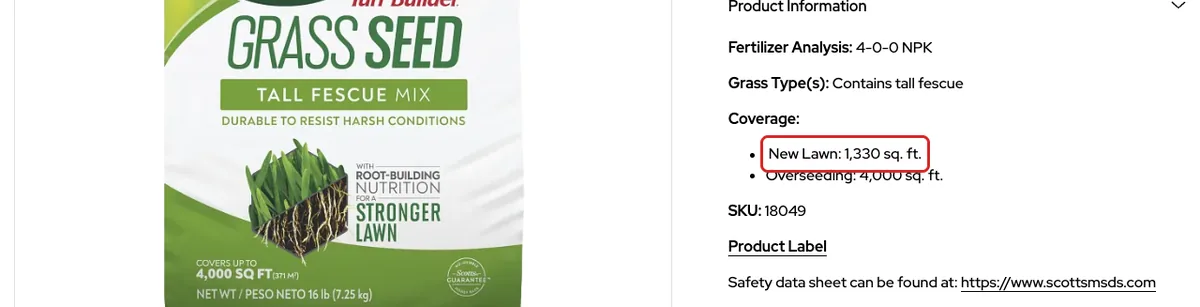
Many retail bags are not pure seed. Scotts Turf Builder Grass Seed Tall Fescue Mix is labeled “Combination seed, fertilizer & soil improver” with a 4-0-0 fertilizer analysis, and its 16 lb bag covers 1,330 sq ft as a new lawn and 4,000 sq ft for overseeding (Scotts product page; bag label PDF). That works out to 12.0 lb per 1,000 sq ft new, against 6 to 8 lb of raw tall fescue at extension rates. The front of the bag prints only the larger figure: “Covers up to 4,000 sq ft.”
| Product (maker page) | What is in the bag | Label: new lawn | Label: overseeding | Extension raw-seed rate (lb per 1,000) | Headline claim |
|---|---|---|---|---|---|
| Scotts Turf Builder Grass Seed Tall Fescue Mix, 16 lb | Seed + 4-0-0 fertilizer + soil improver | 1,330 sq ft = 12.0 lb per 1,000 | 4,000 sq ft = 4.0 lb per 1,000 | 6 to 8 | Front: “Covers up to 4,000 sq ft” |
| Scotts Turf Builder Grass Seed Kentucky Bluegrass Mix, 5.6 lb | Seed + 4-0-0 fertilizer + soil improver | 1,240 sq ft = 4.5 lb per 1,000 | 3,730 sq ft = 1.5 lb per 1,000 | 2 to 3 | Lists both rates |
| Pennington Smart Seed Sun and Shade Tall Fescue Mix for Southern Lawns | Seed with fertilizer seed coat | 12 lb per 1,000 | 4 lb per 1,000 | 6 to 8 | 15 lb bag: 1,250 sq ft new, 3,750 overseeding |
| Pennington Smart Seed Bermudagrass, 8.75 lb | Penkoted seed with fertilizer coating | 3.5 lb per 1,000 = 2,500 sq ft | 1.75 lb per 1,000 = 5,000 sq ft | 1 to 2 raw; 2 to 4 coated | “This bag covers up to 5,000 sq. ft.” |
| Pennington Bermudagrass, 1 lb | Penkoted seed | 500 sq ft (2 lb per 1,000) in the description; 2.5 lb per 1,000 under Planting Rates | 1,000 sq ft = 1 lb per 1,000 | 1 to 2 raw; 2 to 4 coated | Two different new-lawn rates on one page |
Two rules follow. For a coated or seed-plus-fertilizer product, sow at the bag’s own new-lawn rate, because coating and fertilizer take up weight that would be seed in a raw bag. For raw seed sold by species and variety, the extension rate applies and the PLS correction above does the rest. And read past the headline: the biggest number on the bag is usually the overseeding coverage, 3 times the new-lawn figure on the Scotts tall fescue bag and 2 times on Pennington Smart Seed Bermudagrass (Pennington).
Labels can disagree with themselves. Pennington’s 1 lb Bermudagrass page says the bag covers 500 sq ft of new lawn (2 lb per 1,000) and, a few lines lower, lists 2.5 lb per 1,000 sq ft for new lawns (Pennington Bermudagrass). When that happens, use the higher figure for bare soil. Price per square foot, not per bag, is the fair comparison; our grass seed cost page does that math by species.
How much grass seed per acre?
Multiply the per-1,000 rate by 43.56, since an acre is 43,560 sq ft. Purdue publishes acre figures directly: 65 to 87 lb of Kentucky bluegrass and 261 to 348 lb of tall fescue (Purdue AY-3, Table 2). Its per-1,000 column lists tall fescue at 6.0 to 9.0 lb, which would be 261 to 392 lb an acre; the printed 348 lb ceiling matches 8 lb, so the acre column is the one consistent with the other extension rates.
| Grass | lb per 1,000 sq ft | 1/4 acre (10,890 sq ft) | 1/2 acre (21,780 sq ft) | 1 acre (43,560 sq ft) |
|---|---|---|---|---|
| Tall fescue | 6 to 8 | 65 to 87 lb | 131 to 174 lb | 261 to 348 lb |
| Kentucky bluegrass | 2 to 3 | 22 to 33 lb | 44 to 65 lb | 87 to 131 lb |
| Perennial ryegrass | 4 to 6 | 44 to 65 lb | 87 to 131 lb | 174 to 261 lb |
| Bermudagrass, hulled, raw | 1 to 2 | 11 to 22 lb | 22 to 44 lb | 44 to 87 lb |
| Bahiagrass | 5 to 10 | 54 to 109 lb | 109 to 218 lb | 218 to 436 lb |
| Centipedegrass | 0.25 to 0.5 | 2.7 to 5.4 lb | 5.4 to 11 lb | 11 to 22 lb |
Use lawn rates, not the per-acre rates printed for pasture or forage seed. For what those pounds cost per acre at current 50 lb bag prices, see grass seed cost per acre.
When to sow above or below the range
Penn State allows rates above normal in 2 cases: seeding after the late-summer window, when cold soil cuts germination, and turf that will take heavy wear, like a football field. It allows lower rates where a dense stand is not needed, such as an area mowed rarely and high, and warns that a thin stand lets in more weeds.
1Does the bag say coated, Penkoted, or seed plus fertilizer?
YesUse the bag's own new-lawn or overseeding rate, not the extension figure.
NoGo to the next question
2Are you seeding bare soil?
YesUse the new-lawn column, then multiply by 100 / PLS from the tag.
NoThickening a thin lawn: use about half the new-lawn rate (K-State), then go to question 3.
3Are you seeding after the late-summer window, or for heavy wear such as a play area?
YesGo to the top of the range; Penn State allows higher rates in both cases.
NoGo to the next question
4Is it a rarely mowed, low-maintenance area, or slow zoysiagrass on a budget?
YesThe low end is acceptable (Penn State; Arkansas uses 0.5 lb PLS for zoysia), with more weeds as the trade-off.
NoUse the midpoint of the extension range for your grass.
Source: Penn State Extension; K-State; University of Arkansas MP476
The economics of going higher are weak on slow grasses. In the zoysiagrass research Arkansas cites, doubling the rate from 1 to 2 lb of PLS per 1,000 sq ft raised coverage after one season by at most 11 percent, at an estimated $900 more per acre (University of Arkansas MP476). For shady lawns, choose the grass before the rate: fine fescues at 4 to 5 lb are one of Penn State’s 2 picks for full shade, and our grass that grows in shade guide covers the alternatives.
How we compiled this
We read the seeding-rate tables in 8 extension documents (Penn State, Kansas State, University of Tennessee, Purdue, NC State, University of Maryland, UF/IFAS and University of Arkansas), the Federal Seed Act labeling and seed-testing rules in 7 CFR Part 201, and 5 retail product pages from Scotts and Pennington, all in November 2026. Seeds per pound, per square foot and per square inch, PLS multipliers and per-acre amounts are our arithmetic from those figures. We did not test any seed or product.
Frequently asked questions
How much will a 50 lb bag of grass seed cover?
At extension new-lawn rates, a 50 lb bag of raw tall fescue covers 6,250 to 8,333 sq ft (6 to 8 lb per 1,000), Kentucky bluegrass 16,667 to 25,000 sq ft (2 to 3 lb) and raw hulled bermudagrass 25,000 to 50,000 sq ft (1 to 2 lb). Overseeding roughly doubles those figures. A coated or seed-plus-fertilizer bag covers only what its label says.
How much will 20 lbs of grass seed cover?
Twenty pounds of raw tall fescue covers 2,500 to 3,333 sq ft of bare soil or 5,000 to 6,667 sq ft when overseeding at 3 to 4 lb per 1,000 sq ft. The same weight of Kentucky bluegrass covers 6,667 to 10,000 sq ft of new lawn.
How many pounds of grass seed per 1,000 sq ft for overseeding?
About half the new-lawn rate: 3 to 4 lb of tall fescue and 1 to 1.5 lb of Kentucky bluegrass per 1,000 sq ft, per Kansas State. Penn State uses 4 to 6 lb of perennial ryegrass when renovating a lawn.
Can you put too much seed on your lawn?
Yes. University of Tennessee Extension says too much seed most often gives a very dense stand of weak, poorly developed, disease-prone seedlings, and Penn State adds mower scalping. Stay within the published range, 6 to 8 lb per 1,000 sq ft for tall fescue, unless you are seeding late or for heavy wear.
How much grass seed do I need for 1/4 acre?
A quarter acre is 10,890 sq ft. For a new lawn that is 65 to 87 lb of tall fescue, 22 to 33 lb of Kentucky bluegrass or 11 to 22 lb of raw hulled bermudagrass, before any adjustment for the pure live seed on the tag.
Sources
- Penn State Extension, Lawn Establishment (Table 1, seed labels and PLS, seeding rates), accessed November 2026. Accessed November 2026.
- University of Tennessee Extension, W160-B: Establishing a Lawn From Seed, PDF, accessed November 2026. Accessed November 2026.
- Kansas State University, Fall Turfgrass Recommendations and Tips, August 2019. Accessed November 2026.
- Purdue Extension, AY-3-W: Establishing Turfgrass Areas From Seed (Table 2), PDF, accessed November 2026. Accessed November 2026.
- NC State Extension, Extension Gardener Handbook, Chapter 9: Lawns (Table 9-4), accessed November 2026. Accessed November 2026.
- University of Maryland Extension, Starting a New Lawn, accessed November 2026. Accessed November 2026.
- UF/IFAS Extension, ENH-03 (LH013): Establishing Your Florida Lawn (Table 2), 2025. Accessed November 2026.
- University of Arkansas Cooperative Extension, MP476: Establishing Seeded Zoysiagrass on Lawns and Golf Courses, PDF, accessed November 2026. Accessed November 2026.
- eCFR, 7 CFR Part 201, Federal Seed Act Regulations (sections 201.9 to 201.22), current as of November 2026. Accessed November 2026.
- eCFR, 7 CFR 201.46, Weight of working sample (Table 1, seeds per gram), current as of November 2026. Accessed November 2026.
- eCFR, 7 CFR 201.51b, Purity procedures for coated seed, current as of November 2026. Accessed November 2026.
- ScottsMiracle-Gro, Scotts Turf Builder Grass Seed Tall Fescue Mix (product page), checked November 11, 2026. Accessed November 2026.
- ScottsMiracle-Gro, Scotts Turf Builder Grass Seed Tall Fescue Mix, 16 lb bag label (PDF), checked November 11, 2026. Accessed November 2026.
- ScottsMiracle-Gro, Scotts Turf Builder Grass Seed Kentucky Bluegrass Mix (product page), checked November 11, 2026. Accessed November 2026.
- Pennington, Smart Seed Sun and Shade Tall Fescue Mix for Southern Lawns, checked November 11, 2026. Accessed November 2026.
- Pennington, Smart Seed Bermudagrass, checked November 11, 2026. Accessed November 2026.
- Pennington, Bermudagrass Grass Seed, checked November 11, 2026. Accessed November 2026.