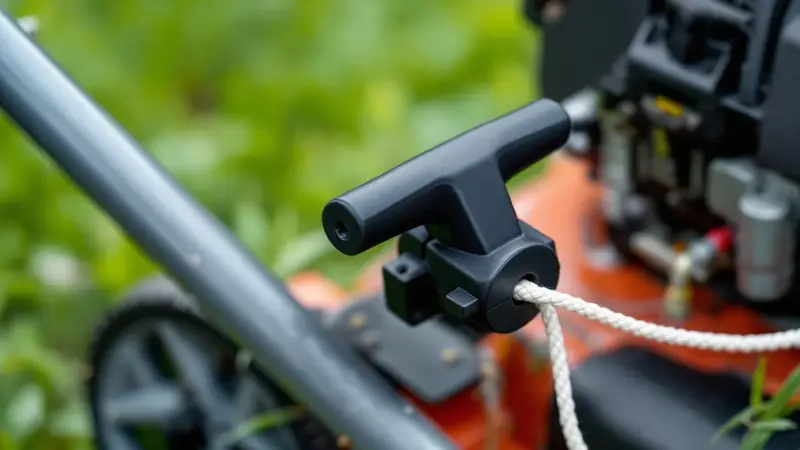
A lawn mower leaving uncut strips shows the cause by where the strip sits: between passes, overlap is under the 2 to 4 inches Deere specifies; down the deck’s center, a blade or spindle fault; along one side, an unlevel deck.
A lawn mower leaving uncut strips is easier to fix once you note where the strip sits and whether it repeats. Deere’s 100-series troubleshooting chart names 3 causes for patches of grass left uncut (travel speed too fast, engine rpm not at wide open throttle, a deck that needs cleaning) and 5 for an uneven cut (OMUC22642, p. 47). Cub Cadet’s support article on uncut strips adds overlap, blade wear, blade size, blades installed upside down and right-hand turns (article 208-1, June 2025).
What those sources rarely put side by side is the number behind each check. Deere allows 1/8 in between the outside blade tips; Toro allows 3/16 in. Both replace a blade whose two tips differ by more than 1/8 in, and Toro says a new blade that still reads over 1/8 in points to a bent spindle. The table below maps 16 strip patterns to the cause, the measurement and the manual page. Front-to-rear deck pitch, the setting that most often causes scalping, is covered in our guide on how to fix a scalped lawn, and blade sharpening steps are in how to sharpen a lawn mower blade.
Which strip do you have? 16 patterns and their causes
Swipe the table sideways to see every column.
| Mower | What the strip looks like | Likely cause | Check (with the maker’s number) | Fix | Source |
|---|---|---|---|---|---|
| Any riding or push mower | Narrow uncut ribbon at the seam between two passes, same place every pass | Overlap too small, so the edge of each pass misses grass | Overlap 2 to 4 in (Deere S100); about 3 in (Cub Cadet XT1); a few inches (Honda HRN216) | Line the deck edge up inside the last pass by the maker’s overlap | Deere OMUC22642 p. 27; Cub Cadet 769-10976 p. 20; Honda HRN216 p. 9 |
| Riding mower | Uncut strip lines up with your tire tracks from the last pass | Tires flattened that grass and it never stood back up for the blade | Cub Cadet: overlap more than the width of your tires | Overlap past the tire track; change mowing direction each time | Cub Cadet article 208-1 |
| Riding mower or tractor deck | Grass laid flat in wheel paths, uneven after the pass | Ground speed too high for the grass to rebound after the tires | Bad Boy: normal ground speed 2 to 5 mph; slow down when tires push grass down | Slow down, keep the engine or PTO at full speed | Bad Boy 54 in mid-mount deck manual p. 8 |
| Two-blade deck | Uncut strip down the middle of every pass (the mohawk) | Worn blade tips, blades too short for the deck, or a blade installed upside down | Measure blade length against the part listing: Cub Cadet 942-0616A for 42 in decks is 21.23 in | Fit the listed blade set, sail toward the deck | Cub Cadet article 208-1; part page 942-0616A |
| Two-blade deck | Center strip shows up after right-hand turns | Twin decks put the left blade ahead of the right; overlap holds on left turns | Cub Cadet: make mostly left-hand turns | Plan the pattern so most turns are to the left | Cub Cadet article 208-1 |
| Any multi-blade deck | Ragged, taller line along one blade’s path | Bent blade | Tip-to-ground on each end, rotate 180 degrees: replace if more than 1/8 in apart | Replace; Deere says never straighten or weld a blade | Toro 3479-424 p. 41; Deere OMUC22642 p. 39 |
| Any multi-blade deck | Same line returns with a new blade fitted | Bent blade spindle (mandrel) | New blade still more than 1/8 in out | Spindle to a dealer (Toro); Husqvarna lists replace the blade mandrel | Toro 3479-424 pp. 41, 42; Husqvarna TS 242 p. 27 |
| Riding mower | One side of every pass cut taller: a step, not a ribbon | Deck not level side to side | Outside blade tips: within 1/8 in (Deere S100, Z300) or 3/16 in at a 3 in cut (Toro TimeCutter) | Adjust the lift link on the high side; recheck | Deere OMUC22642 p. 19; Deere OMUC31576 p. 16; Toro 3479-424 p. 43 |
| Riding mower | Step on one side, but the deck measures level | Unequal tire pressure tilts the frame and deck | Deere S100: 14 psi front, 10 psi rear; Toro TimeCutter 42: 30 psi casters, 13 psi rear | Inflate cold to the manual figure, then re-level | Deere OMUC22642 p. 49; Toro 3479-424 p. 38; Toro 283178 |
| Riding mower | Scattered patches or single blades left standing | Travel speed too fast, or engine not at full throttle | Deere’s chart for Patches of Grass Uncut; Deere Z300 tops out at 7.0 mph | Full throttle, slower ground speed | Deere OMUC22642 p. 47; Deere OMUC31576 pp. 50, 53 |
| Riding mower | Patches uncut, clippings clumping, poor discharge | Grass packed under the deck or clogged vent holes around the spindles | Look under the deck with the engine off and key out | Scrape the underside and clear the vents | Deere OMUC22642 p. 47; Husqvarna TS 242 p. 27 |
| Riding mower | Tall grass pushed over and left uncut | Too much grass for the deck to lift: no air can enter | Toro: cut twice above 6 in; keep 1 side of the deck in already-cut grass | Two passes, the first at the highest setting | Toro 3479-424 p. 23 |
| Any mower | Whiskers and shredded tips that turn gray then brown | Dull blade tearing instead of cutting | Toro: inspect cutting edges before each use; UC IPM: gray cast soon after mowing | Sharpen or replace the blade | UC IPM, Dull mower blades; Toro 3479-424 p. 40 |
| Any mower | Uncut blades and clumps after a mow in dew or after rain | Wet grass bends under the deck and clogs it | Honda: wait for wet grass to dry; Husqvarna lists wet grass under poor discharge | Mow when the grass is dry | Honda HRN216 p. 9; Husqvarna TS 242 p. 27 |
| Push mower | One side or the front cuts lower | Height levers set to different positions | Honda HRN216: front and rear levers on the same setting | Set both levers to the same notch | Honda HRN216 p. 6 |
| Battery push mower | Mower cuts unevenly | Dull blade, cutting height too low, or blade assembled incorrectly | EGO: take about one third, ideally no more than 1.5 in per cut | Sharpen or replace, raise the deck, reassemble the blade | EGO LM2130 manual pp. 42, 52 |
1Is the strip at the seam between passes, in the same spot every pass?
YesOverlap 2 to 4 in (Deere) and more than the tire width (Cub Cadet); slow down if tires flatten grass (Bad Boy: 2 to 5 mph).
NoGo to the next question
2Is it down the middle of each pass on a 2- or 3-blade deck?
YesCheck blade length against the part listing, sails up, tips not worn; on twin decks favor left turns (Cub Cadet 208-1).
NoGo to the next question
3Does one blade's tip-to-floor reading differ by more than 1/8 in when rotated 180 degrees?
YesReplace the blade; if a new blade still reads over 1/8 in, the spindle may be bent (Toro 3479-424 p. 42).
NoGo to the next question
4Is one side of every pass taller than the other?
YesSet tire pressure first, then level the deck: tips within 1/8 in (Deere) or 3/16 in (Toro).
NoGo to the next question
5Are random patches or single blades left standing?
YesFull throttle, slower ground speed, clean the underside of the deck (Deere OMUC22642 p. 47).
NoGo to the next question
6Is the grass over 6 in, wet, or are the tips torn and gray?
YesCut twice with the first pass high (Toro p. 23), wait for dry grass (Honda p. 9), sharpen the blade (UC IPM).
NoIf none fit, check front-to-rear deck pitch in your manual and have a dealer inspect the spindles and deck hangers (Cub Cadet 1944-1).
Work through the flow on a flat driveway with the engine off and the key out. The order runs from free checks (where the strip is, how you mow) to the ones that need a wrench or a new part, so most strips are solved before the deck comes off.
Strip between passes: overlap and tire tracks
A ribbon at the seam between two passes is a driving problem, not a mower fault. Deere’s S100 manual sets the overlap at 50 to 100 mm (2 to 4 in) (OMUC22642, p. 27); Cub Cadet’s XT1 manual says to align with the edge of the mowed strip and overlap approximately 3 in (769-10976, p. 20). Honda says a few inches, and more overlap with a narrower swath when the grass is very tall or thick (HRN216 manual, p. 9).
The tires are the other half of it. Cub Cadet explains that the tires push down grass on each pass, so if you line your tires up with the tire marks from the previous pass, that grass never stands back up; its fix is to overlap more than the width of your tires. Bad Boy’s 2025 mid-mount deck manual says the same about tractor tires and gives a speed: normal ground speed is 2 to 5 mph, and you slow down when tires push grass down so it has more time to rebound (p. 8).
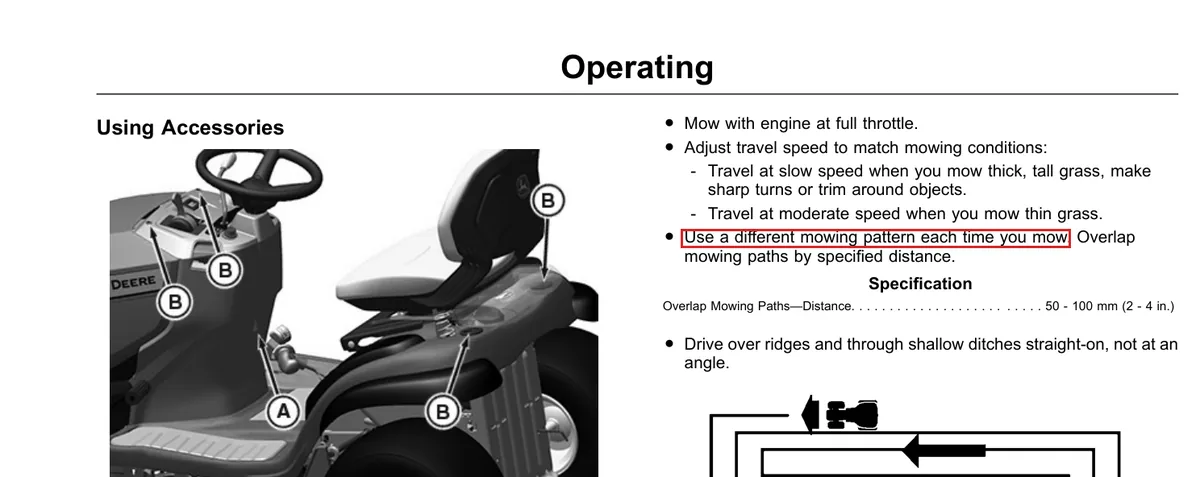
Changing direction every mowing keeps the flattened lanes from lining up week after week. Cub Cadet’s XT1 manual suggests it to prevent rutting or grooving of the turf (p. 20), and our guide on how to mow a lawn covers mowing patterns by grass type. Faint light and dark bands with no height difference are stripes from bent grass, not uncut strips; how to stripe a lawn explains why they show.
Strip down the middle of the deck: the mohawk
A raised strip in the middle of each pass, on a 2-blade or 3-blade deck, means the blades’ cutting circles no longer overlap. Cub Cadet lists worn blade tips, the wrong size blades and blades installed upside down (article 208-1). On its twin-blade decks the left blade sits slightly ahead of the right, which holds the overlap in a straight line and through left turns, so Cub Cadet tells operators to make mostly left-hand turns.
The margin is small. Cub Cadet’s 942-0616A blade for 42 in decks measures 21.23 in (part page, Nov. 21, 2026), so 2 of them span 42.46 in. If the rated 42 in cut runs from tip to tip, the 2 cutting circles share only about 0.46 in in the middle. That is our arithmetic, not a Cub Cadet figure, but it shows why an aftermarket blade a quarter inch short, or tips worn back a quarter inch each, can open a visible strip.
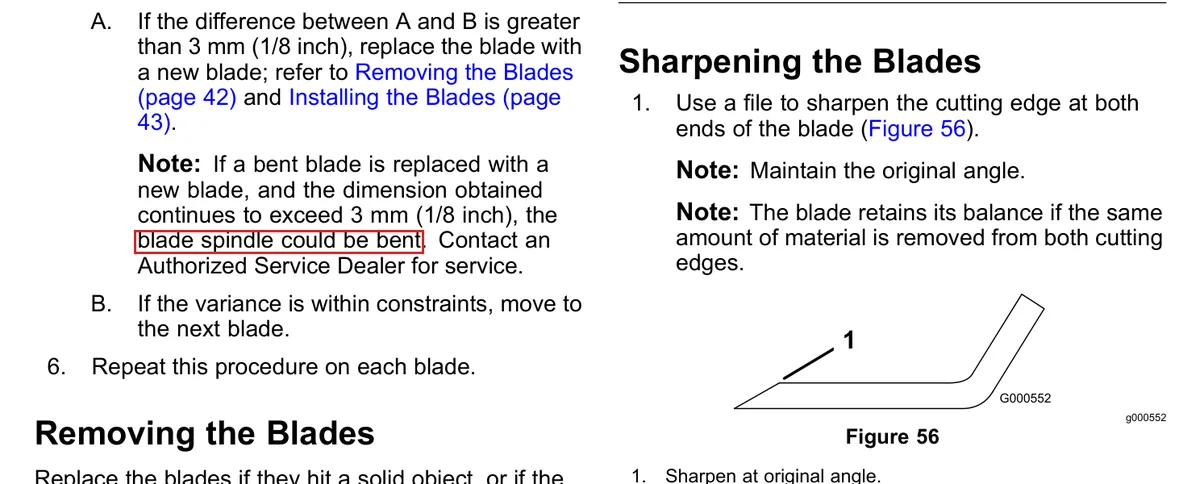
Then check for a bent blade or spindle. With the deck at its highest setting, measure from one blade tip to a flat floor, rotate the blade 180 degrees and measure the other tip. Toro and Deere both replace the blade if the 2 readings differ by more than 1/8 in (Toro 3479-424, p. 41; Deere OMUC22642, p. 39), and Deere says never to straighten or weld one. If a new blade still reads more than 1/8 in out, Toro says the blade spindle could be bent and sends you to a dealer; Husqvarna’s TS 242 chart lists a bent blade mandrel under poor, uneven cut. Spindle and blade prices are in our lawn mower repair cost guide.
Strip along one side: deck level and tire pressure
If one side of every pass is taller than the other, the deck is tilted. Measure with the tires inflated, on a level floor, with the blades turned side to side and measured at the outside tips. Deere allows no more than 1/8 in between the 2 readings on the S100 and the Z300 ZTrak (OMUC22642, p. 19; OMUC31576, p. 16). Toro allows 5 mm (3/16 in) at a 3 in height of cut on the TimeCutter 42 (3479-424, p. 43).
Check tires first. Cub Cadet’s support article on uneven cuts says to check pressure before any other adjustment, and gives 10 psi rear and 14 psi front as typical lawn tractor settings (article 1944-1). At 10 psi, a tire 2 psi low is 20 percent soft, which is enough to drop that side. Toro’s current TimeCutter manual says uneven tire pressure can cause an uneven cut and specifies 30 psi in the casters and 13 psi in the rear tires (Toro TimeCutter manual 283178).
| Machine (manual) | Side-to-side blade tips | Bent-blade limit | Tire pressure (psi) | Pass overlap | Pages |
|---|---|---|---|---|---|
| Deere S100 lawn tractor (OMUC22642) | 1/8 in (3 mm) | 1/8 in; never straighten or weld | 14 front, 10 rear (S100 to S160) | 2 to 4 in | pp. 19, 27, 39, 49 |
| Deere Z315E to Z330R ZTrak (OMUC31576) | 1/8 in (3 mm) | 1/8 in | 15 front, 10 rear | Not stated | pp. 16, 44, 53 |
| Toro TimeCutter 42 zero-turn (3479-424) | 3/16 in (5 mm) at a 3 in cut | 1/8 in; if a new blade still exceeds it, the spindle may be bent | 30 casters, 13 rear | Not stated; keep 1 side of the deck in cut grass | pp. 23, 38, 41, 42, 43 |
| Cub Cadet XT1 tractor (769-10976) | Both tips equal (no tolerance printed) | Replace a bent blade (no figure) | Equal on all tires; see sidewall | About 3 in | pp. 13, 20, 24, 30 |
| Husqvarna TS 242 tractor | Both sides equal; 1 nut turn moves about 1/8 in | Replace a worn, bent or loose blade | PSI on the tire | Not stated | pp. 21, 27 |
| Honda HRN216 push mower | Front and rear height levers in the same position | Sharpen or replace when it stops cutting cleanly | No pneumatic tires | A few inches | pp. 6, 9 |
A deck that is level side to side can still leave uncut grass if its front sits higher than its rear. Cub Cadet says a front higher than the rear upsets the airflow that stands grass up for an even cut. Deere, Toro, Husqvarna and Cub Cadet all set the front lower, by amounts from 1/16 in to 1/2 in; the figure for each maker is in our scalped-lawn guide.
Scattered uncut blades: speed, throttle and a dirty deck
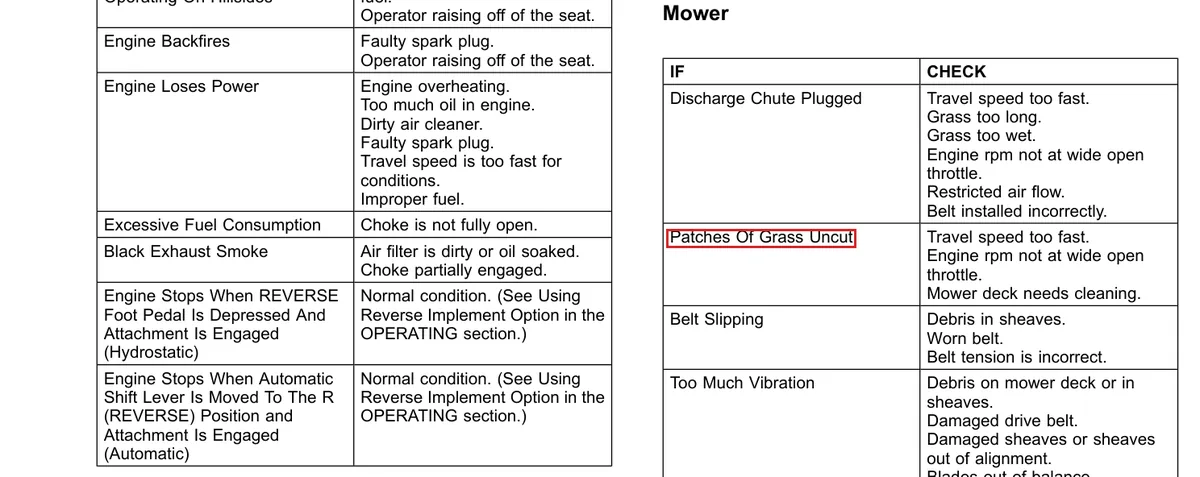
Random tufts and single blades standing after the pass point to blade speed and airflow, not geometry. Deere’s charts for the S100 and the Z300 ZTrak list the same 3 causes for patches of grass uncut: travel speed too fast, engine rpm below full throttle and a deck that needs cleaning (OMUC31576, p. 50). Cub Cadet’s XT1 manual says mowing at full speed will adversely affect cut quality (p. 20).
Top speed is what most zero-turns sell on, and it sits above the mowing range in every case we found. Deere’s Z315E to Z330R top out at 7.0 mph and the older EZtrak Z600 at 9.0 mph (OMM164698, 2011, p. 63), against the 2 to 5 mph Bad Boy calls normal for a mower deck. Speed by model is compared in zero turn vs lawn tractor.
Toro adds a load limit: keep 1 side of the deck in grass that is already cut so air can enter, and cut grass taller than 6 in twice (3479-424, p. 23). Wet grass, a dull blade and a slipping deck belt also leave standing blades. UC IPM describes the dull-blade look as a gray cast soon after mowing, with torn tips that turn yellow to brown (UC IPM, 2017). The wet-grass rules are in our guide to mowing wet grass, and a belt that keeps jumping its pulleys is covered in lawn mower belt keeps coming off.
Push mowers: Honda, EGO and other walk-behinds
A single-blade push mower cannot leave a mohawk, so a strip there is overlap, height or the blade. Honda’s HRN216 has 2 height levers, one for the front wheels and one for the rear, and the manual says to set both to the same position; a lever 1 notch off tilts the deck (p. 6). Honda also says to cut very tall grass once at the highest setting at slow ground speed, then mow again in 2 or 3 days.
EGO’s LM2130 troubleshooting table lists 3 causes for a mower that cuts unevenly: a dull blade, the cutting height set too low and a blade assembled incorrectly (p. 52). Its mowing tips set the bite at about one third of the blade length and ideally no more than 1.5 in at a time (p. 42), which is the first thing to change when a battery mower leaves blades standing in thick grass.
How we compiled this
On Nov. 21, 2026 we read 10 maker documents: operator’s manuals for Deere’s S100, Z300 ZTrak and EZtrak, Toro’s TimeCutter 42 (PDF and current interactive manual), Cub Cadet’s XT1, Husqvarna’s TS 242, Honda’s HRN216, EGO’s LM2130 and Bad Boy’s 54 in mid-mount deck, plus 2 Cub Cadet support articles, 1 Cub Cadet part page and UC IPM’s dull-blade page. We did not test or measure any mower; every tolerance, pressure and speed is as the maker prints it, with the page cited, and the 0.46 in blade overlap is our arithmetic from a part listing.
Frequently asked questions
Why does my riding mower leave a strip of uncut grass?
Check where the strip is. At the seam between passes it is overlap: Deere says 2 to 4 in. Down the middle of the deck it is worn, short or upside-down blades or a bent spindle. Along one side it is deck level (Deere: tips within 1/8 in) or tire pressure.
Why is my mower leaving tracks in my grass?
The tires press grass down and the deck passes over it before it stands back up. Bad Boy says to slow down when this happens (normal mowing is 2 to 5 mph), and Cub Cadet says to overlap more than the tire width and avoid lining up with the last pass’s tire marks.
Why is my EGO lawn mower leaving some blades of grass uncut?
EGO’s LM2130 manual lists a dull blade, a cutting height set too low and a blade assembled incorrectly (p. 52). Take no more than about 1.5 in per cut and slow down in tall or thick grass (p. 42).
Why does my 3-blade mower leave strips between the blades?
The cutting circles stopped overlapping. Check blade length against the part listing, that every sail points up toward the deck, and that no blade’s tips differ by more than 1/8 in. If a new blade still reads out, Toro says the spindle may be bent.
How do I keep a zero-turn from leaving uncut lines?
Mow at full throttle and well under top speed: Deere’s Z300 runs to 7.0 mph, and Bad Boy calls 2 to 5 mph normal for a deck. Keep the deck level within 1/8 in to 3/16 in and the rear tires at the manual pressure (Toro TimeCutter: 13 psi).
What lawn mower leaves lines?
Any mower leaves light and dark lines when passes alternate direction, because bent grass reflects light differently; that is striping, not uncut grass. Lines that stand taller than the rest of the lawn are uncut strips and follow the patterns in the table above.
Sources
- Deere & Company, 100 Series Lawn Tractors S100 to S180 operator’s manual, OMUC22642 Issue H0, 2020; pp. 19, 27, 39, 47, 49. Accessed November 2026.
- Deere & Company, Z315E to Z330R Residential ZTrak operator’s manual, OMUC31576 Issue G2, 2022; pp. 16, 24, 44, 50, 53. Accessed November 2026.
- Deere & Company, EZtrak Z200, Z400, Z600 operator’s manual, OMM164698 G1, 2011; p. 63. Accessed November 2026.
- The Toro Company, TimeCutter 42in riding mower operator’s manual, Form 3479-424 Rev A, pp. 23, 38, 40, 41, 42, 43. Accessed November 2026.
- The Toro Company, TimeCutter 34in, 42in or 50in zero turn riding mower interactive manual, 283178, Checking the Tire Pressure; Troubleshooting. Accessed November 2026.
- Cub Cadet, Uncut Strip: Riding Mower, support article 208-1, modified June 5, 2025. Accessed November 2026.
- Cub Cadet, Uneven Cut: Riding Mower, support article 1944-1, modified June 5, 2025. Accessed November 2026.
- Cub Cadet, 3-in-1 Blade for 42-inch Cutting Decks, 942-0616A, blade length 21.23 in, read Nov. 21, 2026. Accessed November 2026.
- Cub Cadet, XT1 and XT2 Enduro Series tractor operator’s manual, Form 769-10976, pp. 13, 20, 24, 30. Accessed November 2026.
- Husqvarna, TS 242 lawn tractor operator’s manual, 114 14 43-28, pp. 21, 27. Accessed November 2026.
- American Honda Motor Co., HRN216VKAA/HRN216VKPA owner’s manual, 00X31VR8 B103, pp. 6, 9. Accessed November 2026.
- EGO Power+, LM2130/LM2130SP/LM2150SP 56-volt cordless mower operator’s manual, pp. 42, 52. Accessed November 2026.
- Bad Boy Mowers, 54 in Mid Mount Mower owner’s operator service manual, 2025; p. 8. Accessed November 2026.
- University of California Statewide IPM Program, UC Guide to Healthy Lawns: Dull mower blades, 2017. Accessed November 2026.