How to stripe a lawn: mow side-by-side passes in opposite directions, so blades bent away from you look light and blades bent toward you look dark. Cut at the top of your grass’s range, and add a roller or flap to bend blades farther.
Knowing how to stripe a lawn takes no paint and no second grass. What changes the result is the mower, the kit behind it and the grass you grow, so this page lists the striping kit or roller each major mower maker sells, with part numbers and prices read off maker and dealer pages on Nov. 14, 2026, and flags the point where the makers contradict each other: whether warm-season grass stripes at all. The University of Minnesota turf program supplies the physics.
Why does mowing leave light and dark stripes?
Stripes are reflected light. Scag Power Equipment says striped grass is not cut at different heights: blades bent away from you show their long, wide surface and look lighter, while blades bent toward you show their tips and the shadow beneath and look darker. Walk to the other end of the lawn and each light stripe reads dark.
Florence Sessoms of the University of Minnesota tested the common idea that mowing flips leaves to show their undersides. She leaned perennial ryegrass and Kentucky bluegrass leaves toward and away from a light in a dark room; leaves leaning away read lighter whichever side faced up, so blade angle sets the shade, not leaf side (UMN Turfgrass Science, May 1, 2023).
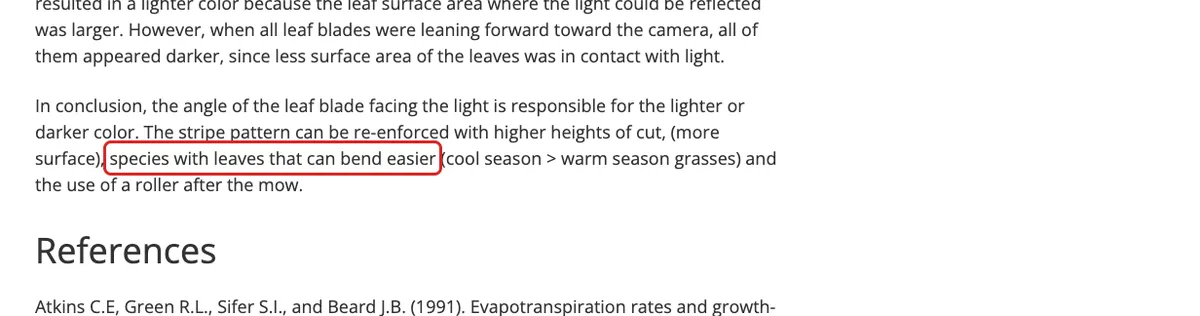
Her post names 3 levers: a higher cut (more blade to bend), a grass that bends easily, and a roller after the mow. Sunlight is the fourth. Scag says stripes look strongest with the sun behind you, and Toro’s manual for its 20601 striper lists lack of sunlight as a reason the pattern does not show, next to grass cut too short.
How to stripe a lawn, step by step
The order below follows the procedures Scag and Simplicity publish, with the measurement each step needs. Heights for 11 grasses, with the extension source for each, are in our guide on how to mow a lawn at the right height.
- Raise the deck to the top of your grass’s range. Scag says going from 2 to 2.5 inches, or 3 to 3.5, visibly deepens the stripe. Keep each cut to one-third of the blade (STMA Mowing BMPs): tall fescue held at 4 inches gets cut when it reaches 6.
- Sharpen the blade first. Simplicity calls for very sharp blades because dull ones tear grass, and Purdue AY-8-W suggests sharpening 4 to 6 times a year; our steps for sharpening a lawn mower blade list bolt torque by maker.
- Mow dry grass. STMA warns that driving on wet turf can leave wheel ruts and compaction, and the cutoffs for mowing wet grass apply double here, because a roller presses ruts deeper.
- Mow 2 laps around the edge first. Scag starts every pattern with the perimeter so you have a headland to turn on.
- Set one straight line. Simplicity suggests a string line for the first stripe, or fixing your eyes on a point at the far end and mowing toward it. If a line goes crooked, it says to go back 2 lines and start over.
- Mow back and forth in opposite directions, overlapping each pass by a few inches (Honda’s HRN216 manual, as compiled in our mowing guide) so no uncut strip shows.
- Turn with a slow Y on the headland. Scag and Simplicity both use a Y-turn at the end of each row to avoid tearing turf; a pivot on the striped area scuffs it.
- Finish with 1 more lap of the perimeter. Scag says the final lap cleans up the marks left by turning.
- Optional: re-roll. Simplicity says to disengage the deck and run the rollers over every other stripe to etch the pattern; David R. Mellor disengages the reels and re-rolls lines for more contrast on an 84,000 sq ft field.
- Next mowing, change direction (rotation below).
Stripe width equals the width of each pass, so deck size sets how many stripes fit. The calculator divides the lawn’s width by the pass width: deck width minus a 3-inch overlap, our assumption inside the few inches Honda gives. The default, a 60 ft lawn and a 21-inch deck, gives 40 passes and 20 light stripes.
If a narrow ribbon of taller grass shows at the seam between passes instead of a light or dark band, the overlap is too small or the tires flattened that grass; our guide to a lawn mower leaving uncut strips gives the 2 to 4 inch overlap Deere specifies.
- Passes across the lawn
- 41
- Light stripes (about half)
- 21
Passes = lawn width divided by pass width (deck minus a 3 in overlap), rounded up. Default: 60 ft / 1.5 ft = 40 passes, 20 light stripes. Add 2 perimeter laps.
| Deck or roller width | Pass width (3 in overlap) | Passes across 60 ft | Light stripes |
|---|---|---|---|
| 21 in walk-behind | 18 in (1.5 ft) | 40 | 20 |
| 30 in walk-behind | 27 in (2.25 ft) | 27 | 14 |
| 42 in rider | 39 in (3.25 ft) | 19 | 10 |
| 54 in rider | 51 in (4.25 ft) | 15 | 8 |
| 60 in rider | 57 in (4.75 ft) | 13 | 7 |
Which mowing patterns can you make?
Every pattern starts from straight stripes. The table gives the order of passes as Scag publishes it; Simplicity suggests sketching a pattern on paper first and shading the light and dark rows.
| Pattern | How to mow it | Source |
|---|---|---|
| Straight stripes | Perimeter, then passes in opposing directions, then the perimeter again | Scag |
| Checkerboard | Finish straight stripes, then mow the whole area again at 90 degrees (north-south, then east-west), then the perimeter | Scag |
| Diagonal or crisscross | The checkerboard method, run on diagonals | Scag |
| Zigzag | From a checkerboard, start on a light stripe, cross a dark one, turn 90 degrees right; cross the next dark one, turn 90 degrees left; repeat | Scag |
| Around trees and beds | Mow around the object into the uncut path; the next pass covers the turn marks | Scag |
| Wide bands | Double or triple-wide lines next to single ones | Mellor |
Which grasses stripe best?
Cool-season grasses, according to 3 of the 4 sources that rate grass types. The table sets each grass’s extension mowing range beside the striping height mower maker Grasshopper recommends, because the two disagree for bermudagrass and zoysiagrass.
| Grass | What the sources say about striping | Extension mowing height, in | Grasshopper striping height, in | Note |
|---|---|---|---|---|
| Kentucky bluegrass | Bends easily; stripes well (UMN, Grasshopper) | 2.0 to 3.5 (Purdue) | 3.5 | Mellor’s patterned field: 100% bluegrass sod at 1 in |
| Perennial ryegrass | Bends easily; stripes well (UMN, Grasshopper) | 2.0 to 3.5 (Purdue) | 2.5 | Leaf sides differ in color, but blade angle sets the stripe (UMN) |
| Tall fescue | Stripes well (Grasshopper) | 2.5 to 4.0 (Purdue) | 4 | Bunch type, spreads by tillers (UT W161-I) |
| Fine fescue | Cool-season; no grass-specific rating found | 2.0 to 3.5 (Purdue) | Not listed | Shade lawns: Purdue adds 0.5 to 1 in |
| Bermudagrass | Harder to stripe (Scag, UMN, Grasshopper); easier (Exmark, 2016) | 0.5 to 1.5 (UF/IFAS ENH10) | 2.5 | Grasshopper’s height is above UF’s range; Toro says bermuda tends to grow horizontally |
| Zoysiagrass | Harder to stripe (Grasshopper) | 1.0 to 2.0 (Purdue); coarse types 2.0 to 2.5 (UF) | 2.5 | Creeping stolons and rhizomes (UT W161-I) |
| St. Augustinegrass | Hearty, does not bend easily (Grasshopper) | 3.5 to 4; dwarf types 2.5 (UF/IFAS ENH10) | 4 | Creeping stolons (UT W161-I) |
| Centipedegrass | No maker or extension striping statement found | 1.5 to 2.0 (UF/IFAS ENH10) | Not listed | Rotary mower (UF) |
On warm-season grass the published sources split. Scag says warm-season grasses are typically more difficult to stripe because they are more rigid, Grasshopper calls them heartier and harder to bend, and UMN ranks cool-season above warm-season. Exmark’s 2016 blog says warm-season grasses tend to be more rigid and stripe better. All 4 agree the blades are stiffer; UMN’s dark-room test ties lighter stripes to blades that lean farther, which supports the majority.
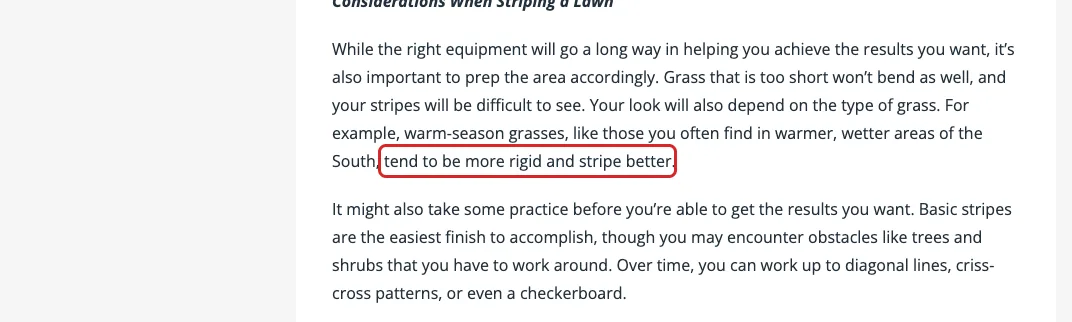
Hold the height your grass needs and accept a fainter stripe. Grasshopper’s 2.5 inches for bermudagrass sits above the 0.5 to 1.5 inches UF/IFAS gives; heights for bermudagrass lawns and tall fescue, best at 3.5 inches, are on their own pages. Ballparks show what low warm-season turf can do: McKechnie Field’s Tifway II bermudagrass was kept at 5/8 inch and mowed daily (SportsTURF, Feb. 1995).
Which striping kit fits your mower?
Each major maker sells a roller, a rubber flap or a bristle groomer that rides behind the deck, and fitments are model-specific: Big League Lawns, which builds CheckMate rollers, says mounting systems differ between machines with the same deck size. Start with the flowchart, then find your mower in the table. Prices were read off maker and dealer pages on Nov. 14, 2026.
1Is it a lawn tractor whose deck already has full-width rear rollers (Simplicity Free Floating decks, for example)?
YesNo kit needed: raise the deck and mow opposing passes. Simplicity says the deck rollers make the pattern.
NoGo to the next question
2Is it a 21 to 22 inch walk-behind?
YesA handle-mounted roller: Toro's 20601 ($174.99 at a dealer) fits most walk-behinds and takes 16 to 20 lb of dry sand; model-specific CheckMate rollers start at $180.
NoGo to the next question
3Is it a John Deere lawn tractor with a 42, 48 or 54 inch Edge deck?
YesGrass Groomer LP1001 (42 in) or LP1002 (48 and 54 in), a bristle brush priced by dealers.
NoGo to the next question
4Is it a residential zero-turn?
YesYour maker's kit by deck size: Cub Cadet 19A70060GFP or 19A70059GFP at $122.42, Husqvarna Z200 tow-behind at $299, or a CheckMate roller from $414.
NoGo to the next question
5Is it a commercial zero-turn or stand-on?
YesA heavy-duty kit: Husqvarna flap $159 (Z400, Z500), Cub Cadet 59C30052150 $259.69, Scag 923G $594.43 retail plus install kit, Exmark 126-7882 $635.79.
NoNo kit fits: mow at the top of your grass's height range, or drag a sand- or cement-filled PVC roller behind the mower.
Source: Maker and dealer pages, checked Nov. 14, 2026; Toro 20601 manual; Simplicity
Swipe the table sideways to see every column.
| Mower class | Fits | Kit and part number | Type | Listed price, Nov. 14, 2026 | Source |
|---|---|---|---|---|---|
| Walk-behind | Most 21 to 22 in walk-behinds, with or without bagger | Toro Lawn Striping System, 22 in, model 20601 | Handle-mounted roller, filled with 16 to 20 lb dry sand | $174.99 (dealer) | Arlington Power Equipment listing |
| Walk-behind | Honda HRX series | Big League Lawns CheckMate, HONHRX-RPM20 | Roller (4 in residential rollers) | $180.00 | Big League Lawns |
| Walk-behind | Toro Recycler, Super Recycler | Big League Lawns CheckMate for Toro Recycler | Roller | from $180.00 | Big League Lawns |
| Walk-behind, commercial | John Deere W36, W48, W52 walk-behinds | John Deere Striping Kit BUC10676 (14.0 lb) | Kit (type not stated) | price not shown online; dealer | Shop.Deere.com |
| Lawn tractor | Simplicity tractors (Free Floating deck) | Full-width rollers on the deck, no kit | Built-in deck rollers | $0 add-on | Simplicity (Briggs & Stratton) |
| Lawn tractor | John Deere 42 in Edge deck: D100, Sport, earlier LA and X300 | John Deere Grass Groomer LP1001 | Bristle groomer | price not shown online; dealer | Shop.Deere.com |
| Lawn tractor | John Deere 48 and 54 in Edge decks | John Deere Grass Groomer LP1002 | Bristle groomer | price not shown online; dealer | Shop.Deere.com |
| Residential zero-turn | Cub Cadet Ultima ZT, 42, 50, 54 in stamped decks (2019 on); Troy-Bilt Mustang | Cub Cadet 19A70060GFP | Kit (type not stated) | $122.42 MSRP | Cub Cadet |
| Residential zero-turn | Cub Cadet 50, 54, 60 in decks | Cub Cadet 19A70059GFP | Kit (type not stated) | $122.42 MSRP | Cub Cadet |
| Residential zero-turn | Husqvarna Z200 series | Husqvarna Tow Behind Striping Kit | Tow-behind roller | $299.00 MSRP | Husqvarna |
| Residential zero-turn | Toro TimeCutter (2021 and newer) | Big League Lawns CheckMate for TimeCutter | Roller | from $414.00 | Big League Lawns |
| Commercial zero-turn | Husqvarna Z400 and Z500 (not 72 in decks) | Husqvarna Deck Mounted Striping Kit | Rubber flap | $159.00 MSRP | Husqvarna |
| Commercial zero-turn | Cub Cadet Pro Z (2016 on), Ultima ZTX and ZTXS | Cub Cadet Heavy Duty Lawn Striping Kit 59C30052150 | Kit (type not stated) | $259.69 MSRP | Cub Cadet |
| Commercial zero-turn | Toro Z Master 6000 | Big League Lawns CheckMate for Z Master 6000 | Roller | from $498.00 | Big League Lawns |
| Commercial zero-turn | Scag Tiger Cat, Cheetah, Turf Tiger (install kit S923H or S921W extra) | Scag Tiger Striper 923G | Spring-loaded rollers, up to 8 | $594.43 retail ($495.36 sale) | SCAG Parts dealer listing |
| Commercial zero-turn | Exmark Radius models listed by serial range | Exmark Turf Striper 126-7882 | Roller | $635.79 | Exmark parts store |
Three rows change the buying decision. Simplicity says every one of its lawn tractors has full-width rollers on its Free Floating deck, so its owners need no kit. John Deere’s Grass Groomers use bristles that, Deere says, bend blades further without changing ground compaction. And commercial kits cost more: $122.42 for Cub Cadet’s residential kit against $594.43 retail for Scag’s 923G, which adds a model-specific install kit.
Scag’s 923G uses spring force: up to 8 rollers pressed onto the grass, which Scag says lays a deeper, longer-lasting stripe than a fixed roller gliding over the tips and follows uneven ground at mowing speed. If you are still choosing the machine, our comparison of a zero-turn vs a lawn tractor covers speed, slopes and price.
A DIY striper: how heavy?
Toro’s own 22-inch roller is a sand-filled tube. Its manual calls for 16 to 20 lb of dry sand and a hitch at least 3-1/2 inches off the ground, which works out to 0.7 to 0.9 lb per inch of roller from the sand alone. A full 24-inch home lawn roller presses 17 to 19 lb per inch, the range in our guide on whether to roll your lawn, so a striper bends blades without the compaction of rolling.
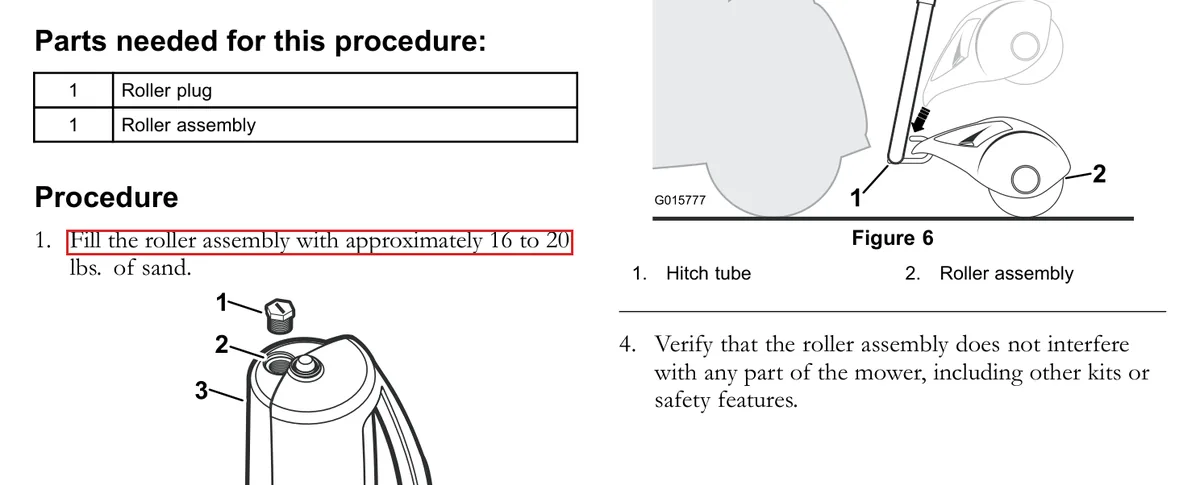
Mellor’s homemade version, from his field-pattern page, is PVC pipe filled with cement, bolts anchored in the ends and an old mower handle attached; he names drag mats and a water squeegee roller as other tools that lay grass over. Aim near Toro’s 16 to 20 lb across 22 inches and test one pass before adding weight.
Does striping hurt your lawn?
Not if the direction changes. Mowing the same way every time builds grain, grass leaning one way: STMA’s Mowing BMPs say to change the pattern each time you mow because alternating promotes upright growth, and UT Extension W161-I adds that varying direction reduces compaction and wear in the wheel tracks. UF/IFAS ENH10 says the same for Florida lawns.
The sources disagree on how often. STMA and UF/IFAS say every mowing; Simplicity says alternate every 2 weeks or sooner. Ballpark crews went furthest in a 1995 SportsTURF survey: Rosenblatt Stadium’s outfield ran north to south, northeast to southwest, east to west, then southwest to northeast on 4 successive days, with starting points varied too.
For a home lawn mowed weekly, the same 4 directions, one per mowing, repeat every 4 weeks. Each still produces stripes; only the angle moves, and the wheels stop tracking the same 2 lines.
Skip striping when turf is stressed. STMA links traffic on wet grass to ruts and compaction, Simplicity says to mow as little as possible under heat stress, and Purdue says to avoid midday mowing above 90°F on dry soil. Toro’s aftercut troubleshooting guide lists consistent mowing direction as the first cause of grain.
How long do lawn stripes last?
Until the blades stand back up, and no maker or extension source we read gives a number of days; the 2 to 7 days printed in other guides carry no source. Faster growth erases stripes sooner, so the interval in our guide on how often to mow is also your restriping schedule.
Two published tricks bring a fading pattern back. Simplicity says you can refresh it between mowings by running the deck rollers over it with the blades off, and suggests misting the turf for 1 minute or less before guests arrive so the droplets add contrast. Viewing angle matters as much: Scag says stripes look strongest with the sun behind you.
How we compiled this
In November 2026 we read 4 university publications (UMN Turfgrass Science, Purdue AY-8-W, UT Extension W161-I, UF/IFAS ENH10), STMA’s Mowing BMPs, a 1995 SportsTURF groundskeeper survey, Toro’s 20601 manual and aftercut guide, and striping pages from Scag, Simplicity, Exmark, Grasshopper and David R. Mellor. Kit prices come from 6 maker sites and 2 dealer listings, checked Nov. 14, 2026. We did not test any kit or mow any lawn; grass ratings are as each source states them.
Frequently asked questions
Is striping good for your lawn?
It is neutral if you rotate direction. STMA says to change the pattern each mowing to prevent grain, and UT Extension W161-I says varying direction cuts compaction and wear in wheel tracks. Striping the same lines every week, or on wet grass, is what causes ruts.
Do you need a striping kit to stripe a lawn?
No. Any mower bends grass in the direction of travel, and Grasshopper says raising the deck is often enough on a lawn kept 3.5 to 4 inches tall. A roller or flap deepens the contrast, which helps most on shorter grass.
What is the best height to cut grass for striping?
The top of your grass’s extension range: 2.5 to 4 inches for tall fescue and 2 to 3.5 for Kentucky bluegrass (Purdue AY-8-W). Scag says even half an inch more, such as 3 to 3.5 inches, makes the stripe more intense.
How do I make a DIY lawn striper?
Fill a capped PVC pipe with sand or cement and drag it behind the mower on a handle or chain. Toro’s 22-inch striper uses 16 to 20 lb of dry sand, about 0.7 to 0.9 lb per inch, a fair target for a homemade roller.
Is there a universal striping kit for lawn mowers?
For walk-behinds, close to it: Toro says its 20601 striper works with most walk-behind, self-propelled and push mowers and clamps to the handle. Rider and zero-turn kits mount to the deck or frame and are sold by model.
Sources
- University of Minnesota Turfgrass Science, Light reflection and mowing patterns (Florence Sessoms), May 1, 2023. Accessed November 2026.
- Scag Power Equipment, Lawn Striping and Lawn Patterns, page live 2026. Accessed November 2026.
- Scag Power Equipment, Tiger Striper Lawn Striping System, page live 2026. Accessed November 2026.
- Simplicity (Briggs & Stratton), Lawn Striping: How to Mow Ballpark Grass Patterns in Your Yard, May 5, 2026. Accessed November 2026.
- Exmark, Get a Distinctive Cut with Striping Kits, Aug. 23, 2016. Accessed November 2026.
- Grasshopper Company, The secret to perfect stripes lies in your deck height, May 22, 2024. Accessed November 2026.
- The Toro Company, Lawn Striper Kit Model No. 20601 Operator Manual, Form 3368-858, 2011. Accessed November 2026.
- The Toro Company (via Turf Products Corp.), Aftercut Appearance Troubleshooting Guide, Part No. 00076SL, Rev. A. Accessed November 2026.
- Sports Turf Managers Association, Mowing BMPs, 2018. Accessed November 2026.
- UT Extension, W161-I Turfgrass Maintenance: Mowing, March 2008. Accessed November 2026.
- UF/IFAS Extension, ENH10 Mowing Your Florida Lawn, current revision. Accessed November 2026.
- Purdue Extension, AY-8-W Mowing, Dethatching, Aerifying and Rolling Turf, Rev. May 2006. Accessed November 2026.
- SportsTURF (MSU Turfgrass Information Center), Mowing Tips: Cutting Heights, Frequency and Patterns (Steve and Suz Trusty), February 1995. Accessed November 2026.
- David R. Mellor, Creating Field Patterns, page live 2026. Accessed November 2026.
- Cub Cadet, Lawn Striping Kits (19A70060GFP, 19A70059GFP, 59C30052150), prices checked Nov. 14, 2026. Accessed November 2026.
- Husqvarna, Deck Mounted Striping Kit (Rubber Flap), price checked Nov. 14, 2026. Accessed November 2026.
- Husqvarna, Tow Behind Striping Kit Z200 Series, price checked Nov. 14, 2026. Accessed November 2026.
- John Deere, LP1001 Grass Groomer Attachment for 42 inch Edge Deck, checked Nov. 14, 2026. Accessed November 2026.
- John Deere, LP1002 Grass Groomer Attachment for 48/54 inch Edge Deck, checked Nov. 14, 2026. Accessed November 2026.
- John Deere, BUC10676 Striping Kit, checked Nov. 14, 2026. Accessed November 2026.
- Exmark, Turf Striper 126-7882, price checked Nov. 14, 2026. Accessed November 2026.
- SCAG Parts (dealer), Scag 923G Lawn Striper, price checked Nov. 14, 2026. Accessed November 2026.
- Arlington Power Equipment (Toro dealer), Toro 22 in Lawn Striping System (20601), price checked Nov. 14, 2026. Accessed November 2026.
- Big League Lawns, CheckMate striping kits for Toro mowers, prices checked Nov. 14, 2026. Accessed November 2026.
- Big League Lawns, CheckMate for Honda HRX-Series, price checked Nov. 14, 2026. Accessed November 2026.