Self propelled vs push mower: a self-propelled mower drives its own wheels, so you steer instead of push. On 3 same-deck pairs, the drive added 5 to 7 lb and $0 to $40. Choose it for slopes, bagging or lawns over 1/3 acre.
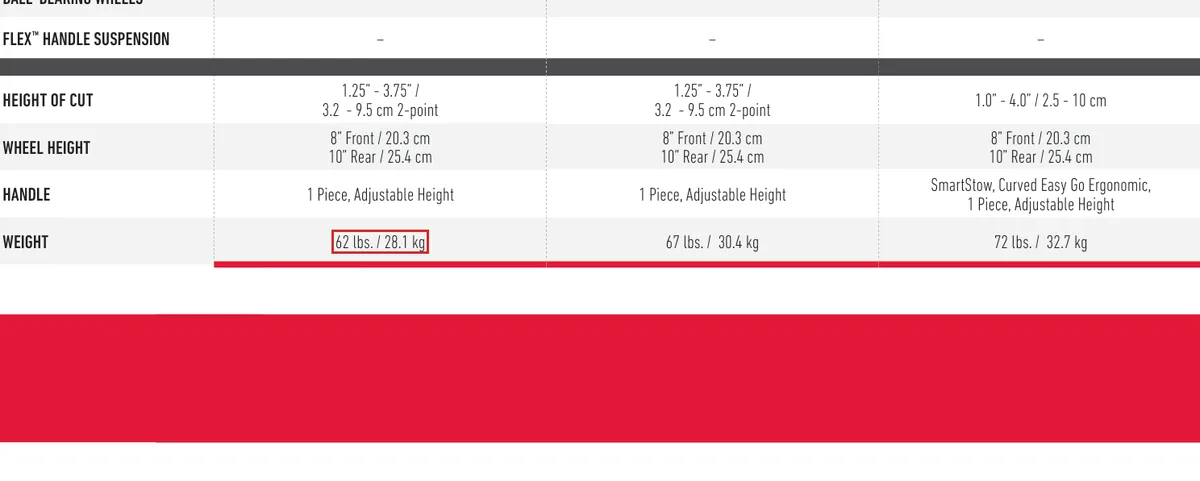
The self propelled vs push mower choice is usually framed as light and cheap against heavy and expensive. Maker spec sheets do not bear that out. Toro sells its 21-inch Recycler with the same Briggs & Stratton 140cc engine and steel deck as a push mower (model 21311, 62 lb, $399) and as a rear-wheel-drive self-propelled mower (model 21321, 67 lb, $439), and rates the push version for lawns up to 1/3 acre and the self-propelled one up to 1/2 acre. Honda and Ryobi pairs land in the same narrow band.
So the gap between two mowers on a store floor comes mostly from deck size, engine, battery and features, not from the drive. A Ryobi 20-inch self-propelled kit weighs 51.9 lb; Honda’s discontinued push HRN216PKA weighs 73 lb. What the drive does change is effort on grades, how a full bag handles, and a short list of wear parts. Power source is a separate decision, covered in our electric vs gas lawn mower comparison by noise, runtime and cost.
Same mower, with and without the drive
We matched push and self-propelled versions that share a deck, engine or battery platform, using each maker’s own page on Nov. 16, 2026. Three pairs share the kit as well; two Ryobi pairs ship with different batteries, so their price gap includes the pack, and they are marked.
| Pair | Push model: weight, price | Self-propelled model: weight, price | What the drive added | Source |
|---|---|---|---|---|
| Toro Recycler 21 in., Briggs & Stratton 140cc gas | 21311: 62 lb, $399 | 21321, rear-wheel, variable speed: 67 lb, $439 | +5 lb, +$40 | Toro 2026 sell sheet; 21311, 21321 pages |
| Honda HRN216, GCV170 gas (both discontinued) | HRN216PKA: 73 lb dry, MSRP $579 | HRN216VKA, rear-wheel Smart Drive, 0 to 4.0 mph: 79 lb dry, MSRP $599 | +6 lb, +$20 | HRN216PKA, HRN216VKA pages |
| Ryobi 40V HP 21 in. multi-blade, two 6Ah batteries in both kits | RY40HPLM04K2: 72.3 lb, $739, up to 80 min | RY40HPLM02K2, variable speed: 79.2 lb, $739, up to 75 min | +6.9 lb, $0, 5 fewer minutes | 04K2, 02K2 pages |
| Ryobi 40V HP 21 in., kits differ | RY40HPLM05K: 64 lb, one 8Ah battery, $519.70 | RY40HPLM01K2, rear-wheel: 74.8 lb, two 6Ah batteries, $639 | +10.8 lb, +$119.30 (second battery included) | 05K, 01K2 pages |
| Ryobi 40V HP 20 in., kits differ | RY40HPLM06K: 46.5 lb, one 6Ah battery, $359 | RY40HPLM08K, rear-wheel, multi-blade: 51.9 lb, one 8Ah battery, $499 sale ($599 list) | +5.4 lb, +$140 (bigger battery, extra blade) | 06K, 08K pages |
Read across the three matched pairs and the drive costs 5 to 7 lb and between nothing and $40. On the matched Ryobi pair it also costs 5 minutes of runtime from the same two 6Ah batteries, 80 minutes falling to 75. The Honda pair carried a $20 MSRP gap; both models are now discontinued, and Honda’s current lineup page lists only battery models, all self-propelled, from the HRN-BV at $899 MSRP (Honda lawn mower lineup).
Toro’s sell sheet prints the comparison itself: its Core Recycler columns are the 21311 push, the 21321 rear-wheel drive and the 21445 front-wheel drive, in that order.
What a self-propelled lawn mower is, drive by drive
A self-propelled lawn mower is a walk-behind mower with a transmission that turns its wheels, engaged by a bail or lever on the handle. Honda’s HRN216VKA manual describes it plainly: push the Smart Drive control and “ground speed will increase as more pressure is applied,” up to 4.11 mph, and release it to stop the rear wheels (Honda HRN216VKA owner manual, p. 8 and p. 18). You still walk the whole lawn; the drive supplies the forward force.
| Drive layout | Example and maker spec | Weight, price | Where the maker or guide places it | Source |
|---|---|---|---|---|
| None (push) | Toro 21311, 21 in., 140cc | 62 lb, $399 | Toro yard rating up to 1/3 acre | Toro |
| Front-wheel | Toro 21442, 22 in., 150cc | 70 lb, $469 | Flat lawns; turn by tipping the front wheels up | Toro; Snapper |
| Rear-wheel, speed lever | Honda HRN216VKA, 0 to 4.0 mph | 79 lb dry, MSRP $599 | Mowing across slopes; bagging, because a filling bag can lift the front end | Honda; Snapper |
| Rear-wheel, battery | Toro 21327, 60V 6Ah, up to 3.2 mph, up to 52 min | 66 lb, $519 | Toro yard rating up to 1/3 acre | Toro |
| Rear-wheel, Personal Pace | Toro 21462, 22 in., 163cc; speed follows your walking pace | 83 lb, $539 | Toro yard rating up to 1/2 acre | Toro |
| All-wheel | Ryobi RY40HPLM03K2, 21 in., two 6Ah batteries | 78.7 lb, $849 | Same 3/4 acre rating as the rear-wheel 02K2; $110 more | Ryobi |
Snapper’s own buying article separates the two common layouts: front-wheel drive models are “ideal for flat lawns” and turn when you tip the front wheels off the ground, while rear-wheel drive “tends to provide better traction when mowing across slopes” and suits baggers (Snapper, Why Buy a Self-Propelled Lawn Mower). Variable speed matters more than layout on a mixed lawn. Toro’s Personal Pace reads the push on the handle; Honda’s Smart Drive and Ryobi’s dial set a speed you hold.
Slopes: where the drive helps and where the manual stops you
On any walk-behind rotary mower, push or self-propelled, the U.S. Consumer Product Safety Commission says to “mow across the slope with the walk-behind rotary mower, never up and down” (CPSC Publication 5126). Across a slope, a push mower makes you hold it against sideways drift and shove it forward at once, which is the job a rear-wheel or all-wheel drive takes over. Slope technique and a drop calculator are on our page on how to mow a lawn, including slopes and deck settings.
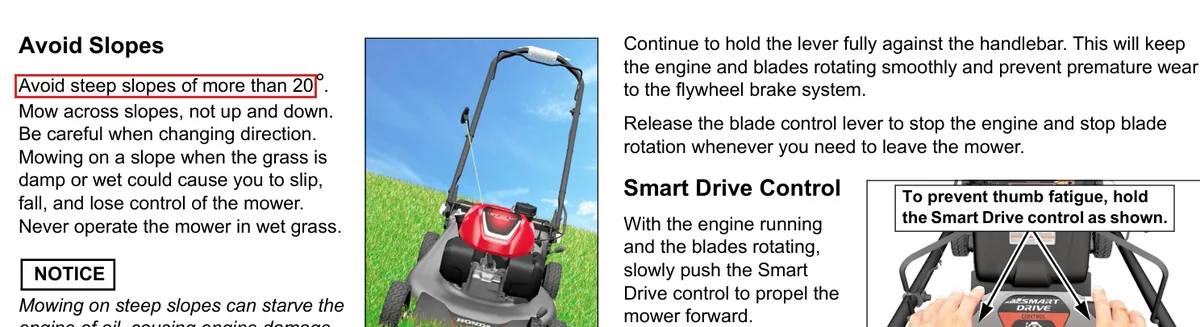
The drive does not raise the limit. Honda’s gas HRN216VKA manual says to avoid slopes over 20 degrees (p. 8), and its battery HRN216YXB manual cuts that to 15 degrees (Honda HRN216YXB owner manual, p. 10). UGA Extension uses the same 20-degree figure for push mowers (UGA Extension, Forsyth County, 2025). Toro’s 60V Recycler manual gives no number: “Do not mow exceedingly steep slopes” (Toro Form 3434-488, p. 4).
| Slope angle | Grade | Drop over a 10 ft run | Whose limit it is |
|---|---|---|---|
| 10 degrees | 17.6% | 21 in. | No manual we read sets a limit this low |
| 15 degrees | 26.8% | 32 in. | Honda battery HRN216YXB manual, p. 10 |
| 20 degrees | 36.4% | 44 in. | Honda gas HRN216VKA manual, p. 8; UGA Extension for push mowers |
| Over 20 degrees | Over 36.4% | Over 44 in. | Above every walk-behind limit we found; neither drive type is rated for it |
Gas engines add a second reason to stay under the line. Honda warns that “mowing on steep slopes can starve the engine of oil,” damage it says the warranty does not cover (HRN216VKA manual, p. 8). That applies to a gas push mower exactly as it does to a self-propelled one.
How much effort and time the drive saves
No published energy study we found measures push and self-propelled mowing side by side. The 2024 Adult Compendium of Physical Activities lists mowing with a walk-behind power mower at 5.0 METs for moderate or vigorous effort and 4.5 METs for light or moderate effort (Compendium codes 08120 and 08125). Treating the lower code as the self-propelled case, a 180 lb (81.6 kg) adult burns about 408 against 367 kcal an hour, a gap of about 41 kcal.
| Compendium code | Activity as listed | METs | kcal per hour, 180 lb adult |
|---|---|---|---|
| 08110 | Mowing lawn, hand mower, vigorous effort | 6.0 | 490 |
| 08095 | Mowing lawn, general, walking, moderate effort | 5.5 | 449 |
| 08120 | Mowing lawn, walk, power mower, moderate or vigorous effort | 5.0 | 408 |
| 08125 | Mowing lawn, power mower, light or moderate effort | 4.5 | 367 |
| 08100 | Mowing lawn, riding mower | 2.5 | 204 |
Time is a pace question. A drive lets you hold a pace up a grade and through thick grass; it does not mow faster than you walk, and the maker ceilings are 3.2 mph (Toro 21327) to 4.0 mph (Honda HRN216VKA). Enter your lawn area, deck and walking pace to see minutes per mow; the default 1/4 acre with a 21-inch deck at 3 mph takes about 26 minutes before turns and bag stops.
- Minutes of mowing (no turns or bag stops)
- 26
- kcal, 180 lb adult at 5.0 METs (Compendium 08120)
- 177
- kcal, 180 lb adult at 4.5 METs (Compendium 08125)
- 159
Default: 10,890 sq ft (1/4 acre), 21 in. deck, 3 mph gives 26 minutes. Minutes = area / (effective swath in ft x pace in ft per minute); a 21 in. deck with 2 in. overlap cuts a 19 in. swath. kcal = METs x 81.6 kg x hours.
What the drive adds to upkeep
Everything a push mower needs, the self-propelled version needs too: the oil change in our guide to changing lawn mower oil on 10 engines, a blade kept to the angle and torque in how to sharpen a lawn mower blade, and an air filter. The drive adds a belt, a control cable and a gearbox. Honda’s HRN216VKA schedule lists a Smart Drive cable adjustment, pinion gear greasing and transmission axle bearing inspection, the last two marked for a Honda dealer (HRN216VKA manual, p. 11).
That drive belt is held in place by guides at each pulley, and Toro’s walk-mower service manual says a bent guide raises the tendency for belt jumping; the checks are in our guide to a lawn mower belt that keeps coming off.
The cable is the part that drifts first: Toro’s service manual sets it by pulling out all slack and pushing the jacket up 1/8 in, and our guide to a self propelled mower not propelling lists the setting for Honda, Deere, Craftsman and Cub Cadet drives too.
| Item | Push | Self-propelled | Source |
|---|---|---|---|
| Drive belt | None | Toro 115-4669 (fits 21321): $14.95 sale, $19.99 list. Honda 22431-VR8-N03 (HRN216): $8.95 sale, $9.64 list | The Mower Shop, Toro belt; Honda belt, Nov. 16, 2026 |
| Warranty on drive parts | Not applicable | Toro: belts and wheels 90 days residential, against 2 years for a steel-deck gas mower. Honda: belt and cable listed as wear parts | Toro warranty; Honda manual, p. 21 |
| Scheduled drive service | None | Honda HRN216VKA: cable adjust; pinion gears and axle bearings by a dealer | Honda manual, p. 11 |
| Battery runtime, same two 6Ah packs | Ryobi 04K2: up to 80 min | Ryobi 02K2: up to 75 min | Ryobi, Ryobi |
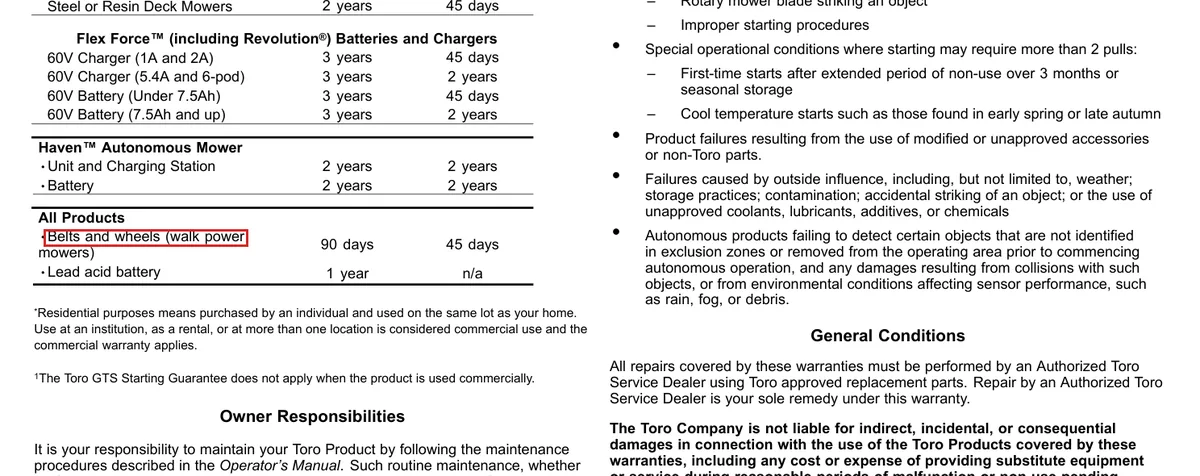
The 90-day belt coverage is the line to note when buying a self-propelled Toro: a slipping drive in the second season is a parts-and-labor bill, not a warranty claim. Our lawn mower repair cost survey of 26 shop price lists puts a walk-behind tune-up at a $104 median and hourly repair labor at $65 to $130. Toro’s full warranty table, with its 90-day belt line and the engine starting guarantee, is reproduced in our Toro lawn mower won’t start guide by model number.
Which one fits your yard
Maker yard ratings give the clearest size line. Toro rates the push 21311 to 1/3 acre and the self-propelled 21321 to 1/2 acre on the same engine; Craftsman calls its push M105 “ideal for smaller yards up to a 1/4 of an acre” (Craftsman M105 page); Ryobi rates both its 21-inch two-battery kits to 3/4 acre. Slope and bagging tip the choice before size does.
1Is any part you mow steeper than your manual's limit (15 or 20 degrees in Honda's manuals, 32 or 44 inches of drop over 10 feet)?
YesNeither drive makes that slope safe to mow. Leave it unmowed or plant it, and mow the rest across the slope.
NoGo to the next question
2Do you mow across a grade, or bag clippings?
YesSelf-propelled, rear-wheel or all-wheel drive. Snapper says rear-wheel drive holds traction across slopes and with a filling bag.
NoGo to the next question
3Is the lawn larger than 1/3 acre?
YesSelf-propelled. Toro rates the push 21311 to 1/3 acre and the same-engine self-propelled 21321 to 1/2 acre.
NoGo to the next question
4Is pushing 60 to 75 lb for 30 minutes or more hard for you?
YesSelf-propelled. On matched pairs it costs 5 to 7 lb and $0 to $40 more.
NoA push mower: on a flat lawn under 1/3 acre it saves $0 to $40 on a matched pair and has no drive belt (Toro covers belts for 90 days).
Source: CPSC 5126; Honda HRN216VKA and HRN216YXB manuals; Snapper; Toro product pages and warranty
A push mower still makes sense on a flat lot under 1/3 acre with tight beds, where you would release the drive at every turn anyway, or as a second mower for a small strip. It saves $0 to $40 on a matched pair and leaves out the 90-day belt. For riders and their weights, see how much a riding lawn mower weighs and our zero turn vs lawn tractor comparison of slope limits by model.
How we compiled this
On Nov. 16, 2026 we read 16 maker product pages (Toro, Honda, Ryobi, Craftsman), Toro’s 2026 Recycler sell sheet and residential warranty, 3 operator’s manuals (Honda HRN216VKA, Honda HRN216YXB, Toro 60V Recycler), CPSC Publication 5126, a UGA Extension slope article, the 2024 Adult Compendium of Physical Activities and one dealer’s belt listings. We did not test or weigh any mower; weights, speeds and ratings are as each maker prints them, and the kcal and slope figures are our arithmetic, shown under each table. EGO’s U.S. site redirected our requests abroad, so EGO models are not in the pairs.
Frequently asked questions
Is a self-propelled mower better than a push?
It is better on slopes you mow across, with a bag, and on lawns over about 1/3 acre. It cuts no better: the matched pairs above share the deck and blade. On a flat, small lawn a push mower does the same job for $0 to $40 less and has no drive belt.
What is the disadvantage of a self-propelled mower?
On the matched pairs it adds 5 to 7 lb and up to $40, plus a belt, cable and gearbox to maintain. Toro covers belts on its walk power mowers for 90 days residential, and Ryobi’s self-propelled 21-inch kit runs 75 minutes against 80 for the push kit on the same batteries.
Can you just push a self-propelled lawn mower?
Yes. Release the drive control and it rolls like a push mower, about 5 to 7 lb heavier. Honda’s HRN216VKA manual tells owners to release Smart Drive and push the mower around trees and obstacles for better control.
How do I know if my lawn mower is self-propelled?
Look for a drive bail, lever or speed control on the handle besides the blade control bar, and a belt or gearbox driving the wheels. The spec sheet settles it: Honda lists drive as N/A on the push HRN216PKA and variable speed on the HRN216VKA.
How much does a self-propelled push lawn mower cost?
Maker prices on Nov. 16, 2026: $439 for Toro’s 21-inch gas 21321, $469 to $539 for its 22-inch models, $519 for the 60V 21327, $639 to $849 for Ryobi 40V HP 21-inch kits and $899 MSRP for Honda’s battery HRN-BV.
Why did people stop using push mowers?
Many have not: Toro, Ryobi and Craftsman all list push models as of November 2026. Honda is the exception; its current lineup page shows only battery mowers, every one self-propelled, after its gas HRN216PKA was discontinued.
Sources
- The Toro Company, 2026 Recycler Walk Power Mowers Sell Sheet, 2026. Accessed November 2026.
- The Toro Company, 21 in. Recycler Push Gas Lawn Mower, model 21311, Nov. 16, 2026. Accessed November 2026.
- The Toro Company, 21 in. Recycler Self-Propel Gas Lawn Mower, model 21321, Nov. 16, 2026. Accessed November 2026.
- The Toro Company, 22 in. Recycler Self-Propel Gas Lawn Mower, model 21442, Nov. 16, 2026. Accessed November 2026.
- The Toro Company, 22 in. Recycler with Personal Pace, model 21462, Nov. 16, 2026. Accessed November 2026.
- The Toro Company, 60V Max 21 in. Recycler Self-Propel, model 21327, Nov. 16, 2026. Accessed November 2026.
- The Toro Company, The Toro Warranty, Consumer Mowers (form 3484-937), Current. Accessed November 2026.
- The Toro Company, 21in Recycler Lawn Mower Operator’s Manual, Form 3434-488, Current. Accessed November 2026.
- American Honda Motor Co., HRN216PKA model page (discontinued), Nov. 16, 2026. Accessed November 2026.
- American Honda Motor Co., HRN216VKA model page (discontinued), Nov. 16, 2026. Accessed November 2026.
- American Honda Motor Co., HRN216VKAA/VKPA Owner’s Manual, 00X31VR8 B103, 2020 to 2022. Accessed November 2026.
- Honda Motor Co., HRN216YXB-VKA4 Owner’s Manual, 00X31V0B 6000, 2025. Accessed November 2026.
- American Honda Motor Co., Lawn mower lineup, Nov. 16, 2026. Accessed November 2026.
- Ryobi, 40V HP Brushless 21 in. Push Multi-Blade Mower Kit RY40HPLM04K2, Nov. 16, 2026. Accessed November 2026.
- Ryobi, 40V HP Brushless 21 in. Self-Propelled Multi-Blade Mower Kit RY40HPLM02K2, Nov. 16, 2026. Accessed November 2026.
- Ryobi, 40V HP Brushless 21 in. Self-Propelled All-Wheel Drive Kit RY40HPLM03K2, Nov. 16, 2026. Accessed November 2026.
- Ryobi, 40V HP Brushless 21 in. Push Mower Kit RY40HPLM05K, Nov. 16, 2026. Accessed November 2026.
- Ryobi, 40V HP Brushless 21 in. Self-Propelled Mower Kit RY40HPLM01K2, Nov. 16, 2026. Accessed November 2026.
- Ryobi, 40V HP Brushless 20 in. Push Mower Kit RY40HPLM06K, Nov. 16, 2026. Accessed November 2026.
- Ryobi, 40V HP Brushless 20 in. Self-Propelled Multi-Blade Kit RY40HPLM08K, Nov. 16, 2026. Accessed November 2026.
- Craftsman, 21-in. 140cc Gas Push Mower (M105), Nov. 16, 2026. Accessed November 2026.
- U.S. Consumer Product Safety Commission, Power Lawn Mowers, Publication 5126, Current PDF. Accessed November 2026.
- UGA Extension, Forsyth County, Lawn mower safety on slopes and hills, 2025. Accessed November 2026.
- Herrmann et al., 2024 Adult Compendium of Physical Activities: Lawn and Garden, 2024. Accessed November 2026.
- Snapper, Why Buy a Self-Propelled Lawn Mower, Current. Accessed November 2026.
- The Mower Shop, Toro Personal Pace Drive Belt 115-4669, Nov. 16, 2026. Accessed November 2026.
- The Mower Shop, Honda HRN216 Drive Belt 22431-VR8-N03, Nov. 16, 2026. Accessed November 2026.