
Electric vs gas lawn mower: under 1/3 acre, a battery mower cuts nearly as well, runs 5 dB quieter at the ear and charges for 11 cents an hour. With DIY tune-ups, gas costs less over 10 years if the battery needs replacing.
The electric vs gas lawn mower decision usually gets argued on noise and fumes. The money turns on one part: the battery. Toro sells the same 22-inch Recycler deck with a gas engine at $469 and with a 60-volt battery at $649, and a replacement 6.0Ah pack lists at $428.99. Run those list prices, EIA fuel and power prices and Honda’s engine fuel rating through 10 years and the battery mower comes out ahead only if its first pack lasts the decade or you pay a shop for gas tune-ups.
Electric vs gas lawn mower, side by side
The table pairs makers’ own figures for gas and battery walk-behind mowers. Where a U.S. page gives no sound figure, the row uses the maker’s European declaration for the twin model, which is measured to EN ISO 5395 and Directive 2000/14/EC.
| Measure | Gas walk-behind | Battery walk-behind | Source |
|---|---|---|---|
| List price, Nov. 2026 | $469 (Toro 21442) | $649 (Toro 21466); $899 MSRP (Honda HRN-BV) | Toro 21442, Toro 21466, Honda |
| Weight | 70 lb (Toro 21442); 79.4 lb dry (Honda HRN216) | 85 lb with battery (Toro 21466); 55.3 lb without battery (EGO LM2130SP) | Maker spec pages; Honda HRN216 manual, p. 18; EGO manual, p. 13 |
| Energy on board | 0.2 gal (Toro); 0.24 gal (Honda GCV170) | 324 Wh (Toro 6.0Ah); 420 Wh (EGO 7.5Ah) | Maker spec pages; our arithmetic for EGO (56 V x 7.5 Ah) |
| Rated run per fill | About 38 min (Toro, 0.2 gal) to 45 min (Honda, 0.24 gal) at 0.32 gal/h (our arithmetic) | Up to 40 min (Toro); 30 to 60 min by load (EGO 7.5Ah) | Honda GCV170 manual, p. 13; EGO manual, p. 14 |
| Refill time | About 1 minute to pour | 150 min (Toro 2 A charger); about 60 min (EGO Rapid Charger) | Toro; EGO |
| Sound at the operator’s ear | 85 dB(A) (Honda HRN536C, GCV170 engine) | 80.3 dB(A) (EGO LM2130E-SP) | Honda HRN536C manual, p. 18; EGO LM2130E-SP manual, p. 7 |
| Guaranteed sound power | 98 dB(A) (Honda HRN536C) | 93 dB(A) (EGO LM2130E-SP); 93 dB (Honda HRN-BV) | Same; Honda HRN-BV manual, p. 19 |
| Energy cost per mowing hour | $1.32 (0.32 gal at $4.153) | $0.10 to $0.12 (0.57 to 0.66 kWh at 18.16 cents) | EIA gasoline, Nov. 2, 2026; EIA Table 5.6.A, Aug. 2026 |
| Scheduled upkeep | Air filter, spark plug, oil top-up; Briggs kit $25.99 | Blade and deck only; pack replacement $428.99 (Toro) or from $429 (Honda 8Ah) | Briggs 84002441; Toro 88960; Honda |
| Maker warranty | 3-year Guaranteed to Start (Toro); 2-year limited (Troy-Bilt TB210B) | 5-year tool, 3-year battery (EGO); 3-year residential (Honda HRN-BV) | Toro; Troy-Bilt; EGO; Honda |
| Temperature limit | None printed for running | Operate at 32 to 104 F (EGO) | EGO manual, p. 13 |
Two rows surprise most buyers. The battery Toro weighs 15 lb more than its gas twin, because the steel deck stays and the pack adds weight, and Honda’s battery HRN-BV weighs 80.6 lb before its battery against 79.4 lb for the gas HRN216 (Honda spec sheet). On cut quality the gap is small: Consumer Reports scored gas 4.7 and electric 4.5 for evenness, and 4.7 against 4.6 for mulching, across its test data through 2025.
Which models we compared
Eight walk-behind mowers, chosen because each maker publishes the spec needed for the comparison. Honda’s U.S. lawn mower page now lists only battery models, HRN-BV, HRX-BE and HRX-BV (Honda, Nov. 2026), so the gas HRN216 row comes from its last owner’s manual.
| Model | Power | Deck | Weight | Fuel or battery | Rated run (EGO: light / medium / heavy load) | List price, Nov. 2026 | Source |
|---|---|---|---|---|---|---|---|
| Toro Recycler 21442 | Gas, Briggs & Stratton 150 cc | 22 in | 70 lb | 0.2 gal | Up to 1/2 acre (yard size) | $469 | Toro |
| Troy-Bilt TB210B | Gas, Briggs & Stratton 550ex 140 cc | 21 in | Not listed | 0.8 qt | Not listed | $429 MSRP (prior-year model) | Troy-Bilt |
| Honda HRN216VKA | Gas, Honda GCV170 166 cc | 21 in | 79.4 lb dry | 0.24 gal | 1.2 L/h fuel use at 3,000 rpm | No longer listed | Honda manual; GCV170 manual |
| Toro Recycler 21466 | Battery, 60 V 6.0Ah | 22 in | 85 lb | 324 Wh | Up to 40 min; 1/3 acre in 40 min | $649 | Toro |
| Honda HRN-BV | Battery, 8Ah (12Ah optional) | 21 in | 80.6 lb without battery | About 400 Wh (our arithmetic from 0.6 kWh per 12Ah) | Up to 30 min (45 min on 12Ah) | $899 MSRP | Honda |
| EGO LM2130 with 5.0Ah | Battery push, 56 V | 21 in | 50.3 lb without battery | 280 Wh | 45 / 35 / 20 min | Not shown on EGO.com | EGO manual |
| EGO LM2130SP with 7.5Ah (sold as LM2135SP kit) | Battery self-propelled, 56 V | 21 in | 55.3 lb without battery | 420 Wh | 60 / 45 / 30 min | Not shown on EGO.com | EGO manual; EGO |
| EGO LM2150SP with 10.0Ah | Battery self-propelled, 56 V | 21 in | 55.56 lb without battery | 560 Wh | 75 / 60 / 40 min | Not shown on EGO.com | EGO manual |
How much lawn does one battery cut?
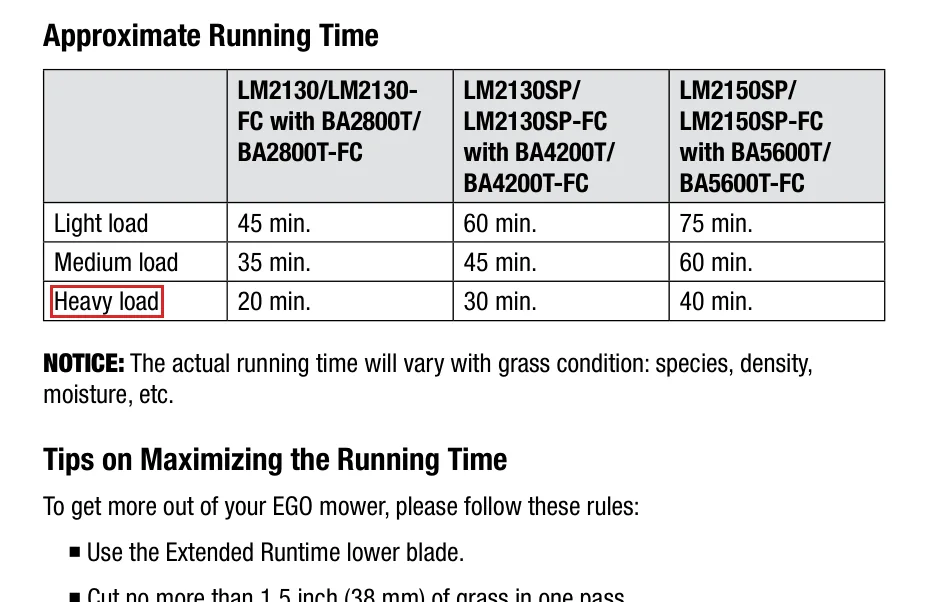
Grass load, not the label, sets the answer. EGO’s U.S. manual prints runtime for three packs at three loads, and heavy grass cuts each figure roughly in half: the 7.5Ah pack runs 60 minutes in light grass, 45 in medium and 30 in heavy (EGO LM2130SP manual, p. 14).
| EGO pack | Light load | Medium load | Heavy load | Sq ft per charge at Toro’s pace (light / medium / heavy) |
|---|---|---|---|---|
| 5.0Ah, 280 Wh | 45 min | 35 min | 20 min | 16,335 / 12,705 / 7,260 |
| 7.5Ah, 420 Wh | 60 min | 45 min | 30 min | 21,780 / 16,335 / 10,890 |
| 10.0Ah, 560 Wh | 75 min | 60 min | 40 min | 27,225 / 21,780 / 14,520 |
A quarter-acre lot is 10,890 sq ft. At that pace a 7.5Ah pack covers it easily in medium grass (16,335 sq ft) and only just in heavy grass (10,890 sq ft, no margin), and a 5.0Ah pack falls short in heavy grass at 7,260 sq ft. EGO’s fix is to cut no more than 1.5 in per pass, use the Extended Runtime blade and keep the deck clean. If your lawn routinely needs a heavy cut, the cheaper answer is mowing more often, which our how often to mow guide sets by grass and month.
Gas has no equivalent ceiling. Honda rates the GCV170 at 1.2 liters (0.32 gal) an hour at 3,000 rpm (Honda GCV170 manual, p. 13), so a 0.24-gal tank lasts about 45 minutes at that load and refills in a minute. A second battery is the battery-side answer: Toro’s 6.0Ah pack lists at $428.99, which is why the half-acre rows below carry two packs.
What does each cost over 10 years?
Energy is the small line. At EIA’s U.S. regular price of $4.153 a gallon for the week of Nov. 2, 2026 (EIA), the GCV170 burns $1.32 of gas an hour. At the August 2026 residential average of 18.16 cents a kWh (EIA Table 5.6.A), a battery mower uses $0.10 to $0.12 an hour, assuming 85 percent of wall power reaches the pack.
| Lawn | Mowing time each cut | Gas, DIY tune-up | Gas, shop tune-up | Battery, original pack lasts | Battery, 1 pack swap | Battery, 2 pack swaps |
|---|---|---|---|---|---|---|
| 1/8 acre (5,445 sq ft) | 15 min | $795 to $938 | $1,575 to $1,718 | $654 to $658 | $1,083 | $1,516 |
| 1/4 acre (10,890 sq ft) | 30 min | $861 to $1,036 | $1,641 to $1,816 | $659 to $667 | $1,088 | $1,525 |
| 1/2 acre (21,780 sq ft) | 60 min | $992 to $1,234 | $1,772 to $2,014 | $1,099 to $1,114 | $1,957 | $2,830 |
On a quarter acre with your own tune-ups, gas totals $861 to $1,036; the battery mower totals $659 if its first pack lasts 10 years and $1,088 after one $428.99 swap. Pay a shop $104 a year and gas climbs to $1,641 to $1,816, so the battery wins even with two swaps. Honda itself gives two lifespans for its packs, 3 to 5 years in one paragraph and 5 to 7 in another (Honda cost page), which is the difference between one swap and two.
Charge cycles are rarely the limit. Honda puts pack life at 500 to 1,000 full cycles; at 20 to 30 charges a season that is 16 or more seasons, so heat, cold storage and calendar age decide when capacity fades. EGO says to store packs between -4 and 158 F and to operate them at 32 to 104 F (EGO manual, p. 13).
Purchase price spread over a 10-year life (Toro 21442 $469, 21466 $649), plus fuel or electricity for 20 to 30 cuts a year and upkeep. Battery low end assumes one pack swap in 10 years, high end two. See How we compiled this.
How much quieter is a battery mower?
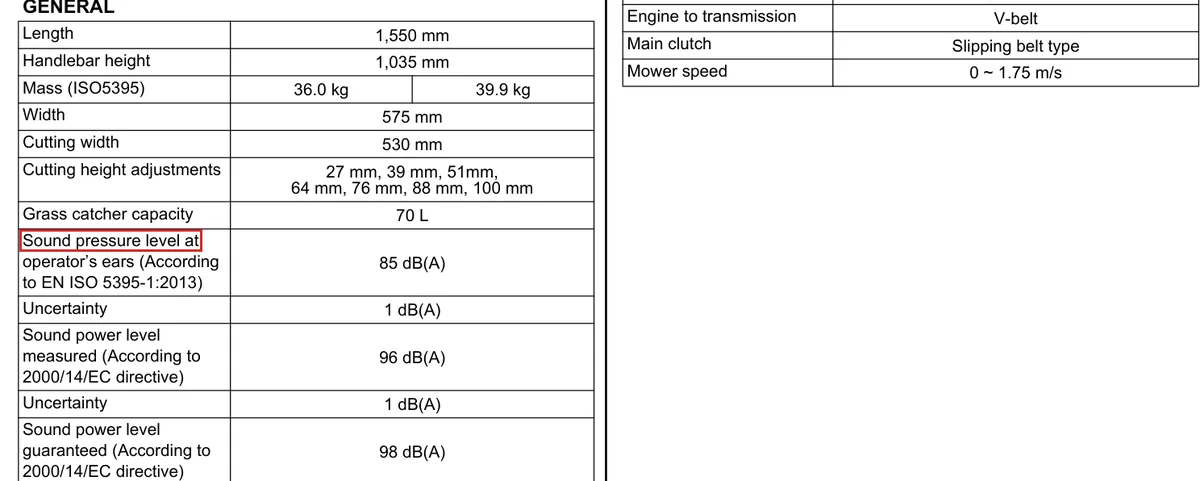
About 5 dB at the handle and 6 dB in sound power, by the makers’ own declarations. Honda declares 85 dB(A) at the operator’s ears for the GCV170-powered HRN536C, 96 dB(A) measured sound power and 98 guaranteed (Honda HRN536C manual, p. 18). EGO declares 80.3 dB(A) at the ear for the LM2130E-SP, 89.8 measured and 93 guaranteed (EGO EU manual, p. 7).
| Mower | Sound at the operator’s ear | Daily time before the NIOSH 85 dBA limit is reached | Source |
|---|---|---|---|
| Gas push mower, top of NIOSH tool study | 92 dBA | 1 h 35 min | NIOSH Science Blog, 2018 |
| Gas push mower, bottom of NIOSH tool study | 86 dBA | 6 h 21 min | NIOSH Science Blog, 2018 |
| Honda HRN536C (GCV170 gas) | 85 dB(A) | 8 h | Honda manual |
| EGO LM2130E-SP (56 V battery) | 80.3 dB(A) | About 23 h | EGO manual |
For one homeowner mowing an hour a week, both machines sit under the limit; the gap matters for crews and for neighbors. Consumer Reports measured at the ear and at 25 ft; at 25 ft the noisiest electric mower in its tests scored better than the quietest gas model. Some city codes cap mowers at 85 dB(A) at the property line or ban early starts, which our guide to how early you can mow lists city by city.
Are gas lawn mowers being phased out?
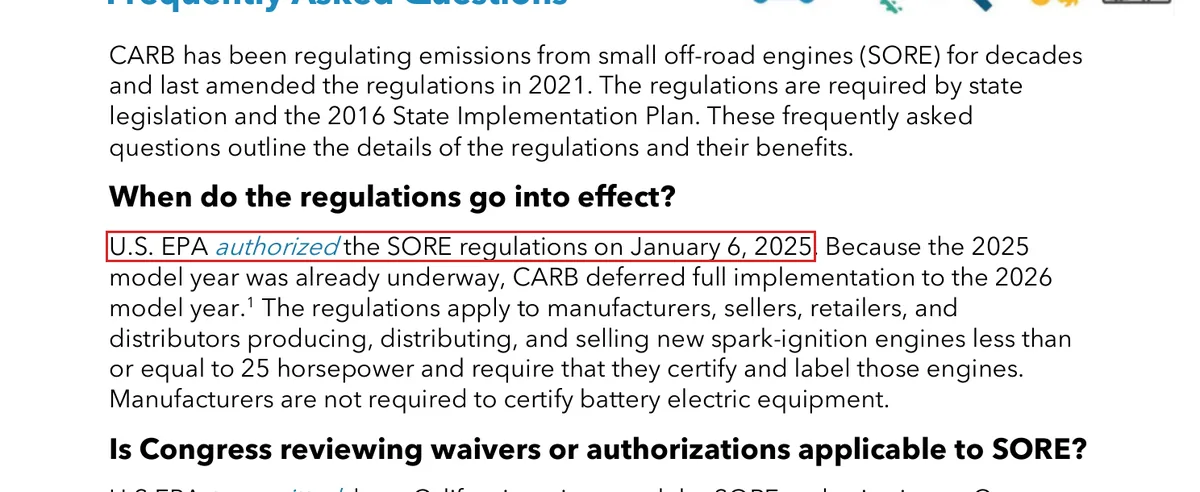
Only for new engines sold in California, and later than most articles say. CARB’s FAQ says EPA authorized the small off-road engine (SORE) rules on Jan. 6, 2025 and that CARB deferred full implementation to the 2026 model year (CARB SORE FAQ); its MAC ECCD-2025-01 let model year 2024 and 2025 engines keep entering California commerce.
It is not a ban on owning or buying gas. The same FAQ says the rules “do not affect equipment already sold and in use,” stores may sell existing CARB-certified inventory, gas engines have been certified for model years 2026 and 2027, and manufacturers may use emission credits to certify gas engines through 2032, with standards for new engines at zero by model year 2028. Federal rules bar other states from copying it (40 CFR 1074.110), so rules elsewhere are local limits on use, like the leaf blower rules in our leaf removal cost guide.
The rule could still go. EPA sent the authorization to Congress for Congressional Review Act consideration on June 12, 2026 (CARB FAQ), and a disapproval resolution, S.J.Res. 205, with House companion H.J.Res. 214, was pending as of Nov. 9, 2026.
On emissions, CARB’s often-quoted comparison is for a commercial machine: one hour on a commercial lawn mower emits as much smog-forming pollution as driving a new passenger car about 300 miles (CARB fact sheet). Honda’s own cost page gives 45 miles in one line and quotes 100 miles in the next, without a source, so treat any single homeowner figure with care.
Rebates that cut the battery premium
Air districts and utilities pay, not the IRS. South Coast AQMD pays residents up to $250 toward a new battery mower if they turn in a working gas mower to an approved dismantler and apply within 6 months of purchase (South Coast AQMD). DC Sustainable Energy Utility offers up to $500 off electric lawn equipment bought from Oct. 1, 2026 to Sept. 30, 2027 (DCSEU). A full $250 rebate would erase the $180 price gap between the two Toro Recyclers and cover 58 percent of one $428.99 replacement pack.
Honda’s cost page says many states offer tax breaks for electric mowers but names none. Before you count on one, ask your utility and air district whether a trade-in is required and whether bundles or kits qualify: South Coast AQMD excludes bundle and combo purchases.
Gas or battery: pick by these thresholds
1Do you live in California and want a new mower built for the 2026 model year or later?
YesBattery, or a gas model from existing CARB-certified inventory (CARB FAQ).
NoGo to the next question
2Is your lawn over 1/2 acre (21,780 sq ft)?
YesGas walk-behind or a rider: a battery mower needs a second pack ($428.99 for Toro 6.0Ah) or a recharge of up to 150 minutes.
NoGo to the next question
3Does your grass often need more than a 1.5 in cut (heavy load)?
YesGas, or a 10.0Ah battery: EGO's 7.5Ah pack drops to 30 minutes in heavy grass.
NoGo to the next question
4Do you pay a shop for a yearly tune-up (median $104)?
YesBattery: it beats gas over 10 years even with two pack swaps.
NoGo to the next question
5Is noise a problem for you, your crew or your neighbors?
YesBattery: about 5 dB lower at the ear (EGO 80.3 vs Honda 85 dB(A)).
NoGas costs less over 10 years with DIY upkeep unless the battery's first pack lasts the decade; pick on weight, storage and noise.
Source: Toro, EGO, Honda and CARB documents; our cost arithmetic
The fuel side has its own rules: 87 octane, no more than 10 percent ethanol and fresh gas, set engine by engine in our guide to what gas a lawn mower takes, with oil grades in the lawn mower oil guide. Battery or gas, a dull blade costs runtime and cut quality; EGO lists sharp blades among its runtime rules, and sharpening a mower blade covers the job.
How we compiled this
We read the 26 documents listed under Sources: maker spec pages and owner’s manuals from Toro, Troy-Bilt, Honda, EGO and Briggs & Stratton, two EIA price series, CARB’s fact sheet, FAQ and advisory, NIOSH and OSHA noise guidance and two rebate program pages, all accessed Nov. 9, 2026. The 10-year totals are our arithmetic from list prices; the 85 percent charging efficiency, 20 to 30 cuts a year and Toro’s mowing pace applied to every model are our assumptions. We did not test any mower.
Frequently asked questions
Are gas or electric mowers better?
For lawns under about a third of an acre, battery mowers match gas on cut quality within 0.1 to 0.2 points on Consumer Reports’ 5-point scales and run quieter. Gas still wins on run time, refill speed, heavy grass and, if you do your own tune-ups, 10-year cost.
What are the downsides of electric lawn mowers?
Run time that halves in heavy grass (EGO 7.5Ah: 60 minutes light, 30 heavy), charge times of 60 to 270 minutes, a 32 to 104 F operating range on EGO, and replacement packs at $428.99 (Toro 6.0Ah) or from $429 (Honda 8Ah).
Are gas lawn mowers being phased out?
Only for new engines in California, where CARB fully applies its zero-emission rules from the 2026 model year after EPA’s Jan. 6, 2025 authorization. Existing mowers and certified inventory can still be used and sold, and a congressional resolution to overturn the authorization was pending in November 2026.
Is it okay to cut wet grass with an electric lawn mower?
EGO’s U.S. manual lists “Do not cut wet grass” among its 6 rules for getting full running time from a pack. Wait until the blades are dry; our guide to mowing wet grass sets out each maker’s rule.
What is cheaper, a gas or electric lawn mower?
Gas is cheaper to buy ($469 against $649 for Toro’s twin Recyclers) and, with DIY tune-ups, over 10 years on a quarter acre: $861 to $1,036 against $1,088 for battery with one pack swap. Battery is cheaper if the first pack lasts 10 years or you pay a shop for tune-ups.
Sources
- Toro, Recycler 22 in. gas lawn mower, model 21442, list price and specs, Nov. 2026. Accessed November 2026.
- Toro, 60V Max Recycler 22 in. lawn mower, model 21466, list price and specs, Nov. 2026. Accessed November 2026.
- Toro, 60V Max Flex-Force 6.0Ah battery, model 88960 (replaces 88660), list price, Nov. 2026. Accessed November 2026.
- Troy-Bilt, TB210B self-propelled lawn mower, prior-year model page. Accessed November 2026.
- American Honda, HRN216VKA owner’s manual, current PDF. Accessed November 2026.
- American Honda, GCV170/GCV200 engine owner’s manual, specifications, current PDF. Accessed November 2026.
- American Honda, HRN-BV battery mower specifications, Oct. 21, 2025. Accessed November 2026.
- American Honda, HRN-BV owner’s manual, specifications, current PDF. Accessed November 2026.
- American Honda, Lawn mowers lineup, Nov. 2026. Accessed November 2026.
- American Honda, The real ownership cost of battery-powered lawn mowers vs gas, 2026. Accessed November 2026.
- Honda Motor Europe, HRN536C owner’s manual, specifications (copy hosted by Mr Plant Hire), current PDF. Accessed November 2026.
- EGO Power+, LM2130, LM2130SP, LM2150SP operator’s manual (North America), v2. Accessed November 2026.
- EGO Power+, LM2135SP product page, Nov. 2026. Accessed November 2026.
- EGO Power+ Europe, LM2130E-SP operator’s manual, EV03, 2026. Accessed November 2026.
- Briggs & Stratton, 84002441 maintenance kit for EX and EXi engines, Nov. 2026. Accessed November 2026.
- U.S. Energy Information Administration, Gasoline and diesel fuel update, week of Nov. 2, 2026. Accessed November 2026.
- U.S. Energy Information Administration, Electric Power Monthly, Table 5.6.A, August 2026 data. Accessed November 2026.
- OSHA, Occupational noise exposure, current page. Accessed November 2026.
- NIOSH, Turn down the noise: landscaping and grounds management, 2018. Accessed November 2026.
- Consumer Reports, Gas vs. battery lawn mower: which is better?, 2025 test data. Accessed November 2026.
- California Air Resources Board, SORE small engine fact sheet, current page. Accessed November 2026.
- California Air Resources Board, Small off-road engine regulations FAQ, 2026. Accessed November 2026.
- California Air Resources Board, MAC ECCD-2025-01, guidance for model year 2024 and 2025 SORE, Jan. 22, 2025. Accessed November 2026.
- U.S. Congress, S.J.Res. 205 (119th Congress), status Nov. 2026. Accessed November 2026.
- South Coast AQMD, Residential electric lawn mower rebate program, 2026. Accessed November 2026.
- DC Sustainable Energy Utility, Electric lawn care rebates, Oct. 2026 to Sept. 2027. Accessed November 2026.