How to charge a lawn mower battery: on 12-volt rider batteries, clip red to positive, black to negative, charge at 2 to 6 amps; a flat 20 Ah battery takes 10 hours at 2 A. Cordless packs need their maker’s charger at 41 to 104°F.
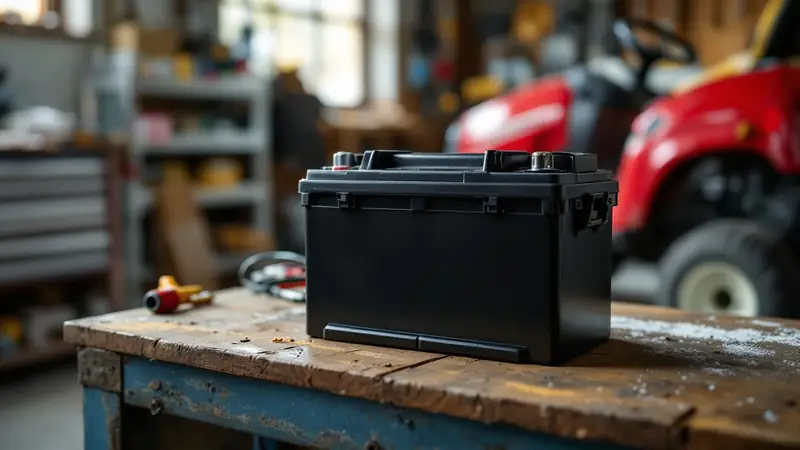
Knowing how to charge a lawn mower battery starts with which battery you have. A riding mower or lawn tractor uses a 12-volt lead-acid starter battery, usually BCI group U1 at 20 to 30 amp-hours; a cordless push mower runs on a 40 to 60 volt lithium-ion pack that only its own charger can fill. The makers do not agree on the amps: Cub Cadet’s support article caps the charger at 6 A, its XT1 and XT2 tractor manual at 10 A, and Toro asks for at least 1 hour at 6 to 10 A. This page sets those instructions side by side, works out the amp ceiling for each U1 battery Interstate lists using East Penn‘s rule of one-third of reserve capacity, and turns your voltmeter reading into hours.
| Battery | Full at rest | Charger | Time to full | Source |
|---|---|---|---|---|
| 12 V flooded, group U1 (Interstate M-U1LH, 20 Ah) | 12.6 V | 12 V lead-acid charger, 6 A max (Cub Cadet) | 10 hours at 2 A from flat (20 Ah / 2 A); 8 to 12 hours on a manual charger | Interstate; Cub Cadet 88-1; East Penn |
| 12 V AGM, group U1 | 12.8 V | Voltage-limited charger with an AGM setting; never above 15.4 V | Same amp-hour arithmetic | East Penn |
| 12 V electric-start walk-behind (Toro TimeMaster 21219) | Charger light | Toro plug-in charger at the harness, about 70°F | 24 h the first time, then monthly or every 25 starts | Toro Form 3471-140 |
| EGO 56 V, 2.5 to 12.0 Ah | Charger light | EGO Standard or Rapid charger only | 50 to 230 min (Standard); 30 to 90 min (Rapid) | EGO battery chart |
| Toro 60V Max Flex-Force, 2.0 to 7.5 Ah | Charger light green | Toro 88602 (2.0 A out) or 88605 rapid (5.5 A out) | 150 min for the 6.0Ah pack in the 21466 kit | Toro 88602 manual, p. 7; Toro 21466 |
| Greenworks 40 V, 2.0 Ah | Charger LEDs | Greenworks 2 A or 5 A charger | 40 min (2 A) or 16 min (5 A); same page also says 1 to 2 hours | Greenworks 29462 |
| DeWalt 60V Max FLEXVOLT 6.0Ah | Charger LED | DCB118, 8 A fan-cooled | 60 min | DeWalt DCB118 |
If your mower will not crank and you are not yet sure the battery is the cause, start with our lawn mower troubleshooting guide for no-start and click-only problems; it covers the solenoid, interlocks and fuse that a charger will not fix. Everything below assumes the battery is the job.
How to charge a riding mower battery, step by step
The steps merge the charging sections of Toro’s TimeCutter manual (Form 3399-367, p. 39), John Deere’s D100 tractor manual (OMGX25410, pp. 18 and 45), Cub Cadet’s support article and East Penn’s battery-care sheet. Where one maker adds a number, it is in the step.
- Park on level ground, disengage the blades, set the brake and take the key out. Toro says to remove the key before any maintenance (Toro MyRIDE Form 3456-108, p. 30).
- Read the resting voltage with a multimeter across the posts: 12.6 V is full on a flooded battery, 12.8 V on AGM, and below 12.4 V means charge it (East Penn). John Deere says never to test by laying a metal tool across the posts.
- Warm a cold battery first. John Deere’s D100 manual says not to charge or jump a frozen battery and to warm it to 60°F (16°C).
- Take it out, or charge it in place. Toro’s manuals remove the battery before charging; to remove one, disconnect the negative (black) cable first, then the positive (red) (John Deere OMGX25410, p. 45). Husqvarna’s UK support page for its TS114 and TC112 tractors charges in place with the negative clamp on the seat frame.
- On a flooded battery with removable caps, check the fluid: East Penn says the plates must be covered before charging; add distilled water at the end of the charge, then charge 30 minutes more to mix it.
- With the charger off and unplugged, clip red to positive (+), then black to negative (-). East Penn says turning the charger off before hook-up avoids sparks near the hydrogen a battery gives off.
- Pick the battery type and amps. Use a 12 V lead-acid charger (Cub Cadet), the AGM setting for AGM batteries (East Penn: never above 15.4 V), and 2 to 6 A; the next section explains the limit.
- Plug in and wait. On an automatic charger, stop when it shows full; on a manual one, Cub Cadet says 8 to 12 hours at 6 A or less. If the battery gasses hard or the case feels hot, East Penn says reduce or stop the charge.
- Unplug the charger, then remove the black clamp and the red clamp. Reinstall the battery positive cable first, negative last (John Deere OMGX25410, p. 45), and coat the terminals with grease or silicone spray.
- Check it the next day. Toro’s MyRIDE manual says to let a charged battery rest 24 hours; if it reads below 12.6 V, charge and test again (Form 3456-108, p. 52).
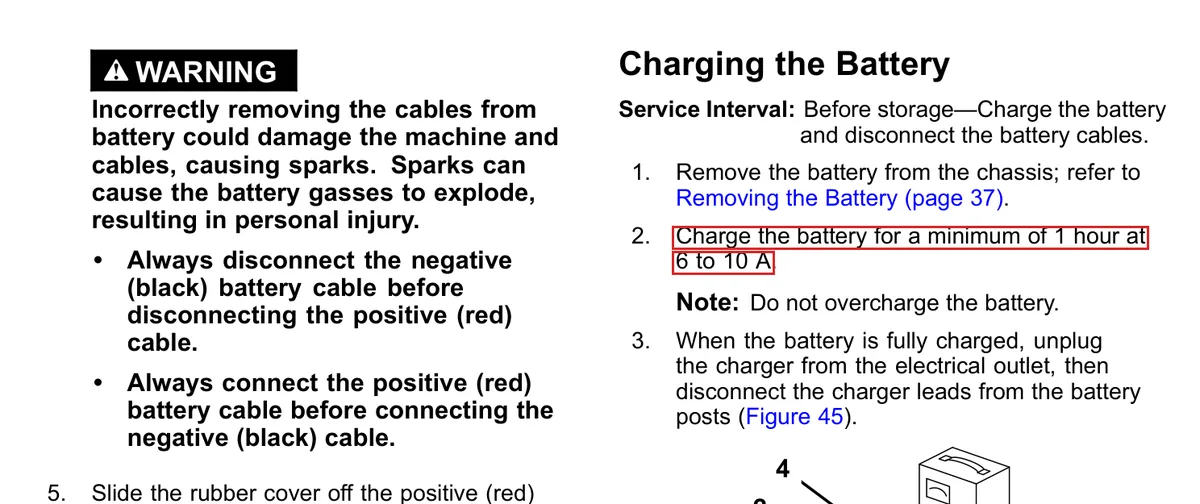
Toro’s figure is a floor, not a ceiling: at least 1 hour, at 6 to 10 A. Cub Cadet’s support article, last updated June 5, 2025, is the strictest maker instruction we found: 6 A at most, 8 to 12 hours on a charger without automatic shut-off, and a suggested recharge during storage longer than 30 days. Its own XT1 and XT2 tractor manual allows 10 A and at least 8 hours (Cub Cadet 769-10184D), so check the manual for your model before you pick the higher figure.
Craftsman’s T100-series tractor manual sets 10 A as its maximum and at least 8 hours on a charger without automatic shut-off; the fuse and interlock checks to make before charging are in our guide to a Craftsman lawn mower that won’t start.
What amp setting should you use?
Use 2 to 6 amps for a U1 riding mower battery. Apart from a 25 to 30 A option in Toro’s 2005 manual, every maker figure we found sits between 4 and 10 A, and the tightest maximum, Cub Cadet’s 6 A, is the only one inside East Penn’s ceiling for every U1 battery Interstate sells. A 1 to 2 A maintainer is safe at any size; it is just slow.
| Maker document | Amps | Time | Other rule | Source |
|---|---|---|---|---|
| Cub Cadet support article 88-1 (riding mowers) | 6 A max | 8 to 12 h if not automatic | Recharge during storage over 30 days | Cub Cadet, June 5, 2025 |
| Cub Cadet XT1, XT2 Enduro tractors | 10 A max | At least 8 h if not automatic | 12 V lead-acid charger only | Form 769-10184D |
| Toro TimeCutter SS 4250, SS 5000, MX 5000 | 6 to 10 A | At least 1 h | Remove battery to charge | Form 3399-367, p. 39 |
| Toro TimeCutter MyRIDE 42, 50, 54 in | 6 to 10 A | At least 1 h | Rest 24 h, recharge if under 12.6 V | Form 3456-108, pp. 38, 52 |
| Toro TimeCutter Z480 (2005) | 4 to 6 A, or 25 to 30 A | 6 h, or 1 h | Keep at 1.260 specific gravity below 32°F | Form 3353-200 |
| Briggs & Stratton (engines) | Not stated | Full within 8 h or replace | Clean, tight connections first | Briggs, Jan. 15, 2026 |
| Interstate Batteries (battery maker) | Under 2 A if adjustable | 5 to 10 h | Ah / amps = hours | Interstate, Oct. 8, 2026 |
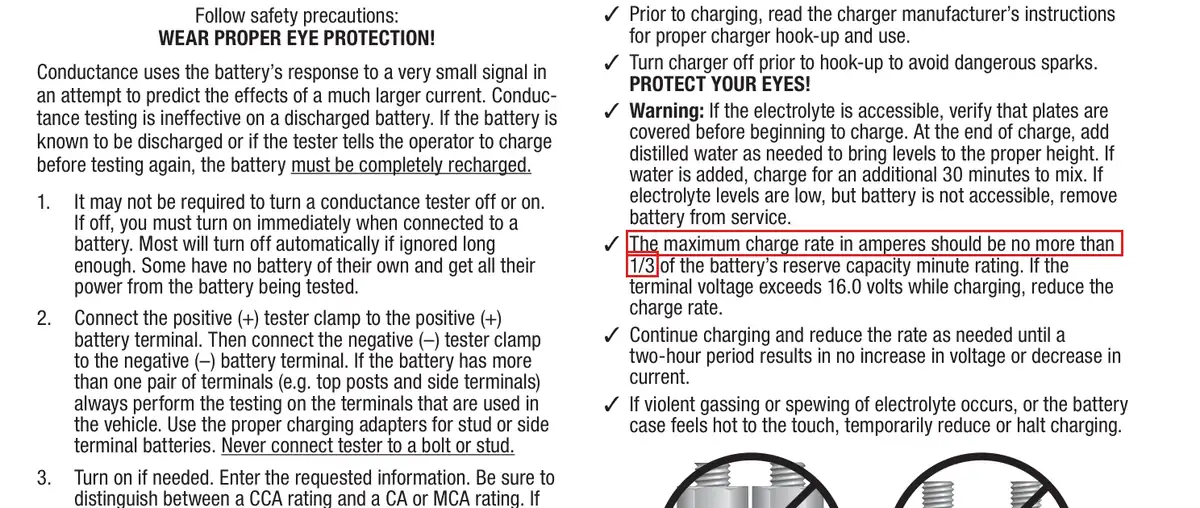
East Penn, which builds Deka batteries, gives the rule that reconciles them: the maximum charge rate in amps should be no more than one-third of the battery’s reserve capacity in minutes (Basic Rules for Battery Care and Maintenance, p. 2). Reserve capacity is printed on the spec sheet. We applied that rule to every U1 battery on Interstate’s lawn and garden list.
| Battery (group) | CCA | Reserve capacity | Amp-hours | Highest rate by East Penn’s rule | Is 10 A inside it? | Price (SRP or MSRP) |
|---|---|---|---|---|---|---|
| Interstate SP-18 (U1) | 215 | 22 min | Not listed | 7.3 A | No | $57.95 |
| Interstate SP-30 (U1) | 250 | 24 min | Not listed | 8.0 A | No | $67.95 |
| Interstate M-U1LH (U1) | 250 | 25 min | 20 Ah | 8.3 A | No | $67.95 |
| Interstate SP-35 (U1) | 300 | 32 min | Not listed | 10.7 A | Yes | $72.95 |
| Interstate SP-40 (U1) | 350 | 41 min | Not listed | 13.7 A | Yes | $82.95 |
| John Deere TY25221B (U1, wet) | 350 | Not listed | 30 Ah | Ask for RC | Unknown | Dealer price |
| Cub Cadet 725P13306 | 300 | Not listed | Not listed | Ask for RC | Unknown | $145.09 |
| Cub Cadet 725P17136 (AGM) | 135 | Not listed | Not listed | Ask for RC | Unknown | $81.61 |
So the familiar 10 A setting on a car charger is too fast for 3 of the 5 Interstate U1 batteries by East Penn’s rule, and only the 300 and 350 CCA models take it. A car charger is fine if it has a 2 A or 6 A position or a lawn-and-garden mode; East Penn also says to cut the rate if terminal voltage passes 16.0 V, or if the battery gasses hard or the case feels hot.
How long does it take to charge a lawn mower battery?
Hours equal the amp-hours the battery is missing divided by the charger’s amps. Interstate’s example is its 20 Ah M-U1LH: flat, it takes a 2 A charge for 10 hours (Interstate). Your voltmeter tells you how much is missing, using East Penn’s open-circuit voltage chart.
| Resting volts, flooded | Resting volts, AGM | State of charge | Ah missing (20 Ah U1) | 1 A | 2 A | 6 A | 10 A (over the M-U1LH limit) |
|---|---|---|---|---|---|---|---|
| 12.6 V | 12.8 V | 100% | 0 | Full | Full | Full | Full |
| 12.4 V | 12.6 V | 75% | 5 | 5 h | 2.5 h | 50 min | 30 min |
| 12.2 V | 12.3 V | 50% | 10 | 10 h | 5 h | 1.7 h | 1 h |
| 12.0 V | 12.0 V | 25% | 15 | 15 h | 7.5 h | 2.5 h | 1.5 h |
| 11.8 V | 11.8 V | 0% | 20 | 20 h | 10 h | 3.3 h | 2 h |
- Hours to full, before the charger tapers
- 5.0
Hours = Ah x share missing / charger amps (Interstate's rule; East Penn voltage chart). Default: 20 Ah x 0.5 / 2 A = 5.0 hours. Automatic chargers slow near full, so allow extra time.
The calculator does the same division for any battery: amp-hours times the share that is missing, divided by the charger’s amps. Its default, a 20 Ah battery at 12.2 V on 2 A, needs 5 hours. Automatic chargers slow down near full, and East Penn’s test of a finished charge is 2 hours with no further rise in voltage, so allow extra time before you call a battery bad.
That is also the replacement test. Briggs & Stratton says that if a lawn mower battery is not fully charged within 8 hours, it is dead and should be replaced (Briggs & Stratton, Jan. 15, 2026). Interstate lists U1 replacements from $57.95 to $82.95 suggested retail, and Cub Cadet’s OEM batteries run $81.61 to $145.09 MSRP; posted shop prices for installing one are in our lawn mower repair cost survey of 26 shops.
How do you know when the battery is fully charged?
Wait, then measure. Right off the charger, a battery reads high from surface charge, which is why Toro’s MyRIDE manual asks for a 24-hour rest before the check. A flooded U1 that reads 12.6 V after resting is full; John Deere’s D100 manual uses the same 12.6 V as its full-charge spec, and East Penn puts AGM at 12.8 V.
A full reading does not prove the battery can still crank. East Penn’s load test applies half the battery’s cold cranking amps for 15 seconds: at 70°F or warmer, a 12 V battery that stays at 9.6 V or above passes, and the floor drops to 9.1 V at 30°F. Interstate says any of its stores will test a lawn and garden battery (Interstate), and our riding mower starting procedure covers the 5-second cranking limit that protects a weak battery.
Can you charge or jump a mower battery from a car?
You can jump-start a 12 V rider from a car battery, but the makers attach conditions, and they are not all the same. Cub Cadet’s support article goes furthest: use an uninstalled, fully charged 12 V car battery, never one still in a vehicle, and never jump an engine with electronic fuel injection (EFI) at all (Cub Cadet 186-1).
| Source | Car battery in the car? | Car engine | Last clamp goes to | After it starts |
|---|---|---|---|---|
| Cub Cadet support 186-1 | No: uninstalled battery only | Not applicable | Bare metal on the mower’s engine block | Remove cables in reverse order; no jump on EFI engines |
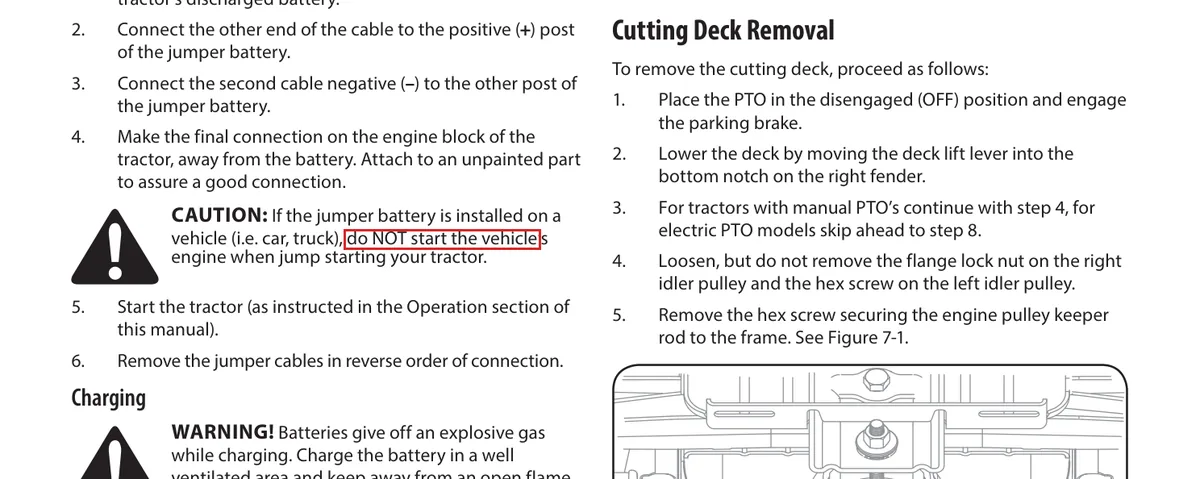
| Cub Cadet XT1, XT2 manual | Allowed | Do NOT start it | Engine block, away from the battery | Reverse order |
| John Deere D100 manual, p. 46 | Not stated | Not stated | Engine block, not the frame | Run several minutes, negative off first |
| Interstate Batteries blog | Allowed | Off, key out | Not stated | Run the mower 2 hours |
| East Penn jump sheet (cars) | Allowed | Start it and run 30 seconds | Engine ground on the dead vehicle | Written for car-to-car jumps |
Read the last row with care: East Penn’s sheet tells car owners to start the helping vehicle first, while Cub Cadet’s XT manual says not to start the car’s engine when jumping a tractor. For a mower, the mower makers’ rule wins. A jump only gets the engine going; the 2 hours of running Interstate suggests is not a substitute for a charge on a battery that read under 12.0 V.
Mowing does recharge a riding mower battery on engines with an alternator. Briggs & Stratton’s quick test: switch on the headlights, then shut off the engine, and if the lights dim the alternator was working. Some walk-behinds have none: Toro’s 30-inch TimeMaster is not equipped with an alternator, so its battery wants 24 hours on the charger at first, then a charge monthly or every 25 starts (Toro Form 3471-140); our Toro no-start guide by model number covers its 40 A fuse.
1Is it a 40 to 60 volt cordless mower pack?
YesUse only that brand's charger, indoors at 41 to 104°F (EGO, Toro). Store it part-charged, not full or empty.
NoGo to the next question
2Has the battery been in freezing weather?
YesBring it inside and let it warm to 60°F before charging or jumping (John Deere D100 manual).
NoGo to the next question
3Does it read 12.4 V or more at rest?
YesIt is 75 percent or fuller: top it off on a 1 to 2 A maintainer, about 2.5 hours at 2 A for a 20 Ah U1.
NoGo to the next question
4Do you need to mow today and the engine is carbureted, not EFI?
YesJump from a 12 V battery with the car engine off, last clamp on the mower's engine block, then charge properly later (Cub Cadet, John Deere).
NoGo to the next question
5Is it an EFI engine?
YesDo not jump it: remove the battery and charge it on a charger (Cub Cadet 186-1).
NoCharge at 2 to 6 A until an automatic charger shows full. If it is not full within 8 hours, replace it (Briggs & Stratton).
How to charge a cordless mower battery
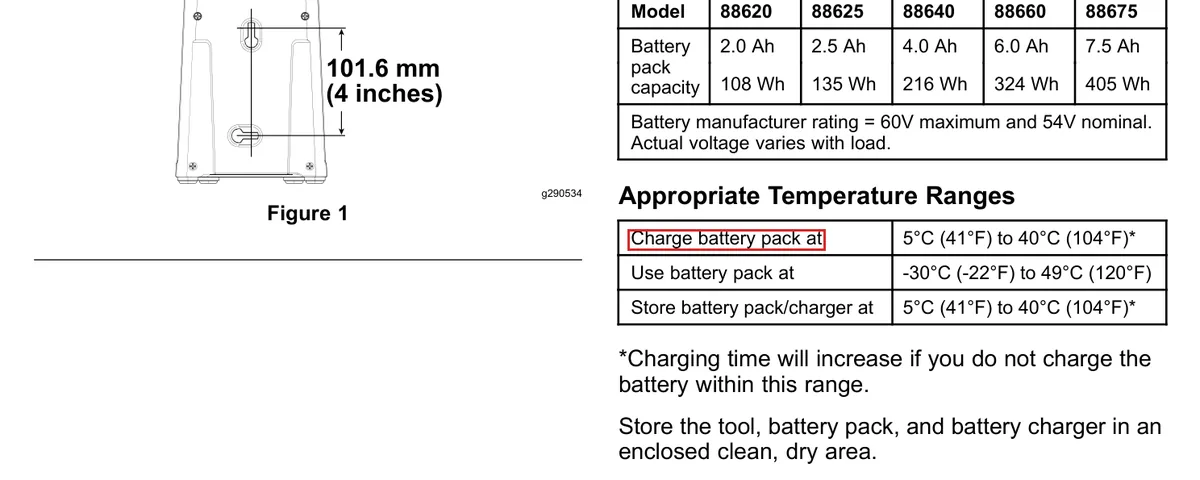
A cordless mower pack goes on its own brand’s charger and nothing else: Toro’s charger manual says a charger suitable for 1 type of pack may create a fire risk with another (Toro 88602 manual, p. 3). Slide the pack in until it seats, wait for the light, and charge indoors between 41 and 104°F, the window EGO and Toro both print.
| Pack | Charger | Charge time | Charge temperature | Price, Nov. 14, 2026 | Source |
|---|---|---|---|---|---|
| EGO 56 V 5.0Ah | Standard / Rapid / 700W Turbo | 100 / 40 / 30 min | 41 to 104°F | Not checked | EGO; EGO battery manual, p. 9 |
| EGO 56 V 7.5Ah | Standard / Rapid / 700W Turbo | 145 / 60 / 45 min | 41 to 104°F | Not checked | EGO |
| Toro 60V 6.0Ah (88960, replaces 88660) | Charger in the 21466 kit | 150 min | 41 to 104°F | $428.99 | Toro 21466; Toro 88960 |
| Toro 60V 7.5Ah (88975) | 88602 (2.0 A) or 88605 (5.5 A) | Not published | 41 to 104°F | $483.99 | Toro 88975; Toro 88602 manual |
| Greenworks 40 V 2.0Ah (29462) | 2 A / 5 A | 40 / 16 min | Not on page | $129.99 | Greenworks |
| Greenworks 60V packs (LB60A00 series) | CH60A00 | Not in manual | 43 to 104°F | Not checked | Greenworks battery manual |
| Ryobi 40V packs | OP406A rapid | 1 hour or less on average | Lights warn if too hot or cold | $129.00 (charger) | Ryobi |
| DeWalt FLEXVOLT 6.0Ah (DCB606) | DCB118, 8 A | 60 min | Not on page | Not checked | DeWalt |
EGO’s own pages differ by 5 minutes on one pack: the battery chart gives the 10.0Ah pack 75 minutes on the Rapid charger, while the Rapid charger page says 70. Greenworks’ 40 V 2.0Ah page lists 40 minutes on a 2 A charger and, a few lines up, 2 hours on a standard charger. Treat each maker’s figure as a range, not a timer. The full table is downloadable as CSV.
Outside the window the charger waits. Toro’s 88602 shows a solid red light when the pack or charger is over or under its range, and says charging time will increase outside 41 to 104°F. EGO says not to store packs outside or in vehicles, and its packs shut down at 158°F during use and resume at 152°F (EGO battery manual, p. 12).
Ryobi’s 40V packs have a narrower window, 50 to 100°F for charging and storage, and its OP406 charger holds a hot or cold pack on an orange light; our page on what to do when a Ryobi lawn mower won’t start decodes those lights.
For the off-season, do not leave a lithium pack full or empty. Toro’s charger manual says to store packs with 2 or 3 of the 4 LEDs lit, and its newer battery-pack manual says 1 or 2 for storage of a year or longer (Toro Flex-Force battery manual, p. 15). EGO packs can drain themselves to 30 percent after a month in storage and go to sleep (EGO battery manual, p. 12), so recharge fully before the first mow. Choosing between the two power types is covered in electric vs gas lawn mower costs over 10 years.
Winter storage: keep a lead-acid battery charged
Charge a riding mower battery fully before storage, then disconnect it. Toro says to check it periodically and recharge below 12.4 V; John Deere says recharge a stored battery every 90 days and keep it where it cannot freeze; Cub Cadet says remove it during long sub-freezing spells and store it above freezing (Cub Cadet 769-10184D). A full battery is the protection: Toro’s older manual says full charge matters most below 32°F.
A 1 to 2 A automatic maintainer covers the 90-day rule without a calendar, since it tops up and then holds. Pair the battery work with the fuel side of storage, which our sibling guide on how to drain gas from a lawn mower covers, and with an oil change; the steps for changing lawn mower oil list drain plugs and capacities by engine.
How we compiled this
We read 27 primary documents on Nov. 14, 2026: 9 operator manuals and support pages from Cub Cadet, Toro, John Deere and Husqvarna, 2 battery parts listings from John Deere and Cub Cadet, Briggs & Stratton’s charging-system page, East Penn’s battery-care sheet, Interstate’s charging blog and battery specification list, and 12 charger, battery and product pages or manuals from EGO, Toro, Greenworks, Ryobi and DeWalt. Charge times by voltage and the amp ceilings are our arithmetic from those figures. We did not test any battery or charger, and prices are list or suggested retail prices on the date checked.
Lead-acid batteries give off explosive hydrogen and contain sulfuric acid (East Penn). This page is general information; follow the manuals for your mower, battery and charger, wear eye protection and charge in a ventilated area.
Frequently asked questions
Can you overcharge a lawn mower battery?
Yes, with a manual charger left on. East Penn says excessive charging shortens battery life and that AGM batteries are damaged by any charger above 15.4 V even once. An automatic charger or maintainer stops or drops to a float when the battery is full.
Can you charge a lawn mower battery while it is still connected?
Some makers do. Husqvarna’s UK page for its TS114 and TC112 tractors charges in place with the negative clamp on the seat frame; Toro’s manuals remove the battery first. Either way, the key is out and the charger is unplugged while you connect it.
How do you bring a dead lawn mower battery back to life?
Clean the terminals, warm it to 60°F if it was cold, and charge it at 2 to 6 A. If it is not full within 8 hours, Briggs & Stratton says the battery is dead; if it reaches 12.6 V but fails a half-CCA load test, East Penn says replace it.
How many seasons a U1 starter battery should give you, and how fast heat drains it in storage, is on our page on how long lawn mower batteries last.
Can I charge a lawn mower battery with a 12 volt car charger?
Yes, at a low setting. Use 6 A or less (Cub Cadet) and the AGM mode for an AGM battery. A 10 A setting exceeds East Penn’s one-third-of-reserve-capacity ceiling for 3 of Interstate’s 5 U1 batteries.
How long to charge a lawn mower battery at 2 amps?
About 10 hours from flat for a 20 Ah U1 battery, 5 hours from half charge (12.2 V) and 2.5 hours from 12.4 V. A 30 Ah battery, like John Deere’s TY25221B, takes half as long again.
Sources
- Cub Cadet, Battery Charging: Riding Mower (article 88-1), updated June 5, 2025. Accessed November 2026.
- Cub Cadet, Jump Starting: Riding Mower (article 186-1), updated June 5, 2025. Accessed November 2026.
- Cub Cadet (MTD), XT1 and XT2 Enduro Series Tractor Operator’s Manual, Form 769-10184D, 2015. Accessed November 2026.
- Cub Cadet, Batteries for outdoor power equipment (parts listing), MSRP checked Nov. 14, 2026. Accessed November 2026.
- East Penn Manufacturing, Basic Rules for Battery Care and Maintenance, form 0004, undated sheet. Accessed November 2026.
- The Toro Company, TimeCutter MyRIDE Operator’s Manual, Form 3456-108, Rev A. Accessed November 2026.
- The Toro Company, TimeCutter SS 4250, SS 5000, MX 5000 Operator’s Manual, Form 3399-367, Rev B. Accessed November 2026.
- The Toro Company, TimeCutter Z480 Operator’s Manual, Form 3353-200, 2005. Accessed November 2026.
- The Toro Company, TimeMaster 30in Lawn Mower Operator’s Manual, Form 3471-140, Rev C. Accessed November 2026.
- The Toro Company, Flex-Force 60V MAX Battery Charger 88602, 88605, 88610 Operator’s Manual, current PDF. Accessed November 2026.
- The Toro Company, Flex-Force Power System 60V MAX Battery Packs Operator’s Manual, current PDF. Accessed November 2026.
- The Toro Company, 60V 22 in. Recycler 21466 product page, checked Nov. 14, 2026. Accessed November 2026.
- The Toro Company, 60V Flex-Force 6.0Ah battery 88960 (replaces 88660), checked Nov. 14, 2026. Accessed November 2026.
- The Toro Company, 60V Flex-Force 7.5Ah battery 88975 (replaces 88675), checked Nov. 14, 2026. Accessed November 2026.
- Deere & Company, John Deere D100 Series Tractors Operator’s Manual, OMGX25410, Issue J4. Accessed November 2026.
- Deere & Company, TY25221B 12 Volt Battery, 30 Ah, 350 CCA, U1, checked Nov. 14, 2026. Accessed November 2026.
- Briggs & Stratton, How to test a small engine charging system, battery and alternator, updated Jan. 15, 2026. Accessed November 2026.
- Interstate Batteries, How to Charge Your Lawn Mower Battery, revised Oct. 8, 2026. Accessed November 2026.
- Interstate Batteries, Lawn and Garden Batteries (specifications and SRP), checked Nov. 14, 2026. Accessed November 2026.
- Husqvarna, Charging the starter battery on a petrol-powered garden tractor, checked Nov. 14, 2026. Accessed November 2026.
- EGO Power+, 56V Battery 2.0Ah to 7.5Ah Operator’s Manual, current PDF. Accessed November 2026.
- EGO Power+, Battery info and charge times, checked Nov. 14, 2026. Accessed November 2026.
- EGO Power+, Power+ Rapid Charger, checked Nov. 14, 2026. Accessed November 2026.
- Greenworks, 40V 2.0 Ah Battery (29462), checked Nov. 14, 2026. Accessed November 2026.
- Greenworks, 60V Rechargeable Lithium-Ion Battery owner’s manual, LB60A00 series, current PDF. Accessed November 2026.
- Ryobi, 40V Rapid Charger OP406A, checked Nov. 14, 2026. Accessed November 2026.
- DeWalt, DCB118 20V MAX/60V MAX FLEXVOLT 8 Amp Fast Charger, checked Nov. 14, 2026. Accessed November 2026.