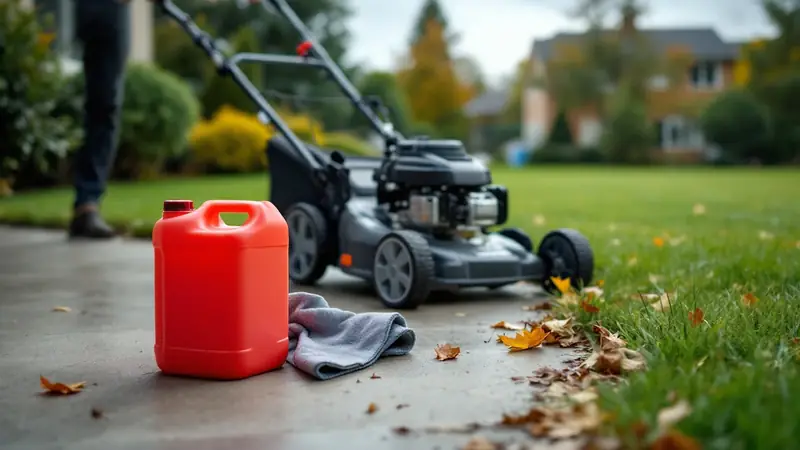
How to drain gas from lawn mower tanks: outdoors, engine cold and plug wire off, hand-pump the fuel into an approved gas can, then run the engine until it stalls to dry the carburetor. Toro’s manuals forbid siphoning; a hand pump is fine.
Whether you should drain at all depends on whose manual you read. We set the storage pages of 17 documents from 10 mower and engine makers side by side: Briggs & Stratton says a tank of stabilized fuel can sit 24 months, Honda says to empty the whole fuel system after 3 months, and Kawasaki and Toro’s TimeCutter manual say to drain after 30 days. Two pages ranking for this search tell you to tip the mower and pour, or to siphon; Craftsman’s manual rules out the first and Toro’s the second.
This page covers getting the fuel out and where it goes. Which gas to put back in is on our page about what gas a lawn mower takes, and varnish that is already in the jets is a job for our guide to cleaning a lawn mower carburetor. Battery and robotic mowers hold no gasoline, so none of this applies to them.
Drain or stabilize? What 10 makers’ manuals say
The split is over stabilizer. Briggs & Stratton’s fuel FAQ (updated Apr. 6, 2026) says treated fuel can stay in the engine for up to 24 months, while untreated gasoline must be drained into an approved container before the engine is run until it stops. Its storage checklist goes the other way for treated fuel: top off the tank so less air and moisture sit above the gas.
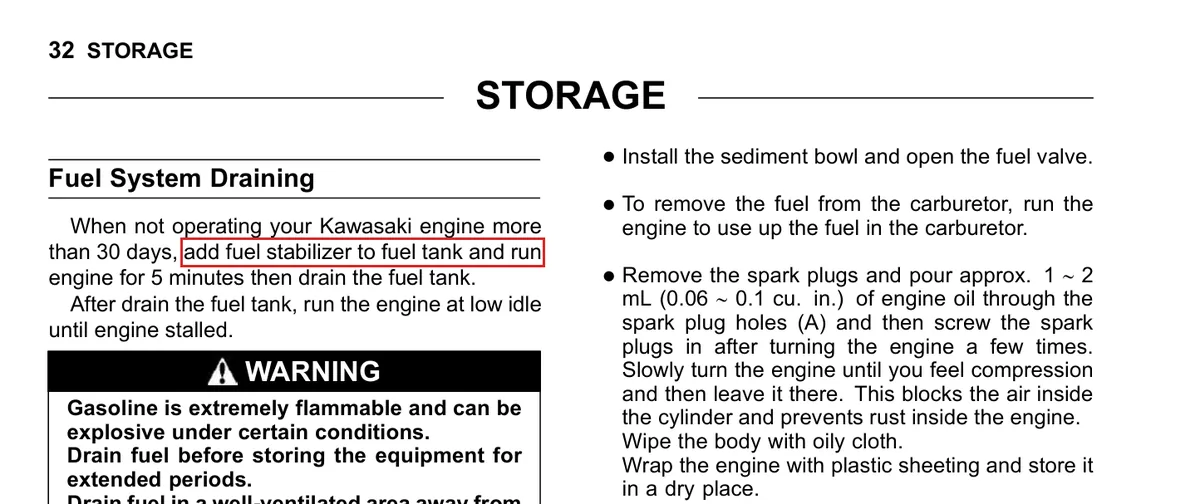
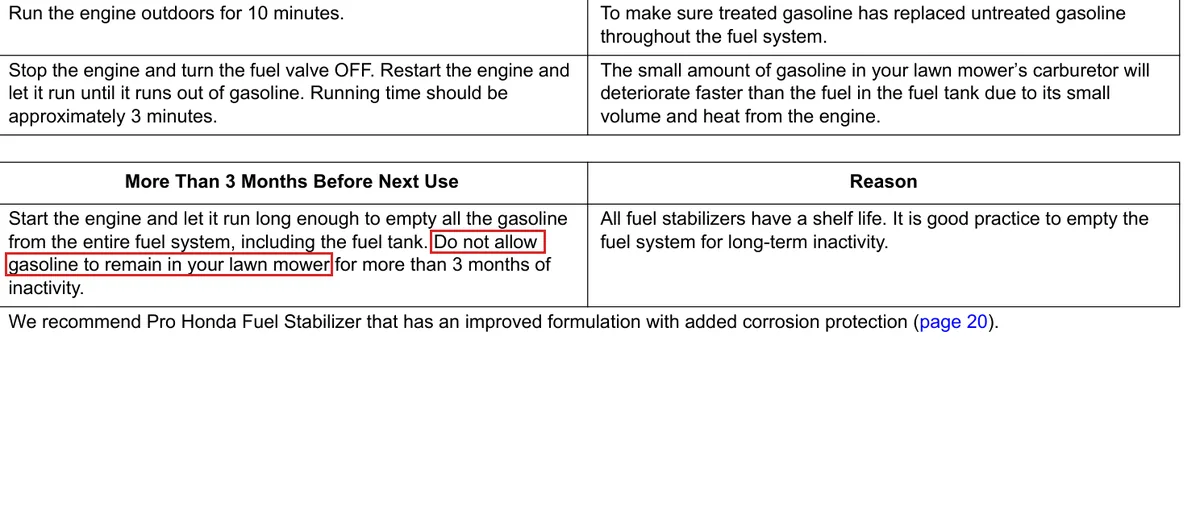
Honda, Kawasaki and Cub Cadet put a ceiling on stabilizer. Honda’s HRN216 manual says all stabilizers have a shelf life and that gasoline should not stay in the mower for more than 3 months of inactivity (p. 19). Kawasaki has owners stabilize, run 5 minutes and then drain the tank anyway once storage passes 30 days (p. 34). Toro’s walk-behind manuals do both every year: stabilizer at the last fill, then run the engine dry.
Swipe the table sideways to see every column.
| Maker and model | When the manual says to empty it | How the manual empties it | Stabilizer instead? | Source |
|---|---|---|---|---|
| Briggs & Stratton engines (fuel FAQ) | Any storage on untreated fuel | Drain into an approved container, then run the engine until it stops | Yes: treated fuel needs no draining for up to 24 months; run 2 minutes after dosing | Briggs & Stratton fuel FAQ, web page |
| Briggs & Stratton storage checklist | Untreated fuel, or fuel containing alcohol such as gasohol | Remove all fuel from the tank, run until it stops | Top off the tank with stabilized fuel before storing | Briggs & Stratton, Storing Your Mower, web page, note |
| Briggs & Stratton tank service | Debris, water or a leak in the tank | Clamp the line at the carburetor, disconnect it, release the clamp over a bucket or fuel can | Not applicable | Briggs & Stratton fuel tank cleaning FAQ, web page |
| Honda HRN216 walk-behind | Idle 3 to 4 weeks: run the carburetor dry; idle over 3 months: empty the whole fuel system | Fuel valve OFF, run the engine about 3 minutes until it stops | 1 to 3 months: stabilizer, run 10 minutes, then run the carburetor dry | Honda owner’s manual 00X31VR8B103, pp. 9, 19 |
| Honda GCV170, GCV200 engines | Over 3 months (about 90 days) of inactivity | Run the engine until the tank and carburetor are empty | Same schedule as the HRN216 | Honda owner’s manual 00X37Z9V0002, pp. 13, 15 |
| Honda GC, GCV135, GCV160, GCV190 carburetors | Storage over 3 months | Run until it stops, or loosen the float chamber drain screw with the engine stopped | Not stated | Honda Motor Europe carburetor check sheet, item 6 |
| Toro 21in Recycler 21321 | Before repairs and before yearly storage | Run until the engine shuts off, restart until it will not start; hand pump if you must tip; never siphon | Stabilizer at the last fill of the year, then run dry anyway | Toro Form 3456-222 Rev B, pp. 19, 22 |
| Toro 22in Recycler SmartStow 21445 | Same, plus any fuel above the engine decal level before upright storage | Drain into an approved fuel container down to the decal level | Same as 21321 | Toro Form 3445-592 Rev B, pp. 17, 19, 23 |
| Toro TimeCutter SS 4250, SS 5000, MX 5000 riders | Non-use over 30 days | Stabilize, run 5 minutes, cool, drain the tank, run until it stops, restart until it will not start | Stabilized fuel no more than 90 days | Toro Form 3399-367 Rev B, pp. 17, 37, 50 |
| Kohler XT-6 to XT8 | Out of service 2 months or more: treat the fuel; no drain step listed | Service manual: float bowl drain screw, used before bowl removal | Kohler PRO Series treatment, run 2 to 3 minutes | Kohler 14 690 01 Rev. G, pp. 4, 21 |
| Kohler 7000 Series KT610 to KT745 | Out of service 2 months or more: treat the fuel; no drain step listed | Not stated | Kohler PRO Series treatment, run 2 to 3 minutes | Kohler 32 690 03 Rev. M, p. 4 |
| Kawasaki FR, FS, FX engines | Stored over 30 days | Close the fuel valve, remove the sediment bowl, drain the tank into a pan, then run the carburetor dry | Stabilizer, run 5 minutes, then drain the tank anyway | Kawasaki owner’s manual, p. 34 |
| John Deere S100 to S180 tractors | Storage without stabilized fuel | Run the engine until it runs out; plan the last mow so little fuel is left | Stabilized fuel: fill the 2.4 gal tank full | John Deere OMUC22642, pp. 48, 50 |
| Cub Cadet XT1, XT2 Enduro tractors | Stored over 90 days | Run empty | 30 to 90 days: stabilizer such as STA-BIL | Cub Cadet Form 769-10184D, pp. 13, 25 |
| Craftsman CMXGMAM1125501 walk-behind | Stored over 30 days | Run until it stops from lack of fuel; do not pour fuel from the engine | Or stabilizer in a full tank, run several minutes | Craftsman Form 769-17053, pp. 15, 16, 18 |
| Troy-Bilt TB200 walk-behind | Before tipping to clean the deck | Drain the tank, or put plastic under the gas cap | 30 to 90 days: stabilizer such as STA-BIL | Troy-Bilt Form 769-09193, pp. 15, 16 |
| Husqvarna LC221RH walk-behind | Long storage; with alcohol blends, before storage of 30 days or longer | Empty the tank, run until lines and carburetor are empty; empty before tipping | Stabilizer accepted, and then do not empty the tank | Husqvarna LC221RH operator’s manual, pp. 13, 22 |
Read the chart as each maker’s limit for its own machine. Start with the manual for the mower, since it covers the engine installed in it; Kohler‘s engine procedure, for one, only treats the fuel after 2 months idle and lists no drain step (p. 4).
Fuel is one of six storage steps; our guide on how to winterize a lawn mower sets each maker’s cylinder oil dose, cleaning, battery and cover rules side by side.
1Is the fuel stale, cloudy, water-laden or over 10 percent ethanol, or are you about to tip the mower or open the fuel system?
YesDrain now: hand-pump the tank into an approved can, run the engine until it will not restart, and take the fuel to a household hazardous waste site.
NoGo to the next question
2Will the mower sit 3 to 4 weeks or less?
YesNo full drain. Honda says to turn the fuel valve OFF and run the carburetor dry, about 3 minutes; on other mowers, just keep the fuel under 30 days old.
NoGo to the next question
3Will it sit 30 to 90 days, and can you add stabilizer to fresh fuel?
YesStabilize and run the engine 2 to 10 minutes so treated fuel reaches the carburetor (Briggs 2, Kawasaki 5, Honda 10). Kawasaki and Toro's TimeCutter still want the tank drained past 30 days.
NoGo to the next question
4Is it a Briggs & Stratton or Kohler engine, and will you treat the fuel?
YesBriggs: fill the tank with stabilized fuel, good for up to 24 months by its fuel FAQ. Kohler: add fuel treatment and run 2 to 3 minutes.
NoEmpty the fuel system: Honda past 3 months, Cub Cadet past 90 days, Kawasaki and Toro TimeCutter past 30 days.
How to drain gas from a lawn mower, step by step
Gasoline is the hazard, not the mower. The Global Partners gasoline SDS (May 22, 2023) lists a flash point of minus 45°F, a flammable range of 1.4 to 7.6 percent in air and a vapor density of 3 to 4, so the fumes sink and drift to pilot lights and floor drains. Toro’s TimeCutter manual says to do fuel work with the engine cold, outdoors in an open area, and never to smoke while draining (p. 37).
Tools: a hand transfer pump with a squeeze bulb or plunger, an approved gas can, a rag, nitrile gloves and, for the fuel-line method, a fuel line clamp. A 1-gallon can holds a full Honda walk-behind tank of 0.24 gal (HRN216, p. 18); a 5-gallon can covers a John Deere S100 tank of 2.4 gal (p. 50) or a Cub Cadet XT1 at 3 gal (p. 13). Gas cans made since Dec. 22, 2022 must have child-resistant closures that meet ASTM F2517-22e1 under 16 CFR 1460.3.
- Move the mower outdoors onto level ground and let the engine cool; Toro’s TimeCutter manual says fuel work starts cold (p. 37).
- Pull the spark plug wire off the plug, as Briggs & Stratton’s tank service steps begin. On a Honda with a fuel valve, turn it OFF.
- Set the gas can on the ground, not in a truck bed or on a tailgate. Toro says that keeps a static charge from igniting the fuel (Form 3445-592, p. 9).
- Put the pump’s intake tube through the filler neck to the bottom of the tank and pump until it draws air. Step 6 burns off what the pump cannot reach.
- No pump? On engines with a fuel line, clamp the line at the carburetor, pull it off, hold it over the can and release the clamp (Briggs & Stratton). On a Kawasaki-powered machine with a sediment bowl, close the valve, remove the bowl, then open the valve over a pan (Kawasaki, p. 34).
- Refit the line, reconnect the plug wire, start the engine and let it run until it stalls. Restart it until it will not start: Toro says the engine is then sufficiently dry (Form 3456-222, p. 22).
- If the carburetor has a float bowl drain screw (Honda GC and GCV, Kohler XT), loosen it over a rag with the engine stopped to empty the bowl, then retighten it (Honda Motor Europe).
- Cap the can, label it OLD GAS with the date, and wipe up any spill before you start the engine again.
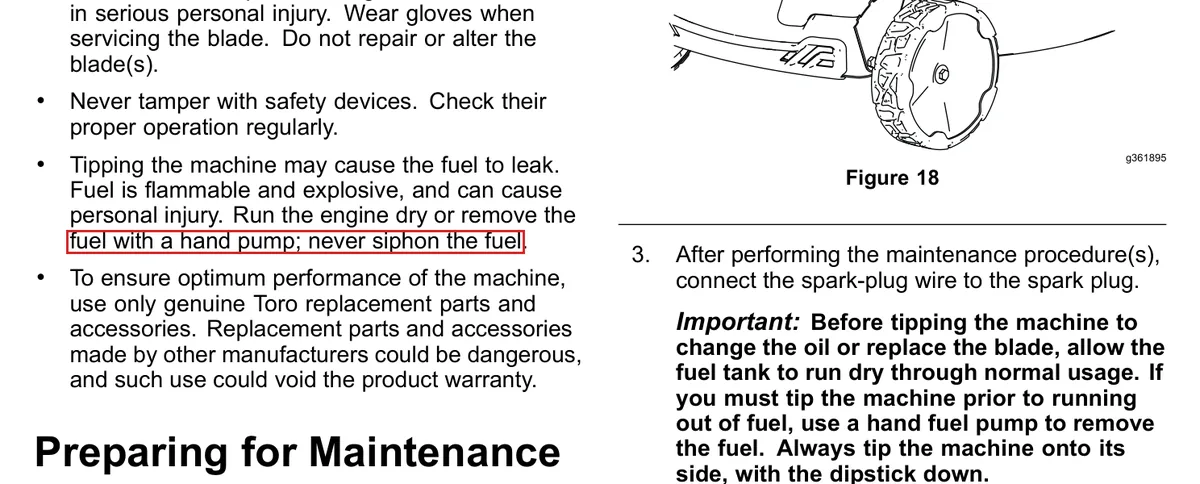
Toro rules out siphoning without saying why, and allows a hand pump. Hardware-store transfer pumps sold as siphon pumps are hand pumps; the version to avoid is a hose started by mouth, since the SDS warns gasoline may be fatal if swallowed and it enters the airways (H304, p. 1). If the mower will not restart after step 6, start with our lawn mower not starting checklist, and our guide on how to start a lawn mower lists the prime and choke steps for 15 models.
Which way of draining fits your mower?
Every method in the maker documents ends the same way: the carburetor is emptied by running the engine. What differs is how the tank gets empty first, and that depends on the plumbing. The Village of Shorewood page notes that some Briggs-powered walk-behinds bolt the carburetor straight onto the tank, so there is no line to pull and a pump is the only way to empty the tank short of running it.
| Method | What it empties | Who prescribes it | The catch |
|---|---|---|---|
| Run it dry | Tank, line and carburetor | Toro, John Deere, Craftsman, Husqvarna, Honda | A full Honda GCV170 tank takes about 45 minutes (table below) |
| Hand pump through the filler neck | Tank only; leaves fuel in the line and float bowl | Toro (when you must tip), Cub Cadet (riders) | Follow with a run-dry restart to clear the carburetor |
| Fuel line clamp and disconnect | Tank and line | Briggs & Stratton tank service | Needs a line to pull; some walk-behinds mount the carburetor on the tank |
| Float bowl drain screw | Carburetor bowl only | Honda GC and GCV carburetors, Kohler XT | Only on carburetors that have the screw; use with the engine stopped |
| Sediment bowl and fuel valve | Tank | Kawasaki FR, FS, FX | Only where the machine has Kawasaki’s valve and bowl |
| Tip and pour through the cap | Some of the tank, plus spills | No maker in our table | Craftsman: do not attempt to pour fuel from the engine |
Running a full tank dry is slow. Honda rates the GCV170 that powers its HRN216 at 1.2 L of fuel an hour at 3,000 rpm on E10, against a 0.91 L tank (00X37Z9V0002, p. 13). That works out to about 45 minutes, which is why pumping first and running only the carburetor dry saves time.
| Fuel left in a Honda GCV170 tank | Fuel volume | Run time at 1.2 L/h | Run time at 1.4 L/h (GCV200) |
|---|---|---|---|
| Full tank | 0.91 L (0.24 gal) | about 45 minutes | about 39 minutes |
| Half tank | 0.46 L | about 23 minutes | about 20 minutes |
| Quarter tank | 0.23 L | about 11 minutes | about 10 minutes |
| Carburetor only, fuel valve OFF | bowl contents | about 3 minutes (Honda’s figure) | about 3 minutes |
Can you tip a mower to pour the gas out?
No maker in our table tells you to drain gas by tipping. Craftsman‘s CMXGMAM1125501 manual says to run the engine out of fuel and not to attempt to pour fuel from the engine (p. 16), and Husqvarna says to empty the tank before you lay the LC221RH on its side (p. 22). Craftsman and Troy-Bilt also cap any tip at 90 degrees, because oil can drain into the top of the engine.
Once the tank is empty, tip by the manual: Honda puts the HRN216 on its right side with the fuel cap up (p. 12), Toro tips the Recycler with the dipstick down (Form 3445-592, p. 19), and Husqvarna keeps the air filter highest. Our lawn mower oil change guide lists the tip side for 10 engines, and our page on why a lawn mower smokes explains the white smoke that follows a wrong-side tip.
Riding mowers and zero-turns
Rider tanks hold 10 to 12 times the fuel of a 0.24 gal walk-behind tank, so running them dry from full is impractical. John Deere‘s S100 manual says to plan the last mow of the season so very little fuel is left in the 2.4 gal tank, then run the engine until it runs out (p. 48). Cub Cadet‘s how-to for its riders uses an oil siphon pump through the filler into a container meant for gasoline disposal, then fresh gas with stabilizer.
Toro’s TimeCutter zero-turns get the longest procedure: past 30 days of non-use, add a petroleum-based stabilizer, run the engine 5 minutes, let it cool, drain the tank, run it until it stops, then start it until it will not start (p. 50). John Deere’s fuel filter procedure puts a drain pan under the filter and slides the hose clamps back with pliers (p. 34), but the manual does not use that point for draining. Our zero-turn vs lawn tractor comparison covers the two machine types, and riders headed for storage also need the battery charged and stored, which how to charge a lawn mower battery covers.
Where the top guides and the manuals disagree
Of the 9 Google results for this search on Nov. 14, 2026, 3 are YouTube videos and 2 are forum threads. The text pages split on siphoning and tipping, and a page ranking for the winter version of the question comes from the company that sells STA-BIL. Each claim below is set against the maker document that covers it.
| What a top-ranking page says | Who says it | What the maker documents say |
|---|---|---|
| Tilt the mower and pour the gas out through the fuel cap opening | Sunseeker blog, June 25, 2026 | Craftsman: do not attempt to pour fuel from the engine (p. 16). Husqvarna: always empty the tank before you put the mower on its side (p. 22). Toro: tipping may cause fuel to leak (p. 19). |
| Siphon with a hose, or lift it out with a baster | Village of Shorewood, Wis. Conservation Committee | Toro: run the engine dry or use a hand pump; never siphon (p. 19). The gasoline SDS lists H304: may be fatal if swallowed and enters airways. |
| Draining the tank could harm your engine | Gold Eagle, maker of STA-BIL | Honda: empty the whole fuel system after 3 months because all stabilizers have a shelf life (p. 19). Kawasaki: stabilize, run 5 minutes, then drain anyway past 30 days (p. 34). |
| Running the mower out of gas takes a good deal of time | Village of Shorewood | True for a full tank: about 45 minutes on a Honda GCV170 by Honda’s consumption rating. Pump the tank first and the carburetor runs dry in about 3 minutes (Honda, p. 19). |
| Remove all fuel if it contains alcohol such as gasohol | Briggs & Stratton storage page (its own note) | Briggs’s fuel FAQ approves up to 10 percent ethanol and says treated fuel needs no draining for 24 months. Read literally, the note covers every E10 tank; the FAQ is the newer page (Apr. 6, 2026). |
What to do with the gas you drained
Fresh fuel can go back into service. Toro’s storage steps say to recycle unused fuel under local codes or use it in your automobile (Form 3445-592, p. 23). The New York DEC disposal sheet says old gasoline without water can be strained through a coffee filter and mixed with fresh gas at 1 part to 5, and to check the owner’s manual first. None of the 17 mower documents we read mentions reconditioned gas, and Honda notes stabilizer will not reconstitute stale fuel (p. 19).
Fuel that is stale, cloudy or mixed with water goes to a household hazardous waste site. Iowa DNR sends gasoline from mowers to its regional collection centers, and NY DEC says never to pour gasoline into storm drains, septic systems or on the ground, or put it in the trash. Household waste is exempt from federal hazardous-waste rules under 40 CFR 261.4(b)(1), so the drop-off rules are your state’s and county’s; the EPA lists pouring on the ground or into storm sewers as improper disposal.
Pouring stale fuel along a fence line is not a shortcut: our check of whether gasoline kills weeds found it kills only the leaves it wets, and one gallon carries enough benzene to bring about 1.09 million gallons of water to the federal limit.
Store the can in the meantime the way Honda stores fuel: a clean, sealed plastic container approved for gasoline, out of direct sunlight, with any vent closed (HRN216, p. 19). Keep it away from any appliance with a flame, such as a furnace, water heater or clothes dryer, the list in Honda’s GCV170 manual (p. 11). If the spring routine has become a chore, our electric vs gas lawn mower comparison prices the switch.
How we compiled this
On Nov. 14, 2026 we read the fuel and storage sections of 18 documents (17 in the main table) from Briggs & Stratton, Honda, Toro, Kohler, Kawasaki, John Deere, Cub Cadet, Craftsman, Troy-Bilt and Husqvarna, plus a gasoline safety data sheet, 16 CFR 1460, 40 CFR 261.4 and disposal sheets from EPA, Iowa DNR and NY DEC. Page numbers are PDF page numbers. Run-dry times are arithmetic from Honda’s consumption ratings. We did not drain or test any mower.
Frequently asked questions
Where is the drain plug on a lawn mower?
Most walk-behind mowers have no fuel drain plug; a plug low on the engine, where there is one, drains oil. Some carburetors, including Honda GC and GCV and Kohler XT, have a float bowl drain screw that empties only the bowl. The tank is emptied with a pump or by running the engine.
How do you drain gas from a lawn mower without a pump?
Run the engine until it stalls, then restart it until it will not start, which Toro calls sufficiently dry. On a mower with a fuel line, Briggs & Stratton’s method works too: clamp the line at the carburetor, pull it off over a gas can and release the clamp.
How long does it take for gas to evaporate in a lawn mower?
No maker gives an evaporation time, and none tells you to let it evaporate. Gasoline left to sit leaves gum and varnish, which is why Honda wants the carburetor run dry after 3 to 4 weeks idle; running the carburetor dry takes about 3 minutes.
Can I tip my lawn mower upside down to drain gas?
No. Craftsman says not to pour fuel from the engine and caps any tip at 90 degrees, and Toro warns that tipping can leak fuel. Pump or run the tank empty first, then tip the way your manual says, such as Honda’s right side with the fuel cap up.
Should you drain the gas from your lawn mower for winter?
It depends on the maker. Honda says to empty the whole system before more than 3 months idle, and Cub Cadet past 90 days. Briggs & Stratton says a full tank of stabilized fuel can stay up to 24 months, so follow the manual for your machine.
Sources
- Briggs & Stratton, What is the best fuel type for lawn mowers and small engines?, updated Apr. 6, 2026. Accessed November 2026.
- Briggs & Stratton, Storing Your Mower & Outdoor Power Equipment, updated Jan. 15, 2026. Accessed November 2026.
- Briggs & Stratton, How do I safely perform fuel tank cleaning for small engines?, updated Jan. 15, 2026. Accessed November 2026.
- American Honda, HRN216 owner’s manual, 00X31VR8B103, pp. 9, 12, 18, 19. Accessed November 2026.
- American Honda, GCV170 and GCV200 owner’s manual, 00X37Z9V0002, pp. 13, 15. Accessed November 2026.
- Honda Motor Europe, Carburetor Check Sheet GC-GCV135/160/190, GS-GSV160/190, edition Sept. 2017. Accessed November 2026.
- The Toro Company, 21in Recycler 21321 Operator’s Manual, Form 3456-222 Rev B, pp. 19, 22. Accessed November 2026.
- The Toro Company, 22in Recycler with SmartStow 21445 Operator’s Manual, Form 3445-592 Rev B, pp. 9, 17, 19, 23. Accessed November 2026.
- The Toro Company, TimeCutter SS 4250, SS 5000, MX 5000 Operator’s Manual, Form 3399-367 Rev B, pp. 17, 37, 50. Accessed November 2026.
- Kohler Engines, XT-6 to XT8 service manual, 14 690 01 Rev. G, pp. 4, 21. Accessed November 2026.
- Kohler Engines, 7000 Series service manual, 32 690 03 Rev. M, p. 4. Accessed November 2026.
- Kawasaki Motors, FR, FS and FX series engine owner’s manual, p. 34. Accessed November 2026.
- John Deere, 100 Series Lawn Tractors Operator’s Manual, OMUC22642 (retailer copy), pp. 34, 48, 50. Accessed November 2026.
- Cub Cadet (MTD), XT1 and XT2 Enduro Series Operator’s Manual, Form 769-10184D, Mar. 25, 2015; pp. 13, 25. Accessed November 2026.
- Cub Cadet, How to Change the Gas on a Cub Cadet Riding Mower, page current Nov. 2026. Accessed November 2026.
- Craftsman (MTD), CMXGMAM1125501 mower instruction manual, Form 769-17053, Aug. 24, 2018; pp. 15, 16, 18. Accessed November 2026.
- Troy-Bilt (MTD), TB200 operator’s manual, Form 769-09193, Oct. 3, 2013; pp. 15, 16. Accessed November 2026.
- Husqvarna, LC221RH operator’s manual, pp. 13, 22. Accessed November 2026.
- Global Partners LP, Safety Data Sheet, Gasoline All Grades, version 8, May 22, 2023; pp. 1, 4, 7. Accessed November 2026.
- eCFR, 16 CFR Part 1460, Children’s Gasoline Burn Prevention Act Regulation, current Nov. 2026. Accessed November 2026.
- eCFR, 40 CFR 261.4, Exclusions, current Nov. 2026. Accessed November 2026.
- U.S. EPA, Household Hazardous Waste (HHW), page current Nov. 2026. Accessed November 2026.
- Iowa DNR, Household Hazardous Materials: Gasoline, undated sheet. Accessed November 2026.
- New York State DEC, Household Hazardous Waste: Gasoline Disposal, undated sheet. Accessed November 2026.
- Village of Shorewood, Wis., Emptying Gas from your Lawn Mower, undated page. Accessed November 2026.
- Sunseeker, How to Drain Gas From Lawn Mower, June 25, 2026. Accessed November 2026.
- Gold Eagle Co., Lawn Mower Storage: Why Draining the Fuel Tank Is a Mistake, undated page. Accessed November 2026.