How long do lawn mower batteries last? A riding mower’s 12-volt lead-acid battery lasts about 3 years, per Interstate. Cordless lithium packs carry 3 to 5 year warranties, and STIHL rates its AP packs at 1,200 to 2,500 charge cycles.
How long do lawn mower batteries last depends first on which battery you mean. A lawn tractor or zero-turn starts its engine with a 12-volt lead-acid battery, usually BCI group U1; a cordless push mower runs on a 40 to 80 volt lithium-ion pack. Interstate Batteries puts the first at “about three years” and lithium packs at 2 to 3 years or 300 to 500 cycles. The makers’ own paperwork says more: Interstate replaces a lawn and garden battery free for only 6 months, while EGO, Ryobi and Toro warrant their packs for 3 years. This page sets those terms, the published cycle ratings and the storage rules side by side, then shows why a weekly-mowed pack almost never uses up its cycles and what actually ends each battery type.
Lawn mower battery life by type: years, cycles and warranty
The table compiles 17 maker and battery-industry documents. “Life” is the maker’s own figure where one is published; most makers publish only a warranty, which is the period they will pay for, not a prediction. Lead-acid starter batteries carry no cycle rating at all, because each start draws a few seconds of current and the engine’s charging system tops it back up.
Swipe the table sideways to see every column.
| Battery | Published life | Cycle rating | Warranty (household) | Storage rule | Source |
|---|---|---|---|---|---|
| 12 V flooded lead-acid, group U1 (Interstate SP-30, SP-35, SP-40) | About 3 years | Not cycle-rated (starter duty) | 6 months free replacement | Charge below 12.4 V; test every 4 to 6 months | Interstate; Interstate warranty; East Penn |
| Lead-acid battery in a Toro mower | Not stated | Not stated | 90 days parts and labor, then parts only to 365 days | Per mower manual | Toro warranty 3478-812 |
| 12 V AGM lead-acid | Not stated | Not cycle-rated (starter duty) | Varies by maker | Recharge at 75% state of charge; self-discharge about 1% a month at 77°F | Trojan; Hawker |
| EGO 56V ARC Lithium packs | Not stated | Not published | 3 years (BA5600T, BA6720T: 5 with registration); ARC Lithium MAX 4, or 5 with registration | 30 to 50% charge, below 80°F; full charge every 6 months | EGO warranty; EGO manual |
| Ryobi 40V packs (OP40602, OP40752, OP4060A) | Not stated | Not published | 3 years; 1 year commercial or rental | 30 to 50% charge, below 80°F; charge every 6 months | Ryobi manual, p. 2; Ryobi OP4060A |
| Toro 60V Flex-Force, under 7.5Ah | Not stated | Not published | 3 years; 45 days commercial | 1 or 2 of 4 LEDs for a year or longer; 41 to 104°F | Toro warranty; Toro pack manual, pp. 14 to 15 |
| Toro 60V Flex-Force, 7.5Ah and up | Not stated | Not published | 3 years; 2 years commercial | Same as above | Toro warranty |
| Greenworks 60V (LB60A00 series) | Not stated | Not published | 2 years (manual rev. 08-01-16) | Fully charge, room temperature, if unused 3 months or more | Greenworks manual, p. 13 |
| STIHL AP 300 S | Not stated | Up to 1,200 cycles “with minimal loss in capacity” | Not checked | 50 to 68°F for maximum life | STIHL; STIHL tips |
| STIHL AP 500 S | Not stated | Up to 2,500 cycles “at 100%” | Not checked | 50 to 68°F | STIHL |
| STIHL ALLPRO packs | Not stated | Up to 3,000 cycles “with no noticeable loss” | Not checked | 50 to 68°F | STIHL tips |
| John Deere Z300R Electric ZTrak lithium battery | Not stated | Not published | 60 months or 200 hours, whichever comes first | Per operator’s manual | Deere DC-1360 |
| Cub Cadet XT1 LT42E lithium battery | “Lifetime of the product” under normal conditions | Not published | 4 years | Per operator’s manual | Cub Cadet |
| Husqvarna Automower robot battery | Typically 2 to 5 years | Shown in the Connect app | Not checked | Fully charge, dry, frost-free | Husqvarna |
Two things stand out. The lead-acid warranty is the shortest number on the page: 6 months at Interstate and 90 days of full coverage at Toro, against Interstate’s 3-year life estimate. And the only cycle ratings any maker prints for mower-class packs come from STIHL, at 1,200 to 3,000 cycles, which is well above the 300 to 500 that Interstate and most retailer guides quote.
Why a riding mower battery dies after 2 or 3 seasons
A riding mower battery cranks for a few seconds per mow, then sits through the off-season, so storage, not starting, wears it out. Battery Council International defines sulfation as discharge crystals that harden into “a state that resists recharge” and says it “often develops when a battery is stored or cycled in a partially discharged state at warm temperatures.” That is a description of a lawn tractor battery left in a garage from October to April.
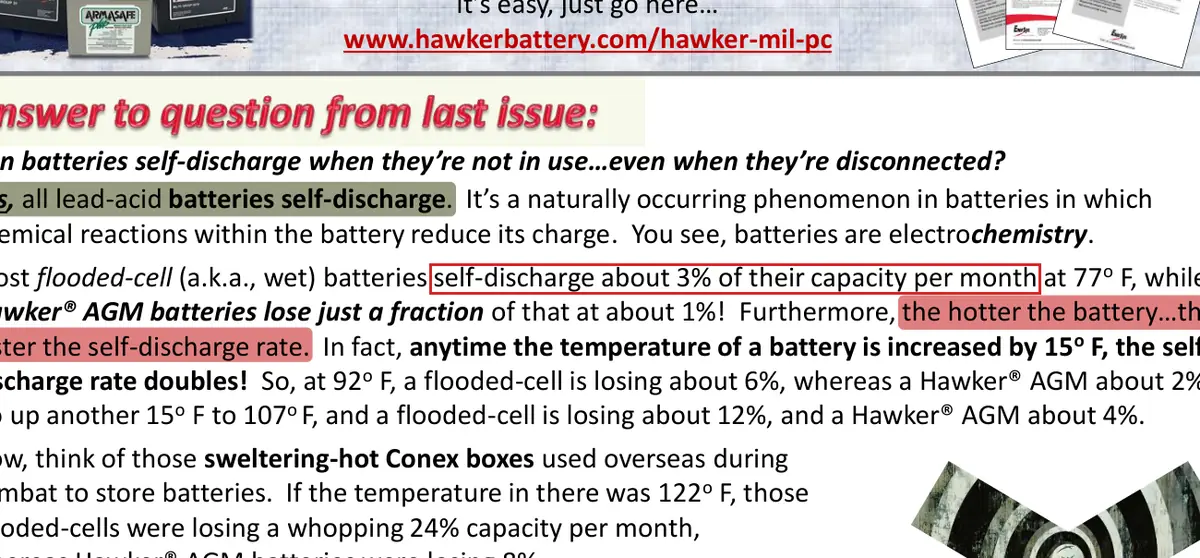
How fast it discharges on its own depends on heat. Hawker, an EnerSys battery brand, puts a flooded battery’s self-discharge at about 3 percent of capacity per month at 77°F and an AGM battery’s at about 1 percent, and says the rate doubles with every 15°F rise: 6 percent at 92°F, 12 percent at 107°F and 24 percent at 122°F (Hawker Headlines, pp. 1 and 6). A shed that reaches 107°F in July can take a flooded battery from full to Trojan’s 70 percent recharge point in 2.5 months.
Cold does the other kind of damage. A discharged battery’s electrolyte is mostly water, so it freezes at a much higher temperature than a charged one. The freezing points below are the BCI figures reprinted in the Trojan Battery User’s Guide, matched to Trojan’s state-of-charge table for flooded batteries.
| Specific gravity | About this state of charge | 12 V open-circuit voltage | Electrolyte freezes at |
|---|---|---|---|
| 1.280 | 100% | 12.73 V | -92°F |
| 1.250 | About 85% | About 12.56 V | -62°F |
| 1.200 | About 60% | 12.24 V | -16°F |
| 1.150 | About 40% | 11.96 V | -5°F |
| 1.100 | About 20% | 11.66 V | 19°F |
So a battery that drifted down to about 20 percent can freeze solid in an unheated garage at 19°F, and a frozen case can crack or buckle the plates; East Penn says never to charge a frozen battery and to let it warm to room temperature first (East Penn form 0004). Trojan’s storage rules are to charge before storage, disconnect the battery to remove parasitic loads, check flooded batteries every 4 to 6 weeks and recharge when they fall to 70 percent. The full off-season routine is in our sibling guide on how to winterize a lawn mower, and charger settings are on our page on how to charge a lawn mower battery.
The calculator applies Hawker’s rates to your storage season. Pick the battery type and the warmest typical storage temperature; the 62°F row halves Hawker’s 77°F rate, which is our extension of its doubling rule, not a published figure.
- Charge lost, percentage points (recharge at 30 points flooded, 25 AGM)
- 5
Default: 5 months, flooded, 77°F = 15 points lost, so about 85% left, above Trojan's 70% recharge point. Rates from Hawker; recharge points from Trojan. Starts full, battery disconnected; a connected mower drains faster.
| Storage temperature | Flooded: loss per month | Flooded: months to 70% | AGM: loss per month | AGM: months to 75% |
|---|---|---|---|---|
| 62°F | 1.5% (extrapolated) | 20 | 0.5% (extrapolated) | 50 |
| 77°F | 3% | 10 | 1% | 25 |
| 92°F | 6% | 5 | 2% | 12.5 |
| 107°F | 12% | 2.5 | 4% | 6.25 |
| 122°F | 24% | 1.25 | 8% | 3.1 |
Do charge cycles decide how long a cordless mower battery lasts?
For a homeowner, almost never. Divide any published cycle rating by the full cycles you use in a season and the answer is a decade or more. The table assumes one full discharge per mow, 30 mows a year (weekly from April to October); the second column assumes a robot mower that uses one full cycle a day for a 210-day season.
| Cycle figure | Who publishes it | Seasons at 30 cycles a year | Seasons at 210 cycles a year |
|---|---|---|---|
| 300 | Interstate (low end of its lithium range) | 10 | 1.4 |
| 500 | Interstate (high end) | 16.7 | 2.4 |
| 1,200 | STIHL AP 300 S | 40 | 5.7 |
| 1,500 | STIHL AR 2000 L, AR 3000 L | 50 | 7.1 |
| 2,500 | STIHL AP 500 S | 83 | 11.9 |
| 3,000 | STIHL ALLPRO | 100 | 14.3 |
The robot column lands at 1.4 to 2.4 seasons for a 300 to 500 cycle pack, close to Husqvarna’s “typically between 2 and 5 years” for Automower batteries; a robot that mows daily really does wear through cycles. The push-mower column does not match Interstate’s 2 to 3 year lithium estimate at all, which means something other than cycling ends most push-mower packs. Calendar aging, driven by heat and by being stored full, is the likely candidate.
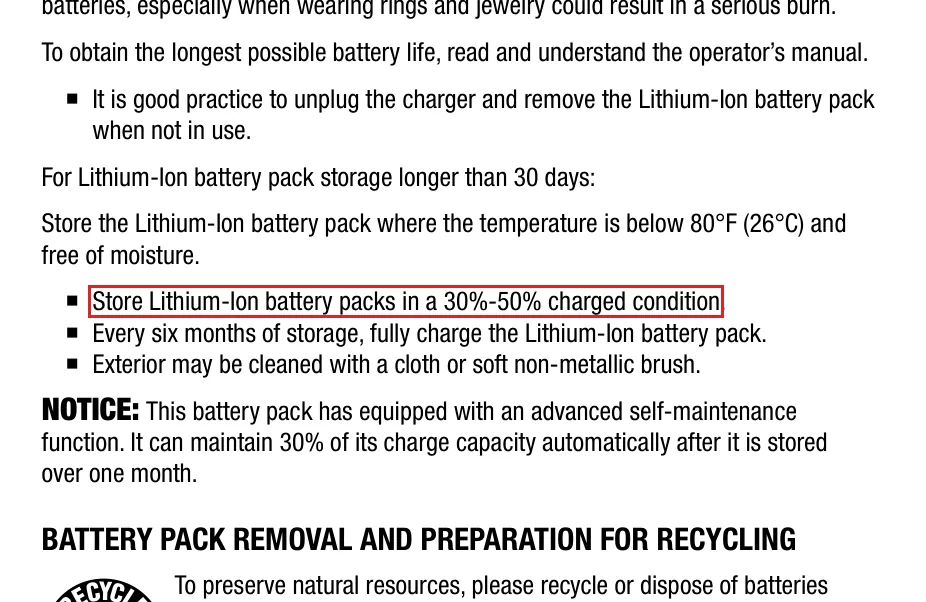
Cadex Electronics’ Battery University, BU-808 Table 3 estimates the capacity a lithium-ion battery keeps after one year in storage. At 77°F (25°C) a pack stored at 40 percent charge keeps 96 percent; stored full it keeps 80 percent. At 104°F (40°C) the figures are 85 and 65 percent. Those are generic Li-ion estimates, not EGO, Ryobi or Toro data, but they explain why every pack manual in the table asks for a partial charge and a cool room.
The maker rules line up with that table. EGO and Ryobi say to store packs 30 days or longer at 30 to 50 percent charge, below 80°F, with a full charge every 6 months; EGO’s packs drain themselves to 30 percent after a month in storage (EGO 56V battery manual). Toro says not to store a Flex-Force pack fully charged or fully depleted, and to stop at 1 or 2 of 4 LEDs for storage of a year or longer (Toro pack manual, p. 15). Greenworks’ 2016 manual is the outlier: fully charge before storing 3 months or more. STIHL’s ideal storage band is 50 to 68°F.
Capacity loss shows up as runtime loss. A pack that delivered 45 minutes new delivers about 36 minutes at 80 percent capacity and about 29 at 65 percent, if the mowing load is the same. How much runtime each pack size buys, and what a replacement pack costs against gas ownership, is covered in our electric vs gas lawn mower comparison.
How to tell if a lawn mower battery is bad
A flat battery and a dead one look the same when the key only clicks. The difference is whether it takes and holds a charge, and then whether it holds voltage under load. If the battery passes and the mower still will not crank, the fault is the solenoid, an interlock or a fuse; our lawn mower not starting guide works through those.
- Look first. East Penn lists a cracked or bulging case, a leaking case-to-cover seal, corrosion and loose or damaged terminals as reasons to stop; neutralize corrosion with baking soda and water, then rinse.
- Read resting voltage with a multimeter, engine off. Below 12.4 V, charge it before testing anything else: East Penn says a discharged battery cannot be load tested.
- Charge it with clean, tight connections. If it is not fully charged within 8 hours, Briggs & Stratton says the battery is dead and needs replacing.
- Let it rest 24 hours and read it again. Toro’s TimeCutter MyRIDE manual, p. 52 says to recharge and recheck if it reads below 12.6 V after that rest; a battery that keeps sliding is not holding a charge.
- Load test a charged battery: half its cold cranking amps for 15 seconds. At 70°F or warmer, a 12 V battery must hold 9.6 V or more; the floor drops 0.1 to 0.2 V for each 10°F colder (table below). If a fully charged battery fails, East Penn says replace it.
| Battery temperature | 12 V battery must hold at least | Load for a 250 CCA U1 battery | Load for a 350 CCA U1 battery |
|---|---|---|---|
| 70°F (21°C) or above | 9.60 V | 125 A for 15 s | 175 A for 15 s |
| 60°F (16°C) | 9.50 V | 125 A | 175 A |
| 50°F (10°C) | 9.40 V | 125 A | 175 A |
| 40°F (4°C) | 9.30 V | 125 A | 175 A |
| 30°F (-1°C) | 9.10 V | 125 A | 175 A |
| 20°F (-6°C) | 8.90 V | 125 A | 175 A |
| 10°F (-12°C) | 8.70 V | 125 A | 175 A |
| 0°F (-18°C) | 8.50 V | 125 A | 175 A |
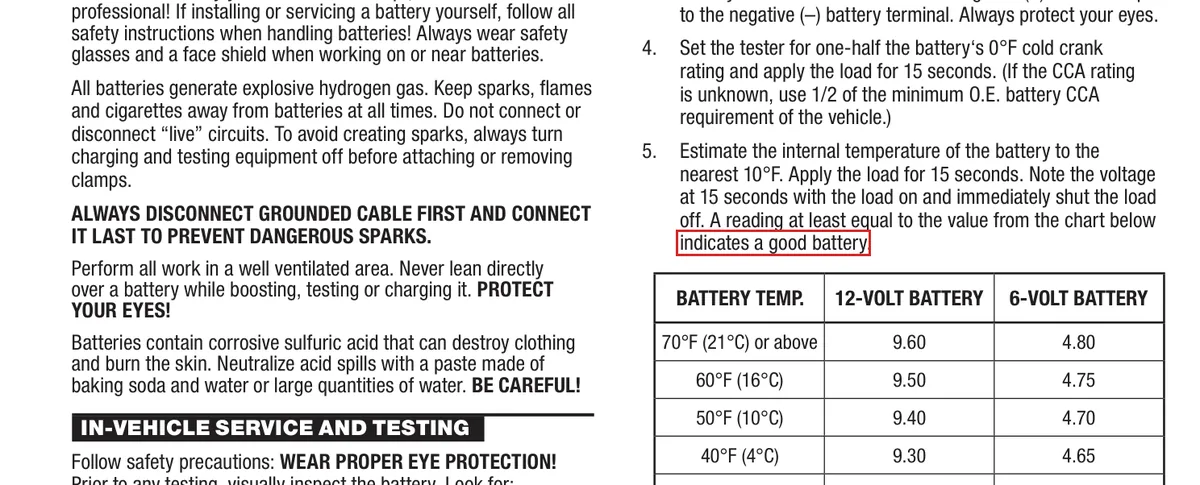
Batteries give off explosive hydrogen and contain sulfuric acid. East Penn’s form says to wear eye protection, keep sparks and flames away, and turn the tester or charger off before connecting or removing clamps.
Lithium packs have no voltage test you can run at home, because the pack’s electronics manage voltage. The signs are behavioral. EGO’s manual says “a significantly reduced run time after fully charging” means the cells “are near the end of their usable life and must be replaced.” Toro’s pack manual says a charger that still blinks red after 2 attempts means the pack goes to recycling, or to a dealer if it is under warranty (Toro pack manual). Husqvarna’s signs for robot mowers are more frequent returns to the charging station and stopping on the lawn with an empty battery and no error.
1Lithium pack: does it run much shorter than it used to after a full charge?
YesEGO says the pack is near the end of its usable life. If it is inside the 3 to 5 year warranty, claim it; otherwise replace and recycle it.
NoGo to the next question
2Lithium pack: does the charger still blink red after 2 attempts?
YesToro says recycle the pack, or take it to a dealer if it is under warranty.
NoGo to the next question
312 V battery: is the case cracked, bulging or leaking?
YesReplace it (East Penn visual inspection).
NoGo to the next question
412 V battery: does it read below 12.4 V at rest?
YesCharge it first. If it is not full within 8 hours, Briggs & Stratton says it is dead.
NoGo to the next question
5After 24 hours of rest, does it read below 12.6 V again?
YesIt is not holding a charge: recharge once (Toro MyRIDE manual), then load test.
NoGo to the next question
6Does it drop below 9.6 V on a 15-second half-CCA load test at 70°F?
YesReplace it (East Penn).
NoThe battery is good. If the mower still only clicks, check the solenoid, safety interlocks and fuse.
Source: EGO 56V manual; Toro pack and MyRIDE manuals; East Penn form 0004; Briggs & Stratton
Replace it or claim the warranty?
Check the dates before you buy. A 2-year-old lithium pack that fails the runtime test is inside every pack warranty in the table, and a registered EGO BA5600T or BA6720T is covered for 5 years. Ryobi’s 3 years drop to 1 year for commercial or rental use, and Toro’s packs under 7.5Ah drop to 45 days. Mower-brand specifics, including what Ryobi and Toro dealers check on a pack, are in our Ryobi lawn mower won’t start and Toro lawn mower won’t start guides.
For lead-acid, the warranty is usually gone by the time the battery fails: Interstate’s lawn and garden models are free-replacement for 6 months, and a battery that fails in year 2 or 3 has met Interstate’s “about three years.” Interstate’s SP-30 lists at $67.95 (suggested retail, checked Nov. 19, 2026), so testing and replacing it yourself costs less than a shop visit; labor rates for mower work are in our lawn mower repair cost guide. When the mower itself is the question, our sibling page on how long lawn mowers last covers engine-hour life.
How we compiled this
We read 17 primary documents in November 2026: battery-maker manuals and data (East Penn, Trojan, Hawker, Interstate), mower and pack warranties and manuals (EGO, Ryobi, Toro, Greenworks, John Deere, Cub Cadet, Husqvarna, STIHL), Battery Council International’s glossary and Cadex’s Battery University storage table. We did not test any battery. Seasons-per-cycle and months-to-recharge figures are our arithmetic from the published rates, with the assumptions stated under each table.
Frequently asked questions
How do I know if I need a new battery for my lawn mower?
For a 12 V riding mower battery: charge it, and if it is not full within 8 hours (Briggs & Stratton) or a full battery drops below 9.6 V during a 15-second half-CCA load test at 70°F (East Penn), replace it. For a lithium pack, EGO’s sign is a significantly shorter runtime after a full charge.
What kills the battery on a lawn mower?
Sitting partly discharged in heat. Flooded lead-acid batteries lose about 3 percent a month at 77°F and 12 percent at 107°F (Hawker), and BCI says sulfation develops when a battery is stored partly discharged at warm temperatures. A discharged battery can also freeze: at about 20 percent charge the electrolyte freezes at 19°F.
How long does a 40V mower battery last?
Ryobi warrants its 40V packs for 3 years of household use and publishes no cycle rating. Interstate’s estimate for lithium mower batteries is 2 to 3 years or 300 to 500 cycles. At 30 mows a season, 300 cycles is 10 seasons, so heat and storage charge usually end a pack before its cycles do.
Can I leave my 40V battery on the charger?
The makers say not for storage. EGO calls it good practice to unplug the charger and remove the pack when not in use, and Toro says not to store a pack fully charged. Both EGO and Ryobi want 30 to 50 percent charge for storage beyond 30 days.
How long do zero turn lawn mower batteries last?
A gas zero-turn uses the same 12 V group U1 starter battery as a lawn tractor, so Interstate’s “about three years” applies. Electric zero-turns are different: John Deere warrants the Z300R Electric’s lithium battery for 60 months or 200 hours, whichever comes first.
Sources
- Interstate Batteries, Lawn and Garden Batteries (specifications, SRP and FAQ), checked Nov. 19, 2026. Accessed November 2026.
- Interstate Batteries, Limited Warranty, United States (batteries purchased Oct. 1, 2023 or later), copy hosted by Ferguson, 2023.10.01. Accessed November 2026.
- East Penn Manufacturing, Basic Rules for Battery Care and Maintenance, form 0004, 02/26. Accessed November 2026.
- Hawker (EnerSys), Hawker Headlines 2010 to 2020: battery self-discharge, 2021 compilation. Accessed November 2026.
- Trojan Battery Company, Trojan Battery User’s Guide, section 6 Storage and Table 7 (retailer-hosted copy), current guide. Accessed November 2026.
- Battery Council International, Acronyms and Glossary of Common Battery and Sustainability Terms (sulfation), checked Nov. 19, 2026. Accessed November 2026.
- The Toro Company, The Toro Warranty, form 3478-812 Rev B (60V Flex-Force batteries, lead-acid battery), current statement. Accessed November 2026.
- The Toro Company, Flex-Force Power System 60V MAX Battery Packs Operator’s Manual, current PDF, pp. 14 to 15. Accessed November 2026.
- The Toro Company, TimeCutter MyRIDE Operator’s Manual, Form 3456-108 (retailer copy), p. 52. Accessed November 2026.
- EGO Power+ (Chervon North America), Warranty Policy, checked Nov. 19, 2026. Accessed November 2026.
- EGO Power+ (Chervon North America), 56V Battery 2.0Ah to 7.5Ah Operator’s Manual, current PDF. Accessed November 2026.
- Ryobi (TTI), 40V Lithium-Ion Battery Pack OP40602/OP40603/OP40752/OP40753/OP40122 Operator’s Manual, 995000925, p. 2. Accessed November 2026.
- Ryobi (TTI), 40V 6Ah Lithium Battery OP4060A product page, checked Nov. 19, 2026. Accessed November 2026.
- Greenworks, 60V Rechargeable Lithium-Ion Battery owner’s manual, LB60A00 series (retailer copy), Rev 00 (08-01-16), p. 13. Accessed November 2026.
- STIHL Inc., Battery Charging Times and Charging Solutions (AP battery cycle ratings), checked Nov. 19, 2026. Accessed November 2026.
- STIHL Inc., How to Optimize STIHL Battery Life, checked Nov. 19, 2026. Accessed November 2026.
- Deere & Company, DC-1360 Limited Warranty for New John Deere Turf and Utility Equipment (U.S.), effective Nov. 1, 2025. Accessed November 2026.
- Cub Cadet, General Battery LT42E (battery information), checked Nov. 19, 2026. Accessed November 2026.
- Husqvarna, Automower battery: signs of ageing and how to maximise lifespan, May 13, 2026. Accessed November 2026.
- Briggs & Stratton, How to test a small engine charging system, battery and alternator, checked Nov. 19, 2026. Accessed November 2026.
- Cadex Electronics, Battery University, BU-808: How to Prolong Lithium-based Batteries, Table 3, checked Nov. 19, 2026. Accessed November 2026.