How long should a lawn mower last? EPA’s model puts the median homeowner gas mower at 5.8 years, about 145 engine hours, and lawn tractors at 5.8 years, about 261 hours. Commercial mowers last 2 to 3 years at 400 to 720 hours yearly.
Ask how long should a lawn mower last and most answers say “10 to 15 years” or “500 to 1,500 hours” with no source. Three federal and manufacturer documents give harder numbers. 40 CFR 1054.107 makes every small engine maker certify a useful life of 125 to 5,000 hours that “most closely matches the expected median in-use life” of its engines, and that hour figure is printed on the engine label. EPA’s NONROAD model (report NR-005d, July 2010) sets how many hours a year each mower type runs and the age at which half are scrapped. Warranty statements from John Deere, Toro and Exmark cap coverage at 120 to 1,500 hours. Divide any of those hour figures by the hours you mow each year and you have your answer in years.
Lawn mower lifespan by mower and engine class
The table pairs each mower type with its EPA engine class (Class I is under 225 cc, Class II is 225 cc and up, per 40 CFR 1054.801), EPA’s use and median-life inputs, and a current warranty. Median life is the age by which 50 percent of units are out of service, so half of all mowers outlast the figure. Push and self-propelled walk-behinds use the same Class I engines, so EPA does not split them; our self-propelled vs push mower guide covers what the drive adds in belts and upkeep.
| Mower type | EPA engine class and useful-life options | EPA typical use | EPA median life | Example warranty | Source |
|---|---|---|---|---|---|
| Gas walk-behind, homeowner | Class I: 125, 250 or 500 h | 25 h/yr | 5.8 years (about 145 h) | Toro Recycler steel deck 2 years; Honda HRN-BV 3 years; Deere JS 24 months | NR-005d Tables 4, 6; Toro; Honda |
| Gas walk-behind, used commercially | Class I: 500 h, or up to 3,000 h Heavy Commercial | 406 h/yr | 2.0 years (about 812 h) | Toro Recycler 45 days commercial; Honda HRN-BV 90 days | NR-005d; Toro |
| Rear-engine rider, homeowner | Class I or II | 36 h/yr | 5.8 years (about 209 h) | Not in our warranty set | NR-005d |
| Lawn tractor, homeowner | Class II: 250, 500 or 1,000 h | 45 h/yr | 5.8 years (about 261 h) | Deere 100 Series 24 months or 120 h; X300 48 months or 300 h; X500 500 h; X700 700 h | NR-005d; Deere DC-1360 |
| Zero-turn, homeowner | Class II | No separate EPA category | No separate EPA figure | Deere Z335E to Z375R 24 months or 120 h; Z500R 500 h; Z700R 1,000 h; Toro TimeCutter 3 years, no hour cap | Deere DC-1360; Toro |
| Commercial zero-turn and wide-area mower | Class II: 1,000 h, or up to 5,000 h Heavy Commercial | 682 h/yr | 2.9 years listed (about 1,648 h) | Exmark Lazer Z E and S 5 years or 1,250 h; Deere Z900M 36 months or 1,200 h; Z997R 1,500 h | NR-005d; Exmark; Deere |
| Lawn tractor, used commercially | Class II | 721 h/yr | 2.9 years (about 2,091 h) | Deere residential terms apply by series | NR-005d |
| Battery walk-behind | No engine class | No EPA figure | No EPA figure | Toro electric Recycler 2 years, 60V pack 3 years; Honda HRN-BV 3 years | Toro; Honda |
Two things stand out. Homeowner medians of 145 to 261 hours sit below the 300 hours Deere puts on a mid-range X300 tractor, so most residential mowers are retired long before their engine hours run out. EPA’s scrappage report (NR-007c) notes that retirement “may be due to aging of the engine or to some other part of the equipment breaking.” Commercial mowers are the opposite: at 406 to 721 hours a year they wear out in 2 to 3 seasons.
Read the hours your engine was certified for
Look on the engine shroud or valve cover for the emission label. Under 40 CFR 1054.135(c)(4) it must read “EMISSION COMPLIANCE PERIOD = [number] HOURS,” sometimes with the word Moderate, Intermediate, Extended or Heavy Commercial added. That number is the maker’s own estimate of median life, filed with EPA, and EPA can require a different value after weighing the maker’s “product warranty statements and marketing materials regarding engine life.”
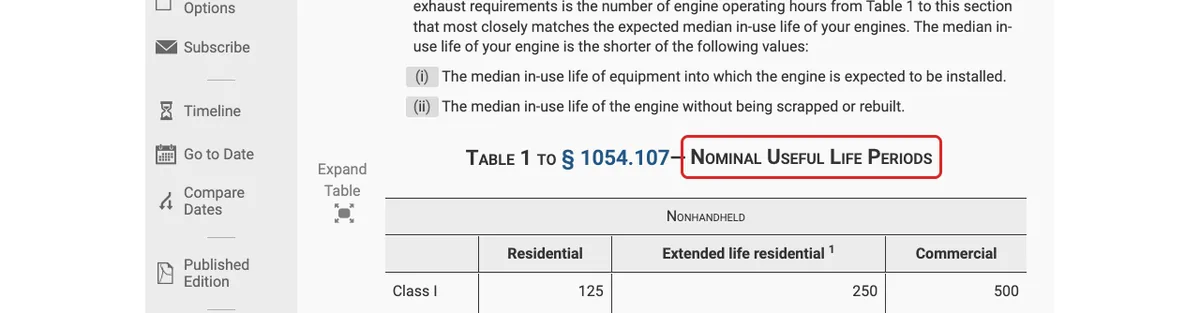
Honda prints the same scale in its HRN216 owner’s manual: Moderate is 125 hours, Intermediate 250 and Extended 500 for engines over 80 cc, and 1,000 hours for 225 cc and larger. A 125-hour label on a 140 to 170 cc push mower engine is the residential minimum, not a defect. Three cautions: the period also ends at 5 years whichever comes first, it measures emission compliance rather than total failure, and a well-kept engine can run past it.
How long is that in years? Divide by your hours
Years = hour figure ÷ hours mowed per year. A quarter-acre lawn cut 30 times with a 21-inch deck at 3 mph takes about 15 hours a year, using Exmark’s acres-per-hour formula (mph × deck inches ÷ 124, which builds in 80 percent efficiency). At EPA’s 25 hours a year, a 125-hour Moderate engine reaches its period in 5.0 years and a 500-hour Extended engine in 20.
| Hours mowed per year | 125 h | 250 h | 500 h | 1,000 h | 1,500 h |
|---|---|---|---|---|---|
| 15 (quarter acre, 30 mows) | 8.3 | 16.7 | 33.3 | 66.7 | 100 |
| 25 (EPA homeowner walk-behind) | 5.0 | 10.0 | 20.0 | 40.0 | 60.0 |
| 45 (EPA homeowner lawn tractor) | 2.8 | 5.6 | 11.1 | 22.2 | 33.3 |
| 100 (large property, about 3.3 h a week for 30 weeks) | 1.3 | 2.5 | 5.0 | 10.0 | 15.0 |
| 406 (EPA commercial walk-behind) | 0.3 | 0.6 | 1.2 | 2.5 | 3.7 |
| 682 (EPA commercial turf mower) | 0.2 | 0.4 | 0.7 | 1.5 | 2.2 |
- Years until the hour figure is used up
- 10.0
- Same in months
- 120
Default: 250 hours at 25 hours a year = 10.0 years. EPA's median for homeowner mowers is 5.8 years, so long results mean something other than engine hours will likely end the mower first. Use rates from EPA NONROAD NR-005d Table 6.
The calculator default is a 250-hour figure at EPA’s 25 hours a year: 250 ÷ 25 = 10.0 years. Enter the number from your engine label or your warranty, then pick the use rate closest to yours; a riding mower with an hour meter gives you the real rate after one season. Without a meter, use seat time: our zero turn vs lawn tractor comparison works out about 32 minutes an acre for a 42-inch tractor at 5.5 mph and 25 for a 42-inch zero-turn at 7 mph.
Results past about 15 years at homeowner hours are not a forecast. EPA’s own median for those mowers is 5.8 years, so decks, transmissions and repair bills usually end the mower first.
What warranty hours say about design life
Hour-capped warranties show which use rate a maker designed for. John Deere’s DC-1360 warranty statement (effective Nov. 1, 2025) climbs from 120 hours on 100 Series tractors to 1,500 hours on Z997R and Z900R commercial zero-turns. Divide hours by years to find the use rate at which the hour cap, not the calendar, ends coverage: 60 hours a year on a 100 Series, 75 on an X300, 175 on an X700 and 500 on a Z997R.
Swipe the table sideways to see every column.
| Mower line | Warranty term | Hours per year to hit the cap | Source |
|---|---|---|---|
| Deere 100 Series; Z335E to Z375R ZTrak | 24 months or 120 h | 60 | Deere DC-1360, line 1 |
| Deere 200 Series; Z315E to Z330R ZTrak | 36 months or 200 h | 67 | line 2 |
| Deere X300 Series; Z515E; Z500M | 48 months or 300 h | 75 | line 3 |
| Deere X500 Series; Z700E; Z500R | 48 months or 500 h | 125 | line 4 |
| Deere X700 Series | 48 months or 700 h | 175 | line 5 |
| Deere Z700M | 48 months or 750 h | 188 | line 6 |
| Deere Z700R | 48 months or 1,000 h | 250 | line 7 |
| Deere Z900B, Z900E, Z900M | 36 months or 1,200 h; no hour cap first 24 months | 400 | line 10 |
| Exmark Lazer Z E-Series, S-Series | 5 years or 1,250 h; no hour cap first 2 years | 250 | Exmark 4505-726 |
| Deere Z997R, Z900R, Z900A | 36 months or 1,500 h; no hour cap first 24 months | 500 | line 11 |
| Toro Titan | 3 years residential; 3 years or 300 h commercial | 100 (commercial) | Toro TimeCutter and Titan warranty |
| Toro Titan MAX | 3 years or 500 h | 167 | Toro |
| Toro TimeCutter | 3 years residential, no hour cap; 30 days commercial | No cap | Toro |
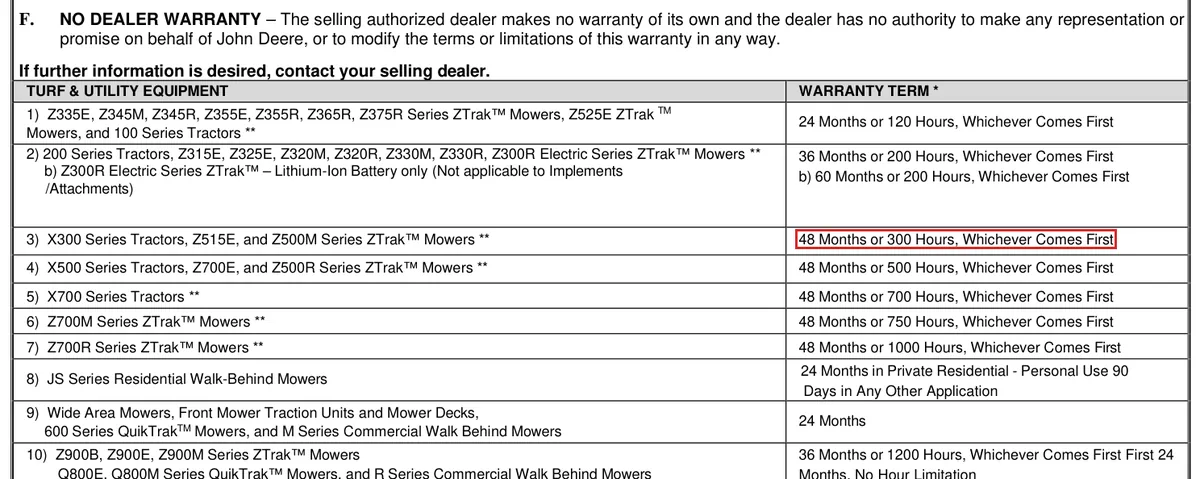
Commercial terms tell the same story from the other side. Toro covers a gas Recycler for 2 to 5 years at home but 45 days in commercial use, Honda gives the HRN-BV 3 years residential and 90 days commercial, and Briggs & Stratton’s standard engines carry 24 months consumer and 3 months commercial, against 36 and 36 for Vanguard and Commercial Series engines. A homeowner mower bought for a mowing route is running at 16 times EPA’s homeowner rate (406 ÷ 25).
The one hour figure for a battery mower in these statements is Toro’s Haven robotic mower pack: 2 years or 5,000 cutting hours. Pack and charge-cycle limits for walk-behind battery mowers are on our page about how long lawn mower batteries last, and the 10-year cost math is in our electric vs gas lawn mower comparison.
How many mowers are still running at 10 years?
About 1 in 10. EPA’s age-distribution report works a residential lawnmower through its default scrappage curve in Table A1 of NR-007c: 76 percent are still in service in year 6, 34 percent in year 7 and 9.5 percent in year 10, and none by year 13, because the curve retires every unit by twice the median life.
Source: EPA NR-007c, Table A1 (residential lawn mower, 5.8-year median) Model scrappage curve, not a brand survey. 100 minus cumulative percent scrapped.
Show the numbers
| Percent still in service | |
|---|---|
| 1 | 100 |
| 2 | 97 |
| 3 | 93.50 |
| 4 | 89.50 |
| 5 | 84 |
| 6 | 76 |
| 7 | 34 |
| 8 | 20.50 |
| 9 | 14 |
| 10 | 9.50 |
| 11 | 5.50 |
| 12 | 2 |
| 13 | 0 |
| Year in service | 1 | 2 | 3 | 4 | 5 | 6 | 7 | 8 | 9 | 10 | 11 | 12 | 13 |
|---|---|---|---|---|---|---|---|---|---|---|---|---|---|
| Still in service | 100% | 97% | 93.5% | 89.5% | 84% | 76% | 34% | 20.5% | 14% | 9.5% | 5.5% | 2% | 0% |
Read the steep drop between years 6 and 7 as a model artifact of a curve centered on 5.8 years, not as a cliff your mower will fall off. The useful takeaway is the spread: a mower past year 10 is in the top 10 percent, which supports replacing rather than rebuilding it once a major repair comes up.
What shortens a mower’s life
Each item below is a maker rule from the Honda HRN216 manual or a federal fuel rule, and each one costs hours when skipped.
| Habit | Maker or federal rule | Where to read more |
|---|---|---|
| Skipping oil changes | Honda: first change at 5 hours or first month, then every 50 hours or 6 months; 25 hours under heavy load or heat | how to change lawn mower oil; which oil a lawn mower takes |
| Running a dirty air filter | Honda: clean every 50 hours or 6 months, replace every 150 hours or 2 years; “Dirt entering the carburetor” wears the engine | why a lawn mower is smoking |
| Stale or high-ethanol fuel | Honda: buy 30 to 60 days of fuel, E10 or less; 40 CFR 1090.230(a) bars E15 from nonroad engines | what gas a lawn mower takes; how to drain gas from a lawn mower |
| Hitting roots, rocks and sprinkler heads | Honda: strikes “may damage the blades, bend the crankshaft, and/or break the mower deck”; stop and check after any hit | how to sharpen a lawn mower blade |
| Storing with fuel in the tank | Honda: add stabilizer past 60 days of storage | how to winterize a lawn mower |
When to replace a lawn mower instead of fixing it
Hours and age tell you how much mower is left; the repair quote tells you what the next hours cost. Our lawn mower repair cost guide sets the price rule: under 25 percent of a comparable new mower, repair; 25 to 50 percent, repair only if engine and deck are sound; over 50 percent, replace. Hours shift you inside that middle band.
On a self-propelled walk-behind the drive is often the first quote, and most drive faults stop short of the $143.43 Troy-Bilt lists for a replacement transmission; rule out the cable, belt and wheel gears with our guide to a self propelled mower not propelling.
1Is it still inside its warranty months and hours?
YesTake it to an authorized dealer: Deere, Toro and Exmark cover parts and labor for defects within the term.
NoGo to the next question
2Is the repair quote over 50 percent of a comparable new mower?
YesReplace it.
NoGo to the next question
3Is it past both its label's emission compliance period and its warranty hours, with a quote of 25 percent or more?
YesLean toward replacing: you are paying to restart a mower already past its rated hours.
NoGo to the next question
4Did it hit something and now vibrate, or burn oil at the correct oil level?
YesGet a quote for a bent crankshaft or ring and valve work, then apply the 25 and 50 percent rules above.
NoRepair and keep it: change oil every 50 hours or 6 months, replace the air filter every 150 hours or 2 years, and use E10 or less (Honda HRN216 manual).
Source: 40 CFR 1054.107; John Deere DC-1360; Honda HRN216 manual; GIR repair cost rule
- Check the warranty first. A Deere X300 at 280 hours and 3 years old is still inside its 48 months or 300 hours; dealer repair of a defect costs nothing for parts and labor.
- Read the hour meter or estimate hours: seasons owned × hours per season. Compare it with the label’s emission compliance period and the warranty hours.
- Past both figures and the quote is 25 percent or more of a new mower: lean toward replacing.
- Blue smoke at a correct oil level points to rings or valves; the parts are cheap but the cylinder head comes off, which is why our lawn mower smoking guide puts the cost in labor.
- A walk-behind that vibrates after a strike may have a bent crankshaft. Get a quote and apply the 50 percent rule; on a mower past year 10 (top 10 percent per EPA’s curve) replacing usually wins.
Riding mowers swing the other way: a $2,399 tractor (Cub Cadet XT1 list price in our repair guide) justifies a $600 repair at 25 percent, so a deck belt or a carburetor job on a 250-hour tractor is worth doing. For a new machine, our zero turn vs lawn tractor comparison and the self-propelled vs push mower guide cover the choice.
How we compiled this
In November 2026 we read 40 CFR 1054.107, 1054.135 and 1054.801 on eCFR, EPA NONROAD reports NR-005d (July 2010) and NR-007c, warranty statements from John Deere (DC-1360), Toro (2 documents), Exmark (4505-726), Briggs & Stratton (2019) and Honda, and the Honda HRN216 owner’s manual. We did not test mowers or survey owners. NONROAD’s small-engine use and life inputs come from data submitted for EPA’s 1999 Phase 2 rule (EPA420-R-99-003), so they predate many current models. One inconsistency: Table 4 lists commercial turf at 2.9 years, but its 988.9 full-load hours at a 0.60 load factor equal 1,648 hours, or 2.4 years at Table 6’s 682 hours a year; we show both.
Frequently asked questions
What is the average lifespan of a lawn mower?
EPA’s NONROAD model uses a median of 5.8 years for homeowner walk-behinds, rear-engine riders and lawn tractors, and 2 to 2.9 years for commercial mowers (NR-005d, Table 4). In hours that is about 145 for a walk-behind and 261 for a lawn tractor. Median means half last longer.
Is 2000 hours a lot for a mower?
Yes for anything but a commercial machine. 2,000 hours is 7.7 times EPA’s homeowner lawn tractor median of about 261 hours and above the 1,250 to 1,500 hour caps on Exmark Lazer Z and Deere Z997R warranties. For a commercial tractor it is close to EPA’s 2,091-hour median.
How often should you replace your lawn mower?
Replace it when a repair quote passes 50 percent of a comparable new mower, or 25 percent once the mower is past its label’s emission compliance period and warranty hours. Calendar age alone is a weak signal: at 15 hours a year a 250-hour engine has 16.7 years of rated hours.
Is it cheaper to repair or replace a lawn mower?
Repair is cheaper for most jobs short of an engine replacement, especially on riding mowers, where a $600 repair is 25 percent of a $2,399 tractor. The full price table is in our lawn mower repair cost guide.
How long should a self-propelled lawn mower last?
The same as a push mower with the same engine: EPA does not separate them, and the 5.8-year median applies. The drive belt is the wear part; Toro warranties walk-mower belts for 90 days residential.
Sources
- U.S. EPA, eCFR, 40 CFR 1054.107: What is the useful life period for meeting exhaust emission standards?, current through Nov. 2026. Accessed November 2026.
- U.S. EPA, eCFR, 40 CFR 1054.135: How must I label and identify the engines I produce?, current through Nov. 2026. Accessed November 2026.
- U.S. EPA, eCFR, 40 CFR 1054.801: Definitions (Class I, Class II), current through Nov. 2026. Accessed November 2026.
- U.S. EPA, eCFR, 40 CFR 1090.230: Limitation on use of gasoline-ethanol blends, current through Nov. 2026. Accessed November 2026.
- U.S. EPA, Office of Transportation and Air Quality, Median Life, Annual Activity, and Load Factor Values for Nonroad Engine Emissions Modeling, NR-005d, EPA-420-R-10-016, Tables 4 and 6, July 2010. Accessed November 2026.
- U.S. EPA, Office of Transportation and Air Quality, Calculation of Age Distributions in the Nonroad Model: Growth and Scrappage, NR-007c, Table 1 and Table A1, 2010. Accessed November 2026.
- John Deere, DC-1360 Limited Warranty for New John Deere Turf and Utility Equipment (U.S.), effective Nov. 1, 2025. Accessed November 2026.
- The Toro Company, The Toro Warranty: Consumer Mowers (21 and 22 in walk power mowers, robotic mowers), current statement. Accessed November 2026.
- The Toro Company, The Toro Warranty: TimeCutter and Titan, current statement. Accessed November 2026.
- Exmark Mfg. Co., Lazer Z E-Series and S-Series Limited Warranty, 4505-726, current statement. Accessed November 2026.
- Briggs & Stratton, Engine owner warranty policy, standard warranty terms, 2019. Accessed November 2026.
- American Honda, Honda HRN-BV lawn mower features and benefits (warranty terms), 2025. Accessed November 2026.
- American Honda, HRN216VKA owner’s manual (maintenance schedule, fuel, emission durability terms), current manual. Accessed November 2026.
- Exmark, Zero-turn vs lawn tractor productivity comparisons (acres-per-hour formula), Jan. 14, 2016. Accessed November 2026.
- The Green Industry Report, lawn mower lifespan dataset (CSV), compiled Nov. 19, 2026.