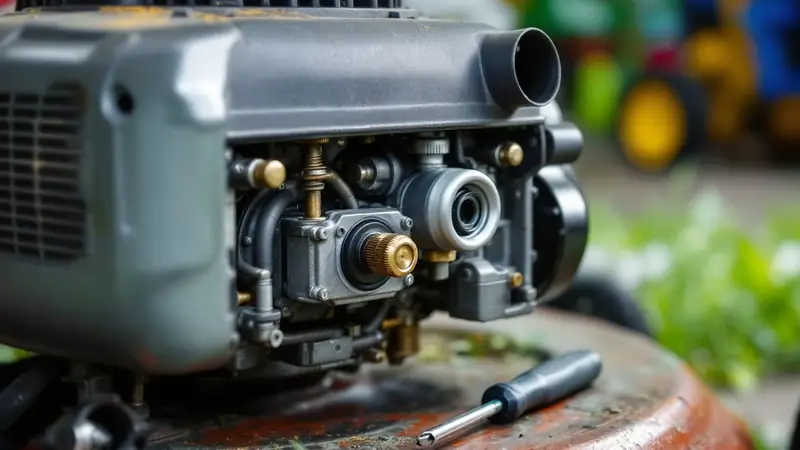
How to adjust lawn mower carburetor screws depends on the engine. Most emission-era engines have a fixed main jet and a capped or sealed idle mixture, so only idle speed is set. Older carburetors start 1 to 1-1/2 turns out, then split rich and lean.
Before you look up how to adjust lawn mower carburetor screws, check that yours has any you may turn. Briggs & Stratton says adjustments “can only be made on older, non-EPA regulated carburetors” (Briggs carburetor guide, Jan. 13, 2026), Kohler’s Courage XT idle mixture “cannot be adjusted” (Kohler 14 690 01, p. 19), and Kawasaki fits a cap or stop plate on every mixture screw (Kawasaki FR manual, PDF p. 24).
No top-ranked video sorts engines by what is still adjustable. The tables below do, for 15 engine families, with each maker’s factory turns and idle speeds. If it runs badly and nothing has been turned, suspect stale fuel and varnish: check which gas a lawn mower takes, then follow our steps for cleaning a lawn mower carburetor’s jets.
Can your lawn mower carburetor be adjusted at all?
Emission rules took the screws away. An engine must meet its standards “for any adjustment in the practically adjustable range” (40 CFR 1054.115(b)), so makers fix the jets or cap the screw. EPA’s general rule, mandatory from model year 2027, defines an adequate limit as one a typical owner cannot defeat with ordinary tools within 15 minutes and $30 of parts (40 CFR 1068.50(e), (f)).
| Engines below 19 kW, nonhandheld | Standard | Model years | HC + NOx limit, g/kW-hr |
|---|---|---|---|
| Class I (below 225 cc: most walk-behinds) | Phase 1 | 1997 | 16.1 |
| Class I | Phase 2 | New engines from Aug. 1, 2007 (new engine models from Aug. 1, 2003) | 16.1, now held over the engine’s useful life |
| Class I | Phase 3 | 2012 on | 10.0 |
| Class II (225 cc and up: most riding mowers) | Phase 1 | 1997 | 13.4 |
| Class II | Phase 2 | 2001 on (phased limits to 2004) | 12.1 |
| Class II | Phase 3 | 2011 on | 8.0 |
Removing a limiter cap can count as tampering: EPA may assess up to $4,454 per engine against an owner and $44,539 against a dealer or manufacturer (40 CFR 1068.101(b)(1)). Briggs says rebuilding a carburetor or fitting high-altitude jets is routine servicing, not tampering.
Match your carburetor to one of these 4 cases. The third catches owners who see a slotted head and assume it adjusts something.
| What you see on the carburetor | What it means | What to do |
|---|---|---|
| Slotted mixture screw(s) with springs, no plastic cap | Pre-emission carburetor: Briggs before EPA rules, Tecumseh non-emission, Walbro LMH, WHG, LME | Set the factory starting turns, then the lean-rich midpoint (procedure below) |
| Mixture screw under a plastic cap with a tab or stop | Limiter cap: the screw moves only within the cap’s range | Adjust only inside the cap (Kohler SV); on Honda and Kawasaki, leave it to a dealer |
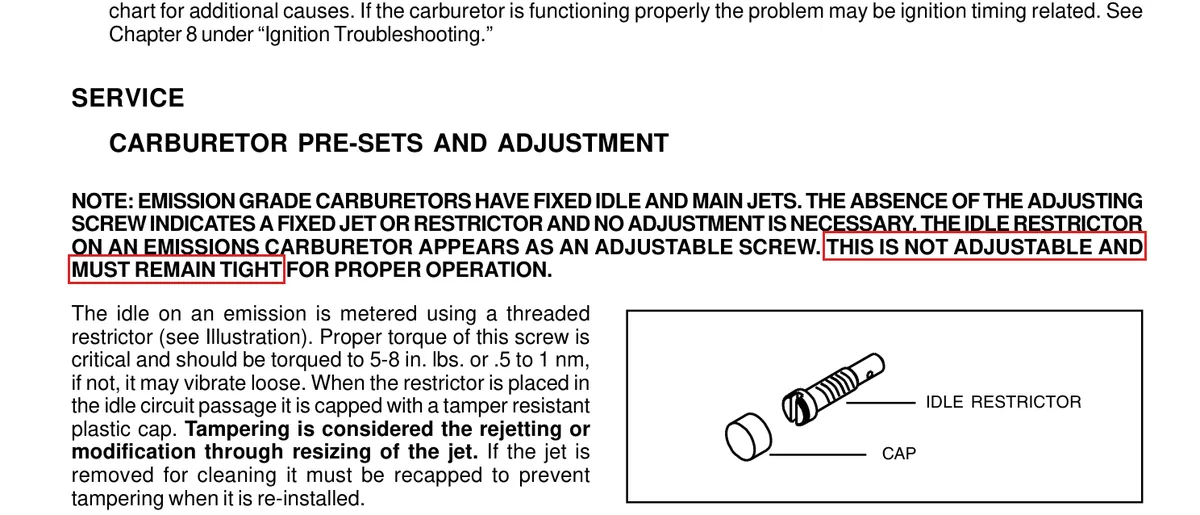
| A capped screw head on a Tecumseh emission carburetor | Idle restrictor: a fixed jet that looks like a screw | Keep it tight at 5 to 8 in-lb; it is not an adjustment |
| No mixture screw, only a throttle stop or nothing | Fixed main and idle jets (most current walk-behinds) | Clean, do not adjust; set idle speed only if your engine has an idle screw |
1Is the fuel stale, or does the engine run badly with nothing turned?
YesDrain and refill with fresh fuel, check the cap vent and air filter, then clean the jets before touching any screw (Kohler 14 690 01, p. 19).
NoGo to the next question
2Do you see slotted mixture screws with springs and no plastic caps?
YesPre-emission carburetor: set the maker's starting turns, warm the engine 3 to 5 minutes, and set each screw midway between lean and rich (Tecumseh 692509, p. 16).
NoGo to the next question
3Is a mixture screw covered by a plastic limiter cap?
YesKohler SV: adjust only within the cap. Honda and Kawasaki: leave it; pulling a Honda cap breaks the pilot screw (Kohler 20 690 01, p. 25; Honda check sheet).
NoGo to the next question
4Do you mow regularly above 2,000 ft (Honda), 3,300 ft (Kawasaki), 4,000 ft (Kohler) or 5,000 ft (Briggs)?
YesFit the maker's high-altitude main jet or kit; it is not tampering (Briggs carburetor guide; Honda PCI54675).
NoGo to the next question
5Is idle speed too low or too high, and is there an idle speed screw?
YesSet idle with a tachometer to the maker's figure, for example 1,800 rpm on a Kohler XT (Kohler 14 690 01, p. 20).
NoFixed jets and no idle screw: there is nothing to adjust. Top speed belongs to the equipment maker's spec; take the mower and its engine model and type numbers to a dealer.
Engine by engine: what you can turn and the factory setting
Read your engine maker and model off the shroud or valve cover, then find its row among the 15 below.
Swipe the table sideways to see every column.
| Engine family | Carburetor | What you can adjust | Factory setting | How it is set | Source |
|---|---|---|---|---|---|
| Briggs & Stratton, older non-EPA float carburetors | Adjustable high-speed needle (if fitted) and idle valve | High-speed needle and idle mixture | High-speed needle 1-1/2 turns open from the seat; idle valve 1-1/4 turns open | Start from those turns, then fine-tune warm | Briggs carburetor how-to guide, updated Jan. 13, 2026, web page |
| Briggs & Stratton, EPA-era walk-behind engines (e.g. 080000 to 100000 series) | Factory set; no mixture screws for the owner | Nothing by the owner | Carburetor set at the factory; maximum speed set by the equipment maker | Dealer only; do not tamper with the governor spring or linkage | Briggs operator’s manual 80024908USCN, PDF p. 9 |
| Briggs & Stratton 110000/120000 single-cylinder OHV | Fixed main jet in the bowl nut | Top no-load rpm (governor spring tang), with the engine fully assembled | Equipment maker’s rpm for the model-type-trim, listed in Briggs engine replacement data | Tachometer #19200 or #19389 and tang bender #19229 or #19352 | Briggs service manual 279000, PDF pp. 17, 42 |
| Honda GCV160, GCV190 | Pilot screw under a limiter cap | Idle speed (dealer item in Honda’s tune-up chart) | Idle 1,400 rpm, 1,700 rpm on fixed-throttle types, 2,500 rpm on auto-throttle types, each plus or minus 150 | Honda: see your authorized dealer; pulling the cap breaks the pilot screw | Honda GCV160/190 owner’s manual 00X37Z8B0023; Honda carburetor check sheet, 2004, PDF p. 11 |
| Honda GCV170, GCV200 | Fixed jets; pilot screw not an owner adjustment | Idle speed (dealer) | Idle 1,700 rpm plus or minus 150; maximum governed speed 2,800 to 3,100 rpm by engine type | Honda lists no other adjustments | Honda GCV170/200 owner’s manual 00X37Z9V0002; shop manual 62Z9L20, p. 2-2, PDF p. 13 |
| Kohler Courage XT-6 to XT8 (walk-behind) | Fixed main jet; idle mixture set at the factory | Low idle speed screw only | Low idle 1,800 rpm plus or minus 75 on basic engines | Turn the idle speed screw in or out, engine warm | Kohler service manual 14 690 01 Rev. G, PDF pp. 19, 20 |
| Kohler SV470 to SV620 (riding) | Walbro or Nikki fixed main jet; fixed idle or limiter cap on the idle fuel needle | Low idle speed, governed idle, high speed, and idle fuel within the cap | Low idle 1,200 rpm plus or minus 75; governed idle 1,500 to 1,800 rpm (equipment maker’s figure) | Idle fuel: midway between rich and lean, only inside the cap; do not remove limiter caps | Kohler service manual 20 690 01 Rev. J, PDF pp. 25, 26 |
| Kohler 7000 Series KT610 to KT745 (riding twins) | Keihin or Walbro fixed main jet; idle fuel set at the factory | Idle speed screw, governed idle tab, high speed screw | Idle about 1,450 rpm, then governed idle 1,750 rpm by bending the tab | Tachometer; set governed idle before high speed | Kohler service manual 32 690 03 Rev. M, PDF p. 34 |
| Kawasaki FR651V, FR691V, FR730V (riding) | Cap or stop plate on each mixture screw | Nothing by the owner | Low idle 1,550 rpm, high idle 3,600 rpm (may vary by equipment) | Do not tamper; authorized Kawasaki dealer | Kawasaki FR owner’s manual, PDF pp. 14, 24 |
| Tecumseh, non-emission float carburetors | Main and idle mixture screws | Main and idle mixture | Pre-set: main 1-1/2 turns, idle 1 turn out from finger tight | Warm 3 to 5 minutes, then split lean and rich on each screw | Tecumseh Technician’s Handbook 692509, 1998, pp. 15, 16 |
| Tecumseh, non-emission diaphragm carburetors | Main and idle mixture screws | Main and idle mixture | Pre-set: main 1 turn, idle 1 turn | Same lean-rich midpoint method | Tecumseh Technician’s Handbook 692509, 1998, p. 16 |
| Walbro LMH on Tecumseh engines | Main and idle mixture screws | Main and idle mixture | Pre-set: main 1-1/2 turns, idle 1-1/2 turns | Same lean-rich midpoint method | Tecumseh Technician’s Handbook 692509, 1998, p. 16 |
| Walbro WHG and LME on Tecumseh engines | Main and idle mixture screws | Main and idle mixture | Pre-set: main 1-1/4 turns, idle 1-1/4 turns | Same lean-rich midpoint method | Tecumseh Technician’s Handbook 692509, 1998, p. 16 |
| Walbro LMK on Tecumseh engines | Fixed main; idle mixture screw | Idle mixture only | Main fixed; idle pre-set 1 turn | Idle lean-rich midpoint at SLOW | Tecumseh Technician’s Handbook 692509, 1998, p. 16 |
| Tecumseh emission-grade carburetors | Fixed idle and main jets; idle restrictor that looks like a screw, under a tamper-resistant cap | Nothing | Restrictor torqued to 5 to 8 in-lb (0.5 to 1 N·m) and recapped | Leave it tight; it is not an adjustment | Tecumseh Technician’s Handbook 692509, 1998, p. 15 |
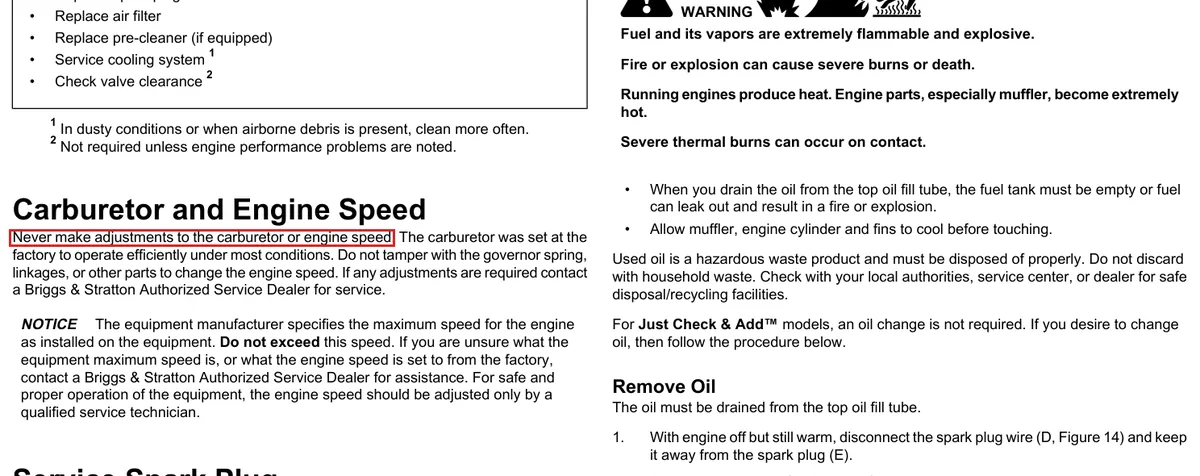
Every current walk-behind in the table leaves the owner idle speed at most, and Briggs’s EPA-era manual says “Never make adjustments to the carburetor or engine speed” (Briggs 80024908USCN, p. 9). Riding-mower engines keep more screws, but their fuel screws sit under caps.
Older carburetors with open mixture screws: the procedure
Tecumseh’s 1998 handbook gives the fullest method, and Kohler uses the same rich-lean midpoint inside its caps. Seat screws finger tight only; Tecumseh warns that overtightening damages the needle taper (Tecumseh 692509, p. 16). An engine that will not start needs our lawn mower not starting checklist before any mixture screw.
- Fit fresh fuel and a clean air filter, and check the governor linkage.
- Engine off: turn the main and idle mixture screws in, clockwise, until finger tight.
- Back each out to its preset: 1-1/2 turns main and 1 turn idle on Tecumseh float carburetors, 1-1/2 and 1-1/4 on older Briggs, 1-1/2 and 1-1/2 on a Walbro LMH.
- Start the engine and warm it for 3 to 5 minutes.
- Throttle at FAST: turn the main screw in until the engine runs erratic (lean), then out until erratic again (rich), and set it midway.
- Throttle at SLOW: repeat on the idle mixture screw.
- Under load, if it hesitates, turn the main screw out 1/8 turn at a time; if it smokes, in 1/8 turn at a time.
- Recheck idle and top speed with a tachometer.
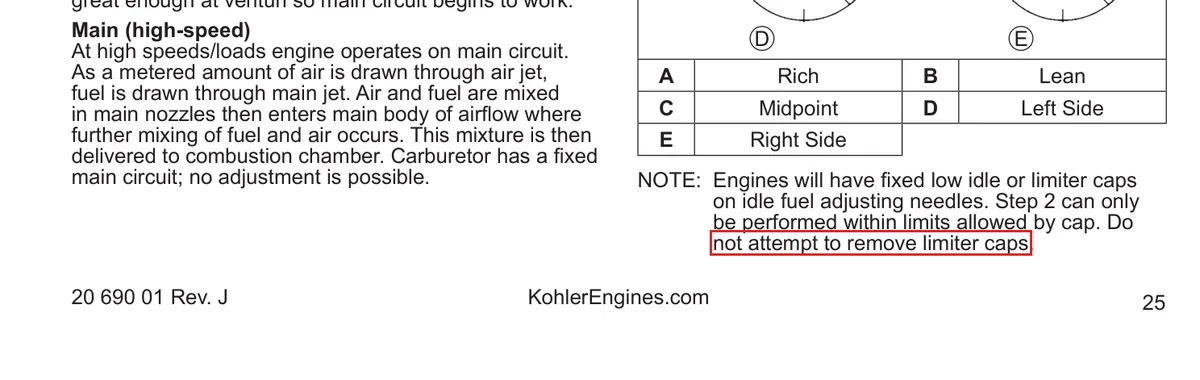
One ranking guide says a limiter cap can be pried off to go past its range, with the best setting one to two turns out on any mower. Kohler says “Do not attempt to remove limiter caps” (Kohler 20 690 01, p. 25). A capped engine that only runs at the cap’s stop needs cleaning, not more turns.
Capped and fixed carburetors: what is still yours to set
Kohler’s SV riding engines allow an owner adjustment inside the cap. Set low idle to 1,200 rpm, turn the idle fuel needle out until speed drops (rich), in until it rises and drops again (lean), and leave it midway, “within limits allowed by cap” (Kohler 20 690 01, pp. 25, 26).
Honda is stricter. Its GC and GCV pilot screw sits under a limiter cap set with Loctite 638, and when the cap comes off “the pilot screw breaks at the narrow point”; the repair is a new screw set to the shop-manual position (Honda check sheet, 2004). Kawasaki sends carburetor and governor adjustments to a dealer (Kawasaki FR manual, PDF p. 24).
Lawn mower idle adjustment and top speed
The idle speed screw stops the throttle plate; it changes speed, not mixture. Engine warm and throttle at idle, turn it clockwise to raise speed and counterclockwise to lower it, and check with a tachometer, the tool Kohler lists (Design Technology DTI-110, Kohler 20 690 01, p. 14).
| Engine | Idle setting printed by the maker | Source |
|---|---|---|
| Kohler SV470 to SV620 | 1,200 rpm plus or minus 75 (low idle) | Kohler 20 690 01, p. 25 |
| Honda GCV160, GCV190 | 1,400 rpm plus or minus 150 | Honda 00X37Z8B0023, p. 11 |
| Kohler 7000 KT610 to KT745 | About 1,450 rpm, then 1,750 rpm governed idle | Kohler 32 690 03, p. 34 |
| Kawasaki FR651V to FR730V | 1,550 rpm (low idle) | Kawasaki FR manual, PDF p. 14 |
| Honda GCV170, GCV200 and fixed-throttle GCV160, GCV190 | 1,700 rpm plus or minus 150 | Honda 00X37Z9V0002, p. 13 |
| Kohler Courage XT-6 to XT8 | 1,800 rpm plus or minus 75 | Kohler 14 690 01, p. 20 |
| Honda GCV160, GCV190 auto-throttle types | 2,500 rpm plus or minus 150 | Honda 00X37Z8B0023, p. 11 |
Top speed belongs to the mower maker. Briggs ships an adjustable top no-load rpm “which the equipment manufacturers set to their own specifications,” checked with tachometer #19200 or #19389 on the assembled mower (Briggs 279000, PDF pp. 17, 42). Honda’s GCV145 to GCV200 governed maximums run 2,800 to 3,100 rpm by type (Honda 62Z9L20, p. 2-2); Kawasaki’s FR twins, 3,600 rpm.
The 3,060 rpm figure quoted for Briggs engines is the speed at which Briggs rates gross torque, not a governor setting (Briggs 80024908USCN, p. 11). A mower that will not hold speed is usually lean; our guide to a lawn mower surging up and down matches the jet to the throttle position.
Lawn mower running rich, lean or badly at altitude?
Black, sooty exhaust means rich. Kohler’s causes are a clogged air cleaner, a choke partly closed, dirt under the inlet needle, plugged bowl vents and a leaking float: repairs, not screw settings (Kohler 14 690 01, p. 20). Our guide to what black, white and blue mower smoke means covers each check.
Altitude is the rich condition with a sanctioned fix: a smaller main jet, not a screw. Honda’s current threshold is 2,000 ft, lower than the 5,000 ft in its older GCV160 manual (Honda PCI54675, 2020).
| Maker | Fit the high-altitude jet or kit above | Do not run the kit below | Who fits it | Source |
|---|---|---|---|---|
| Honda (current guidance, GCV170/200) | 2,000 ft (610 m); second smaller jet above 10,000 ft | 2,000 ft | Dealer, or owner with the shop manual | Honda PCI54675; 00X37Z9V0002, p. 12 |
| Honda (GCV160/190 manual) | 5,000 ft (1,500 m) | 5,000 ft | Dealer | Honda 00X37Z8B0023, p. 10 |
| Kawasaki FR series | 3,300 ft (1,000 m), main jet swap | Not stated | Dealer or owner, per Kawasaki service data | Kawasaki FR manual, PDF p. 8 |
| Kohler XT, SV, 7000 | 4,000 ft (1,219 m) | 4,000 ft | Kohler dealer kit | Kohler 20 690 01, p. 26 |
| Briggs & Stratton | 5,000 ft (1,524 m) | 2,500 ft (762 m) | Authorized dealer | Briggs 80024908USCN, pp. 6, 7 |
A jetted engine still loses about 3.5 percent of its power per 1,000 ft; Honda’s example generator jetted for 7,200 ft makes about 75 percent of rated output (Honda PCI54675, p. 2). Back at low elevation a jetted carburetor runs lean and can overheat (Honda 00X37Z9V0002, p. 12).
- Power lost, percent of rated output, even when jetted
- 17.5
- Elevation in meters
- 1,524
Default: 5,000 ft gives 17.5 percent, from Honda's figure of about 3.5 percent per 1,000 ft for a correctly jetted engine (PCI54675). An unjetted carburetor loses more. Compare your elevation with each maker's kit threshold in the table above.
Hand it to a shop if the cap is already gone, the equipment speed spec is unknown, or cleaning did not cure it. Our lawn mower repair cost survey lists posted carburetor prices; ask the shop to tachometer-check idle and top speed against your engine’s model and type numbers.
General information from maker documents and federal rules, not legal or repair advice. Pull the spark plug wire when the engine is not running, and follow your mower’s manual where it differs.
How we compiled this
On Nov. 24, 2026 we read the carburetor, governor and altitude sections of 13 maker documents (3 Briggs & Stratton, 5 Honda, 3 Kohler, 1 Kawasaki, 1 Tecumseh), 6 sections of 40 CFR parts 1054 and 1068, and Google’s results for 5 phrasings of the query. We did not adjust or test any engine. Page numbers are PDF pages unless the document prints its own.
Frequently asked questions
How do I set my carburetor to factory settings?
Seat each mixture screw finger tight and back it out to the maker’s preset: 1-1/2 turns main and 1-1/4 idle on older Briggs float carburetors, 1-1/2 and 1 on Tecumseh (Tecumseh 692509, p. 16). Capped and fixed carburetors are already at factory settings.
How do you adjust H and L screws on a carburetor?
H is the main (high-speed) mixture, L the idle mixture. From the preset, find erratic lean and erratic rich on each and leave it midway: H at full throttle, L at idle (Tecumseh 692509, p. 16).
How do you adjust a lawn mower carburetor without screws?
You do not. No mixture screw means fixed jets; Kohler says its main jet is calibrated at the factory (14 690 01, p. 20). Clean the jets, fit an altitude jet if needed, and set idle speed if there is an idle screw.
How do I adjust the idle on my lawn mower?
Engine warm, throttle at idle, turn the idle speed screw clockwise to raise speed and check with a tachometer: 1,800 rpm plus or minus 75 on a Kohler XT, 1,700 plus or minus 150 on a Honda GCV170.
Why is my lawn mower running rich?
Kohler lists a clogged air cleaner, a partly closed choke, dirt under the inlet needle, plugged bowl vents and a leaking float (14 690 01, p. 20). Above 2,000 to 5,000 ft, by maker, a sea-level jet also runs rich.
Sources
- Briggs & Stratton, Carburetor Repair, Maintenance & Adjustment How-To Guide, updated Jan. 13, 2026. Accessed November 2026.
- Briggs & Stratton, Operator’s manual, engine models 080000, 090000, 093J00, 100000, Form 80024908USCN, 2018; PDF pp. 6, 7, 9, 11. Accessed November 2026.
- Briggs & Stratton, Service, troubleshooting and repair manual, 110000/120000 Professional Series, Part No. 279000 (equipment-maker copy), March 2011; PDF pp. 12, 17, 42. Accessed November 2026.
- American Honda Motor Co., GCV160 and GCV190 owner’s manual, 00X37Z8B0023, PDF pp. 10, 11. Accessed November 2026.
- American Honda Motor Co., GCV170 and GCV200 owner’s manual, 00X37Z9V0002, PDF pp. 12, 13. Accessed November 2026.
- Honda Motor Co., GCV145H, GCV170H, GCV200H shop manual, 62Z9L20, 2019; p. 2-2. Accessed November 2026.
- American Honda Motor Co., Carburetor check sheet, GC and GCV135/160/190, GS and GSV160/190, 2004. Accessed November 2026.
- American Honda Motor Co., Carburetor Jetting for High Elevations, PCI54675-B, first issued June 2015, revised April 2020. Accessed November 2026.
- Kohler Engines, Courage XT-6 to XT8 service manual, 14 690 01 Rev. G, PDF pp. 19 to 21. Accessed November 2026.
- Kohler Engines, SV470 to SV620 service manual, 20 690 01 Rev. J, PDF pp. 14, 23, 25, 26. Accessed November 2026.
- Kohler Engines, 7000 Series KT610 to KT745 service manual, 32 690 03 Rev. M, PDF p. 34. Accessed November 2026.
- Kawasaki Engines USA, FR651V, FR691V, FR730V owner’s manual, PDF pp. 8, 14, 24. Accessed November 2026.
- Tecumseh Products Co., Technician’s Handbook, 3 to 11 HP 4-cycle L-head engines, 692509 (parts-dealer copy), 1998; printed pp. 15, 16. Accessed November 2026.
- eCFR, U.S. EPA, 40 CFR 1054.115, What other requirements apply? (adjustable parameters, altitude), current Nov. 2026. Accessed November 2026.
- eCFR, U.S. EPA, 40 CFR 1068.50, Adjustable parameters, current Nov. 2026. Accessed November 2026.
- eCFR, U.S. EPA, 40 CFR 1068.101, What general actions does this regulation prohibit?, current Nov. 2026. Accessed November 2026.
- eCFR, U.S. EPA, 40 CFR 1054.105, What exhaust emission standards must my nonhandheld engines meet?, current Nov. 2026. Accessed November 2026.
- eCFR, U.S. EPA, 40 CFR 1054.1, Does this part apply for my engines and equipment?, current Nov. 2026. Accessed November 2026.
- eCFR, U.S. EPA, 40 CFR part 1054, appendix A, Summary of Previous Emission Standards, current Nov. 2026. Accessed November 2026.