Why is my lawn mower backfiring? One bang after you turn the key off is afterfire: unburned fuel lighting in the hot muffler. Popping while running points to a lean carburetor, fuel over 10 percent ethanol, a bad spark plug or a sheared flywheel key.
Why is my lawn mower backfiring is really two questions, and the fix depends on which one you have. Briggs & Stratton defines backfire as a bang while the engine runs or is shutting down, and afterfire as one that comes after it has stopped. It also says both, when they come through the carburetor, “will not harm the engine at all.” The loud single bang from a riding mower’s muffler at shutoff is the afterfire case; repeated pops while mowing are the backfire case.
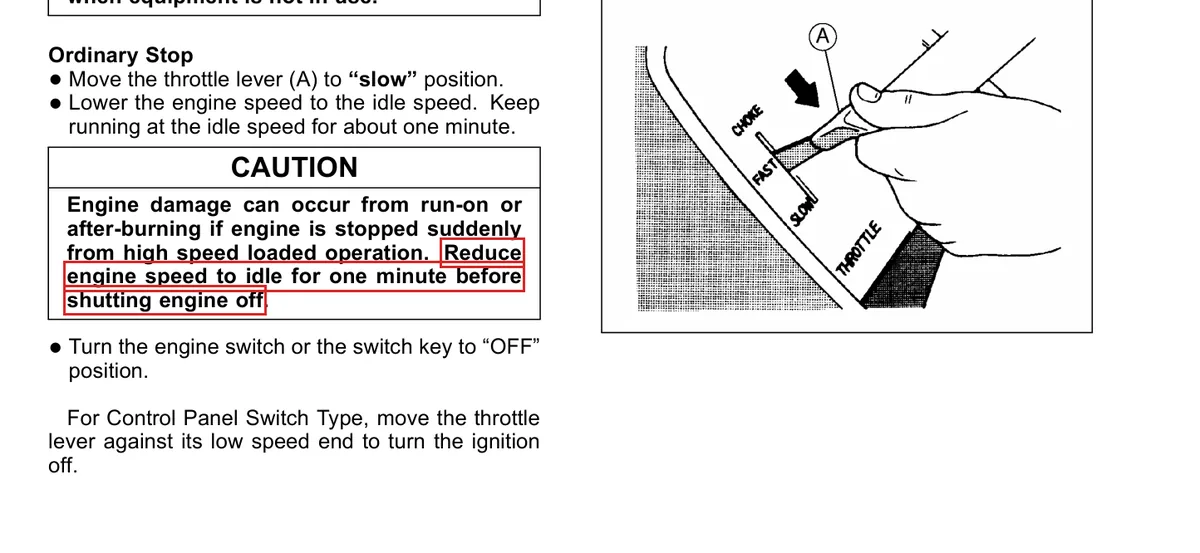
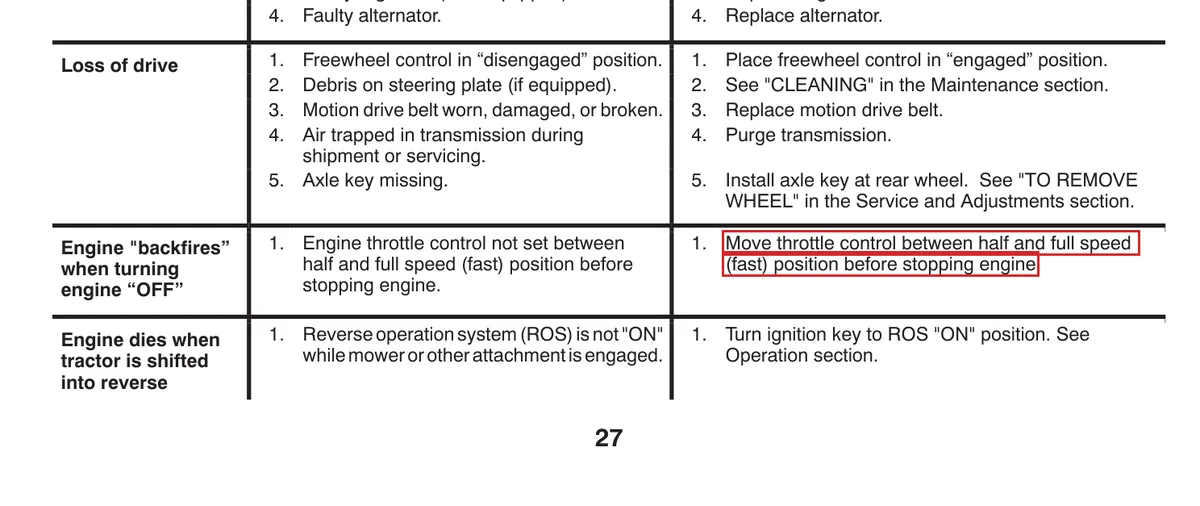
For the shutoff bang, the manuals do not agree on what to do with the throttle. Kawasaki says to idle about 1 minute; John Deere says to run a few seconds at high throttle; Briggs says full throttle if the engine has an anti-afterfire solenoid. Husqvarna’s TS 242 manual says both: slow on page 9, half to full on page 27. The table further down sets 10 shutdown instructions side by side, which none of the top 5 results for this question does.
1Is it one bang from the muffler 1 to 2 seconds after the key goes off?
YesAfterfire. Shut down the way your manual says (idle 15 to 30 s without a solenoid, per Briggs; half to full throttle on many tractors), then bench-test the anti-afterfire solenoid with 12 V.
NoGo to the next question
2Does it pop only when you pull the throttle back quickly?
YesDeceleration backfire. Lower engine speed over a few seconds; Briggs lists dropping speed too fast as the first cause.
NoGo to the next question
3On a rider, does it pop only when you lift off the seat?
YesSeat switch cutting ignition. John Deere lists it as a backfire cause; stay seated or have the switch checked.
NoGo to the next question
4Did it start after the blade hit something, with harder starting?
YesSuspect a partly sheared flywheel key: pull the flywheel, replace the key, check blade and crankshaft.
NoGo to the next question
5Does it pop back through the air filter while running?
YesLean mixture: fresh E10-or-less fuel, then clean the carburetor jets and idle passages.
NoPopping through the muffler under load: replace the spark plug and air filter, drain old fuel; if it persists on a high-hour engine, have valve clearance checked against the spec table.
Source: Briggs & Stratton FAQ; John Deere OMUC44974; Kohler 32 690 03 and 14 590 26
Afterfire or backfire: which one is your mower doing?
Note when the pop happens and where it comes from before you buy parts. A single bang from the muffler just after the key goes off is afterfire. Pops while running that blow back through the air filter usually point to a lean mixture, which Briggs lists as a backfire cause and Kohler’s 7000 Series service manual says also shows up as misfiring, lost power and governor hunting (p. 33). The table runs the 7 patterns in the order a shop would check them.
| When it pops | Where the sound comes from | Most likely cause | Quick test | Fix | Source |
|---|---|---|---|---|---|
| Once, a moment after the key goes off | Muffler | Afterfire: unburned fuel lighting in the hot muffler; on riders, often an anti-afterfire (fuel shut-off) solenoid that no longer closes | Check for 12 V at the solenoid lead with the key at RUN, then bench-test the pin with 12 V (steps below) | Shut down the way your manual says (table below); replace a solenoid whose pin will not move | Briggs FAQ; Kohler 32 690 03, p. 33 |
| Every time you pull the throttle back fast | Muffler or carburetor | Deceleration backfire: engine speed lowered too fast | Ease the throttle down slowly; if the pop stops, it was technique | Lower speed slowly | Briggs FAQ |
| While running, through the air filter side | Carburetor intake | Lean mixture: dirty jets or idle holes, carburetor set too lean, or fuel above 10 percent ethanol | Fresh E10-or-less fuel first; then check for lean signs Kohler lists: misfiring, loss of speed and power, governor hunting | Clean the carburetor; refill with E10 or less | Briggs FAQ; Kohler 32 690 03, p. 33 |
| Under load, with misfires | Muffler | Faulty spark plug, dirty air cleaner, dirt in the fuel line, improper fuel or an overloaded engine | Pull the plug: wet, sooty or cracked means replace; gap it to the manual (0.030 in. on a Kohler XTX, 0.020 in. on a Briggs 110000) | New plug, clean filter, fresh fuel | Kohler 14 590 26, p. 8; John Deere OMUC44974, p. 70-1 |
| On a rider, when you shift your weight off the seat | Muffler | Seat switch cutting ignition for a moment while fuel keeps flowing | Does it pop only when you lift off the seat? | Stay seated; have the seat switch and harness checked if it cuts out while seated | John Deere OMUC44974, p. 70-1 |
| Right after the blade hit a root, stump or curb, with hard starting | Carburetor or muffler | Partly sheared flywheel key, which moves ignition timing | Pull the flywheel and look for a cut or twisted key | New key; check blade and crankshaft for bends | Briggs flywheel key FAQ; Tecumseh 692509, p. 65 |
| Persistent popping on a high-hour engine | Carburetor or muffler | Valve clearance out of spec (a valve not seating) | Feeler gauge, engine cold, against the spec in the table below | Set clearance; lap or replace a burned valve | Briggs valve FAQ; Kawasaki FR manual, p. 12 |
If the same engine also surges up and down at a steady throttle, the lean causes are the same ones behind a lawn mower surging, and black smoke with the pops points the other way, to the rich causes in our guide to what lawn mower smoke color means.
Why does my lawn mower backfire when I turn it off?
Briggs lists 5 causes of afterfire: shutting off at high rpm, alcohol in the gasoline, the muffler’s design, carburetor adjustment and an anti-afterfire solenoid that is not working. Briggs’ explanation is that shutting off at high rpm causes fuel to pump through the engine “for ignition” after the key is off. Briggs’ fix for engines without a solenoid is to idle down for 15 to 30 seconds before switching off (Briggs FAQ, updated Apr. 6, 2026).
The solenoid changes the advice. An anti-afterfire solenoid is a fuel shut-off valve in the carburetor bowl: when the key goes off, its pin extends and blocks fuel to the main jet (Kohler 32 690 03, p. 33). With that valve working, there is no fuel to burn in the muffler even at high rpm, which is why Briggs says to shut those engines off at full throttle. Read your own manual first: the 10 instructions below disagree, and the one printed for your machine is the one its maker wrote for that engine and muffler.
| Manual (model) | Throttle before key off | Idle time | What it says about backfire or afterfire | Source |
|---|---|---|---|---|
| Briggs & Stratton FAQ, engines without an anti-afterfire solenoid | Idle down | 15 to 30 seconds | Shutting off at high rpm pumps fuel through the engine to ignite | Briggs FAQ, Apr. 6, 2026 |
| Briggs & Stratton FAQ, engines with an anti-afterfire solenoid | Full throttle | None given | “Shut engine off at full throttle” | Briggs FAQ, Apr. 6, 2026 |
| Kawasaki FR651V, FR691V, FR730V | Slow, then idle | About 1 minute | Run-on or after-burning can damage the engine if stopped suddenly from high-speed loaded operation | Kawasaki FR owner’s manual, p. 20 |
| John Deere S100 to S180 (OMUC44974) | High throttle, no load | A few seconds | Never stop with the choke: backfire, fire or engine damage can occur | OMUC44974, p. 30-8 |
| Toro TimeCutter 42 in. (75749, 75752TA) | Between half and full | None given | No backfire wording; blades off and levers in PARK first | Toro interactive manual |
| Husqvarna TS 242 (114 14 43-28), operation page | Slow, then idle | Not stated | Not idling first “may cause engine to back fire” | TS 242 manual, p. 9 |
| Husqvarna TS 242 (114 14 43-28), troubleshooting page | Between half and full (fast) | None given | Backfire at OFF: throttle “not set between half and full speed” | TS 242 manual, p. 27 |
| Kohler XTX650, XTX675, XTX775 (walk-behind) | Slow or idle | Not stated | Close the fuel shut-off valve if equipped | Kohler 14 590 26, p. 4 |
| Honda GCV160, GCV190 (walk-behind) | SLOW | Not stated | Turn the fuel valve OFF after stopping; have “afterburning (backfiring)” inspected | Honda 00X37Z8B0023, pp. 5, 10 |
| Briggs & Stratton 080000 to 100000 (walk-behind) | STOP position, if the throttle has one | Not stated | Do not choke the carburetor to stop the engine | Briggs 80024908USCN, p. 8 |
The pattern: walk-behind engines (Honda GCV, Kohler XTX, small Briggs) say slow or idle, while the 3 lawn tractor manuals lean toward half to full throttle (Toro, Husqvarna troubleshooting, John Deere). Kawasaki is the exception among riding engines, at about 1 minute of idle. Every manual that mentions the choke says never to use it to stop the engine; Briggs and John Deere both print that warning, and John Deere names backfire and fire as the result.
If the bang started suddenly on a tractor that used to shut down quietly, the habit is not the problem; the solenoid or the fuel is. Fuel matters at shutdown too: Briggs lists alcohol blends under both backfire and afterfire, its 080000 manual rules out E15 and E85, and Husqvarna’s TS 242 manual says fuel above E10 voids the warranty. Federal rules on E15 in mowers are covered on our page about what gas a lawn mower takes.
How do you test an anti-afterfire solenoid?
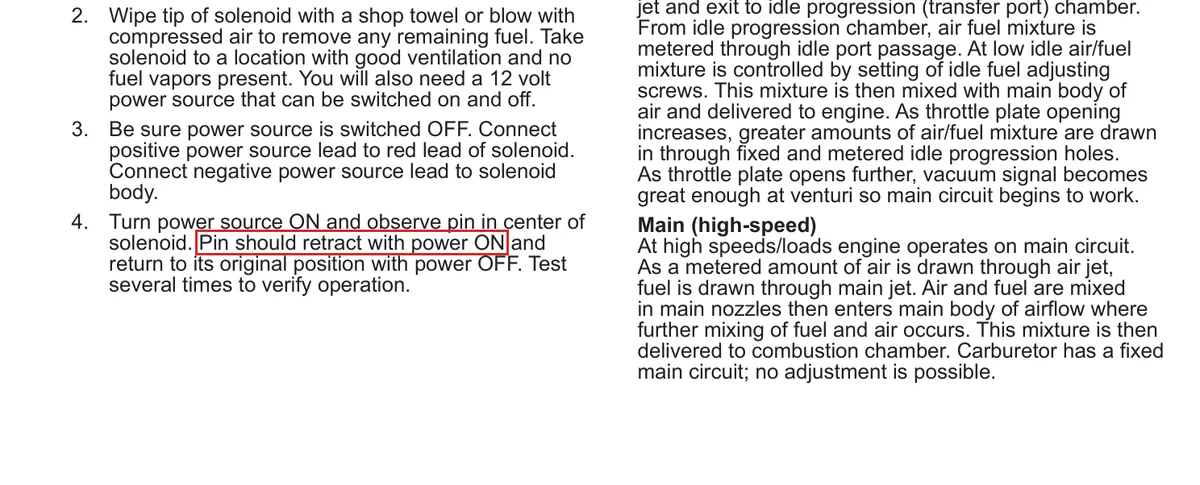
Kohler prints the simplest bench test, in its 7000 Series service manual (32 690 03 Rev. M, p. 33). Its solenoid has a spring-loaded pin that retracts when 12 volts reach the lead, letting fuel reach the main jet, and extends to block the jet when power is cut. Do this with the engine off and cold, and away from any spark.
- Shut off the fuel and set a container under the carburetor bowl: fuel will run out when the solenoid comes loose.
- Unscrew the solenoid from the bottom of the bowl and wipe or blow the fuel off its tip. Move it to a ventilated spot with no fuel vapor.
- With a switched 12 V source turned OFF, connect positive to the solenoid’s red lead and negative to the solenoid body.
- Switch the power ON and watch the pin in the center: it should pull in, then return when power goes OFF. Repeat several times.
- A pin that does not move, or moves only sometimes, fails. Kohler’s test ends there; if the pin passes but the engine still afterfires, check with a meter that 12 V reaches the lead at RUN, since Kohler’s troubleshooting list also names a blown fuse and a failed harness diode (p. 24).
A solenoid that sticks the other way, closed, starves the engine instead: Kohler lists “carburetor solenoid malfunction” under engine cranks but will not start (32 690 03, p. 24). Unplug it during carburetor work; our steps for cleaning a lawn mower carburetor cover removing the bowl with the solenoid attached.
Why does my lawn mower pop and backfire while it runs?
Briggs’ running-backfire list is short: dropping engine speed too fast, gasoline with higher alcohol blends, a carburetor set too lean, the muffler’s construction, high engine temperature, and transitional passages in some carburetors that make them backfire-prone, a condition Briggs says “cannot be corrected.” Kohler’s XTX owner’s manual chart ties “backfires” to 5 causes: improper fuel, dirt in the fuel line, an overloaded engine, a dirty air cleaner and a faulty spark plug (p. 8).
Work through them in cost order. Drain fuel older than 30 days and refill with E10 or less; clean or replace the air filter; pull the spark plug and gap a new one to the manual (0.030 in. on the Kohler XTX, 0.020 in. on the Briggs 110000). If it still pops, clean the carburetor’s jets and idle passages. Turning mixture screws is the last step, and many have none: Kohler says the 7000 Series carburetor “has a fixed main circuit; no adjustment is possible” (p. 33). Our guide to adjusting a lawn mower carburetor lists what each engine family still allows.
Riding mowers add one cause that walk-behinds lack. John Deere’s troubleshooting chart for the S100 to S180 lists two causes of “engine backfires”: a faulty spark plug and “operator raising off of the seat” (OMUC44974, p. 70-1). The likely mechanism, which the manual does not spell out: lifting off the seat trips the seat switch, ignition cuts for an instant, and fuel that passed through unburned lights in the hot muffler.
Backfiring after you hit a rock or root? Check the flywheel key
A blade strike can shear the soft flywheel key, which Briggs says is designed to absorb the damage (Briggs flywheel key FAQ, Jan. 14, 2026). The key sets where the flywheel magnets sit relative to the crankshaft, so a key that is only partly sheared moves spark timing; Briggs says ignition timing problems are “most often due to a sheared flywheel key” (Briggs ignition FAQ). Tecumseh’s handbook says a sheared or partly sheared key leaves the engine unable to start or hard to start (Tecumseh 692509, p. 65).
None of the maker documents we read lists backfire as a key symptom by name; hard starting after a strike is the documented sign, and pops through the carburetor on the pull are the usual companion. Briggs’ inspection: pull the flywheel with a puller, never a hammer, replace the key at any sign of shearing, and check the blade and crankshaft for straightness. Kohler’s XT manual goes further: a sheared key or damaged keyway means replacing the crankshaft, flywheel and key (14 690 01, p. 37). A bent blade from the same hit needs replacing, not sharpening.
Torque the flywheel fastener to spec on reassembly; an under-torqued nut lets a new key shear again. The table below gives each engine’s figure where its manual prints one, from 38 ft-lb on a Kohler Courage XT to 60 lb-ft on a Briggs 110000, along with the valve clearance that matters for the next cause.
Can valve clearance cause backfiring?
A valve that does not close fully lets combustion escape: through the intake it pops back at the carburetor, through the exhaust it fires into the muffler. Briggs says to recheck tappet clearance after lapping valves because lapping removes metal, and says gummy intake deposits come from old gasoline, a plugged air filter or an overfilled crankcase (Briggs valve FAQ, Mar. 23, 2026). Briggs checks it cold with a feeler gauge, piston 1/4 in. past top dead center on the compression stroke (279000, p. 12); Kohler sets it at top dead center.
| Engine | Intake clearance (cold) | Exhaust clearance (cold) | Check interval | Flywheel fastener torque | Source |
|---|---|---|---|---|---|
| Briggs & Stratton 110000, 120000 | 0.004 to 0.008 in. | 0.004 to 0.008 in. | Not in this manual | 60 lb-ft (nut) | Briggs 279000, pp. 68, 70 |
| Honda GCV160, GCV190 | 0.006 in. ± 0.002 (0.15 mm ± 0.04) | 0.008 in. ± 0.002 (0.20 mm ± 0.04) | Every year or 100 hours | Not in owner’s manual | Honda 00X37Z8B0023, pp. 7, 11 |
| Kawasaki FR651V, FR691V, FR730V | 0.004 to 0.006 in. (0.10 to 0.15 mm) | 0.004 to 0.006 in. (0.10 to 0.15 mm) | Every 100 hours or 1 year | Not in owner’s manual | Kawasaki FR manual, pp. 12, 24 |
| Kohler 7000 Series KT610 to KT745 | 0.004 to 0.006 in. (set with a 0.005 in. gauge) | 0.004 to 0.006 in. | Every 500 hours, by a Kohler dealer | 55 ft-lb (screw) | Kohler 32 690 03, pp. 3, 16, 87 |
| Kohler SV470 to SV620 | 0.005 in. (0.127 mm) | 0.007 in. (0.178 mm) | Every 200 hours | See manual | Kohler 20 690 01, pp. 3, 11 |
| Kohler Courage XT-6 to XT8 | 0.003 to 0.005 in. | 0.003 to 0.005 in. | See manual | 38 ft-lb (nut) | Kohler 14 690 01, pp. 6, 8 |
Specs vary by engine, so do not use a “typical” number: the 6 engines above run from 0.003 to 0.008 in. Kohler puts the check at 200 hours on SV engines and 500 hours on the 7000 Series, the latter by a dealer; Kawasaki and Honda say every 100 hours or yearly. On a mower with a clean carburetor, fresh fuel and a new plug, this is the next check, not the first. When it is needed, the labor is in our lawn mower repair cost survey of posted shop prices.
Is it bad for a lawn mower to backfire?
Occasional pops are not an emergency. Briggs says backfire and afterfire through the carburetor will not harm the engine, and its 279000 repair manual says the electric starter’s clutch is built to absorb “shock loads such as engine backfire” (Briggs 279000, p. 22). Kawasaki is more cautious, warning that after-burning from a sudden high-speed stop can damage the engine.
The muffler takes the hit from loud, repeated afterfire. Shane Louwerens, who restored a John Deere 4010 with his students at Mississippi Northwest Community College, told Successful Farming he has seen afterfire “blow an end out of a muffler,” and has seen a mower catch fire while it was being checked for backfiring (Successful Farming, updated Mar. 31, 2025). Stop mowing and fix it if the bangs come every time, if the muffler is cracked or loose, or if you smell fuel: Honda tells owners to have “afterburning (backfiring)” inspected under its emissions section (p. 10).
If it backfires and then will not start at all, start with our lawn mower not starting checklist, then the two causes above that do both: a solenoid stuck closed or a sheared flywheel key.
How we compiled this
On Nov. 26, 2026 we read 12 operator, owner’s and service manuals (Briggs & Stratton 279000 and 80024908USCN; Kohler 32 690 03, 20 690 01, 14 690 01 and 14 590 26; Kawasaki FR; Honda GCV160/190; John Deere OMUC44974; Husqvarna TS 242; Toro TimeCutter 75749; Tecumseh 692509), 4 Briggs & Stratton support pages and one attributed trade interview. Shutdown steps, causes and specs are as printed; we converted units only. We did no engine testing.
Frequently asked questions
What causes an engine to backfire when you shut it off?
Fuel still passing through after the spark stops lights in the hot muffler. Briggs lists shutting off at high rpm, alcohol in the fuel, muffler design, carburetor adjustment and a failed anti-afterfire solenoid. Without a solenoid, Briggs says to idle 15 to 30 seconds first.
What does an anti-backfire solenoid do?
It is a 12 V fuel shut-off valve in the carburetor bowl. With the key on, its pin retracts and fuel flows to the main jet; with the key off, the pin extends and blocks it, so no fuel reaches a hot muffler (Kohler 32 690 03, p. 33).
Is it bad for a lawn mower to backfire?
Occasional pops through the carburetor are not, per Briggs & Stratton. Loud, repeated afterfire can crack or blow out a muffler, and Kawasaki warns after-burning from a sudden high-speed stop can damage the engine. Fix it if it happens every time.
Why does my lawn mower backfire when I try to start it?
Usually a lean mixture or wrong timing. Start with fresh E10-or-less fuel and a new spark plug; if it also starts hard after a blade strike, check for a partly sheared flywheel key, which Briggs says is the usual cause of timing problems.
Can a bad spark plug cause backfire?
Yes. John Deere’s tractor chart and Kohler’s XTX chart both list a faulty spark plug under backfires. Replace it and set the gap to your manual: 0.030 in. on a Kohler XTX, 0.020 in. on a Briggs 110000.
Sources
- Briggs & Stratton, Why Does My Engine Backfire or Afterfire?, Updated Apr. 6, 2026. Accessed November 2026.
- Briggs & Stratton, How do I check if my engine’s flywheel key needs replacement?, Updated Jan. 14, 2026. Accessed November 2026.
- Briggs & Stratton, Ignition system theory and testing, Checked Nov. 26, 2026. Accessed November 2026.
- Briggs & Stratton, Small Engine Valve Maintenance & Repair, Updated Mar. 23, 2026. Accessed November 2026.
- Briggs & Stratton, Service, troubleshooting and repair manual, 110000/120000 Professional Series, Part No. 279000 (equipment-maker copy), Undated PDF. Accessed November 2026.
- Briggs & Stratton, Operator’s manual, engine models 080000, 090000, 093J00, 100000, Form 80024908USCN, Undated PDF. Accessed November 2026.
- Kohler Engines, 7000 Series KT610 to KT745 service manual, 32 690 03 Rev. M, Rev. M. Accessed November 2026.
- Kohler Engines, SV470 to SV620 service manual, 20 690 01 Rev. J, Rev. J. Accessed November 2026.
- Kohler Engines, Courage XT-6 to XT8 service manual, 14 690 01 Rev. G, Rev. G. Accessed November 2026.
- Kohler Engines, XTX650, XTX675, XTX775 owner’s manual, 14 590 26, Undated PDF. Accessed November 2026.
- Kawasaki Engines, FR651V, FR691V, FR730V owner’s manual, Undated PDF. Accessed November 2026.
- American Honda Motor Co., GCV160 and GCV190 owner’s manual, 00X37Z8B0023, Undated PDF. Accessed November 2026.
- John Deere, S100 to S180 tractors operator’s manual, OMUC44974 (retailer-hosted copy), Undated PDF. Accessed November 2026.
- Husqvarna, TS 242 operator’s manual, 114 14 43-28, Undated PDF. Accessed November 2026.
- The Toro Company, TimeCutter 42in riding mower 75749 and 75752TA interactive operator’s manual, Checked Nov. 26, 2026. Accessed November 2026.
- Tecumseh Products Co., Technician’s Handbook, 3 to 11 HP 4-cycle L-head engines, 692509 (parts-dealer copy), 1998 edition. Accessed November 2026.
- Successful Farming (Jodi Henke), What to Do When Your Lawn Mower Engine Is Backfiring, Updated Mar. 31, 2025. Accessed November 2026.