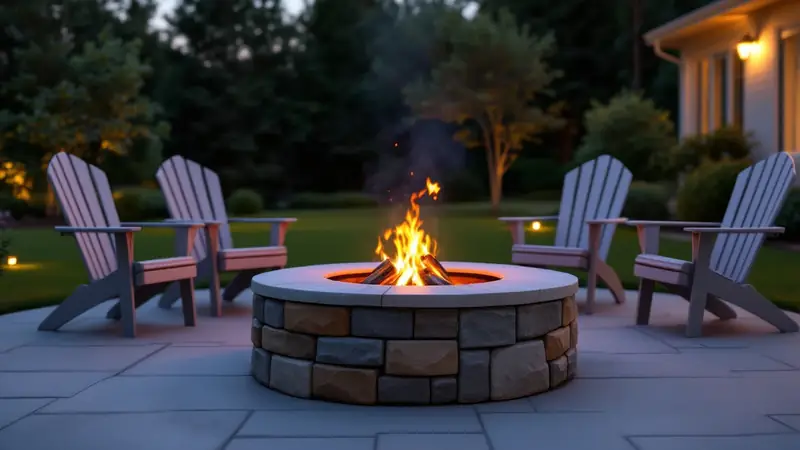
Short answer: A fire pit costs $150 to $600 if you buy a portable one, about $540 to $1,560 for a DIY block kit, and an estimated $1,370 to $3,330 for a kit built by a contractor. Custom stone runs about $3,400 to $6,810 for wood or $4,470 to $10,560 for gas, and a gas line adds $740 to $2,590.
$1,370–$10,560 built fire pit, contractor-installed block kit to custom gas masonry (estimate; see method)
$9.40–$16.70 per foot to run a buried gas line, plus $650–$920 for tie-in, risers and testing (estimate)
25 ft the International Fire Code setback for recreational fires from structures and combustibles (IFC 307.4.2)
56% of a $9,000 gas fire feature’s cost that Realtors estimate a seller recovers (NAR/NALP 2023)
A fire pit is four different purchases that share a name. A $250 steel bowl, a $900 pallet of interlocking block, a mortared stone ring built by a mason and a gas-fed fire feature with a flame-sensing burner differ in price by a factor of 40, and most cost pages blur them into one “average” that fits none of them.
This page prices each type separately. Purchase prices come from manufacturers’ and supply yards’ published price lists checked in October 2026 (supply yards in Georgia, Colorado and Massachusetts). Labor uses BLS wage data for masons, plumbers and landscaping crews (OEWS, May 2025), and overhead comes from how masonry and plumbing contractors’ revenue splits in the 2022 Economic Census. Gas-line rules come from the International Fuel Gas Code, setbacks from the International Fire Code as adopted by cities, and fuel prices from the U.S. Energy Information Administration. The arithmetic is in the method box near the end, and the calculator uses the same numbers. Other project prices are in our cost guides.
Fire pit cost by type: portable, kit, custom masonry and gas
The table below is the whole market in one view. “Installed” means a contractor builds it, including overhead and profit; portable pits have no installation. Gas prices exclude the gas line, which depends on distance and is priced in its own section.
| Fire pit type | What you get | Parts / purchase | Installed (estimate) |
|---|---|---|---|
| Portable propane fire bowl | 19 to 24 in. steel bowl, 58,000 Btu/hr burner, hose and regulator for a 20-lb tank | $150–$280 | No install |
| Portable wood or smokeless steel pit | 19 to 24 in. steel or stainless pit; larger sizes cost more | $250–$600 | No install |
| Block fire pit kit, DIY | Pallet kit of interlocking concrete units, gravel base, optional steel ring, delivery | $540–$1,560 | Your labor |
| Block fire pit kit, pro-installed | Same kit on a compacted base, leveled and glued by a crew | $540–$1,560 | $1,370–$3,330 |
| Custom masonry, wood-burning | Block core on a footing, natural stone veneer, cap, steel liner | $990–$2,260 | $3,400–$6,810 |
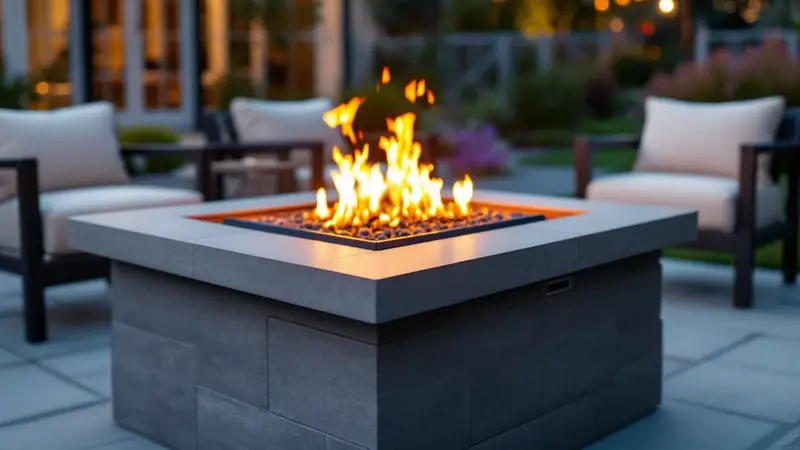
| Block kit with gas burner | Kit plus push-button or flame-sensing burner and fire glass; gas line extra | $1,310–$4,010 | $2,890–$7,740 |
| Custom masonry with gas burner | Stone-faced masonry plus burner and fire glass; gas line extra | $1,550–$4,370 | $4,470–$10,560 |
Uses the ranges in this guide. Pick one gas line length, or none for wood or portable pits. Excludes tax, seat walls and lighting. Local prices vary; see How we built these numbers.
Three things drive the spread. First, labor and overhead are most of a built pit: a contractor-installed kit costs two to two and a half times the parts it is built from, and a custom masonry pit three to three and a half times its materials. Second, gas adds three separate costs (the burner, the line and the permit), which is why a gas fire pit costs roughly $1,100 to $4,400 more than the same pit burning wood, before a foot of pipe is laid. Third, the seating area around the pit usually costs more than the pit; a 12×12 paver patio alone is an estimated $4,300 to $6,300 (see the packages section below).
Portable fire pits: what $150 to $3,100 buys
A portable pit is the cheapest way in and the only kind most renters can use. The prices below are the manufacturers’ own published list prices.
| Model (fuel) | Size | Published price |
|---|---|---|
| Outland Living Standard Fire Pit (propane, 58,000 Btu/hr) | 19 x 19 x 11 in. | $149.99 |
| Outland Living Mega Fire Pit (propane, 58,000 Btu/hr) | 24 x 24 x 13 in. | $214.99 |
| TIKI Social Smokeless Fire Pit (wood) | Small | $249.00 |
| TIKI Reunion Smokeless Fire Pit (wood) | Large | $595.00 |
| Breeo X Series (wood), X19 to X24, Corten | 19 to 24 in. | $399–$599 |
| Breeo X Series (wood), X30, Corten or stainless | 30 in. | $1,399–$1,599 |
| Breeo X Series (wood), X42, Corten or stainless | 42 in. | $2,899–$3,099 |
Outland lists its propane bowls as CSA approved and “safe to use during most fire bans” on its product page. That claim tracks the rules: the Puget Sound and Bay Area air agencies quoted below exempt gas and propane devices from their wood-burning bans. A propane bowl is the one fire pit you can usually light on a burn-ban night. The trade-off is heat: a 58,000 Btu/hr flame is closer to a large gas grill burner than a log fire.
Large steel pits change the math. Breeo’s 42-in. model lists at $2,899 to $3,099, which buys a pro-installed block kit with money left over. A big portable pit makes sense if you may move house or want to move it around the yard; it adds nothing to the property.
Fire pit kits: published prices from three supply yards
A fire pit kit is a pallet of precut concrete units that stack into a ring or square, usually two to four courses high, sometimes with a cap course and a steel liner. The interlocking units need no mortar, which is what makes them a weekend project. Here is what landscape supply yards in three regions publish:
| Kit | Yard (state) | Published price |
|---|---|---|
| Hamilton fire pit kit | Cummin Landscape Supply (GA) | $429 |
| Basalite Ring of Fire set with cap | Bedrock Landscaping Materials (CO) | $455 |
| Basalite Rosetta Belvedere fire pit | Bedrock Landscaping Materials (CO) | $575 |
| Techo-Bloc Valencia fire pit | South Shore Landscape Supply (MA) | $640 |
| Unilock Sunset round / square fire pit | South Shore Landscape Supply (MA) | $728 / $736 |
| Belgard Melville wedge fire pit kit | South Shore Landscape Supply (MA) | $801 |
| Unilock Romanstack round fire pit | South Shore Landscape Supply (MA) | $935 |
| Weston fire pit, 54 x 54 x 16 in. | Cummin Landscape Supply (GA) | $995 |
| Belgard Weston wall fire pit | South Shore Landscape Supply (MA) | $1,168 |
| Techo-Bloc Prescott / Brandon / Raffinato | South Shore Landscape Supply (MA) | $2,285–$2,312 |
| Techo-Bloc Sculptura (precast), 40 in. round to 24 x 52 in. | South Shore Landscape Supply (MA) | $2,817–$3,908 |
| Steel insert ring (optional) | Bedrock (30.5 in.) / South Shore (Unilock) | $215 / $555 |
| Grate (optional) | Bedrock Landscaping Materials (CO) | $170 |
Most mainstream kits fall between $429 and $1,168, so that is the range we use. Add a compacted gravel base (about 0.6 cu yd of crusher run for a 6-ft circle, $35 to $50 at Cummin’s $55 to $79 per cu yd), an optional steel ring and delivery. Bzak Landscaping in Ohio lists delivery at $75 to $125 depending on ZIP code. That puts a DIY kit at about $540 to $1,560 all in.
A contractor adds labor (5 to 8 crew-hours by our planning assumption: excavate, compact the base, level the first course, stack and glue, set the cap) and overhead. The result is an estimated $1,370 to $3,330 installed. The premium Techo-Bloc and precast kits above that range install the same way; with their higher purchase prices, they land around $5,150 to $7,790 installed.
Built-in stone fire pit cost: a line-item build
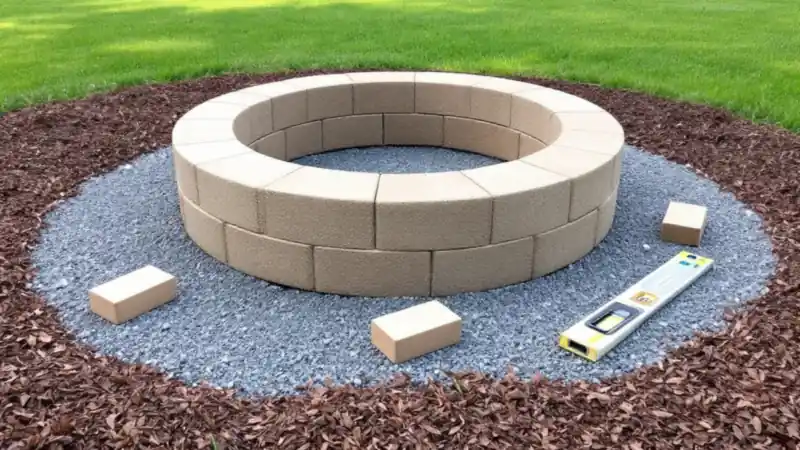
A custom masonry pit is what most people mean by a “built-in stone fire pit.” The version we priced is a ring of 8x8x16 concrete block on a poured footing, three courses tall with one below grade, faced with natural stone veneer, capped, and lined with a steel ring so the fire never sits against the block. It has a 36- to 42-in. interior.
| Line item | Quantity | Low | High | Price source |
|---|---|---|---|---|
| 8x8x16 concrete block | 36 blocks | $142 | $147 | Bedrock $3.95 each; Cummin $368 per 90-block pallet |
| Footing (portland cement, #57 stone, sand) | ~0.3 cu yd | $106 | $179 | Cummin cement $20 per 94-lb bag; #57 stone $68–$99 per cu yd |
| Mortar and masonry sand | 5–7 bags | $118 | $214 | Cummin Type S $17, Type N buff $20 per 75-lb bag; sand $65–$99 per cu yd |
| Natural stone veneer | 31 sq ft | $222 | $335 | Cummin $265 per ton, Bedrock $400 per ton; 35–37 sq ft per ton coverage |
| Cap | ~14 linear ft | $114 | $704 | concrete wall caps $9.50 each to natural stone caps $88 each |
| Steel liner ring | 1 | $215 | $555 | Bedrock / South Shore |
| Delivery | 1 load | $75 | $125 | Bzak Landscaping |
| Materials | $992 | $2,259 | ||
| Mason and helper | 16–28 crew-hours | $1,098 | $1,922 | BLS OEWS May 2025 + benefits |
| Overhead and profit | divide by 0.6141 | $1,314 | $2,627 | Census, masonry contractors |
| Installed estimate | $3,400 | $6,810 | Rounded |
The cap is the single most variable line. Concrete wall caps keep the material bill under $1,000, while thick natural stone caps add about $600 and are where a “custom” look comes from. Labor is the biggest line either way. A mason’s crew-hour costs about $68.65 with benefits at national median wages, before overhead, and a job that needs a return trip for the footing to cure pays for the drive twice.
If you already have retaining-wall or seat-wall plans, the same masons price those per face foot; our retaining wall cost guide breaks that work down.
Gas fire pit cost: burner, line and permit
A gas fire pit has three costs that a wood pit does not: the burner assembly, the gas line, and the permit and inspection for that line. The burner choice moves the price most.
| Burner tier | Example and published price | Notes |
|---|---|---|
| Match-lit pan and burner, DIY parts | 25 in. stainless pan with 18 in. burner, $160 + LP connection kit with key valve and regulator, $110 | No ignition or flame sensing; the seller recommends professional gas connections |
| Push-button spark burner | Outdoor GreatRoom Crystal Fire round burner, 20 in. $649, 30 in. $1,169 | Listed by the seller as UL listed; includes regulator, flex hose, ball valve and spark ignition |
| Flame-sensing safety pilot | HPC round drop-in kit, push-button, 13 in. $1,600 to 37 in. $3,000 | CSA certified; gas shuts off if the flame goes out |
| Flame-sensing with remote start | HPC round drop-in kit, remote start, 13 to 19 in. $3,700–$3,800 | Remote sold separately |
| Fire glass to cover the burner | 20-lb bulk bag $48 to $54 | A 25-in. pan is designed for about 50 lb |
Our gas estimates use a push-button burner with 50 lb of glass at the low end ($769) and a 31-in. flame-sensing HPC kit with glass at the high end ($2,662), plus 1.5 to 3 hours of a plumber and helper for the final connection and leak test. On the block kit, that comes to an estimated $2,890 to $7,740 installed; on custom masonry, $4,470 to $10,560. Both exclude the line from the house.
Spend on the safety controls before the size. A flame-sensing valve shuts the gas off if wind blows the flame out, which a match-lit key valve cannot do. Some inspectors also ask for a listed or certified burner assembly before they will sign off the line, so confirm that before you buy parts online.
How much does it cost to run a gas line to a fire pit?
Our estimate is about $650 to $920 for the fixed work, plus $9.40 to $16.70 per foot of buried line. The fixed work is the tie-in at the house, a shutoff, two anodeless risers (one at each end) and the pressure test. The per-foot rate covers trenching, pipe, tracer wire and backfill. Materials are a small share: 3/4-in. yellow polyethylene gas pipe lists at $102.95 per 150 ft and 14-gauge tracer wire at $24.95 per 100 ft, and a 3/4-in. anodeless riser at $57.50. Labor is a plumber and helper at national median wages of $30.67 and $20.36 an hour (BLS OEWS, May 2025).
| Distance from gas source | Estimated installed cost | Per foot, all in |
|---|---|---|
| 10 ft | $740–$1,090 | $74–$109 |
| 25 ft | $880–$1,340 | $35–$54 |
| 50 ft | $1,110–$1,760 | $22–$35 |
| 75 ft | $1,350–$2,170 | $18–$29 |
| 100 ft | $1,580–$2,590 | $16–$26 |
- Low
- High
Source: Green Industry Report estimates from PexUniverse pipe and riser prices (Oct. 14, 2026), BLS OEWS May 2025 plumber and helper wages and the 2022 Economic Census (NAICS 238220) Polyethylene line with tracer wire, two anodeless risers, tie-in and pressure test. Excludes permit fees and boring under paving.
Show the numbers
| Low | High | |
|---|---|---|
| 10 ft | 740 | 1,090 |
| 25 ft | 880 | 1,340 |
| 50 ft | 1,110 | 1,760 |
| 75 ft | 1,350 | 2,170 |
| 100 ft | 1,580 | 2,590 |
Short runs are expensive per foot because the tie-in and test cost the same at 10 ft as at 100 ft. If the pit can sit near an existing gas grill stub or the meter side of the house, that saves more than any choice of burner. Three things push a line above these ranges: boring under a driveway or walk, a long run that needs a larger pipe size to carry the burner’s load, and a meter or regulator that the utility says is too small for the added appliance.
Gas line cost by state
Labor is about 70 to 80 percent of the line, so the price follows plumber pay. Using each state’s median wages for plumbers and plumbers’ helpers, the same 50-ft line runs from about $970 to $1,510 in Arkansas to $1,380 to $2,210 in Oregon.
Swipe the table sideways to see every column.
| State | Plumber median | Helper median | 50-ft gas line (estimate) |
|---|---|---|---|
| Arkansas | $23.39 | $18.11 | $970–$1,510 |
| Florida | $25.44 | $18.06 | $1,000–$1,560 |
| Georgia | $27.50 | $18.14 | $1,030–$1,610 |
| Texas | $28.77 | $20.17 | $1,080–$1,700 |
| U.S. | $30.67 | $20.36 | $1,110–$1,760 |
| Colorado | $30.40 | $21.65 | $1,130–$1,780 |
| Ohio | $30.45 | $22.00 | $1,140–$1,790 |
| California | $35.01 | $22.66 | $1,220–$1,930 |
| New York | $37.26 | $25.00 | $1,290–$2,050 |
| Washington | $38.96 | $26.99 | $1,350–$2,150 |
| Massachusetts | $45.14 | $21.32 | $1,360–$2,160 |
| Illinois | $48.05 | $18.42 | $1,360–$2,160 |
| Oregon | $46.66 | $21.54 | $1,380–$2,210 |
Gas line rules, permits and fees
Underground gas piping falls under the fuel gas code. Per the International Code Council’s CodeNotes on underground gas piping (2021 IRC and IFGC), buried piping needs at least 12 inches of cover, with an exception allowing 8 inches for a line serving an individual outdoor appliance where the code official approves it. Plastic pipe cannot run above ground; it surfaces through anodeless risers, which is why every estimate above includes two. Call 811 before anyone digs.
The line needs a permit almost everywhere, and the fee is usually small next to the work. Three published 2026 schedules: McMinnville, Ore., charges $66 for residential gas piping covering up to 4 outlets; La Mirada, Calif., charges $47.55 to issue a plumbing permit plus $28.14 for a low-pressure gas piping system of 5 outlets or fewer; and San Francisco charges $290 for its single-residential-unit plumbing and gas-appliance categories. We use $65 to $290 as the permit adder in the calculator. Who may pull the permit varies by state; our state licensing table covers the landscape side.

What it costs to burn: propane vs. natural gas per hour
Gas pits are rated by heat input in Btu per hour. The EIA puts propane at 91,452 Btu per gallon and natural gas at 1,036 Btu per cubic foot. Priced at the EIA’s U.S. average residential propane price of $2.598 a gallon (week of Oct. 5, 2026, excluding taxes) and the 2025 U.S. average residential natural gas price of $15.34 per thousand cubic feet, the cost per hour at full flame works out like this:
| Burner rating | Propane used | Propane cost | Natural gas used | Natural gas cost |
|---|---|---|---|---|
| 58,000 Btu/hr (portable bowl) | 0.63 gal/hr | $1.65/hr | 56 cu ft/hr | $0.86/hr |
| 90,000 Btu/hr (built-in) | 0.98 gal/hr | $2.56/hr | 87 cu ft/hr | $1.33/hr |
| 150,000 Btu/hr (large built-in) | 1.64 gal/hr | $4.26/hr | 145 cu ft/hr | $2.22/hr |
Natural gas costs about half as much per hour as delivered propane and never runs out mid-evening, which is the usual argument for paying for the line. Propane needs no trench, so for a pit used a dozen nights a year the fuel savings take many years to repay the line. State prices vary widely: the same EIA tables show residential propane from $1.61 a gallon in North Dakota to $4.86 in Florida that week.
How long will a 20-lb propane tank last with a fire pit?
About 7.5 hours at a full 58,000 Btu/hr, and roughly twice that at half flame. The arithmetic: 20 lb of liquid propane at NIST’s 31.63 lb per cubic foot at 60 F is about 4.73 gallons, or roughly 432,600 Btu at the EIA heat content. A 90,000 Btu/hr built-in burner on high empties the same tank in under 5 hours, which is why built-ins on propane usually move to a larger tank.
How far a fire pit must be from the house, and when you cannot light it
Setbacks for wood fires come from the International Fire Code (IFC), Section 307, which most U.S. cities adopt, sometimes with amendments. As adopted in Bismarck, N.D. and Holland, Mich.:
- Recreational fires (an open fire no more than 3 ft across and 2 ft high): not within 25 ft of a structure or combustible material (IFC 307.4.2).
- Portable outdoor fireplaces (manufactured solid-fuel units of steel, concrete or clay): used per the manufacturer’s instructions and not within 15 ft of a structure or combustibles, with an exception for one- and two-family dwellings (IFC 307.4.3).
- Bonfires: 50 ft (IFC 307.4.1).
- Attendance: someone stays with the fire until it is out, with a 4-A extinguisher, a garden hose, sand or similar on hand (IFC 307.5).
Which line applies to a built-in pit depends on how your fire marshal classifies it, so ask. Shaker Heights, Ohio, for example, lists “commercial fire pits” as portable outdoor fireplaces, while an open ring of stones is a recreational fire held to 25 ft. Bismarck also bans portable outdoor fireplaces, even at houses, when its fire index is very high or extreme and during red flag warnings. Gas fire pits are not wood fires under these sections; their clearances come from the burner maker’s installation instructions.
Air-quality burn bans are the other limit, and they increasingly cover outdoor fire pits:
- San Francisco Bay Area: during a Spare the Air wood-burning ban, which can now be called any time of year, the Bay Area Air District prohibits outdoor wood-burning devices including fireplaces, fire pits and chimineas. The district’s FAQ lists a $100 fine for a first wood-smoke violation and $500 for a second. Gas-fueled devices are not subject to the bans.
- Puget Sound (King, Pierce, Snohomish counties, Wash.): a Stage 1 burn ban means no outdoor fires, including fire pits and chimineas, with a $1,000 penalty; natural gas and propane stoves and inserts remain allowed, per a Puget Sound Clean Air Agency burn ban notice.
If you live where these bans are frequent, a gas pit is the version you can use on the nights it is cold enough to want one. That is a real argument for gas that has nothing to do with convenience.
This page is general information, not legal or safety advice. Fire codes, burn-ban rules and gas permit requirements are local and change; confirm with your fire department, air district and building department before you build or burn.
Paver patio with a fire pit: what complete fire pit areas cost
The pit is often the smaller line. We combined the fire pit estimates above with the installed paver patio ranges from our paver patio cost guide ($29 to $45 per sq ft for standard concrete pavers) to price common packages:
| Package | Estimated total |
|---|---|
| DIY block kit on an existing patio or gravel pad | $540–$1,560 |
| Pro-installed block kit + 12×12 paver patio | $5,700–$9,600 |
| Custom stone wood-burning pit + 12×12 paver patio | $7,700–$13,100 |
| Block kit with gas burner + 25-ft gas line + permit + 12×12 patio | $8,100–$15,700 |
| Custom stone gas pit + 50-ft gas line + permit + 16×16 patio | $13,100–$23,500 |
One independent check: in the 2023 Remodeling Impact Report: Outdoor Features, members of the National Association of Landscape Professionals put a “fire feature” (a dry-stacked natural stone kit with a gas burner on a 10-ft-diameter flagstone patio) at $9,000. That sits inside our gas-kit package range above. If the patio is the bigger decision, our pavers vs. concrete comparison covers the surface choice.
“Fire pit cost per square foot” is a mismatch: pits are priced per unit and patios per square foot. Price the two separately, and size the patio for the chairs around the pit, not just the pit.
Are backyard fire pits worth it?
Financially, partly. The same NAR and NALP report estimates that sellers recover $5,000 of that $9,000 fire feature at sale, or 56 percent, the same as an in-ground pool and below a new patio (95 percent). Homeowners who had built one gave it a “joy score” of 9.7 out of 10, and 49 percent of landscape professionals reported more demand for fire features in the prior year.
So the case for a built-in pit is mostly use, not resale. A portable pit or DIY kit captures most of the use for a fraction of the money; the built-in versions pay off if you will use them for years and want the space to look finished.
Build it yourself or hire it out?
A block kit is a reasonable DIY job: dig a level base, compact gravel, stack the units with masonry adhesive. Doing it yourself saves roughly $830 to $1,770 against our installed range, almost all of it labor and overhead. Mortared stone takes masonry skill to look right and hold up through freeze-thaw cycles, and gas work is the line not to cross. The burner seller’s own instructions recommend a professional gas installer, and the line needs a permit and inspection regardless of who digs the trench.
Before hiring, check what the contractor is licensed for. Many states license hardscape work under a general or landscape contractor license, and the gas piping under a plumbing or gas-fitter license; our guide to checking a landscaper’s license shows how to look one up.
How much should a contractor charge for a fire pit?
Start from the same build-up this page uses: materials at your cost, crew-hours at your loaded labor rate, then overhead and profit. Masonry contractors’ materials, payroll and benefits together came to 61.4 percent of revenue in the 2022 Economic Census, so dividing direct costs by about 0.61 reproduces the average shop’s markup. For a kit at $1,168 with 8 crew-hours, that is roughly $3,300. Our guide to bidding landscaping jobs covers setting the labor rate and markup.
Red flags in a fire pit quote
- No base detail. A kit or masonry pit set on loose soil heaves and cracks. The quote should say how deep the gravel base or footing is.
- No liner on a wood-burning pit. Ordinary concrete block and veneer are not built for direct flame; look for a steel ring or firebrick lining.
- Gas work with no permit line item. If the quote includes a gas line but no permit or inspection, ask who pulls it.
- A match-lit burner sold as the “standard” option without mentioning flame-sensing alternatives.
- A location inside the setback. A wood pit 10 ft from a house or under tree limbs may fail a fire marshal’s check under the 25-ft rule above.
- A single lump sum. Ask for the pit, gas line, patio and seat walls as separate lines so you can compare quotes.
How we built these numbers
We do not have our own job data. Each installed estimate is materials plus labor, grossed up for overhead and profit, built from the published inputs below; ranges are estimates, not quotes. Our general approach is on the methodology page. All retail and supply-yard prices were checked Oct. 14, 2026 (the Bedrock list is dated March 10, 2026).
Labor rates. National median hourly wages, BLS OEWS May 2025: brickmasons and blockmasons $29.87, masonry helpers $22.86, landscaping supervisors $28.09, landscaping workers $18.82, plumbers $30.67, plumbers’ helpers $20.36. Benefits add 30.2 percent of payroll for masonry contractors (NAICS 238140) and 29.4 percent for plumbing contractors (NAICS 238220), from the 2022 Economic Census (EC2223BASIC). That gives $68.65 per mason crew-hour, $61.08 per landscape crew-hour and $66.03 per plumber crew-hour.
Overhead and profit. Materials plus labor divided by 0.6141 for pit work and 0.664 for gas lines: masonry contractors spent 27.7 percent of revenue on materials, 25.9 percent on payroll and 7.8 percent on benefits in 2022; plumbing contractors 31.5, 27.0 and 7.9 percent. Applying the ratio to retail prices slightly overstates the high end, since contractors buy below retail.
Crew-hours (planning assumptions, not measured rates). Block kit: 5 to 8 landscape crew-hours. Block kit with burner: 6 to 9, plus 1.5 to 3 plumber crew-hours for connection and leak test. Custom masonry: 16 to 28 mason crew-hours, including footing, three block courses, veneer, cap and a return trip. Gas line: 4 to 6 plumber crew-hours fixed, plus 0.08 to 0.15 crew-hours per foot for trenching to 12 in., laying pipe and tracer wire, and backfill.
Materials. Kits $429 to $1,168 plus 0.6 cu yd crusher run ($35 to $50), steel ring $0 to $215 and delivery $75 to $125. Custom masonry quantities and prices are in the line-item table; veneer coverage uses 37 sq ft per ton (low) and 35 (high). Burner packages: Crystal Fire 20-in. burner $649 plus 50 lb glass at $48 per 20 lb ($769); HPC 31-in. push-button flame-sensing kit $2,500 plus 60 lb glass at $54 per 20 lb ($2,662). Gas line: two 3/4-in. anodeless risers $115, fittings and valve allowance $50 to $100, pipe and tracer wire $0.94 to $1.20 per foot.
Size and calculator. The calculator multiplies the per-pit range by a size factor: 1.0 for a 36- to 42-in. interior, 1.15 for 48 in. (perimeter rises about 14 percent), 1.4 for 60 in. or a 5- to 6-ft linear pit. Leave it at 1.0 for portable pits and stock kits. Gas line adders use the 25-, 50- and 100-ft estimates; patio adders use our paver patio estimates.
Fuel. EIA heat contents (propane 91,452 Btu per gallon, natural gas 1,036 Btu per cubic foot); EIA residential propane price for the week of Oct. 5, 2026 ($2.598 U.S., excluding taxes) and 2025 annual residential natural gas price ($15.34 per Mcf); propane liquid density at 60 F from the NIST Chemistry WebBook (31.631 lb per cubic foot, 4.23 lb per gallon).
Excluded throughout: sales tax, seat walls, lighting, furniture, tree work, removal of an old pit, boring under paving, gas meter upgrades and design fees.
Fire pit cost questions, answered with numbers
What is the average cost of a fire pit?
It depends on the type more than any average can show. Portable pits cost $150 to $600 for mainstream models. A DIY block kit runs about $540 to $1,560 with base and delivery, and a contractor-built kit an estimated $1,370 to $3,330. Custom stone is about $3,400 to $6,810 for wood and $4,470 to $10,560 for gas, before the gas line.
Is it cheaper to buy or build a fire pit?
Buying a portable pit is cheapest: $150 to $600 for most propane bowls and steel wood pits. Building with a kit yourself costs about $540 to $1,560, and having it built costs more because labor and overhead are over half of a built pit. Building only beats buying when you compare it with large premium portable pits, which list up to about $3,100.
How much does it cost to install a gas fire pit?
An estimated $2,890 to $7,740 for a block kit with a gas burner, or $4,470 to $10,560 on custom stone masonry, plus the gas line: about $880 to $1,340 for a 25-ft run and $1,110 to $1,760 for 50 ft. Permit fees in three published 2026 schedules run from about $66 to $290.
How much does it cost to run a gas line to a fire pit?
About $650 to $920 for the tie-in, risers and pressure test, plus roughly $9.40 to $16.70 per foot of buried line, by our estimate. That is $740 to $1,090 for 10 ft and $1,580 to $2,590 for 100 ft at national median plumber wages. Labor is 70 to 80 percent of it, so high-wage states cost more.
Are gas fire pits worth the money?
They cost roughly $1,100 to $4,400 more than the same pit burning wood, plus the line. You get instant on and off, no smoke or ash, natural gas at about $0.86 to $2.22 an hour at full flame, and the ability to use it during wood-burning bans in places such as the Bay Area and Puget Sound. You give up the heat and crackle of a wood fire.
How long will a 20 lb propane tank last with a fire pit?
About 7.5 hours at 58,000 Btu per hour on full flame, and about twice that at half flame. A 20-lb tank holds roughly 4.73 gallons, or about 432,600 Btu. A 90,000 Btu/hr built-in burner on high uses it in under 5 hours.
How much value does a fire pit add to a house?
Realtors surveyed for the 2023 NAR and NALP Remodeling Impact Report estimated that a seller recovers $5,000 of a $9,000 gas fire feature, or 56 percent. Treat a fire pit as something you build to use, not to resell.
How far does a fire pit need to be from a house?
Under the International Fire Code as many cities adopt it, a recreational wood fire must be at least 25 ft from structures and combustible material, and a portable outdoor fireplace 15 ft, though that 15-ft rule often exempts one- and two-family homes. Gas fire pits follow the manufacturer’s installation clearances. Check your local fire department, since cities amend these rules.
Does having a fire pit increase your insurance?
We found no published insurer rate data on fire pits, so there is no reliable figure to give. Tell your insurer before you build a permanent wood-burning pit and ask whether it changes your premium or coverage, and check HOA rules, which can restrict wood-burning features. A permitted gas line and an inspected installation make that conversation easier.
Sources
- U.S. Bureau of Labor Statistics, Occupational Employment and Wage Statistics, May 2025: national and state estimates for SOC 47-2021, 47-3011, 47-2152, 47-3015, 37-1012 and 37-3011, May 2025 estimates, released May 15, 2026. Accessed October 2026.
- U.S. Census Bureau, 2022 Economic Census, Construction, EC2223BASIC (NAICS 238140 masonry contractors; 238220 plumbing, heating and air-conditioning contractors), 2022 data. Accessed October 2026.
- National Association of REALTORS and National Association of Landscape Professionals, 2023 Remodeling Impact Report: Outdoor Features (Fire Feature), March 2023. Accessed October 2026.
- Bedrock Landscaping Materials, Denver and Brighton, Colo., Price list (fire pit kits, inserts, cinder block, veneer, caps), Valid as of March 10, 2026. Accessed October 2026.
- Cummin Landscape Supply, Atlanta, Fire pit kits (published prices), Checked Oct. 14, 2026. Accessed October 2026.
- Cummin Landscape Supply, Atlanta, Mortar, portland cement and masonry sand (published prices), Checked Oct. 14, 2026. Accessed October 2026.
- Cummin Landscape Supply, Atlanta, Stone veneer (published prices), Checked Oct. 14, 2026. Accessed October 2026.
- Cummin Landscape Supply, Atlanta, Concrete block and wall caps (published prices), Checked Oct. 14, 2026. Accessed October 2026.
- Cummin Landscape Supply, Atlanta, Gravel and sand products (#57 stone, crusher run), Checked Oct. 14, 2026. Accessed October 2026.
- South Shore Landscape Supply, Rockland, Mass., Fire pit kits, inserts and gas inserts (published prices), Checked Oct. 14, 2026. Accessed October 2026.
- Bzak Landscaping, Ohio, Delivery charges by ZIP code, Checked Oct. 14, 2026. Accessed October 2026.
- Wicki Stone, Great Meadows, N.J., How to Calculate Natural Stone Weights and Coverage, May 2025. Accessed October 2026.
- Outland Living, Standard Fire Pit, model 823 (price and specifications), Checked Oct. 14, 2026. Accessed October 2026.
- Outland Living, Mega Fire Pit, model 883 (price and specifications), Checked Oct. 14, 2026. Accessed October 2026.
- TIKI Brand, Social Smokeless Fire Pit (published price), Checked Oct. 14, 2026. Accessed October 2026.
- TIKI Brand, Reunion Smokeless Fire Pit (published price), Checked Oct. 14, 2026. Accessed October 2026.
- Breeo, X Series Smokeless Fire Pit (published prices by size), Checked Oct. 14, 2026. Accessed October 2026.
- Celestial Fire Glass (authorized HPC Fire reseller), HPC Round Drop-In Fire Pit Burner Kit with Push Button Ignition, Checked Oct. 14, 2026. Accessed October 2026.
- Celestial Fire Glass (authorized HPC Fire reseller), HPC Fire Round Drop-In Fire Pit Burner Kit with Remote Start, Checked Oct. 14, 2026. Accessed October 2026.
- Celestial Fire Glass, 25 in. Stainless Steel Round Drop-In Fire Pit Pan with 18 in. Burner, Checked Oct. 14, 2026. Accessed October 2026.
- Celestial Fire Glass, LP Burner Connection Kit with 90k Btu Air Mixer, Key Valve and Regulator, Checked Oct. 14, 2026. Accessed October 2026.
- Celestial Fire Glass, Tempered fire glass, bulk 20 lb bags, Checked Oct. 14, 2026. Accessed October 2026.
- Starfire Direct, Outdoor GreatRoom Round Crystal Fire Gas Burner, Checked Oct. 14, 2026. Accessed October 2026.
- PexUniverse, Yellow PE gas pipe and burial tracer wire (published prices), Checked Oct. 14, 2026. Accessed October 2026.
- PexUniverse, Anodeless underground risers (published prices), Checked Oct. 14, 2026. Accessed October 2026.
- International Code Council, CodeNotes: Underground Gas Piping System Requirements in the I-Codes (2021 IRC and IFGC), 2024. Accessed October 2026.
- City of Bismarck, N.D., City ordinance and 2021 International Fire Code sections 307.4.2, 307.4.3 and 307.5, Checked Oct. 14, 2026. Accessed October 2026.
- City of Holland, Mich., International Fire Code Section 307, Open Burning and Recreational Fires, Checked Oct. 14, 2026. Accessed October 2026.
- City of Shaker Heights, Ohio, Open Burning and Outdoor Cooking checklist, Checked Oct. 14, 2026. Accessed October 2026.
- Bay Area Air Quality Management District, Frequently Asked Questions, Regulation 6, Rule 3: Wood-Burning Devices, Updated February 2020. Accessed October 2026.
- Puget Sound Clean Air Agency, Stage 1 burn ban notice, Snohomish County, Nov. 25, 2023. Accessed October 2026.
- City of McMinnville, Ore., Resolution 2026-25, Exhibit A: 2026 fee schedule, 2026. Accessed October 2026.
- Los Angeles County Public Works for the City of La Mirada, 2026-27 City of La Mirada Plumbing Code Fees, FY 2026-27. Accessed October 2026.
- San Francisco Department of Building Inspection, Table 1A-C: Plumbing/Mechanical Permit Issuance and Inspection Fees, 2026. Accessed October 2026.
- U.S. Energy Information Administration, Weekly Heating Oil and Propane Prices: residential propane, Week of Oct. 5, 2026, released Oct. 7, 2026. Accessed October 2026.
- U.S. Energy Information Administration, Natural Gas Prices: average residential price, annual, 2025, released Sept. 30, 2026. Accessed October 2026.
- U.S. Energy Information Administration, British thermal units (Btu): heat content of fuels, Checked Oct. 14, 2026. Accessed October 2026.
- National Institute of Standards and Technology, NIST Chemistry WebBook: Thermophysical Properties of Fluid Systems (propane, saturated liquid at 60 F), Checked Oct. 14, 2026. Accessed October 2026.
- Common Ground Alliance, 811: Know what’s below, Checked Oct. 14, 2026. Accessed October 2026.