Short answer: Grass pavers cost about $6.30 to $12.60 per square foot installed for a car-rated driveway, by our estimate: roughly $3,400 to $5,600 for a 10×50 driveway in plastic rolls and $5,100 to $6,300 in concrete turf block. The grid itself is $2.92 to $5.67 per sq ft; the gravel base under it is the biggest variable.
$6.30–$12.60 per sq ft installed, car-rated base with grass fill (estimate; see method)
6 in. to 12 in. of compacted base, from car driveway to fire lane (Invisible Structures installation guide)
0.2–0.4 runoff coefficient for grass-filled grids, vs 0.9–1.0 for asphalt or concrete (CMHA PAV-TEC-008)
+60.7% producer prices for sand, gravel and crushed stone, Aug 2019 to Aug 2026 (BLS PPI)
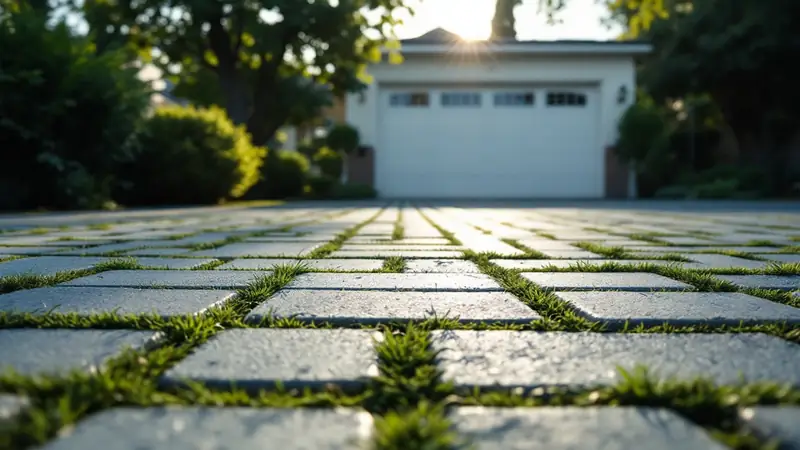
Grass pavers (also sold as turf block, grass grids, porous pavers or drivable grass) are open cells of plastic or concrete that carry a vehicle’s weight down into a gravel base while grass or gravel fills the openings. The product pages that dominate this search give a price per roll or per block and stop there. This page prices the whole system: the grid, the base the manufacturers’ own guides call for, the fill, the grass and the labor, using published October 2026 prices, and it covers the rules that decide whether a grass driveway counts as impervious or can serve as a fire lane.
What grass pavers cost per square foot, by type
Three product families cover nearly everything sold in the U.S. The grid prices below are list prices published by manufacturers and sellers, checked October 13, 2026, converted to dollars per square foot of coverage.
| Type | Example products and published price | Grid only, per sq ft | Installed, grass fill | Installed, gravel fill |
|---|---|---|---|---|
| Plastic interlocking tiles | GeoGrid cellular paving tile, $7.70 per 2.64 sq ft tile (Greatmats) | $2.92 | $6.30–$8.50 | $5.60–$7.40 |
| Plastic roll systems (ring or honeycomb cells) | NDS EZ Roll $2,101.13 per 4 x 150 ft roll (Longview Supply) to $544.04 per 96 sq ft roll (Landscape Discount); Grasspave2 $475.31 per 107 sq ft; Gravelpave2 $550.11 per 107 sq ft (Invisible Structures) | $3.49–$5.67 | $6.70–$11.20 | $6.10–$10.10 |
| Concrete grid (turf block) | TurfStone $12.68 per 2.6 sq ft unit (Mutual Materials, WA); Belgard Turfstone $639 per 133 sq ft pallet (Cummin, Atlanta) | $4.80–$4.88 | $10.20–$12.60 | $9.30–$11.10 |
The surprise in the grid column is how close the materials are. A concrete turf block costs about the same per square foot as a mid-priced plastic roll. The concrete system ends up $2 to $4 per sq ft more expensive installed because the industry guidance puts a deeper base under it, adds a bedding sand layer, and each 65 lb unit is laid by hand.
Plastic tiles are the cheapest route on paper, but the low figure comes from one retail product. Roll systems from the two oldest U.S. makers cost more and come with published installation guides, load testing and fire lane documentation, which matters if anyone (a fire marshal, a stormwater program, an HOA) will ask for cut sheets.
Uses the per-sq-ft ranges in this guide (car-rated base, grass fill) times fill and base factors. Excludes soil haul-off, edging, demolition, engineering and permits. Local stone prices vary most; see How we built these numbers.
The calculator multiplies your area by the installed range for the paver type (car-rated base, grass fill), then applies the fill and use factors. Gravel fill runs about 11 percent cheaper than sod in our model; a fire-lane base about 30 percent more for plastic systems. For a concrete grid fire lane the factor overstates slightly, because the concrete baseline already assumes an 8-inch base. For whole-yard budgets beyond the driveway, see our landscaping cost guide.
Grass paver cost by size: parking pads, driveways and fire lanes
These are the sizes people price most often. Parking spaces follow the common 9 x 18 ft zoning standard (Durham, N.H., zoning ordinance Article XXI is a typical example, and it caps a single-lane driveway at 10 ft wide). The fire lane row uses a 20 ft width and the 150 ft maximum length Newport Beach, Calif. allows for alternative-surface fire lanes without special approval.
| Project | Area | Plastic rolls, grass | Plastic rolls, gravel | Plastic tiles, gravel | Concrete grid, grass |
|---|---|---|---|---|---|
| One parking pad, 9×18 | 162 sq ft | $1,090–$1,810 | $980–$1,630 | $910–$1,200 | $1,650–$2,050 |
| Parking pad, 10×20 | 200 sq ft | $1,350–$2,240 | $1,210–$2,020 | $1,120–$1,480 | $2,040–$2,530 |
| Two-car pad, 18×18 | 324 sq ft | $2,180–$3,630 | $1,970–$3,270 | $1,820–$2,400 | $3,300–$4,090 |
| Square pad, 20×20 | 400 sq ft | $2,690–$4,480 | $2,430–$4,030 | $2,240–$2,960 | $4,080–$5,050 |
| Single-lane driveway, 10×50 | 500 sq ft | $3,370–$5,600 | $3,040–$5,040 | $2,810–$3,700 | $5,100–$6,320 |
| Long driveway, 10×100 | 1,000 sq ft | $6,730–$11,190 | $6,070–$10,080 | $5,610–$7,400 | $10,190–$12,640 |
| Fire lane, 20×150, 12 in. base | 3,000 sq ft | $25,950–$43,060 | $23,970–$39,720 | Not rated for this use by the seller | $34,850–$43,190 |
Two patterns hold across every size. Per square foot, a small pad costs about the same as a long driveway in our model, because nearly every task scales with area; real quotes for small pads run higher because contractors carry a minimum day, trailering and setup on every job. And the base depth, not the paver, is what makes a fire lane expensive: going from 6 to 12 inches of stone adds about $1.90 to $3.20 per sq ft under plastic rolls.
| Use (base depth) | Plastic rolls, grass | Plastic tiles, grass | Concrete grid, grass |
|---|---|---|---|
| Foot traffic, patios, paths (4 in.) | $6.10–$10.10 | $5.70–$7.50 | $8.80–$10.90 |
| Cars and pickups (6 in. plastic, 8 in. concrete) | $6.70–$11.20 | $6.30–$8.50 | $10.20–$12.60 |
| Delivery and utility trucks (8 in.) | $7.40–$12.30 | $6.90–$9.60 | $10.20–$12.60 |
| Fire trucks (12 in.) | $8.70–$14.40 | Not rated by seller | $11.60–$14.40 |
What goes under grass pavers: base depth by load
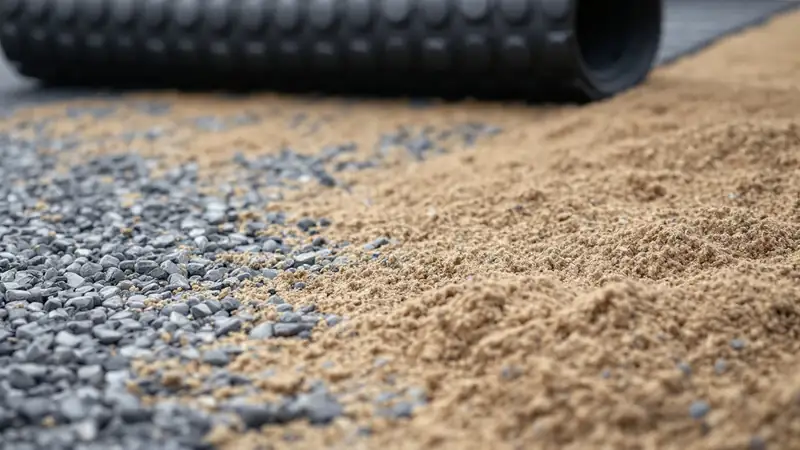
Every manufacturer says the same thing in different words: the grid spreads the load, the base carries it. The grid only keeps tires from compacting the root zone. If the base is too thin or the wrong stone, ruts appear no matter which paver is on top.
| Source | Foot traffic / light | Cars and pickups | Trucks / heavy | Fire lanes |
|---|---|---|---|---|
| Invisible Structures, Grasspave2 guide | 1 in. pedestrian, 2 in. golf cart | 6 in. | 8 in. | 12 in. (also H-20 loading) |
| Invisible Structures, base depth chart | 2–4 in. (trails, carts) | 6–8 in. normal traffic on weak soil; 2–4 in. infrequent passes on firm soil | 8–10 in. (40,000 lb utility truck) | 12–14 in. (80,000 lb fire truck) |
| NDS, EZ Roll guide | 4 in. minimum | 6 in. minimum | 8 in. minimum | 8 in. minimum plus fire authority requirements |
| CMHA (ICPI), concrete grids | Not specified | 8 in. minimum for driveways and parking | Thicker where loads are extreme | 8 in. minimum |
The stone is as important as the depth, and the two families disagree. Plastic ring and cell systems want a porous base. Invisible Structures’ base course recommendation specifies a sandy road-base gravel or, as an alternate, AASHTO #57 stone mixed 70/30 with ASTM C33 sand, and tells installers to avoid recycled asphalt, decomposed granite and straight limestone, which lose porosity. Its installation guide calls for compaction to 95 percent Proctor in lifts of no more than 6 inches, and for leaving 1.5 inches below finished grade for the grid, sand fill and grass.
Concrete grids want the opposite. CMHA Tech Note PAV-TEC-008 (the Interlocking Concrete Pavement Institute’s bulletin on concrete grid pavements) calls for a dense-graded crushed stone base, the same material used under asphalt, compacted to at least 98 percent standard Proctor, then 1/2 to 1 inch of washed concrete sand, then the grids. It says open-graded bedding and base can let grids tilt and crack under traffic. The base should also extend 12 inches past the grids where no curb or building restrains them.
Can you lay grass pavers directly on dirt?
For foot traffic on firm soil, sometimes: Invisible Structures’ chart lists no base at all for trails and cart paths that see only infrequent passes. For anything with wheels, no. NDS says percolation of the soil below should be at least 0.25 inches per hour and the water table at least 3 feet below the base. Grids laid straight on topsoil sink, and the soil inside them compacts into mud, which is the most common failure homeowners describe.
Building the price: each layer, per square foot
This is what a car-rated driveway costs layer by layer at published prices. The low column uses the Ohio supplier’s prices and the cheapest grid in each family; the high column uses Atlanta prices and the costliest grid.
| Line item | Plastic rolls, grass, 6 in. base | Concrete grid, grass, 8 in. base | Published inputs |
|---|---|---|---|
| Grid, with 5–10% overage | $3.66–$5.95 | $5.04–$5.37 | Prices in the first table |
| Base stone | $1.34–$2.29 | $2.08–$2.36 | #57 stone $38.50/ton and coarse sand $34/ton (Bzak, OH); #57 $79/yd, river sand $70/yd, crusher run $59/yd (Cummin, GA); #304 limestone $38.50/ton |
| Bedding sand (concrete only) | None | $0.13–$0.22 | 1 in. of sand, same suppliers |
| Fill in the cells | $0.13–$0.22 (sand) | $0.16–$0.30 (soil) | Lawn soil mix $35.99/yd (Houston); river sand $70/yd (Atlanta) |
| Grass (thin-cut sod or plugs) | $0.35–$0.67 | $0.35–$0.67 | Trade sod 30 to 55 cents per sq ft plus 5 to 12 cents delivery (USDA AMS National Quarterly Sod Report, Apr–Jun 2026) |
| Labor, equipment, overhead and profit | $1.26–$2.07 | $2.44–$3.72 | 20.8–34.2 and 40.4–61.6 person-hours per 1,000 sq ft at $60.39 per hour |
| Total | $6.73–$11.19 | $10.19–$12.64 | Rounded in the tables above |
On a 500 sq ft plastic-roll driveway at the midpoint, the grid is about $2,400 of a $4,500 job and labor about $830. That is the reverse of a paver patio, where hand labor is most of the bill (our paver patio cost breakdown shows the comparison). It also means shopping the grid price moves the total more than shopping the installer, as long as the installer builds the base the manufacturer specifies.
Regional differences: stone prices and labor
Base stone is local and heavy, so its price swings more by region than any other input. Three suppliers’ published prices for the same 6-inch porous base:
| Supplier and region | Base mix price (70% #57 stone, 30% sand) | 6 in. base, per sq ft | Angular fill gravel |
|---|---|---|---|
| Bzak Landscaping, southwest Ohio | $44.58 per cu yd (stone and sand at $38.50 and $34 per ton) | $1.34 | #8 limestone, $38.50/ton |
| Cummin Landscape Supply, Atlanta | $76.30 per cu yd | $2.29 | #89 granite, $98/cu yd |
| Texas Garden Materials, Houston | $143.49 per cu yd (3/4 in. washed limestone $174.99/yd, torpedo sand $69.99/yd) | $4.30 | 3/8 in. black star gravel $219.99/yd |
On a 500 sq ft driveway, that is the difference between about $670 and $2,150 of base stone. If a Houston-area quote looks $1,500 higher than a Midwest price guide, the stone may explain all of it.
Labor varies less, but it adds up. Using the same crew hours with each state’s May 2025 median wages for landscaping workers and supervisors:
| State | Landscaping worker median wage | Supervisor median wage | Loaded crew rate per hour | Labor for a 500 sq ft plastic-roll driveway |
|---|---|---|---|---|
| Washington | $22.57 | $34.58 | $73.06 | $760–$1,250 |
| Massachusetts | $23.40 | $30.65 | $72.04 | $750–$1,230 |
| New York | $21.56 | $34.02 | $70.50 | $730–$1,210 |
| Minnesota | $22.41 | $29.94 | $69.41 | $720–$1,190 |
| California | $21.90 | $30.42 | $68.66 | $710–$1,170 |
| U.S. median | $18.82 | $28.09 | $60.39 | $630–$1,030 |
| Ohio | $18.38 | $26.77 | $58.51 | $610–$1,000 |
| Georgia | $18.25 | $26.36 | $57.94 | $600–$990 |
| Florida | $17.84 | $24.66 | $55.84 | $580–$950 |
| Texas | $17.66 | $22.90 | $54.20 | $560–$930 |
| Mississippi | $15.21 | $22.66 | $48.78 | $510–$830 |
Load ratings: what the spec sheets actually say
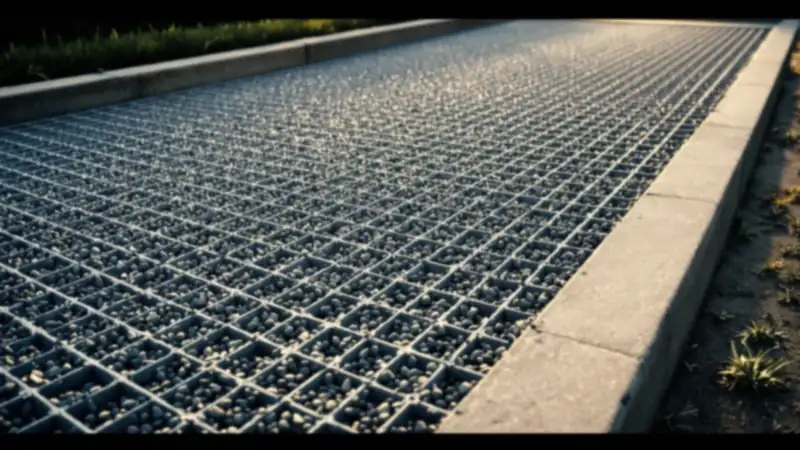
Load claims are where grass paver marketing gets slippery, because each maker tests differently. A compressive strength in psi measured on a filled cell is not comparable with a psf figure on an empty one, and neither tells you whether a driveway will rut. The rating that matters is the one stated for a full system on a stated base.
| Product | Manufacturer’s stated strength | Vehicle rating as published | Notes |
|---|---|---|---|
| Grasspave2 | 15,940 psi (2,295,000 psf) | Handles or exceeds HS-25 and H-20 loading (FAQ) | 100% recycled HDPE; 92% void space; lifetime warranty contingent on proper installation; maker will issue a strength letter for fire lanes |
| Gravelpave2 | 15,940 psi when filled with sand | Same family; gravel-filled with bonded filter fabric | Fill must be sharp, angular 3/16 to 3/8 in. stone, not rounded pea gravel; pinned with 8 in. nails and washers |
| NDS EZ Roll | 53,683 psf unfilled | Rated for H-20 and H-25 loads with the correct base | 1 in. honeycomb cells; maker cites a 25-year life expectancy when well maintained |
| GeoGrid tile (Greatmats) | 350 tons per square meter | Seller lists driveways and parking lots | 4 cm HDPE tile; no fire-lane rating published |
| TurfStone / concrete grids | ASTM C1319 requires 5,000 psi average (CMHA) | Mutual Materials markets it for pedestrian or low-vehicular-use areas | CMHA limits grid pavements to about 7,500 lifetime 18,000 lb axle loads; 3.5 in. thick, 40% open, 65 lb each |
Read the ratings this way. Every plastic system makes its truck rating conditional on a base built to its chart, so the paver alone is never the limit. Concrete grids are strong in compression but are rigid slabs that, CMHA notes, may crack during compaction or under settling; one or two cracks per unit usually don’t matter, and units can be lifted and reset. For daily traffic beyond those limits, CMHA steers designers to permeable interlocking concrete pavers instead.
Grass or gravel in the cells
The fill decision is mostly about how often the space is parked on, and how much sun it gets.
| Question | Grass fill | Gravel fill |
|---|---|---|
| Installed cost (plastic rolls, 6 in. base) | $6.70–$11.20 per sq ft | $6.10–$10.10 per sq ft |
| Daily parking in one spot | Not recommended: CMHA says use aggregate if cars cover the grids all day for consecutive days; NDS says rotate spots or park less than daily | Suitable |
| Sun needed | At least 5 hours a day for most grasses (CMHA) | None |
| Wait before use | 3 to 4 weeks for sod, up to 8 weeks for seed (Invisible Structures) | Usable once pinned and filled |
| Watering | Three times a day for the first 6 to 8 weeks, then regularly; deeper bases drain faster and may need more water | None |
| Ongoing work | Mow and fertilize; never core-aerate plastic grids | Rake or top up displaced stone |
| Runoff coefficient (CMHA, concrete grids) | 0.2–0.4 | 0.2–0.25 with No. 8 stone |
| Looks | Reads as lawn when established | Reads as a stabilized gravel drive |
Grass also has a specific soil rule that installers get wrong. Invisible Structures fills its rings with clean sand, not topsoil, and asks for thin-cut sod grown in sand or sandy loam; its troubleshooting list blames soil instead of sand, clay fertilizers and geotextile under the rings for most drainage failures. Concrete grids, by contrast, are filled with topsoil and seeded or plugged. If your yard grows grass poorly from shade or traffic now, it will grow it worse inside a grid; our sod vs seed guide covers establishment choices, and sod installation cost prices sod by region.
Stormwater credits and impervious-surface rules
This is often the real reason to choose grass pavers. Many towns cap the share of a lot that can be impervious, and many utilities bill a stormwater fee by impervious area. The EPA’s Soak Up the Rain program lists plastic grid pavers alongside pervious asphalt, pervious concrete and interlocking pavers as permeable pavements that let rain and snowmelt soak into the soil and gravel below. How your town counts them is set locally, and the rules differ more than most homeowners expect.
| Jurisdiction | How permeable paving is treated | What it takes |
|---|---|---|
| Lake Stevens, Wash. | Permeable hard surfaces count as 50% impervious toward the lot cap; compacted gravel counts as fully impervious | Built to the Western Washington stormwater manual; feasibility check first |
| New York City (DOB Bulletin 2016-016) | Impervious increase = area x (runoff coefficient of proposed paving minus existing surface) | Calculation submitted with the application; permeable paving in residential parking areas only where the Buildings Commissioner accepts it |
| Minneapolis | Residential stormwater fee credit for pervious pavement: up to 35%, or 45% in a Green Zone | Must treat runoff from impervious areas on your own lot; apply May 1 to Oct 1 |
| Washington, D.C. (RiverSmart Rewards) | Up to 55% off the DOEE stormwater fee for retaining a 1.2 in. storm | Discount scales with the volume retained; permeable pavement is an eligible practice |
| Takoma Park, Md. | Up to 50% fee reduction for the pavement area | Stone reservoir layer plus geotextile; credit reduced if the reservoir is under 12 in. |
| Alexandria, Va. | Partial stormwater utility fee credit | Permeable surface, washed-stone reservoir and an underdrain; annual self-certified inspection |
Three practical points come out of those documents. First, a credit usually requires a stone reservoir under the surface, which is the same deep base a driveway needs anyway; a grid laid over 2 inches of gravel may not qualify. Second, some programs describe permeable pavement as pavers with gravel in the joints, so ask before assuming a grass-filled grid is eligible. Third, the gravel driveway you might build instead can count as fully impervious, as it does in Lake Stevens, which is the strongest argument for paying the grid premium where lot coverage is tight.
The numbers behind those rules come from runoff coefficients. CMHA gives 0.2 to 0.4 for grids with established grass, similar to natural grassed areas, against 0.9 to 1.0 for conventional pavement. NDS publishes a runoff table based on USDA’s TR-55 method and says EZ Roll over a rock and sand base with sandy loam is unlikely to generate surface runoff in storms under 6 inches in 24 hours. Delaware’s state resilience program, DNREC I-ADAPT, put grass paver systems at $9.50 to $11.50 per sq ft installed in 2022 dollars, inside our range, and notes they should not be used in areas with hazardous material handling or high sediment loads.
This page is general information, not legal, engineering or fire-safety advice. Stormwater credits, impervious-surface limits and fire access standards are set locally and change; confirm with your planning department, stormwater utility and fire marshal before you build.
Grass pavers as fire lanes
Model fire codes require fire apparatus access roads to be an all-weather surface able to carry a fire truck. The City of Maricopa, Ariz. handout puts it in the code’s words: asphalt, concrete or another approved all-weather surface “capable of supporting the imposed load of fire apparatus weighing at least 75,000 pounds.” Grass pavers can meet that, but only with the fire department’s sign-off, and local conditions vary in ways that change the cost.
| Fire authority | Key conditions for grass or grid surfaces |
|---|---|
| Maricopa, Ariz. | Submit cut sheets and design criteria for a 75,000 lb apparatus; contractor field-tests in front of the fire code official, possibly with a weight-verified vehicle after soaking the soil three days in a row; engineer of record certifies the installation |
| San Diego (FPB Policy A-14-9) | Written case-by-case approval only; maximum 5% grade for combination grass surfaces; minimum 8 in. concrete border on both sides; grass kept at 2 in. or shorter; settlement repaired immediately; the Fire Marshal can require replacement with standard paving |
| Newport Beach, Calif. (Guideline C.01) | Stamped engineer’s certification; 72,000 lb design load plus 75 psi outrigger loads; 150 ft maximum length unless approved; slope 1.75% or less; 4 in. concrete strip on both sides; maintenance clause recorded in CC&Rs or deed; final field test with fire apparatus |
Manufacturers add their own conditions. Invisible Structures’ installation guide says every fire lane needs fire department approval before the base goes in, that all roll connectors must be joined, and that fire lanes should not exceed a 5 percent slope. NDS tells buyers to check with the local fire authority for inspection requirements. Budget for the delineation (curbs or concrete bands) and the engineering letter on top of the per-square-foot figures in our tables; on a 150 ft lane, two 8-inch concrete borders are 300 linear feet of extra work.
Maintenance and lifespan
- Before first use: keep all traffic off sodded grids for 3 to 4 weeks (about two mowings), and seeded grids up to 8 weeks (Invisible Structures); CMHA gives the same 3 to 4 weeks for concrete grids.
- Mowing and feeding: mow and fertilize like a lawn. Do not core-aerate plastic grids; the tines damage the cells.
- Parking habits: rotate where cars sit. Daily parking in one spot shades and heats the grass until it dies, which both NDS and CMHA warn about.
- Snow: plowing is fine with the blade raised about an inch or fitted with skids. Never use de-icing salt on grass grids (CMHA), and don’t pile plowed snow on them for long.
- Spills: small oil drips break down in the turf; large oil or antifreeze spills mean replacing the turf, sand and base in that spot as hazardous waste.
- Sediment: keep soil and mulch from washing onto the surface. CMHA cites research showing clogged grid openings lose infiltration and recover when the soil is cleaned out.
- Lifespan claims: Invisible Structures states 60-plus years for Grasspave2; NDS states 25 years for EZ Roll when well maintained. These are manufacturer claims, not independent tests.
Hiring, DIY, and red flags in a grass paver quote
A homeowner can install a small foot-traffic area with a rented plate compactor. A driveway is a different job: 1,000 sq ft of 6-inch-base driveway means digging out about 23 cubic yards of soil (7.5 inches deep including the grid and sod layer), bringing in about 30 cubic yards of stone as delivered (by the supplier coverage rule in our method note), and compacting it in lifts. A concrete grid with an 8-inch base runs about 39 cubic yards of excavation per 1,000 sq ft. That volume is why haul-off is often the line item that surprises people.
When comparing bids, check for these:
- No base depth or stone type written down. The quote should state compacted depth and material, and it should match the manufacturer’s chart for your use. Limestone screenings or decomposed granite under a plastic grass grid is a warning sign.
- Topsoil in plastic rings. The two roll-system makers specify sand or sandy loam; topsoil compacts and turns to mud.
- Fabric under grass rings. Invisible Structures lists geotextile beneath the rings as a cause of poor drainage. Fabric at the subgrade over weak soil is a different, sometimes necessary, item.
- No edge plan. Concrete grids need edge restraint per CMHA; fire lanes need the delineation your fire department specifies.
- No establishment period in the schedule. If the contractor promises you can park the day after sodding, they are not following any maker’s guide.
- Haul-off and delivery left vague. Ask for excavated volume and disposal as separate lines.
Some states license landscape or hardscape contractors and others don’t; see license requirements by state and how to check a landscaper license before you sign. For a related build with the same base logic, see our retaining wall cost guide, and browse more project prices on the Costs hub.
Prices are rising faster for stone than for the grids
Producer prices for construction sand, gravel and crushed stone rose 60.7 percent from August 2019 to August 2026, compared with 54.9 percent for plastic construction products and 47.3 percent for concrete pavers (BLS Producer Price Index, series WPU1321 and WPU133141; WPU0721; August 2026 preliminary). Plastic prices jumped in 2021 and 2022 and have been roughly flat since; stone has climbed every year. Since the base is the regional swing item in a grass paver job, that trend matters more than the grid price.
- Sand, gravel and crushed stone (WPU1321)
- Plastic construction products (WPU0721)
- Concrete pavers (WPU133141)
Source: BLS Producer Price Index, August values; Aug 2026 preliminary Rebased by The Green Industry Report.
Show the numbers
| Sand, gravel and crushed stone (WPU1321) | Plastic construction products (WPU0721) | Concrete pavers (WPU133141) | |
|---|---|---|---|
| 2019 | 100 | 100 | 100 |
| 2020 | 104.80 | 101.30 | 101.50 |
| 2021 | 109.10 | 131.70 | 107.10 |
| 2022 | 121.90 | 157.90 | 123.60 |
| 2023 | 132.10 | 149.70 | 133 |
| 2024 | 142.30 | 149.90 | 139.60 |
| 2025 | 151.30 | 147.80 | 144.20 |
| 2026 | 160.70 | 154.90 | 147.30 |
How we built these numbers
We have no job data of our own. Every installed figure is an estimate assembled from published prices (checked October 13, 2026), manufacturers’ installation guides and BLS wage data. Ranges are low-input to high-input, not quotes.
Grids: tiles $2.92 per sq ft (GeoGrid, $7.70 per 2.64 sq ft tile); rolls $3.49 (NDS EZ Roll, $2,101.13 per 602 sq ft roll, roll coverage from NDS) to $5.67 ($544.04 per 96 sq ft roll), with Grasspave2 ($4.44) and Gravelpave2 ($5.14) inside that span; concrete grids $4.80 (Belgard, $639 per 133 sq ft pallet) to $4.88 (TurfStone, $12.68 per 2.6 sq ft unit). Overage 5 percent, the figure NDS recommends, and 10 percent for concrete at the high end for cuts.
Base: plastic systems use Invisible Structures’ alternate mix of 70 percent #57 stone and 30 percent sand: $44.58 per cubic yard in Ohio (Bzak: $38.50 and $34 per ton at 1.2 tons per yard, the weight Cummin publishes for #57 and sand) to $76.30 in Atlanta (Cummin: #57 $79, river sand $70). Concrete grids use dense-graded stone: $51.98 per yard (Bzak #304 limestone at 1.35 tons per yard, Cummin’s published crusher-run weight) to $59 (Cummin crusher run), plus 1 inch of bedding sand ($0.13 to $0.22 per sq ft). Coverage follows Cummin’s statement that a cubic yard of crusher run covers about 100 sq ft at 2 inches, i.e., 200 sq ft per compacted inch; applying that rule to the #57 mix is our assumption. Depths: 4, 6, 8 and 12 inches per the manufacturer charts cited above; the car-rated concrete case uses CMHA’s 8-inch minimum.
Fill and grass: 1 inch of sand in plastic rings ($34 per ton to $70 per yard, 324 sq ft per yard); 1.57 inches for the 4 cm tile; for 3.5-inch, 40-percent-open concrete grids, the equivalent of 1.4 inches of soil ($35.99 to $70 per yard). Gravel fill uses #8 limestone ($38.50 per ton) to #89 granite ($98 per yard) at the same depths. Sod is 35 to 67 cents per sq ft: USDA AMS trade prices of roughly 30 to 55 cents (weighted averages by grass type, April to June 2026) plus its reported 5 to 12 cents per sq ft delivery.
Labor: a crew of three landscaping workers at the BLS OEWS May 2025 median ($18.82) and one supervisor ($28.09), divided by 0.70 because wages are 70.0 percent of private-industry compensation (BLS ECEC, June 2026), then doubled for equipment, vehicles, insurance, overhead and profit: $60.39 per person-hour, the same rate we use on our sod page. Hours per 1,000 sq ft are planning assumptions, not measurements: 0.8 to 1.2 per inch of excavation depth, 0.8 to 1.2 per inch of base placed and compacted, 2 to 4 to roll out plastic (3 to 5 for tiles), 11 to 16 to screed bedding sand and hand-set about 385 concrete units, 2 to 5 to fill cells, and 6 to 10 to lay sod (10 to 16 for plugs or sod in concrete grid openings). Excavation depth is base plus 1.5 inches for rolls, 2.1 for tiles and 4.5 for concrete grids.
Calculator factors: gravel fill 0.89 and base factors of 0.9 (4 in.), 1.1 (8 in.) and 1.3 (12 in.) are the averages of our model’s ratios for plastic systems; they are approximations for concrete grids. The stone delivery adder is two loads at Bzak’s published $75 to $125 per delivery by ZIP code.
Not included: material markup by the contractor, soil haul-off and dump fees, demolition of an existing driveway (Delaware DNREC estimates $1 to $5 per sq ft), edging or concrete bands, Gravelpave2 anchor pins, geotextile over weak soils, irrigation, engineering, permits and sales tax. Minimum job charges make small pads cost more per square foot than we show. Our cross-check, Delaware’s 2022 estimate of $9.50 to $11.50 per sq ft, falls inside our range.
Grass paver questions, answered
How much does a grass paver cost?
Per piece, a concrete TurfStone unit is $12.68 for 2.6 sq ft at Mutual Materials, and a pallet of Belgard Turfstone is $639 for 133 sq ft in Atlanta. Plastic grids run $2.92 to $5.67 per sq ft, from $7.70 tiles to $475 to $544 rolls. Installed for a car driveway, expect roughly $6.30 to $12.60 per sq ft by our estimate.
What are grass pavers called?
They go by turf block, turf pavers, grass grids, grass rings, geocells, porous or permeable pavers, and drivable grass. ASTM calls the concrete version concrete grid paving units (ASTM C1319). Specifiers file the plastic roll systems under CSI sections 32 12 43, Porous Flexible Paving, and 32 14 43, Porous Unit Paving.
Is a grass driveway a good idea?
It works well for overflow parking, a second driveway, RV pads and fire lanes that see occasional traffic. It works poorly where one car parks in the same spot every day or the area gets under 5 hours of sun; CMHA recommends gravel fill in that case. You also take on mowing and watering, and no salt in winter.
What is the cheapest permeable driveway?
In our estimates, plastic grid tiles filled with angular gravel are cheapest at about $5.60 to $7.40 per sq ft installed on a 6-inch base. A plain gravel driveway costs less, but some jurisdictions, such as Lake Stevens, Washington, count compacted gravel as fully impervious, while a permeable grid may count as 50 percent.
What are the downsides of permeable pavers?
Grass versions need sun, water and a 3 to 8 week wait before use; they can’t take daily parking in one spot, core aeration or de-icing salt; sediment washed onto them clogs the cells; and fire lane use needs engineering and fire department approval. The deep porous base also costs more than many expect.
Salt poured into the cells to kill weeds hurts the same grass: about 1/4 tablespoon per sq ft injured bermudagrass over 20 percent in a University of Georgia trial, per our salt dose and soil math.
How much does 1,000 sq ft of grass pavers cost?
About $6,730 to $11,190 installed in plastic rolls with grass, $5,610 to $7,400 in plastic tiles with gravel, or $10,190 to $12,640 in concrete grids with grass, by our estimate for a car-rated base. Excavation is about 23 cubic yards for the plastic version, so ask how haul-off is priced.
How much would a 20×20 grass paver pad cost?
A 20×20 (400 sq ft) pad runs about $2,690 to $4,480 in plastic rolls with grass and $4,080 to $5,050 in concrete grids, by our estimate, before stone delivery and soil haul-off. A 200 sq ft pad is about $1,350 to $2,240 in plastic rolls.
Sources
- Mutual Materials, TurfStone Gray Permeable Paver (price, weight, pallet count), Price checked Oct 13, 2026. Accessed October 2026.
- Mutual Materials, TurfStone Pavers (dimensions, coverage, ASTM C1319), Checked Oct 13, 2026. Accessed October 2026.
- Cummin Landscape Supply (Atlanta, GA), Blocks and pavers price list (Belgard Turfstone pallet), Price checked Oct 13, 2026. Accessed October 2026.
- Cummin Landscape Supply (Atlanta, GA), Gravel and sand products (#57, #89, crusher run, river sand), Prices checked Oct 13, 2026. Accessed October 2026.
- Invisible Structures, Grasspave2 product page, Checked Oct 13, 2026. Accessed October 2026.
- Invisible Structures, Grasspave2 Porous Paving 1010 Roll (online price), Price checked Oct 13, 2026. Accessed October 2026.
- Invisible Structures, Gravelpave2 Porous Paving 1010 Roll (online price), Price checked Oct 13, 2026. Accessed October 2026.
- Invisible Structures, Grasspave2 FAQ (load rating, base, roll sizes, slopes), Checked Oct 13, 2026. Accessed October 2026.
- Invisible Structures, Base Course Depth Recommendations, 2026. Accessed October 2026.
- Invisible Structures, Grasspave2 Installation and Maintenance Guide, Version 1h, checked Oct 13, 2026. Accessed October 2026.
- Invisible Structures, Base Course Material Recommendation, 2024. Accessed October 2026.
- Invisible Structures, Gravelpave2 Technical Specification, 2024. Accessed October 2026.
- NDS (ADS), EZ Roll Grass Pavers product page and load ratings, Checked Oct 13, 2026. Accessed October 2026.
- NDS, EZ Roll Grass Pavers Technical Specifications Guide (hosted by distributor Longview Supply), Checked Oct 13, 2026. Accessed October 2026.
- Landscape Discount, NDS EZ Roll Grass Pavers EZ4X24 (price), Price checked Oct 13, 2026. Accessed October 2026.
- Longview Supply, Grass Cell Pavers, 4 x 150 ft roll (price), Price checked Oct 13, 2026. Accessed October 2026.
- Greatmats, GeoGrid Cellular Paving System (price, size, load), Price checked Oct 13, 2026. Accessed October 2026.
- Concrete Masonry & Hardscapes Association (ICPI), Tech Note PAV-TEC-008: Concrete Grid Pavements, Checked Oct 13, 2026. Accessed October 2026.
- Bzak Landscaping (Ohio), #57 Limestone, Price checked Oct 13, 2026. Accessed October 2026.
- Bzak Landscaping (Ohio), #304 Limestone, Price checked Oct 13, 2026. Accessed October 2026.
- Bzak Landscaping (Ohio), Coarse Sand, Price checked Oct 13, 2026. Accessed October 2026.
- Bzak Landscaping (Ohio), #8 Limestone, Price checked Oct 13, 2026. Accessed October 2026.
- Bzak Landscaping (Ohio), Delivery Charges, Checked Oct 13, 2026. Accessed October 2026.
- Texas Garden Materials (Houston, TX), Limestone Gravel 3/4 in. Washed, price per cubic yard, Price checked Oct 13, 2026. Accessed October 2026.
- Texas Garden Materials (Houston, TX), Torpedo Sand, price per cubic yard, Price checked Oct 13, 2026. Accessed October 2026.
- Texas Garden Materials (Houston, TX), Lawn Soil Mix, price per cubic yard, Price checked Oct 13, 2026. Accessed October 2026.
- Texas Garden Materials (Houston, TX), Black Star Gravel 3/8 in., price per cubic yard, Price checked Oct 13, 2026. Accessed October 2026.
- USDA Agricultural Marketing Service, National Quarterly Sod Report, Apr 1 to Jun 30, 2026 (published July 17, 2026). Accessed October 2026.
- U.S. Bureau of Labor Statistics, Occupational Employment and Wage Statistics, SOC 37-3011 and 37-1012, national and state, May 2025. Accessed October 2026.
- U.S. Bureau of Labor Statistics, Employer Costs for Employee Compensation, June 2026. Accessed October 2026.
- U.S. Bureau of Labor Statistics, Producer Price Index, nonmetallic mineral products (WPU1321, WPU133141), Aug 2019 to Aug 2026 (Aug 2026 preliminary). Accessed October 2026.
- U.S. Bureau of Labor Statistics, Producer Price Index, plastic construction products (WPU0721), Aug 2019 to Aug 2026 (Aug 2026 preliminary). Accessed October 2026.
- Delaware DNREC, I-ADAPT Yard Adaptation: Grass Paver System, 2022 dollars. Accessed October 2026.
- U.S. Environmental Protection Agency, Soak Up the Rain: Permeable Pavement, Checked Oct 13, 2026. Accessed October 2026.
- City of Minneapolis, Residential stormwater credits, Checked Oct 13, 2026. Accessed October 2026.
- District Department of Energy and Environment, District Establishes New Stormwater Fee Discount Program (RiverSmart Rewards), Program launch release. Accessed October 2026.
- City of Takoma Park, Md., Stormwater Utility Fee Credit Policy and Guidance Document, Checked Oct 13, 2026. Accessed October 2026.
- City of Alexandria, Va., Self-Certification Guide for Residential Permeable Pavement, Rev. Nov 2018. Accessed October 2026.
- City of Lake Stevens, Wash., Permeable Hard Surface Fact Sheet Handout, Approved Jan 8, 2025. Accessed October 2026.
- NYC Department of Buildings, Buildings Bulletin 2016-016: permeable paving and impervious surface, Nov 1, 2016. Accessed October 2026.
- City of Maricopa, Ariz., Fire Access Plan handout, Rev. Nov 2024. Accessed October 2026.
- City of San Diego Fire-Rescue, FPB Policy A-14-9: Access Roadways, Modified Roadway Surface, Checked Oct 13, 2026. Accessed October 2026.
- City of Newport Beach, Calif., Guideline C.01: Emergency Fire Access, Roadways, Fire Lanes, Gates and Barriers, Revised Jan 4, 2017. Accessed October 2026.
- Town of Durham, N.H., Zoning Ordinance Article XXI: Off-Street Parking, Checked Oct 13, 2026. Accessed October 2026.