How to install artificial grass: dig out 3 to 4 inches, compact 3 to 4 inches of crushed rock to 90 percent, tape and glue seams, nail edges every 3 to 6 inches and brush in 1 to 2 lb of infill per sq ft.
Those figures are where most of the 11 installation documents we read agree, and knowing how to install artificial grass well is mostly knowing where they do not. Compaction targets run from 80 percent in SYNLawn’s DIY guidelines to 95 percent in the Synthetic Turf Council guidelines. Perimeter nails run from every 3 to 4 inches in Star Nursery’s installation guide to about every 12 inches in Tarkett’s On the Green manual. The table below sets every step side by side, and the material math further down turns your yard’s length and width into tons of rock, linear feet of turf, nails and bags of infill.
What 11 installation documents specify, step by step
Nine are maker or distributor manuals for landscape turf; the other two are the Synthetic Turf Council’s November 2011 guidelines, written for sports fields, and the Mountain House, Calif., quality guidelines for front-yard turf, which the community wrote with the council’s help. Where a figure appears in only one document, the table names it.
| Step | What most documents say | Who says what |
|---|---|---|
| Dig out | 3 to 4 in of sod and soil | SYNLawn, Star Nursery, ForeverLawn, K9Grass, Tarkett, Watersavers Turf, Imperial Synthetic Turf; 4 in: Turf Distributors |
| Base depth | 3 to 4 in for lawns; 6 in or more for putting greens | Star Nursery, SYNLawn, Imperial Synthetic Turf (greens); 3 in: Synthetic Grass Warehouse, Turf Distributors; minimum 2 in: Mountain House |
| Base material | Crushed rock with fines: Class 2 or Type II road base, 3/8 in crushed stone, decomposed granite | Star Nursery, Tarkett, Turf Distributors; 3/4 in minus plus a 1 in fines cap: ForeverLawn, Watersavers Turf |
| Compaction | 90 percent with a plate compactor, base wetted | Star Nursery, Watersavers Turf, Tarkett; 90 to 95%: Imperial Synthetic Turf, ForeverLawn, K9Grass; 80%: SYNLawn; 95% Standard Proctor (fields): STC |
| Passes | At least 2 vibratory-plate passes per 3 to 4 in of base | ForeverLawn, K9Grass |
| Surface tolerance | No more than 1/4 in under a 10 ft straightedge | STC (sports fields) |
| Drainage grade | 2 percent fall, or a crown | 2%: Watersavers Turf; crown preferred: Imperial Synthetic Turf |
| Finish below paving | 1/2 in to 1.5 in below adjoining concrete | 1/2 in: Tarkett, K9Grass; 3/4 to 1 in: ForeverLawn; 1 to 1.5 in: SYNLawn |
| Weed barrier | Over the base, laps 6 to 12 in | Star Nursery, Imperial Synthetic Turf; under the base on shifting soils: Star Nursery; skip with pets: Turf Distributors |
| Acclimate turf | Unrolled 1 to 2 hours in the sun | 2 hr: Star Nursery; 1 to 2 hr: Watersavers Turf, Imperial Synthetic Turf; 30 to 60 min: Turf Distributors; never unroll frozen: STC |
| Grain | Every piece the same direction | SYNLawn, Star Nursery, Tarkett, Imperial Synthetic Turf; face the street, or uphill on steep slopes: Mountain House |
| Factory edge | Trim 3 to 4 stitch rows off seamed edges | 3 stitches: Star Nursery; 3 to 4 rows: Imperial Synthetic Turf |
| Seam gap | 1/8 in, or no wider than the stitch-row gauge | Watersavers Turf; STC; rows about 3/8 in apart: ForeverLawn |
| Seam fastening | Seam tape plus adhesive, then nails along the seam | 1 to 2 in: Star Nursery; 4 in: Watersavers Turf; U-nails 6 in: Synthetic Grass Warehouse; staples 6 to 8 in: Tarkett; staggered 8 to 12 in: SYNLawn |
| Perimeter nails | Every 3 to 6 in | 3 to 4 in: Star Nursery, Watersavers Turf; 4 to 6 in: Synthetic Grass Warehouse, Imperial Synthetic Turf; 6 in: Turf Distributors; 8 to 10 in: ForeverLawn; 8 to 12 in: SYNLawn; about 12 in: Tarkett |
| Field nails | Every 12 to 24 in | Star Nursery; optional: Watersavers Turf |
| Nail size | 5 to 6 in, 40D or 60D | Star Nursery, SYNLawn, ForeverLawn, Watersavers Turf, Imperial Synthetic Turf, Turf Distributors |
| Infill | 1 to 2 lb of sand per sq ft | SYNLawn, Star Nursery; 1.5 to 2 lb: Watersavers Turf; at least 2 lb: Imperial Synthetic Turf; 3/4 to 1 lb rubber: ForeverLawn; sand capped at 4 lb per 2 in pile: Mountain House |
Two disagreements matter more than the rest. Base compaction is the step a DIY job most often skimps, and SYNLawn’s 80 percent is the only target below 90 in the set; Imperial Synthetic Turf warns that less than 4 inches of base compacted to 90 percent or better leaves a lawn that turns lumpy soon after installation. Perimeter nailing differs fourfold, partly because ForeverLawn and Tarkett assume spikes or perimeter boards. SYNLawn’s own guide contradicts itself, saying 6 to 8 inches on its estimating page and 8 to 12 inches on its installation page.
How to install artificial grass in 12 steps
This sequence follows the majority figure at each step, with the source that sets it. Swap in your turf maker’s numbers where they differ: warranty claims usually require following the maker’s own instructions, and SYNLawn’s checklist ends with registering the warranty.
- Measure and sketch. Turf comes in 15 ft widths sold by the linear foot (SYNLawn). Draw the yard, mark the grain direction and the seams, and add 10 to 20 percent for cuts on curved or irregular shapes (SYNLawn). Call 811 a few business days before you dig.
- Shut off and cap irrigation. SYNLawn says to turn off the water a few days ahead, cap or remove every sprinkler in the area and reroute drip lines to trees and beds that still need water. Our drip irrigation setup guide covers the reroute.
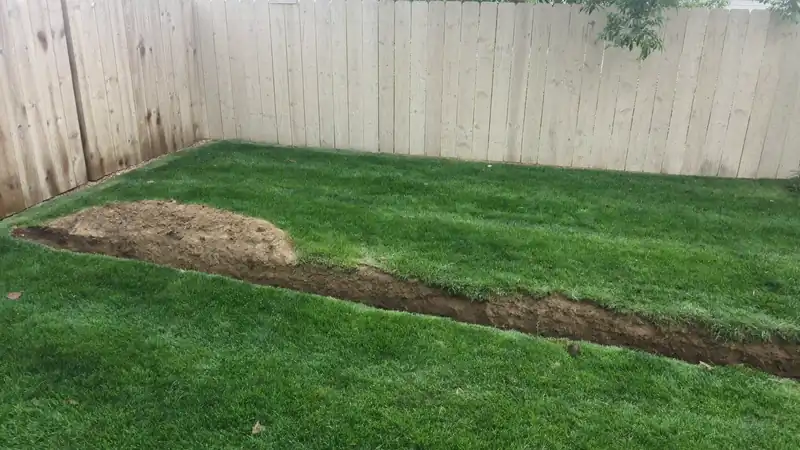
- Kill weeds, then dig out 3 to 4 inches. Spray tough weeds before excavation (SYNLawn). SYNLawn recommends a sod cutter for any job over 150 sq ft. Our page on killing grass before replanting lists the herbicide routes.
- Fix drainage and pests in the subgrade. Where soil percolates poorly, ForeverLawn says to dig deeper, use larger gravel and add perforated drain pipe at the subgrade; our French drain build guide gives the trench specs. Lay gopher wire here if burrowing pests are present (Imperial Synthetic Turf, Tarkett).
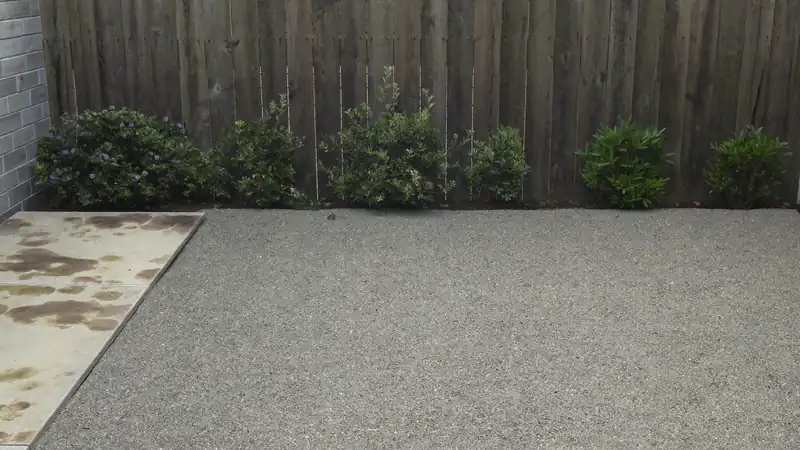
- Spread 3 to 4 inches of base. Use Class 2 road base, 3/8 in crushed stone or decomposed granite (Tarkett). ForeverLawn caps 3 inches of 3/4 in minus with 1 inch of fines, and Watersavers caps 2.5 to 3 inches of 3/4 in base rock with 1 to 1.5 inches of decomposed granite.
- Grade and compact. Wet the base and run a plate compactor to 90 percent, at least two passes per 3 to 4 inches (ForeverLawn). Set about 2 percent fall, 1/4 inch per foot (Watersavers Turf), and finish 1/2 to 1.5 inches below adjoining concrete (Tarkett, SYNLawn). Check with a 10 ft straightedge.
- Lay weed barrier. Lap the fabric 6 to 12 inches and pin it with 40D nails or landscape staples, then sweep it clean (Star Nursery). Turf Distributors advises against weed barrier under dog areas.
- Unroll and rest the turf. Roll it out blades down in the sun for 1 to 2 hours so it relaxes (Watersavers Turf), and drag it as little as possible across the finished base (Turf Distributors).
- Position, then cut from the back. Lay every piece with the grain the same way, trim the factory edge 3 stitches in where pieces will meet (Star Nursery), and leave a 1/4 to 1/2 inch overcut at borders for tucking (Turf Distributors).
- Seam. Center seam tape under the joint, trowel on adhesive, lay one side then the other with a 1/8 inch gap (Watersavers Turf), and weight the seam while it sets: about 15 minutes for Turf Distributors’ glue, 45 to 60 minutes in K9Grass’s guide.
- Stretch and nail. Nail one end every 3 to 4 inches, stretch the turf with a carpet kicker, nail the far end and sides the same way, then nail the field every 12 to 24 inches (Star Nursery). Part the blades so none are trapped, and stop each nail flush: driven deeper, it leaves a dimple (Star Nursery).
- Brush, infill, brush again. Power broom against the grain, drop-spread 1 to 2 lb of infill per sq ft in thin layers, brooming between layers (Imperial Synthetic Turf), until the blades stand and the backing is hidden (SYNLawn).
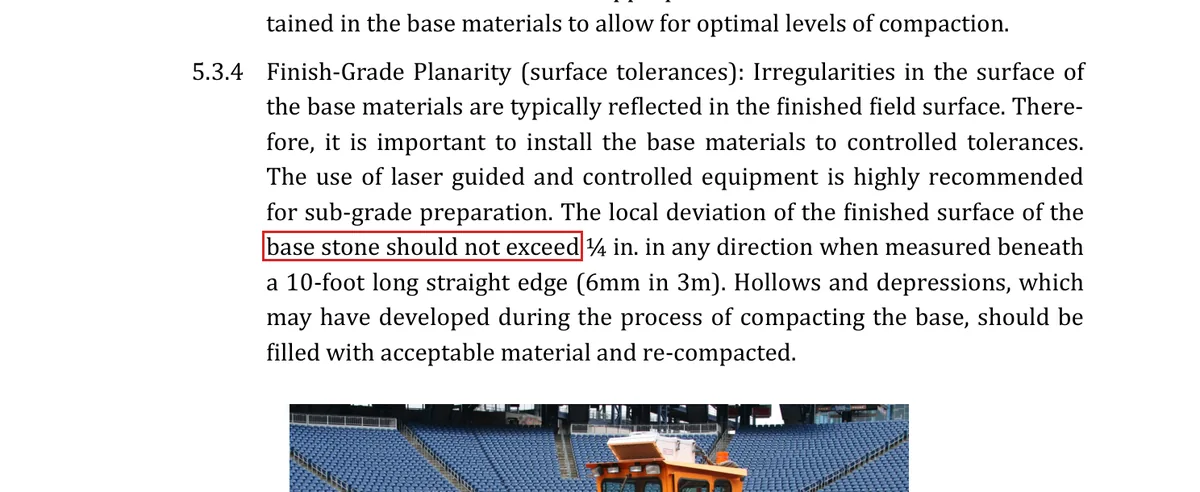
The straightedge check in step 6 comes from sports-field practice: the Synthetic Turf Council’s guidelines hold the finished stone to within 1/4 inch under a 10 ft straightedge, because base irregularities show through the turf (section 5.3.4). No residential manual we read gives a number for flatness, so that is the tightest published figure. ForeverLawn’s warning is blunter: the grass will reveal the base, not hide it.
How much base, turf, nails and infill do you need?
Take a 28 ft by 20 ft backyard, 560 sq ft with one straight seam. The quantities below use the majority figures from the table above; change the rate column to your maker’s numbers and the arithmetic still holds.
| Item | Rate | Arithmetic | For 560 sq ft |
|---|---|---|---|
| Soil dug out | 3.5 in deep | 560 x 3.5 / 12 / 27 | 6.0 cu yd (before it fluffs up) |
| Base rock | 3.5 in deep | Same volume | 6.0 cu yd |
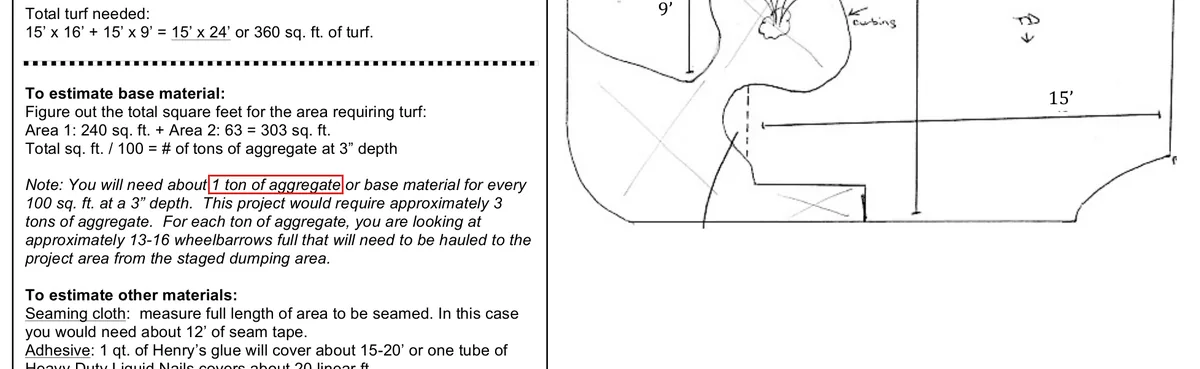
| Base rock by weight | 1.3 tons per cu yd (Star Nursery) | 6.05 x 1.3 | 7.9 tons |
| Wheelbarrow trips, rock in | 13 to 16 loads per ton (SYNLawn) | 7.9 x 13 to 16 | 102 to 126 loads |
| Turf | Two 15 ft x 21 ft pieces | 15 x 42 linear ft | 630 sq ft ordered (12.5% over) |
| Seam tape | One seam the depth of the yard | 20 ft plus 1 ft | 21 ft |
| Seam adhesive | 1 qt covers 15 to 20 ft (SYNLawn) | 21 / 15 to 20 | 2 qt |
| Perimeter nails | Every 4 in | 96 ft x 12 / 4 | 288 nails |
| Field nails | One per 24 in grid square | 560 / 4 | 140 nails |
| Seam nails | Every 4 in (Watersavers) | 20 x 12 / 4 | 60 nails |
| Infill | 1.5 lb per sq ft | 560 x 1.5 | 840 lb, 17 bags of 50 lb |
- Soil to dig out at 3.5 in (cu yd)
- 6.0
- Base rock at 3.5 in (cu yd)
- 6.0
- Base rock (tons at 1.3 per cu yd)
- 7.9
- Wheelbarrow loads of rock (13 per ton, low end)
- 102
- Turf to order with 15 percent extra (sq ft)
- 644
- Linear feet of 15 ft wide roll
- 43
- Infill at 1.5 lb per sq ft (lb)
- 840
- 50 lb bags of infill
- 17
- Boxes of 40D to 60D nails (1 per 600 sq ft)
- 1
Default 560 sq ft: 6.0 cu yd of soil out, 6.0 cu yd (7.9 tons) of rock, 102 wheelbarrow loads, 644 sq ft of turf (43 linear ft), 840 lb of infill in 17 bags, 1 box of nails. Rates from Star Nursery, SYNLawn and Watersavers Turf; seam tape equals your total seam length, and roll layout can change the turf order (see the layout table).
Base rock is where the rules of thumb disagree. SYNLawn says 1 ton per 100 sq ft at 3 inches and per 80 sq ft at 4 inches; Star Nursery says 1 cubic yard per 80 sq ft at 4 inches and weighs a yard at 1.3 tons; Tarkett says 1 cubic yard per 100 sq ft when 3 to 4 inches of soil comes out. For the same 560 sq ft at 4 inches, SYNLawn’s rule orders 7.0 tons and Star Nursery’s orders 9.1 tons, a 2.1 ton gap. Ask the rock yard what its product weighs per cubic yard and order by volume.
| Document | Depth | Rule of thumb | For 560 sq ft |
|---|---|---|---|
| SYNLawn | 3 in | 1 ton per 100 sq ft | 5.6 tons |
| SYNLawn | 4 in | 1 ton per 80 sq ft | 7.0 tons |
| Star Nursery | 4 in | 1 cu yd per 80 sq ft, 1.3 tons per cu yd | 7.0 cu yd, 9.1 tons |
| Tarkett | 3 to 4 in removed | 1 cu yd per 100 sq ft | 5.6 cu yd |
| Volume arithmetic | 4 in | sq ft x 4 / 12 / 27 | 6.9 cu yd |
Which way should the rolls run?
Roll direction can change your turf order by more than a third. In the same 28 ft by 20 ft yard, running two pieces front to back covers the 28 ft width with 30 ft of roll; running them along the house needs a full 15 ft piece plus a 5 ft strip, and the strip has to come from another 15 ft wide cut.
| Layout | Pieces ordered | Turf bought | Seams | Leftover |
|---|---|---|---|---|
| Rolls run front to back (20 ft) | 2 pieces, 15 x 21 ft | 630 sq ft | 1 seam, 20 ft | 70 sq ft |
| Rolls run along the house (28 ft) | 15 x 29 ft plus 15 x 29 ft cut to 5 ft | 870 sq ft | 1 seam, 28 ft | 310 sq ft |
The cheaper layout is not always the right one. SYNLawn says to point the grain toward where the lawn is seen most, and accepts a worse direction only to cut waste; the Mountain House guidelines say grain should usually face the street, and face uphill on a steep slope. Plan for width loss too: trimming 3 stitch rows at a 3/8 inch row spacing takes about 1 1/8 inches off each seamed edge, so two rolls will not quite span a full 30 ft.
How far apart should turf nails go?
For a 96 ft perimeter, the documents call for anywhere from 96 nails to 384. The chart counts nails at each document’s stated spacing; the gap is mostly fastening style, since ForeverLawn and Tarkett were written with spikes or perimeter boards in mind, while Star Nursery and Watersavers Turf nail bare edges tight.
| Document | Perimeter spacing | Nails for 96 ft | Nail named |
|---|---|---|---|
| Star Nursery | 3 to 4 in | 288 to 384 | 40D or 60D |
| Watersavers Turf | 3 to 4 in | 288 to 384 | 5 or 6 in |
| Imperial Synthetic Turf | 4 to 6 in | 192 to 288 | 5 in bright |
| Synthetic Grass Warehouse | 4 to 6 in, 1/2 in from edge | 192 to 288 | 40D |
| Turf Distributors | 6 in | 192 | 40D, 5 in, non-galvanized |
| ForeverLawn | 8 to 10 in, 3/8 to 1/2 in from edge | 116 to 144 | 6 in 60D galvanized spikes |
| SYNLawn | 8 to 12 in | 96 to 144 | 6 in 60D galvanized |
| Tarkett | About 12 in (spikes) | 96 | Landscape spikes |
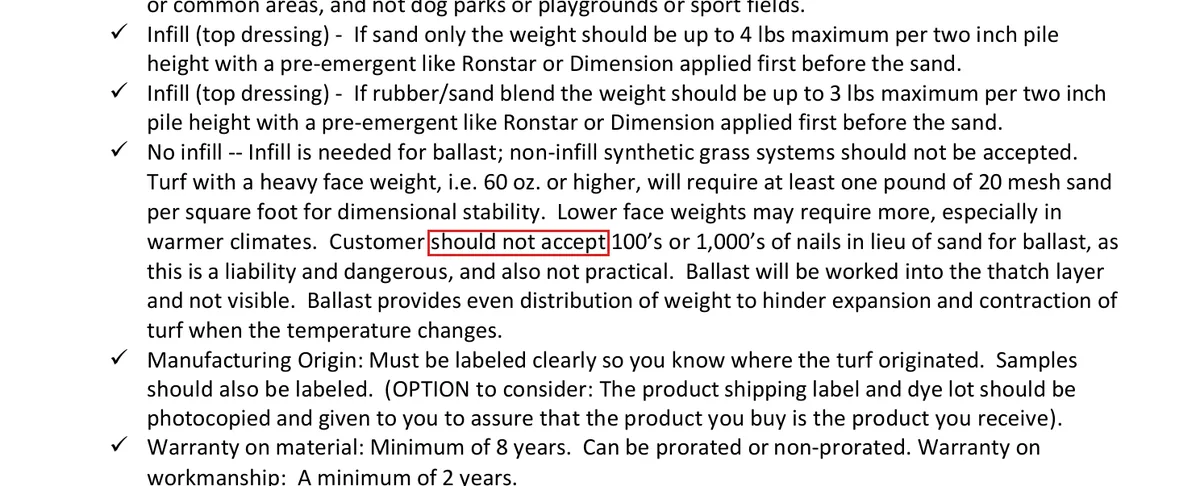
More nails do not replace ballast. The Mountain House guidelines tell homeowners not to accept hundreds or thousands of nails in place of sand, and call for at least 1 lb of 20 mesh sand per sq ft under turf of 60 oz face weight or more, since infill spreads weight evenly and limits expansion and contraction in temperature swings.
How much infill goes in, and which kind?
Most landscape manuals land on 1 to 2 lb of sand per sq ft; your turf’s spec sheet sets the number for that product. Watersavers Turf says a 50 lb bag covers 25 to 35 sq ft. Imperial Synthetic Turf sets a floor of 2 lb and names #20 silica sand and #16 green sand. ForeverLawn’s guide is built around crumb rubber at 3/4 to 1 lb and multiplies by 4 for sand.
| Document | Rate per sq ft | Infill named | For 560 sq ft |
|---|---|---|---|
| SYNLawn | 1 to 2 lb | Coated sand, silica sand or zeolite | 560 to 1,120 lb |
| Star Nursery | 1 to 2 lb | Turfill, Wonderfill, Turfresh | 560 to 1,120 lb |
| Watersavers Turf | 1.5 to 2 lb | Maker-recommended infill only; never regular sand | 840 to 1,120 lb |
| Imperial Synthetic Turf | At least 2 lb | #20 silica, #16 green sand | 1,120 lb or more |
| ForeverLawn | 3/4 to 1 lb rubber; 4 times that in sand | Crumb rubber | 420 to 560 lb rubber |
| Mountain House | At least 1 lb (60 oz face weight and up); at most 4 lb sand per 2 in pile | 20 mesh sand | 560 lb minimum |
For dog runs, Star Nursery spreads its Turfresh product on the base at 1/2 lb per sq ft and compacts it before the turf goes down. Odor control after installation, including enzyme cleaners and zeolite toppers, is covered in our guide to cleaning artificial grass.
Can you lay artificial grass on dirt, concrete or old grass?
Not straight onto dirt or old grass, in any landscape manual we read: all 9 strip the existing surface and build a compacted stone base, and 8 of them dig out 3 to 4 inches first. Concrete is the exception. SYNLawn says turf over concrete can be glued down with no base, and Tarkett sells interlocking drainage tiles for solid surfaces so water can pass under the turf.
1Is the area concrete or another solid slab?
YesNo stone base: glue the turf down (SYNLawn) or lay drainage tiles under it so water can pass (Tarkett).
NoGo to the next question
2Is it a putting green?
YesBuild at least 6 inches of road base (Imperial Synthetic Turf) and skip surface and perimeter nails (Watersavers Turf).
NoGo to the next question
3Does the soil drain poorly after rain?
YesDig deeper, use larger gravel and add perforated drain pipe at the subgrade before the base (ForeverLawn).
NoGo to the next question
4Do gophers or moles dig in the yard?
YesLay galvanized gopher wire over the whole subgrade and pin it with staples (Imperial Synthetic Turf, Tarkett).
NoGo to the next question
5Will dogs use it?
YesSpread 1/2 lb per sq ft of an odor product on the base (Star Nursery) and consider skipping weed barrier (Turf Distributors).
NoDig out 3 to 4 inches, lay 3 to 4 inches of crushed rock compacted to 90 percent, then weed barrier lapped 6 to 12 inches.
Can you install artificial grass yourself?
Yes, but the base is the hard part. The 560 sq ft example moves about 6 cubic yards of soil out and 7.9 tons of rock in, 102 to 126 wheelbarrow loads at SYNLawn’s rate, and needs a rented plate compactor. SYNLawn also says non-professional seams may stay more visible, because professional installers are trained to hide them.
A split job is common: hire excavation and base, then lay, seam, nail and infill yourself. Our artificial turf cost guide prices both routes per square foot, and our turf vs real grass comparison runs the 10 and 15 year math. If you hire, the Mountain House guidelines ask for at least 2 years of workmanship warranty and, in California, a contractor licensed with a D-12 classification; our guide to checking a landscaper license shows where to look it up.
How we compiled this
In November 2026 we read 11 installation documents: manuals from SYNLawn, Star Nursery, ForeverLawn, K9Grass, Tarkett and Imperial Synthetic Turf, installation pages from Watersavers Turf, Synthetic Grass Warehouse and Turf Distributors, the Synthetic Turf Council’s 2011 guidelines and the Mountain House, Calif., quality guidelines. We recorded every depth, rate, spacing and time, and did the quantity arithmetic ourselves. We did not install turf or test products; no maker paid for inclusion.
Frequently asked questions
Can I just lay artificial turf on dirt?
No landscape manual we read allows it. All 9 strip the surface and lay about 3 to 4 inches of compacted crushed rock first, because the rock drains and holds nails; Imperial Synthetic Turf warns that a thin base turns lumpy soon after installation.
What should I put down before installing artificial grass?
Compacted crushed rock, then weed barrier. Star Nursery calls for 3 to 4 inches of Type II road base compacted to 90 percent, then fabric lapped 6 to 12 inches and pinned with 40D nails or staples. Add gopher wire under the base where burrowing pests are present.
Can I install artificial grass myself?
Yes. SYNLawn publishes a DIY guide and recommends a sod cutter and a vibratory plate compactor for jobs over 150 sq ft. Expect about 13 to 16 wheelbarrow loads of base per ton; seams are the step where DIY work most often shows.
Can I just put artificial turf over grass?
Not in any landscape manual we read. Each removes the sod first, and 8 of 9 dig out 3 to 4 inches of soil before laying rock. ForeverLawn’s reason applies to anything left underneath: the grass will reveal the base, not hide it.
Do you need sand under artificial grass?
Not under it, on it: sand goes in as infill after the turf is nailed. Most manuals use 1 to 2 lb per sq ft, and the Mountain House guidelines call for at least 1 lb of 20 mesh sand on 60 oz face weight turf. Under the turf goes crushed rock, sometimes capped with 1 inch of fines.
Sources
- SYNLawn (hosted by Lowe’s), DIY Installation Guidelines for SYNLawn Artificial Grass, Undated; checked November 2026. Accessed November 2026.
- Star Nursery, Emerald Carpet Synthetic Turf Installation Guide, Undated; checked November 2026. Accessed November 2026.
- ForeverLawn, General Landscape Installation Guidelines, M1374 Rev. 05/19, May 2019. Accessed November 2026.
- K9Grass by ForeverLawn, K9Grass Installation Guidelines, March 2024 upload. Accessed November 2026.
- Tarkett Home, On the Green Synthetic Grass Installation Manual, Undated; checked November 2026. Accessed November 2026.
- Imperial Synthetic Turf, Synthetic Turf Installation Guide, June 2020 version. Accessed November 2026.
- Watersavers Turf, How to Install Artificial Grass, Checked November 2026. Accessed November 2026.
- Synthetic Grass Warehouse, Step by Step Guide to Installing Artificial Grass, Checked November 2026. Accessed November 2026.
- Turf Distributors, Installation Guide, Checked November 2026. Accessed November 2026.
- Synthetic Turf Council, Suggested Guidelines for the Essential Elements of Synthetic Turf Systems, Fifth revision, November 2011. Accessed November 2026.
- Mountain House, Calif., Quality Guidelines for Landscape Synthetic Grass in Mountain House, Undated; checked November 2026. Accessed November 2026.