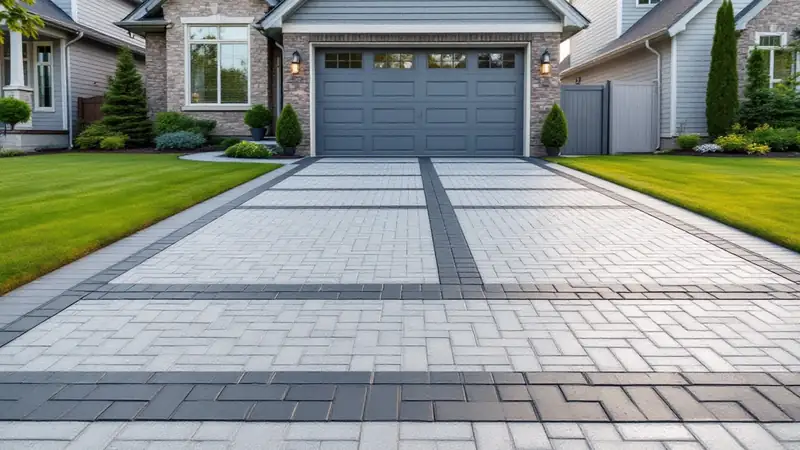
Short answer: A professionally installed concrete paver driveway costs about $23 to $43 per square foot by our estimate, or $14,000 to $26,100 for a 12×50 (600 sq ft) driveway on a 6-inch base. Clay brick runs $26 to $49 per sq ft, permeable pavers $25 to $45. Removing old concrete adds about $1.60 to $2.80 per sq ft.
$23–$43 per sq ft installed, 60 mm concrete pavers on a 6-in. base (estimate; see method)
6 in. minimum compacted base for a residential driveway on well-drained soil (CMHA PAV-TEC-002)
$15 per sq ft D.C. rebate for replacing pavement with permeable pavers, up to $6,000 (D.C. DOEE)
+47.3% producer prices for concrete pavers, Aug 2019 to Aug 2026 (BLS PPI)
Most paver driveway price pages quote a single per-square-foot range with no source, and at least one prices a paver thinner than the industry standard allows under cars. This page builds the price the other way round: the base depth and paver thickness the paving industry’s own construction bulletin sets for driveways, published 2026 prices for each layer, state DOT bid prices for tearing out the old driveway, and the rules cities actually publish for the apron at the street. Every number links to where it came from; the arithmetic is in the method note near the end.
Paver driveway cost per square foot, by paver type
These are installed prices for a new driveway on firm, reasonably drained soil, built to the cross-section in the next section: pavers, 1 inch of bedding sand and 6 inches of compacted aggregate base, with edge restraints and polymeric joint sand. They exclude removing an old driveway, the apron in the public right-of-way and permit fees, which are priced separately below.
| Paver type | Pavers only, per sq ft (incl. waste) | All materials, per sq ft | Installed, per sq ft | Notes |
|---|---|---|---|---|
| Concrete pavers, 60 mm (2 3/8 in.) | $4.72–$6.86 | $7.19–$11.10 | $23–$43 | The standard spec for residential driveways |
| Concrete pavers, 80 mm (3 1/8 in.) | $4.63–$9.60 | $7.10–$13.85 | $23–$45 | Heavier units; at one Atlanta yard, the same price as 60 mm |
| Clay brick pavers (2 3/8 in.) | $7.89–$13.66 | $10.36–$17.91 | $26–$49 | Color is fired in; one published U.S. price list found |
| Permeable interlocking pavers (PICP), 80 mm | $7.49–$9.60 | $8.88–$13.20 | $25–$45 | Open-graded stone base about 12 in. deep instead of dense base |
| Natural stone (bluestone) mortar-set on a concrete slab | $10.45–$12.38 | $19.29–$30.01 | $35–$61 | Priced as 1.5-in. bluestone mortar-set on a 6-in. concrete slab |
Two things stand out. The paver is not where the money goes: swapping standard 60 mm concrete pavers for clay brick adds only about $3 to $7 per sq ft of material, while labor, excavation, equipment and overhead account for $15.50 to $31 of every square foot. And the spread inside each row is mostly the installer, not the product. The low end reflects large public jobs; the high end reflects what residential contractors charge for small, hand-built projects.
Uses the per-square-foot ranges in this guide. Small driveways often carry a contractor minimum above this range. Local prices vary; see How we built these numbers.
The calculator uses the per-square-foot ranges above. The base and demolition settings are percentage adjustments worked out in the method note; the apron and drainage add-ons are flat amounts for a typical job.
Paver driveway cost by size: 20×20, 12×50, 1,000 and 2,000 sq ft
These are the sizes people search for, priced with the same model. A 20×20 paver driveway (400 sq ft) comes to about $9,300 to $17,500 with standard concrete pavers. A 1,000 sq ft driveway runs about $23,000 to $43,000, and a 2,000 sq ft driveway about $45,900 to $85,600.
| Driveway | Area | Materials only (DIY) | Installed: 60 mm concrete pavers | Installed: clay brick | Installed: permeable (PICP) |
|---|---|---|---|---|---|
| 10×20 (Single-car pad) | 200 sq ft | $1,700–$2,700 | $4,800–$9,000 | $5,500–$10,400 | $5,200–$9,400 |
| 12×24 (Short single-car) | 288 sq ft | $2,300–$3,700 | $6,800–$12,800 | $7,700–$14,700 | $7,400–$13,400 |
| 20×20 (Two-car pad) | 400 sq ft | $3,100–$4,900 | $9,300–$17,500 | $10,600–$20,200 | $10,200–$18,500 |
| 24×24 (Two-car, garage-width) | 576 sq ft | $4,300–$6,800 | $13,300–$25,000 | $15,200–$28,900 | $14,600–$26,500 |
| 12×50 (Single-car, typical suburban) | 600 sq ft | $4,600–$7,200 | $14,000–$26,100 | $15,900–$30,200 | $15,200–$27,500 |
| 20×40 (Two-car, medium) | 800 sq ft | $5,900–$9,300 | $18,500–$34,500 | $21,000–$40,000 | $20,100–$36,600 |
| 20×50 (1,000 sq ft) | 1,000 sq ft | $7,400–$11,500 | $23,000–$43,000 | $26,200–$49,800 | $25,100–$45,600 |
| 24×50 (Two-car, long) | 1,200 sq ft | $8,700–$13,700 | $27,600–$51,500 | $31,400–$59,700 | $30,100–$54,700 |
| 20×100 (2,000 sq ft) | 2,000 sq ft | $14,500–$22,600 | $45,900–$85,600 | $52,200–$99,200 | $50,100–$90,900 |
Per square foot, the price barely drops as the driveway gets bigger, because nearly every hour of the job (digging, hauling, compacting, screeding, laying, cutting) scales with area. A 10×20 pad works out to $24 to $45 per sq ft and a 2,000 sq ft driveway to $23 to $43. What does change with size is the fixed cost of getting a crew and equipment to the site, which a per-square-foot model cannot see: expect quotes for small pads to land at or above the top of the range.
Widths are set by local code more than by taste. Palatine, Illinois sets a 9-foot minimum driveway width (2026 paver permit handout); Mentor, Ohio and Rockton, Illinois cap residential driveways at 24 feet where they meet the right-of-way or property line (Mentor application, Rockton permit); La Grange Park, Illinois limits a driveway serving a detached garage to 12 feet wide (2025 application packet). Mentor also caps driveway coverage at 40 percent of the front yard. Measure length times width, and check the width rule before you price a wider driveway.
What the paving standard says a driveway needs
The technical body for interlocking concrete pavement is the Interlocking Concrete Pavement Institute (ICPI), now part of the Concrete Masonry and Hardscapes Association (CMHA). Its construction bulletin, PAV-TEC-002-22, Construction of Interlocking Concrete Pavements, sets the cross-section that drives most of the cost of a driveway:
- Paver thickness: “Pedestrian areas, driveways, and areas subject to limited vehicular use are paved with units 2 3/8 in. (60 mm) thick. Streets and industrial pavements should be paved with units at least 3 1/8 in. (80 mm) thick.”
- Base depth: “Residential driveways on well-drained soils should be at least 6 in. (150 mm) thick. In colder climates, continually wet or weak soils will require that bases be thicker.” Patios get 4 inches; residential streets 8 to 10.
- Compaction: subgrade and base for residential driveways compacted to at least 98 percent of standard Proctor density, with the base spread and compacted in 4- to 6-inch lifts.
- Bedding: concrete sand (ASTM C33) screeded about 1 inch thick. “Masonry sand for mortar should never be used for bedding, nor should limestone screenings or stone dust.”
- Pattern: herringbone (45 or 90 degree) is recommended for street applications because it resists “creep from starting, braking and turning tires.”
- Slope: at least 1.5 percent so water runs off.
Edges get their own bulletin. PAV-TEC-003-22 says plastic edging made for pavers “can be used with light duty residential” work if it is spiked into the base, and that a submerged concrete curb used as a restraint should be at least 8 x 8 inches for residential driveways. Flat landscape edging is not a paver restraint.
Add it up and a standard paver driveway is about 9.4 inches deep from the top of the pavers to the bottom of the base, against about 7.4 inches for a patio. On a 12×50 driveway with the base extended 6 inches past the edges, that is roughly 19 cubic yards of soil to dig out and about 27 tons of base stone, 2 tons of bedding sand and 8 tons of pavers to bring in. That tonnage, more than the paver choice, is why driveways cost what they do.
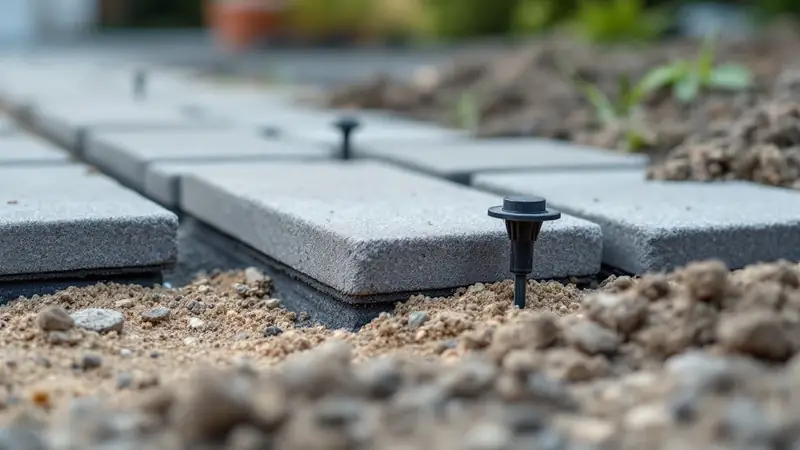
A city’s code minimum is not the same as the industry standard. Palatine’s 2026 permit handout asks for “a min. 4 inches compacted Grade C.A. 6 stone base” under brick pavers (Village of Palatine), and La Grange Park’s packet says driveway pavers “should have a four to six inch (4″-6″) compacted base” (Village of La Grange Park). A quote built to the 4-inch permit minimum is a patio base under a car.
60 mm or 80 mm pavers for a driveway?
By CMHA’s standard, 60 mm (2 3/8 in.) concrete pavers are correct for a home driveway, and 80 mm units are for streets and industrial pavement. Two cases call for 80 mm anyway: permeable pavers, which CMHA says are “typically a minimum of 3 1/8 in. (80 mm) thick for vehicular areas” (PAV-TEC-018-22), and driveways that see delivery trucks or heavy equipment. Washington, D.C.’s rebate program specifies a 3 1/8-inch minimum for permeable paver blocks (DOEE applicant guide).
The upgrade is not always a premium. Cummin Landscape Supply in Atlanta lists Belgard Holland Stone 80 mm at $529 per 120 sq ft pallet (product page) and its 60 mm Holland Stone at $539 (product page), both checked Oct. 14, 2026. Thicker units weigh more, so they take longer to carry and lay; the paver price is rarely the reason to skip them. Clay is similar: Pine Hall Brick makes its pavers 2 1/4 inches thick and offers 2 3/4 inches “for heavy vehicular applications” (2025 paver brochure), and Mutual Materials’ 2 3/8-inch clay pavers are rated for “pedestrian and light vehicular applications” (tech sheet). Thin “patio” pavers sold in big-box sizes are not driveway pavers.
Line by line: what each layer costs
Here is what each layer costs at published 2026 prices, converted to dollars per square foot of finished driveway. Pallet coverages, weights and bag coverages come from the sellers’ and manufacturers’ own pages.
| Layer | Published price | Cost per sq ft of driveway |
|---|---|---|
| 60 mm concrete pavers | $539 per 120 sq ft pallet (Cummin, Atlanta); $3.97 per triple Holland at 1.57 per sq ft (Mutual Materials, Wash.) | $4.72–$6.86 incl. 5–10% cutting waste |
| 80 mm concrete pavers | $529 per 120 sq ft pallet (Cummin); $661.20 per 75.74 sq ft pallet, Barkman Boardwalk 80 mm (coverage per tech sheet) | $4.63–$9.60 |
| Clay brick pavers, 2 3/8 in. | $1.67–$2.76 each, 4.5 per sq ft (Mutual Materials tech sheet) | $7.89–$13.66 |
| Permeable pavers, 80 mm | $7.13 listed for Eco-Priora (the same price for 4×8 and 8×8 units, so we read it as per sq ft); Barkman Boardwalk as above | $7.49–$9.60 |
| Natural stone, 1.5 in. bluestone | $9.50 per sq ft (Conestoga Stone, Pa.); $11.25 per sq ft (Cummin) | $10.45–$12.38 |
| Dense-graded base, 6 in. compacted | $38.50 per ton #304 limestone (Bzak, Ohio); $59 per cu yd crusher run (Cummin); $99.99 per cu yd crushed limestone (Houston) | $1.56–$3.00 |
| Bedding sand, 1 in. | $34 per ton coarse sand (Bzak); $64.99 per cu yd torpedo sand (Houston) | $0.13–$0.20 |
| Polymeric joint sand | $41 and $42 per 50 lb bag; 65–85 sq ft per bag (Alliance Gator spec) | $0.48–$0.65 |
| Edge restraint | $13.80 per 8 ft Snap Edge (Mutual); $12 per 7 ft 8 in. Paver Rail plus $0.60 spikes (Cummin) | $1.73–$2.16 per linear ft; $0.30–$0.40 per sq ft on a 12-ft-wide driveway |
| Geotextile (wet, clay or freeze-thaw soils) | $79 per 12.5 x 27 ft woven roll (Cummin) | about $0.23 |
| Delivery | $75–$100 per load by ZIP code (Bzak) | $200–$400 per job |
| Labor, excavation, spoil haul-off, equipment, overhead, profit | Anchored to public bids and a contractor survey (next section) | $15.68–$31.50 |
Materials for a standard 60 mm driveway come to about $7.20 to $11.10 per sq ft. The biggest swing inside that is base stone, and it is mostly trucking distance. Oconee County, South Carolina’s quarry sells #57 stone at $23.50 a ton (price list effective Aug. 3, 2026); Gill Quarries outside Philadelphia sells it at $26 (2026 list); the same stone is $79 a cubic yard at Cummin in Atlanta (product list).
Why labor is two-thirds or more of the price
Homeowner quotes are private, so we anchored the installation component to the two kinds of public price data that exist:
- Public bids, the low end. Oklahoma DOT awarded three “(PL) Landscape Pavers” items in early 2025, all at $22.00 per sq ft installed, totaling 16,238 sq ft (ODOT Weighted Average Item Price Report, Jan. 2026). Subtracting a typical paver-and-base materials cost of about $6.50 leaves $15.50 for everything else. River Forest, Illinois’ low bidders to remove and reinstall existing pavers charged $13.75 per sq ft in April 2026 and $196 per square yard ($21.78 per sq ft) in February 2025 (2026 bid tab, 2025 bid tab), labor with little new material.
- A contractor survey, the high end. Landscape professionals surveyed for NAR’s 2023 Remodeling Impact Report: Outdoor Features priced an 18×16 concrete paver patio at $10,500, or $36.46 per sq ft. Subtracting materials and escalating for wage growth since 2022 gives $31.10 per sq ft for labor, equipment, overhead and profit, the same component our paver patio estimate uses.
So the labor component runs $15.50 to $31.10 per sq ft, plus $0.18 to $0.40 because a driveway is 2 inches deeper than a patio. That is roughly 70 to 75 percent of the installed price. The tonnage explains it: CMHA’s mechanical installation bulletin (PAV-TEC-011) says that “with manual installation, most crew members move between 7 and 10 tons of material per day,” and a 12×50 driveway moves roughly 37 tons of pavers, sand and stone in and 19 cubic yards of soil out.
Labor has also gotten more expensive. Average hourly earnings in the landscaping services industry rose from $20.15 in 2019 to $27.63 in 2025 and reached $28.78 in August 2026 (preliminary), per BLS Current Employment Statistics. For what crews themselves are paid by state, see our landscaper salary data; for how a whole-yard budget breaks down, our landscaping cost guide.
Removing an old asphalt or concrete driveway
Most paver driveways replace something. State transportation departments publish what contractors bid to remove driveways and pavement, which is the best public benchmark for tear-out (Arkansas’s item explicitly includes disposal):
| Item | Agency and period | Average bid | Per sq ft |
|---|---|---|---|
| Concrete driveway removal | Oklahoma DOT, Jul. 2024–Dec. 2025 | $15.22 per sq yd (46 awards) | $1.69 |
| Concrete driveway pavement removal | South Dakota DOT, 2024 | $14.11 per sq yd (11 bids) | $1.57 |
| Removal and disposal of concrete driveways | Arkansas DOT, 2025 | $25.23 per sq yd (weighted average) | $2.80 |
| Asphalt driveway removal | Oklahoma DOT, Jul. 2024–Dec. 2025 | $11.58 per sq yd (28 awards) | $1.29 |
| Asphalt approach removal | South Dakota DOT, 2024 | $6.33 per sq yd | $0.70 |
| Removing asphaltic surface | Wisconsin DOT, FY 2025 | $4.14 per sq yd | $0.46 |
That puts tear-out at about $1.60 to $2.80 per sq ft for concrete and $0.50 to $1.30 for asphalt, or roughly $940 to $1,680 for a 600 sq ft concrete driveway. Residential jobs are smaller than highway jobs, so expect a minimum charge on a short driveway.
Disposal is part of that price, and it is weight-driven. A 4-inch concrete slab weighs about 50 lb per sq ft, so a 600 sq ft driveway is about 15 tons of debris. Published 2026 dump fees: Portland Rock in Gresham, Oregon takes clean concrete at $18 a ton and “clean rock, brick, & asphalt” at $75 a ton (2026 price list); Boyas Recycling near Cleveland takes clean fill, including concrete and asphalt, at $15.50 a cubic yard with a $75 minimum (disposal fees).
Permeable paver driveway cost
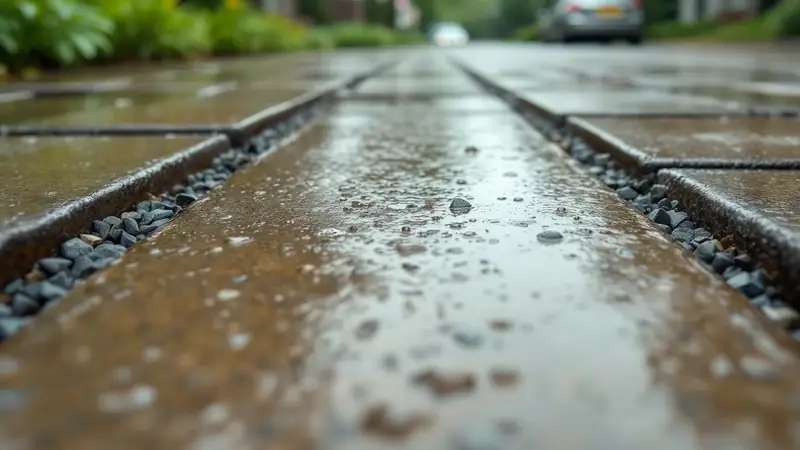
Permeable interlocking concrete pavement (PICP) is a different build, not a different paver. Water drains through wide joints filled with small stone into an open-graded stone reservoir, and the soil underneath is generally left uncompacted so it can soak the water in (CMHA PAV-TEC-018-22). Washington, D.C.’s rebate specification is a good residential example of the layers (DOEE applicant guide):
- Joints: No. 8, 89 or 9 stone.
- Pavers: permeable interlocking blocks, 3 1/8 in. minimum.
- Bedding: No. 8, 89 or 9 stone, 1 1/8 to 2 in.
- Base: No. 57 stone, 4 in.
- Subbase: No. 2 stone, 6 in. minimum, with bedding, base and subbase together at least 10 inches.
Priced with the stone above (No. 8 class stone at $21.75 a ton to $98 a cubic yard, No. 57 at $23.50 a ton to $79 a cubic yard, and large No. 2 to No. 4 stone at $22 a ton to $78 a cubic yard), the stone layers cost about $1.04 to $3.10 per sq ft, only slightly more than a dense base. The real premium is the extra 6 inches of digging and spoil, keeping every load of stone free of fines, and installers trained in the system. Our estimate is $25 to $45 per sq ft installed, or about $15,200 to $27,500 for a 600 sq ft driveway.
Public programs report similar or higher numbers. D.C.’s Department of Energy and Environment says “the cost of installing permeable pavers or re-vegetating an area is approximately $30-$40 per square foot” (DOEE). Philadelphia’s Rain Check program put most participants’ projects at $30 to $50 per sq ft in its 2020 pricing sheet, with one 170 sq ft permeable driveway, including removal of the old concrete, at $8,386, or $49.33 per sq ft; the sheet notes the price “reflects deeper excavation and stone base layer required to accommodate vehicle weight” (Philadelphia Water Department, Aug. 2020). Small urban jobs with demolition sit at the top of every range.
Two add-ons are common. On clay or other slow-draining soil the design usually needs an underdrain: perforated pipe in the base to an outlet. Wisconsin DOT paid $22.45 to $25.74 per linear foot for 4-inch underdrain in FY 2023 and 2024 (average unit price list), so 40 to 60 feet runs roughly $900 to $1,540. And D.C. requires an impermeable liner if the system is within 10 feet of a building with a basement (DOEE).
Stormwater rebates and credits for permeable driveways
This is where permeable pavers can pay for themselves. A few cities pay part of the cost or cut the stormwater fee, and some count permeable surfaces differently against lot-coverage limits:
| Jurisdiction | What permeable paving earns | Conditions |
|---|---|---|
| Washington, D.C. (RiverSmart Homes) | $15 per sq ft of impervious surface replaced with permeable pavers; $6,000 maximum per property | 100 sq ft minimum; the cap applies in Wards 7 and 8 and the MS4 area, so check eligibility by address; area must take downspout water; installer needs a PICP Record of Completion and DIY is not allowed (Alliance for the Chesapeake Bay) |
| Philadelphia (Rain Check) | $15 per sq ft, up to $1,500 (2020 pricing sheet) | Subsidy covers pavers only; $25 consultation required |
| Minneapolis | Stormwater fee cut by up to 35%, or 45% in a Green Zone | Pervious pavement is an eligible practice |
| Takoma Park, Md. | Up to a 50% fee reduction for the pavement area | Needs a stone reservoir and geotextile over uncompacted subgrade; less credit under 12 in. of stone |
| Lake Stevens, Wash. | Permeable hard surfaces count as 50% impervious toward the lot-coverage cap | Lots developed before April 1, 2020 are capped at 40% impervious |
| Shorewood, Minn. | No credit: permeable pavers count as impervious | Most lots capped at 33%; stormwater plan for 1,000 sq ft or more of new hard surface |
| Mentor, Ohio | Not a credit but a rule: paver driveways must be “permeable type pavers approved by the City” | Gravel driveways may not be expanded |
In D.C., the rebate on a 600 sq ft permeable driveway would be capped at $6,000, bringing our estimate down to about $9,200 to $21,500: still more than a standard paver driveway at the low end, but less at the high end. Outside the handful of programs like these, a permeable driveway costs more and pays back in drainage, not dollars. If you are pricing grass-filled plastic grids instead of interlocking pavers, those are a separate, cheaper system with lighter load limits.
What are the downsides of permeable pavers?
- They cost more: about $2 more per sq ft than standard pavers at the low end of our estimate, more where deeper reservoirs or underdrains are needed.
- They clog without upkeep. D.C. tells owners to “sweep and/or vacuum pervious pavers every three months” and refill the joint stone (DOEE). River Forest, Illinois’ low bids for restorative maintenance of village permeable pavers were $2.19 per sq ft in 2025 and $2.40 in 2026, against $9.50 and $10.00 from the second bidders (2025, 2026 bid tabs).
- Sediment during construction can ruin them, which is why CMHA’s bulletin puts keeping sediment out of the aggregates as “the highest priority.”
- They do not get you around every lot-coverage rule; Shorewood, Minnesota counts them as fully impervious.
- Installer skill matters more, and some rebate programs require a certified installer.
On the plus side, CMHA lists PICP as “immediately ready for traffic upon completion, no additional time needed for curing” and notes reduced ice and de-icer use (PAV-TEC-018-22).
The apron, the right-of-way and permits
The part of a driveway between the property line and the street (the apron or approach) usually sits in the public right-of-way, and the city or county that owns the road sets its rules. Those rules decide whether your pavers can run to the curb. A sample of what local governments publish:
| Jurisdiction | Permit fee | Apron and paver rules | Other limits |
|---|---|---|---|
| Mentor, Ohio | $30 zoning permit; $140 with right-of-way work ($30 + $50 + $60 deposit) | Apron: 6 in. concrete on 4 in. stone; paver driveways must be permeable type | Max 24 ft at right-of-way; 40% front-yard coverage |
| Rockton, Ill. | $25 ($50 without a permit, plus fines) | Driveway may be pavers; apron and anything in the right-of-way must be 6 in. concrete on 2 in. base or 3 in. asphalt on 10 in. base | Max 24 ft at property line; apron flares to 34 ft |
| Palatine, Ill. | $103 (2026) | Pavers allowed in the right-of-way with a signed hold harmless release; the village need not reinstall them after utility work | 4 in. min. CA-6 base; 9 ft min. width |
| La Grange Park, Ill. | 1.5% of construction cost, minimum $100 | Approach concrete 7 in. thick; pavers on a 4 to 6 in. base | 12 ft max. for a detached garage |
| Fox Crossing, Wis. | Permit required; fee not stated in the policy | On curbed (urban) streets, aprons must be an “improved surface,” defined as asphalt or concrete; residential concrete 6 in. on 6 in. base | Max apron 40 ft residential |
| Davenport, Iowa | $50 residential approach; $25 widening; $10 per curb cut | Set by city standards | |
| Flagler Beach, Fla. | $75 application + $75 review + $75 inspection | Pavers in the right-of-way need a Right of Way Utilization Agreement signed by everyone on the deed | Drainage affidavit and grading plan required |
The pattern: fees are small (about $25 to $225 in this sample), and the cost is in the apron rule. Where a city requires a concrete apron, budget it as a separate line. At public bid prices for 6-inch concrete driveway of $65.55 to $131.70 per square yard (WisDOT, ARDOT), a 150 sq ft apron costs about $1,090 to $2,190; Darien, Illinois’ 2026 resident program prices concrete aprons at $9.95 per sq ft (city price sheet). Where pavers are allowed in the right-of-way, read the hold harmless terms: in Palatine, the village is “under no obligation to reinstall, repair, or restore” them after its own work.
Most places also require a building or zoning permit for the driveway itself, as Palatine and La Grange Park do. Before you sign, check the installer with our guide to checking a landscaper’s license; whether hardscape contractors need a license varies by state, as our state licensing table shows.
This page is general information, not legal advice. Permit, right-of-way and stormwater rules vary by parcel and change; confirm with your city or county and the agency that owns the road before you build or sign a contract.
Paver vs. concrete driveway (and asphalt): upfront cost and the long run
Pavers cost two to three times as much as poured concrete up front, and several times as much as asphalt. The fairest primary-source comparison we could build puts public bid prices for concrete and asphalt next to our paver estimate for the same 12×50 driveway:
| Surface, 12 x 50 ft (600 sq ft) | Per sq ft | Total | Basis |
|---|---|---|---|
| Asphalt, 3 in. on a 6 in. base (public bid prices) | $3.78–$4.57 | $2,300 to $2,700 | Asphalt driveway $173.33 (WisDOT FY25) and $180.03 (ODOT) per ton at 106 lb per sq yd per inch (TDOT); base and excavation at DOT unit prices |
| Concrete, 6 in. | $7.28–$20.00 | $4,400 to $12,000 | Public bids $65.55 (WisDOT) to $131.70 (ARDOT) per sq yd; $20.00 per sq ft in Darien, Ill.’s 2026 resident program |
| Concrete pavers, 60 mm (our estimate) | $23–$43 | $14,000 to $26,100 | This page |
| Clay brick pavers (our estimate) | $26–$49 | $15,900 to $30,200 | This page |
| Permeable pavers (our estimate) | $25–$45 | $15,200 to $27,500 | This page |
| Permeable pavers after a D.C. rebate | $9,200 to $21,500 | DOEE $15 per sq ft, $6,000 cap |
The long-run argument for pavers is that they last and repair cleanly. CMHA’s glossary says a pavement design life of “twenty to forty years is normally used in North America” (PAV-TEC-001), and its maintenance bulletin describes pavers as a “zipper”: units come out for a repair underneath and the same pavers go back, with “no ugly patches” (PAV-TEC-006). We could not find a primary source that measures how long residential asphalt or concrete driveways last, so we do not put a lifespan on them.
What we can do is the break-even arithmetic. On the 600 sq ft example, pavers cost about $9,600 to $14,100 more than concrete (low end against low end, high against high). Tearing out and repouring that concrete driveway would cost $5,300 to $13,700 at the prices above. So pavers come out ahead of concrete only if the concrete would need full replacement about once or twice more than the pavers during the time you own the house. Against asphalt the premium is $11,700 to $23,400, or about five to seven full asphalt tear-outs and repaves at public prices.
The paver industry’s own research reaches a similar answer. In life-cycle cost studies commissioned by the ICPI Foundation, interlocking pavement on roads cost more over 50 years than asphalt and concrete in the base case, and the summary points to “the difficulty of justifying ICP on lightly trafficked residential roads” on cost alone (CMHA/ICPI Foundation). Where pavers won was repairs: with utility cuts, asphalt pavement “can have an almost 200% higher life-cycle costs than an ICP pavement.” The practical reading for a homeowner: choose pavers for looks, repairability, salt resistance, drainage credits or a sewer or utility line under the driveway, not to save money.
If you are weighing the same choice for a backyard surface, our pavers vs. concrete patio comparison covers freeze-thaw, scaling and cracking in more depth, and our paver patio cost guide prices the 4-inch-base version of this build. A gravel driveway is the low-cost alternative to all three hard surfaces.
Paver and stone prices have risen faster than inflation
A quote that looks high next to a price you remember from a few years ago is consistent with the producer price data. From August 2019 to August 2026, the producer price index for concrete pavers rose 47.3 percent and the index for construction sand, gravel and crushed stone rose 60.7 percent, against 30.6 percent for consumer prices.
| Price index | Aug 2019 | Aug 2026 | Change since 2019 | Last 12 months |
|---|---|---|---|---|
| Concrete pavers (WPU133141) | 227.8 | 335.6 | +47.3% | +2.2% |
| Construction sand, gravel and crushed stone (WPU1321) | 349.8 | 562.2 | +60.7% | +6.2% |
| Ready-mixed concrete (WPU1333) | 282.3 | 395.2 | +40.0% | +2.3% |
| Asphalt paving mixtures (WPU13940113C) | 120.9 | 160.9 | +33.1% | +10.1% |
| Consumer prices, all items (CPI-U) | 256.6 | 335.0 | +30.6% | +3.4% |
- Concrete pavers (WPU133141)
- Sand, gravel and crushed stone (WPU1321)
- Ready-mixed concrete (WPU1333)
- Asphalt paving mixtures (WPU13940113C)
- Consumer prices, all items (CPI-U)
Source: BLS Producer Price Index and CPI-U annual averages, rebased by The Green Industry Report Annual averages; CPI from cu.data.1.AllItems.
Show the numbers
| Concrete pavers (WPU133141) | Sand, gravel and crushed stone (WPU1321) | Ready-mixed concrete (WPU1333) | Asphalt paving mixtures (WPU13940113C) | Consumer prices, all items (CPI-U) | |
|---|---|---|---|---|---|
| 2019 | 100 | 100 | 100 | 100 | 100 |
| 2020 | 101.80 | 104.50 | 102.50 | 99.90 | 101.20 |
| 2021 | 106.90 | 108.60 | 106.40 | 99.60 | 106 |
| 2022 | 121.90 | 119.60 | 117.40 | 112.90 | 114.50 |
| 2023 | 133.50 | 131.40 | 130.40 | 118.50 | 119.20 |
| 2024 | 139.70 | 141.20 | 138 | 120.70 | 122.70 |
| 2025 | 144.50 | 151.10 | 139.10 | 128.20 | 125.90 |
Over the last 12 months, though, paver prices rose only 2.2 percent while asphalt paving mixtures jumped 10.1 percent, so the upfront gap between pavers and asphalt narrowed slightly in 2026.
How much location changes the price
Two inputs move by region: base stone, which is mostly trucking, and labor. Labor is the bigger one because it is most of the price. The cleanest public benchmark is the median wage for landscaping and groundskeeping workers by state from BLS Occupational Employment and Wage Statistics, May 2025:
| State | Median hourly wage, landscaping workers | Versus U.S. |
|---|---|---|
| Massachusetts | $23.40 | +24% |
| Washington | $22.57 | +20% |
| Minnesota | $22.41 | +19% |
| Colorado | $22.00 | +17% |
| California | $21.90 | +16% |
| New York | $21.56 | +15% |
| Illinois | $21.05 | +12% |
| New Jersey | $19.88 | +6% |
| Pennsylvania | $18.99 | +1% |
| U.S. | $18.82 | 0% |
| Arizona | $18.71 | -1% |
| Ohio | $18.38 | -2% |
| Georgia | $18.25 | -3% |
| North Carolina | $18.22 | -3% |
| Florida | $17.84 | -5% |
| Texas | $17.66 | -6% |
Wages are not the whole installation component, so treat these as a direction rather than a multiplier. As a rough upper bound, if the $15.50 to $31.10 labor component moved one for one with wages, a driveway in Massachusetts or Washington would run about $3 to $8 per sq ft above our range and one in Texas or Florida about $1 to $2 below it. Cold-winter states add a second cost: CMHA says colder climates and wet soils need thicker bases, and the calculator’s 10-inch-base setting adds about 6 percent.
DIY paver driveway: what you save and what you take on
Doing it yourself removes the $15.50 to $31.10 per sq ft labor component but not the work. Materials and delivery for a 12×50 driveway come to about $4,600 to $7,200. Add equipment: published rates from two Midwest rental yards are $88 to $110 a day for a plate compactor and $250 to $290 a day for a skid steer (A USA Rentals, Bloomfield Rent-All), and CMHA’s bulletin cites 7,000 lbf reversible plate compactors for 4- to 6-inch base lifts. Cutting pavers needs a masonry saw or splitter, and CMHA warns saw dust contains respirable crystalline silica.
The trade-off is the base. Under-compacted subgrade, stone dust as bedding and landscape edging as a restraint are the shortcuts the standard warns against, and on a driveway they show up as ruts in the wheel paths. DIY also rules out some rebates: D.C.’s program does not allow DIY permeable paver projects (Alliance for the Chesapeake Bay). If the driveway needs a wall to hold a cut slope, price it with our retaining wall cost guide.
Red flags in a paver driveway quote
- No base depth, or 4 inches. CMHA’s minimum for a residential driveway on well-drained soil is 6 inches compacted; wet, clay or cold sites need more. A permit minimum of 4 inches is not the same thing.
- Patio pavers under cars. Anything thinner than 60 mm (2 3/8 in.) concrete or a light-duty clay paver does not meet the driveway spec; one national cost estimator’s driveway example prices 3 cm units.
- Stone dust or screenings as the setting bed. The standard says concrete sand, 1 inch, and “waste screenings and stone dust should not be used.”
- Flat landscape edging. Edge restraints must be made for pavers and spiked into the base, or a concrete curb.
- No compaction spec. Ask how many lifts, with what compactor, to what density (98 percent standard Proctor is the standard).
- No mention of the apron or right-of-way permit. In Rockton, Illinois, building the apron without a permit doubles the fee and brings fines.
- A “permeable” driveway on a dense-graded base, or with the subgrade compacted hard. That is a standard paver driveway with wider joints.
- Demolition with no disposal line. Fifteen tons of concrete has to go somewhere, and someone pays the dump fee.
How we built these numbers
We have no job data of our own. We compiled published prices from sellers’ websites on October 14, 2026 (and the sources dated in the tables), quantities from CMHA’s construction bulletins and the D.C. permeable paver specification, and installation costs from public bids and a contractor survey.
Pavers per sq ft: 60 mm $539/120 (Cummin) x 1.05 = $4.72 to $3.97 x 1.57 (Mutual triple Holland) x 1.10 = $6.86; 80 mm $529/120 x 1.05 = $4.63 to $661.20/75.74 (Barkman Boardwalk) x 1.10 = $9.60; clay $1.67 to $2.76 each x 4.5 per sq ft x 1.05 to 1.10 = $7.89 to $13.66; permeable $7.13 x 1.05 = $7.49 to $9.60; bluestone $9.50 to $11.25 x 1.10 = $10.45 to $12.38. Herringbone patterns cut more, so we used 10 percent waste at the high end.
Base: 6 in. compacted at about 81 lb per sq ft (Cummin: a 2,700 lb cubic yard of crusher run covers 100 sq ft at 2 in.), so $38.50/ton x 0.0405 ton = $1.56 (Bzak) to $99.99 per cu yd / 33.3 sq ft = $3.00 (Houston). The base area extends 6 in. past the edges per CMHA. Sand 1 in. (1 cu yd per 324 sq ft) $0.13 to $0.20; polymeric sand $41/85 sq ft = $0.48 to $42/65 = $0.65; edge restraint $13.80/8 ft = $1.73 to $12/7.67 ft + a $0.60 spike per foot = $2.16 per linear foot on both long sides (plus the street end at the high end); delivery $200 to $400 per job.
Installation component: low $15.50 = Oklahoma DOT’s 2025 award of $22.00 per sq ft for installed landscape pavers minus about $6.50 of materials for a 4-in.-base paved area (our paver patio build). High $31.10 = the NALP survey’s $10,500 for a 288 sq ft paver patio (NAR, 2023) minus that patio’s materials, escalated by BLS landscaping average hourly earnings from 2022 ($24.90) to August 2026 ($28.78). Driveway depth: 2 more inches of excavation at $8.33 to $17.12 per cu yd (ODOT and ARDOT unclassified excavation) plus spreading another lift, $0.18 to $0.40 per sq ft. Installed = materials + delivery + area x ($15.68 to $31.50).
Permeable: 80 mm permeable pavers; No. 8 class bedding and joint stone 2.25 in. equivalent ($21.75/ton at 0.0074 ton per sq ft to $98 per cu yd); No. 57 base 4 in. ($23.50/ton at 1.2 tons per cu yd to $79 per cu yd); No. 2 to No. 4 subbase 6 in. ($22/ton at 1.3 tons per cu yd to $78 per cu yd); side geotextile $0.05 to $0.10; edge restraint as above; same installation component plus 5.75 in. of extra excavation ($0.15 to $0.30) and spoil disposal ($0.41 to $0.62, from Boyas’ $15.50 per cu yd and Portland Rock’s $26 per ton for dirt). Natural stone: 6-in. concrete slab at $65.55 to $131.70 per sq yd (WisDOT, ARDOT) + 6-in. base + bluestone + the installation component as a proxy for setting labor and mortar; this row has the weakest inputs.
Comparison surfaces: asphalt 3 in. at 106 lb per sq yd per inch (TDOT) x $173.33 to $180.03 per ton, plus 6 in. of base at WisDOT’s in-place $12.07 to $22.56 per ton and 9 in. of excavation, $3.78 to $4.57 per sq ft. Concrete $65.55 per sq yd (WisDOT) to $20.00 per sq ft (Darien). Demolition from the DOT removal items in the table.
Calculator: area x the installed range for the chosen paver, times 1.06 for a 10-in. base with geotextile (4 more inches of base at $1.04 to $2.00 plus excavation and fabric, about 6 percent of the installed price), 1.03 for asphalt removal and 1.07 for concrete removal (the DOT removal prices as a share of the installed price), plus flat adders: permit $25 to $225 (the fee range in our apron table), a 150 sq ft concrete apron at $7.28 to $14.63 per sq ft, a 40 to 60 ft underdrain at $22.45 to $25.74 per foot, and delivery. Factor-based results are approximate.
Limits: the installation component rests on one public bid and one survey, neither of them a residential driveway. Access, slope, curves, borders and inlays, soft soil, drainage work, steps and a long haul to the dump all push real quotes up. Seller prices are list prices on one date and exclude sales tax. See our methodology page for how we source cost estimates.
Paver driveway questions, answered
Is a paver driveway cheaper than concrete?
No. Pavers cost about two to three times as much up front. For a 600 sq ft driveway we estimate $14,000 to $26,100 in 60 mm concrete pavers against $4,400 to $12,000 for 6-inch concrete at public bid and resident-program prices. Pavers are easier to repair in sections and handle de-icing salt well, but the paver industry’s own life-cycle studies found they rarely win on cost for lightly trafficked residential pavement.
How much does it cost to pave a 2000 sq ft driveway?
With 60 mm concrete pavers, about $45,900 to $85,600 by our estimate, or $50,100 to $90,900 with permeable pavers. At public bid prices the same area would cost about $14,600 to $40,000 in concrete and $7,600 to $9,100 in asphalt. Removing an old concrete driveway adds roughly $3,100 to $5,600.
How much is 1000 square feet of pavers?
For a driveway, about $23,000 to $43,000 installed with standard concrete pavers, or $7,400 to $11,500 in materials and delivery if you lay them yourself. The pavers alone are about $4,700 to $6,900 of that; the 6-inch base, sand, edging and labor make up the rest.
How much does a 20×20 paver driveway cost?
A 20×20 is 400 sq ft: about $9,300 to $17,500 with 60 mm concrete pavers, $10,600 to $20,200 in clay brick and $10,200 to $18,500 with permeable pavers, by our estimate. Materials alone run about $3,100 to $4,900.
How much does it cost for a permeable driveway?
About $25 to $45 per sq ft installed by our estimate, or $15,200 to $27,500 for a 600 sq ft driveway. Washington, D.C.’s environment department puts the average at $30 to $40 per sq ft, and Philadelphia’s Rain Check program reported $30 to $50, with one small driveway including concrete removal at $49.33. D.C. currently rebates $15 per sq ft, and Philadelphia’s 2020 sheet listed $15 per sq ft up to $1,500.
Are permeable driveways worth it?
Financially, mainly where a program pays for them: D.C. rebates $15 per sq ft up to $6,000, Minneapolis cuts the stormwater fee by up to 35 or 45 percent, and Lake Stevens, Washington counts permeable surfaces at half their area toward the lot-coverage cap. Elsewhere they cost more than standard pavers and need regular vacuuming, so the benefit is drainage and fewer puddles and ice patches rather than savings.
More pricing guides live on our costs hub.
Sources
- Concrete Masonry & Hardscapes Association (ICPI), PAV-TEC-002-22: Construction of Interlocking Concrete Pavements, Revised 2022. Accessed October 2026.
- Concrete Masonry & Hardscapes Association (ICPI), PAV-TEC-003-22: Edge Restraints for Interlocking Concrete Pavements, Revised 2022. Accessed October 2026.
- Concrete Masonry & Hardscapes Association (ICPI), PAV-TEC-018-22: Construction of Permeable Interlocking Concrete Pavements, Revised 2022. Accessed October 2026.
- Concrete Masonry & Hardscapes Association (ICPI), PAV-TEC-006-22: Operation and Maintenance Guide for Interlocking Concrete Pavement, Revised 2022. Accessed October 2026.
- Concrete Masonry & Hardscapes Association (ICPI), PAV-TEC-001: Glossary of Terms, current. Accessed October 2026.
- Concrete Masonry & Hardscapes Association (ICPI), PAV-TEC-011: Mechanical Installation of Interlocking Concrete Pavements, Revised 2021. Accessed October 2026.
- ICPI Foundation / CMHA, Interlocking Concrete Pavement Life-Cycle Cost Studies, accessed Oct. 2026. Accessed October 2026.
- National Association of REALTORS and National Association of Landscape Professionals, 2023 Remodeling Impact Report: Outdoor Features, March 2023. Accessed October 2026.
- Cummin Landscape Supply (Atlanta, Ga.), Holland Stone 60mm, checked Oct. 14, 2026. Accessed October 2026.
- Cummin Landscape Supply (Atlanta, Ga.), Belgard Holland Stone 80mm Pavers, checked Oct. 14, 2026. Accessed October 2026.
- Cummin Landscape Supply (Atlanta, Ga.), Pavers and retaining wall price list (bluestone), checked Oct. 14, 2026. Accessed October 2026.
- Cummin Landscape Supply (Atlanta, Ga.), Gravel and sand products, checked Oct. 14, 2026. Accessed October 2026.
- Cummin Landscape Supply (Atlanta, Ga.), Hardscape accessories (Paver Rail, spikes, geotextile), checked Oct. 14, 2026. Accessed October 2026.
- Cummin Landscape Supply (Atlanta, Ga.), Pavermate polymeric sand, 50 lb, checked Oct. 14, 2026. Accessed October 2026.
- Mutual Materials (Washington), Holland Series Concrete Pavers, checked Oct. 14, 2026. Accessed October 2026.
- Mutual Materials (Washington), Barkman Boardwalk 80mm Permeable Pavers, checked Oct. 14, 2026. Accessed October 2026.
- Mutual Materials / Barkman, Boardwalk 2026 Tech Sheet, June 2026. Accessed October 2026.
- Mutual Materials (Washington), Eco-Priora Permeable Pavers, checked Oct. 14, 2026. Accessed October 2026.
- Mutual Materials (Washington), Clay Pavers, checked Oct. 14, 2026. Accessed October 2026.
- Mutual Materials, Clay Pavers product data sheet, November 2024. Accessed October 2026.
- Mutual Materials (Washington), Edging, Snap Edge 8 ft Edge Restraint, checked Oct. 14, 2026. Accessed October 2026.
- Mutual Materials (Washington), PolySweep Polymeric Joint Sand, checked Oct. 14, 2026. Accessed October 2026.
- Pine Hall Brick, Paver Brochure 2025, July 2025. Accessed October 2026.
- Alliance Designer Products, Gator Maxx G2 polymeric sand: coverage, checked Oct. 2026. Accessed October 2026.
- Bzak Landscaping (Ohio), 304 Limestone, checked Oct. 14, 2026. Accessed October 2026.
- Bzak Landscaping (Ohio), Coarse Sand, checked Oct. 14, 2026. Accessed October 2026.
- Bzak Landscaping (Ohio), Delivery Charges, checked Oct. 14, 2026. Accessed October 2026.
- Texas Garden Materials (Houston), Crushed Limestone 1.5 in. minus, checked Oct. 2026. Accessed October 2026.
- Texas Garden Materials (Houston), Torpedo Sand, checked Oct. 2026. Accessed October 2026.
- Oconee County, S.C., Rock Quarry, Price list, effective Aug. 3, 2026. Accessed October 2026.
- Gill Quarries (Pa.), Our Prices, 2026. Accessed October 2026.
- Conestoga Stone (Pa.), Pricing, checked Oct. 14, 2026. Accessed October 2026.
- Portland Rock (Ore.), 2026 Retail Price List, 2026. Accessed October 2026.
- Boyas Recycling (Cleveland, Ohio), Clean Fill disposal fees, checked Oct. 14, 2026. Accessed October 2026.
- Wisconsin Department of Transportation, Average Unit Price List, FY 2023–2025; dated Oct. 21, 2025. Accessed October 2026.
- Oklahoma Department of Transportation, Weighted Average Item Price Report, Jul. 2024–Dec. 2025; dated Jan. 22, 2026. Accessed October 2026.
- Arkansas Department of Transportation, 2025 Weighted Average Unit Prices, Jan. 15–Nov. 5, 2025. Accessed October 2026.
- South Dakota Department of Transportation, 2024 Bid Item Price Report, calendar 2024. Accessed October 2026.
- Tennessee Department of Transportation, Instructional Bulletin 16-16: asphalt mixture quantities, current. Accessed October 2026.
- City of Darien, Ill., 2026 Concrete Replacement Program, 2026. Accessed October 2026.
- Villages of River Forest, Ill., 2025 Permeable Paver Maintenance bid tabulation, Feb. 5, 2025. Accessed October 2026.
- Villages of River Forest, Ill., 2026 Permeable Paver Maintenance bid tabulation, Apr. 8, 2026. Accessed October 2026.
- Philadelphia Water Department (Rain Check), Permeable Paver Pricing, Aug. 21, 2020. Accessed October 2026.
- D.C. Department of Energy and Environment, Permeable Pavers and Re-Vegetation, accessed Oct. 2026. Accessed October 2026.
- D.C. Department of Energy and Environment, RiverSmart Homes: Permeable Surface Rebate Program, accessed Oct. 2026. Accessed October 2026.
- D.C. Department of Energy and Environment, Permeable Surface Rebate Program Applicant Guide, 2021. Accessed October 2026.
- Alliance for the Chesapeake Bay, RiverSmart Homes: Permeable Surfaces, accessed Oct. 2026. Accessed October 2026.
- City of Minneapolis, Residential stormwater credits, accessed Oct. 2026. Accessed October 2026.
- City of Takoma Park, Md., Stormwater Utility Fee Credit Policy and Guidance Document, accessed Oct. 2026. Accessed October 2026.
- City of Lake Stevens, Wash., Permeable Hard Surface Fact Sheet, accessed Oct. 2026. Accessed October 2026.
- City of Shorewood, Minn., Impervious Surface Frequently Asked Questions, accessed Oct. 2026. Accessed October 2026.
- City of Mentor, Ohio, Application for Residential Driveway, rev. June 2016. Accessed October 2026.
- Village of Rockton, Ill., Driveway Permit, rev. Dec. 2025. Accessed October 2026.
- Village of Palatine, Ill., 2026 Paver Driveway, Patio, Sidewalk permit handout, 2026. Accessed October 2026.
- Village of Palatine, Ill., 2026 Asphalt Driveway permit handout and Hold Harmless Release, 2026. Accessed October 2026.
- Village of La Grange Park, Ill., Driveway, Patio & Walkway Application Packet, 2025. Accessed October 2026.
- Village of Fox Crossing, Wis., Driveway Apron Policy, effective Jan. 1, 2025. Accessed October 2026.
- City of Davenport, Iowa, Sidewalk, driveway approach and curbs fee schedule, 2024. Accessed October 2026.
- City of Flagler Beach, Fla., Driveway Permit Checklist, accessed Oct. 2026. Accessed October 2026.
- U.S. Bureau of Labor Statistics, Producer Price Index, nonmetallic mineral products (WPU133141, WPU1321, WPU1333, WPU13940113C), Aug. 2019 to Aug. 2026 (Aug. 2026 preliminary). Accessed October 2026.
- U.S. Bureau of Labor Statistics, Consumer Price Index, all items (CUUR0000SA0), Aug. 2019 to Aug. 2026. Accessed October 2026.
- U.S. Bureau of Labor Statistics, Current Employment Statistics, landscaping services average hourly earnings, 2019 to Aug. 2026 (Aug. 2026 preliminary). Accessed October 2026.
- U.S. Bureau of Labor Statistics, Occupational Employment and Wage Statistics, SOC 37-3011, state estimates, May 2025. Accessed October 2026.
- A USA Rentals (West Chicago, Ill.), Earthmoving equipment rates, checked Oct. 2026. Accessed October 2026.
- Bloomfield Rent-All (Bloomfield, Iowa), Dirt moving and excavation rates, checked Oct. 2026. Accessed October 2026.