If your chainsaw chain keeps coming off, the chain is usually too loose: tension it cold until it touches the bar’s underside yet pulls freely by hand. If it still derails, check chain direction and size, then measure bar groove depth and sprocket wear.
A chainsaw chain keeps coming off for a short list of reasons, and Husqvarna ranks them: incorrect tension, a worn guide bar, damaged drive parts, then a bad installation. What the forum threads skip are the numbers. STIHL’s MS 170/180 manual prints a minimum groove depth for each pitch (5.0 mm on 3/8 in. Picco), and STIHL, ECHO and Oregon give sprocket wear limits of 0.4 to 0.5 mm. The ladder below puts those fail points in one table and shows where the makers disagree.
First, stop the engine or pull the battery, let the saw cool and wear gloves. Husqvarna’s tensioning guide has you engage the chain brake while adjusting; STIHL and ECHO have you release it to fit a chain. If the chain came off during storm work on a hung-up tree, read emergency tree removal after a storm first: spring poles are crew jobs.
1Can you lift the chain at mid-bar until the drive-link tangs leave the groove, or is there slack under the bar?
YesToo loose: loosen the bar nuts, hold the nose up, turn the adjuster until the chain touches the underside of the bar, tighten rear nut then front. Recheck in the first 30 minutes.
NoGo to the next question
2Was it tight when cold but slack after a few cuts?
YesHeat or break-in stretch: let it cool and retension. Run a new chain about 3 minutes at low speed first (STIHL).
NoGo to the next question
3Will tension not hold at all?
YesCheck the bar nuts (ECHO CS-310: 20 to 23 N·m) and that the adjuster pin sits in the bar's adjuster hole.
NoGo to the next question
4Do the cutters on top of the bar point back toward the engine?
YesChain is on backwards: refit it with the top cutters facing the nose.
NoGo to the next question
5Does the pitch, gauge or drive-link count on the chain differ from the bar stamp?
YesWrong chain: buy by all 3 numbers, not by bar length.
NoGo to the next question
6Does the chain lean against a straightedge, or is the groove under the minimum depth (5.0 mm on 3/8 in. Picco)?
YesWorn bar: replace it. File off wire edges on a bar that still passes.
NoGo to the next question
7Are the sprocket wear marks deeper than 0.4 to 0.5 mm, or the drive-link bottoms battered?
YesWorn sprocket: replace the sprocket or rim and do not run a new chain on the old one.
NoLook at technique and the clutch side: no twisting a pinched bar, oil reaching the bar, brake strap not dragging. If it still throws, have a dealer check the clutch drum and bar.
The cause ladder: symptom, test and the number that fails
Work down the rows in order. The first 4 cost nothing and fix most throws; rows 7 to 10 need a straightedge, the groove-depth scale on a filing gauge, and a look at the sprocket teeth. Each fail point is the maker’s number, not ours. All 11 rows are in the downloadable dataset.
| Symptom | Likely cause | Test | Fail point | Fix | Source |
|---|---|---|---|---|---|
| Slack hangs under the bar; chain lifts out of the groove at mid-bar | Tension too loose | Lift the chain at the top middle of the bar (STIHL); look for sag on the underside (Husqvarna) | Drive-link tangs clear the groove, or any slack under the bar | Retension cold, nose held up, rear nut then front nut | STIHL Sharp Advice p. 11; Husqvarna 435/440 manual |
| Chain was tight cold, throws once the saw is hot | Chain stretched at operating temperature | Check tension after the first cuts | Drive links leave the groove on the underside (STIHL MS 170/180) | Stop, let it cool, retension (Oregon); slacken after work (STIHL) | STIHL MS 170/180 manual p. 26; Oregon manual p. 23 |
| New chain loosens every few minutes | Normal break-in stretch | Recheck often in the first 30 minutes | Slack returns within the first half-hour | Run 3 min at low speed before cutting (STIHL); light first cuts (Oregon) | STIHL Sharp Advice p. 12; Oregon manual pp. 23, 38 |
| Tension will not hold at all | Bar nuts loose or adjuster pin not in the bar hole | Check nut torque and that the pin sits in the bar’s adjuster hole | Nuts below 20 to 23 N·m on an ECHO CS-310 | Reseat the bar on the pin; torque nuts to spec | ECHO CS-310 manual pp. 24 to 25; Husqvarna NZ support page |
| Chain will not cut after reinstalling | Chain on backwards | Look at the cutters on top of the bar | Cutting edges point back toward the engine | Refit so top cutters face the nose | ECHO CS-310 manual p. 24; Husqvarna 435/440 manual |
| Chain hangs loose even at full adjuster travel, or binds | Wrong drive-link count, pitch or gauge | Read the bar tail stamp and the numbers on the drive links | Any of the 3 numbers differs from the bar | Buy by pitch, gauge and drive-link count, not bar length | STIHL Sharp Advice pp. 6 to 7; Oregon manual p. 48 |
| Chain leans or rocks sideways in the groove | Groove worn wide or rails spread | Straightedge against the bar body and a cutter side plate | Straightedge sits flush with the bar body | Replace the bar | Oregon manual (2004) p. 79 |
| Drive-link tangs scrape bottom; tie straps do not ride the rails | Groove too shallow | Measure groove depth where most cutting is done | Under 5.0 mm on 3/8 in. P (Picco); under 6.0 mm on 3/8 in. and .325 in. | Replace the bar | STIHL MS 170/180 manual p. 27 |
| Burrs or wire edges on the rail sides | Normal rail wear | Run a finger along the outside of each rail | A lip or feather of metal on the rail edge | Square the rails with a flat file; flip the bar each time you sharpen | Oregon manual p. 94; STIHL MS 170/180 manual p. 27 |
| Battered or burred drive-link bottoms; chain climbs off the sprocket | Worn drive sprocket | Check wear marks on the sprocket teeth | Deeper than 0.5 mm (STIHL, ECHO) or 1/64 in., 0.4 mm (Oregon) | Replace sprocket or rim; do not run a new chain on it | ECHO CS-310 manual p. 42; Oregon manual p. 146 |
| Throws during limbing; nose rails chipped or spread | Technique: twisting the nose or pushing drive links sideways; loose tension | Inspect nose rails and nose sprocket | Cutters or tie straps touch the nose rails; nose rails spread | Replace the nose sprocket or bar; keep tension correct | Oregon manual pp. 89, 97 |
Step 1: Is the chain too loose, or was it tensioned hot?
Loose tension heads every maker’s list. Oregon’s Maintenance and Safety Manual (2020, p. 20) names it among the conditions that raise the risk of a chain “throwing itself off the guide bar” and calls it “the leading cause of drive sprocket problems” (p. 145). STIHL’s quick check: lift the chain at the top middle of the bar. If the drive-link tangs leave the groove, it is too loose.
- Stop the engine or remove the battery, and let the bar and chain cool. Oregon says to tension only a cool chain (p. 22).
- Loosen the bar nuts a turn; do not remove them.
- Lift the bar nose and keep holding it up through step 5.
- Turn the adjuster screw clockwise until the lowest tie straps and cutters just touch the underside of the bar rail. On a sprocket-nose bar, go slightly tighter so they solidly contact the rail (Oregon, p. 22).
- Still holding the nose up, tighten the rear bar nut, then the front. ECHO’s CS-310 manual gives 20 to 23 N·m (175 to 200 lbf·in.) for its nuts.
- With a gloved hand, pull the chain along the top of the bar toward the nose a few times: snug, but it moves freely. On a sprocket-nose bar, pull the chain down under the bar and let go; it should snap back against the rail.
- Recheck often during the first half-hour of cutting (Oregon, p. 23) and at every refuel (Husqvarna).
| Document | How tight | Test or caution | Page |
|---|---|---|---|
| STIHL MS 170/180 manual (0458-207-8321-C, 2024) | Chain fits snugly against the underside of the bar but still pulls along by hand (cold) | Hot chain must not let drive links leave the groove; slacken after work | pp. 19, 26 |
| STIHL Sharp Advice booklet (2010) | Moves freely without binding by hand | Lift chain at top middle of the bar: drive links stay in the groove | p. 11 |
| Husqvarna 435/440 manual (2009) | As tight as possible but still turns freely by hand | No sag on the underside of the bar; check at every refuel | pp. 14, 17 |
| ECHO CS-310 manual (X7503275305, 2023) | Adjuster turned until the chain contacts the underside of the bar | Pull around by hand; loosen if you feel tight spots | p. 25 |
| Oregon Maintenance and Safety Manual (2020), solid-nose bar | Lowest tie straps and cutters just touch the bottom of the bar rail | Snug but pulls freely along the top; tension only when cool | pp. 22 to 23 |
| Oregon manual (2020), sprocket-nose bar | Tighter: tie straps and cutters solidly contact the rail | Snap test: pull chain down under the bar, release, it snaps back to the rail | pp. 22 to 23 |
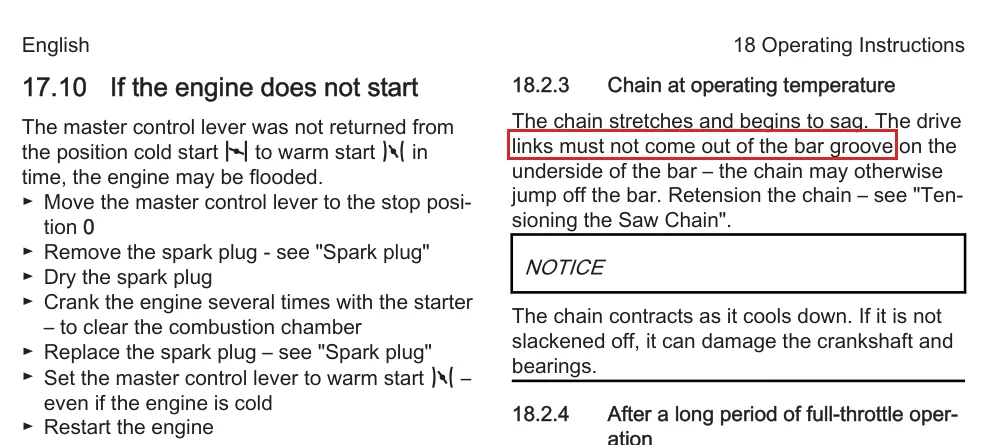
Heat changes the answer. STIHL’s MS 170/180 manual (p. 26) says a hot chain sags, and if its drive links leave the groove under the bar “the chain may otherwise jump off the bar”: retension, then slacken after work, because a cooling chain contracts and can damage the crankshaft bearings. Oregon (p. 22) says never to tension right after cutting. STIHL’s Sharp Advice booklet adds that a chain tensioned in very cold weather sags at operating temperature.
New chains stretch too: STIHL says to run one about 3 minutes at low speed, then retension; Oregon says to keep the first cuts light (p. 38). If a used chain goes slack every few minutes, check the bar nuts and clutch cover (Husqvarna’s checklist) and make sure the adjuster pin sits in the bar’s adjuster hole (ECHO, p. 24).
Step 2: Is the chain on backwards or off the sprocket?
After a chain has come off once, the refit is the next suspect. ECHO says to install it “with cutters on top of guide bar facing forward” (p. 24), Husqvarna’s 435/440e manual says the same (p. 17), and STIHL’s fitting illustration has the top cutting edges “point to the right” (p. 16). A reversed chain usually shows up as a saw that will not cut, but Oregon lists “incorrectly installed parts” beside loose tension as a cause of throws (p. 20).
Seat it in this order: drive links around the drive sprocket, then into the bar groove from the top, then the clutch cover with its adjuster pin in the bar hole. Husqvarna’s manual says to confirm the links sit correctly on the sprocket and in the groove before tightening the bar nut (p. 17).
Step 3: Does the chain match the bar?
Bar length alone does not identify a chain. Size is three numbers: pitch, gauge and drive-link count. STIHL (booklet pp. 6 to 7) stamps pitch on each depth gauge, the last digit of the gauge in millimeters on every drive link, and the drive-link count on the bar tail. Oregon stamps a chain number on its drive links (p. 48) and etches a part number on its bars whose third digit is the gauge: 4 = .043, 0 = .050, 8 = .058, 3 = .063 in. (p. 102).
| Number on the drive links | Pitch | Gauge |
|---|---|---|
| Oregon 25 | 1/4 in. | .050 in. (1.3 mm) |
| Oregon 90 | 3/8 in. Low Profile | .043 in. (1.1 mm) |
| Oregon 91 | 3/8 in. Low Profile | .050 in. (1.3 mm) |
| Oregon 80 | .325 in. Low Profile | .043 in. (1.1 mm) |
| Oregon 20 and 95 | .325 in. | .050 in. (1.3 mm) |
| Oregon 21 | .325 in. | .058 in. (1.5 mm) |
| Oregon 22 | .325 in. | .063 in. (1.6 mm) |
| Oregon 72 | 3/8 in. | .050 in. (1.3 mm) |
| Oregon 73 | 3/8 in. | .058 in. (1.5 mm) |
| Oregon 75 | 3/8 in. | .063 in. (1.6 mm) |
| Oregon 26 and 58 | .404 in. | .058 in. (1.5 mm) |
| Oregon 27, 59 and 68 | .404 in. | .063 in. (1.6 mm) |
| STIHL 61 (61 PMM3) | 3/8 in. P (Picco, 9.32 mm) | 1.1 mm (.043 in.) |
| STIHL 63 (63 PM3, 63 PD3) | 3/8 in. P (Picco, 9.32 mm) | 1.3 mm (.050 in.) |
Too thin a gauge lets the chain lean and wear one rail low (Oregon, p. 94); a pitch that does not match the sprocket peens the drive links (STIHL booklet, pp. 20 to 21). STIHL warns that non-matching parts can be damaged “beyond repair after a short period of operation” (MS 170/180 manual, p. 15). Four common saws list these sizes:
| Saw | Pitch | Gauge | Drive links by bar | Sprocket | Source |
|---|---|---|---|---|---|
| STIHL MS 170 | 3/8 in. P | 1.1 mm (.043 in.) | 30, 35, 40 cm bars; DL count stamped on bar tail | 6-tooth | MS 170/180 manual p. 37 |
| STIHL MS 180 | 3/8 in. P | 1.1 or 1.3 mm (.043 or .050 in.) | 30, 35, 40 cm bars; DL count stamped on bar tail | 6-tooth | MS 170/180 manual p. 37 |
| ECHO CS-310 | 3/8 in. Low Profile (91PX/91VG) | Must match bar groove | 45 (12 in.), 52 (14 in.), 57 (16 in.) | Not listed | CS-310 manual pp. 40 to 41 |
| Husqvarna 435/440e | .325 in. | 1.3 mm (.050 in.) | 56 (13 in.), 64 (15 in.), 66 (16 in.), 72 (18 in.) | Bar nose 10T | 435/440e manual p. 31 |
One example of why you count. Oregon’s S56 page (3/8 in. Low Profile, .050 in., 56 drive links) lists the ECHO CS-310 among the saws it fits, while ECHO’s own CS-310 manual pairs the 16 in. bar (part 16A0CD3757) with 57 links. Bars of the same called length can differ, so count the drive links on your old loop or read your bar’s stamp before ordering.
Step 4: Measure the bar: groove depth, rails and nose
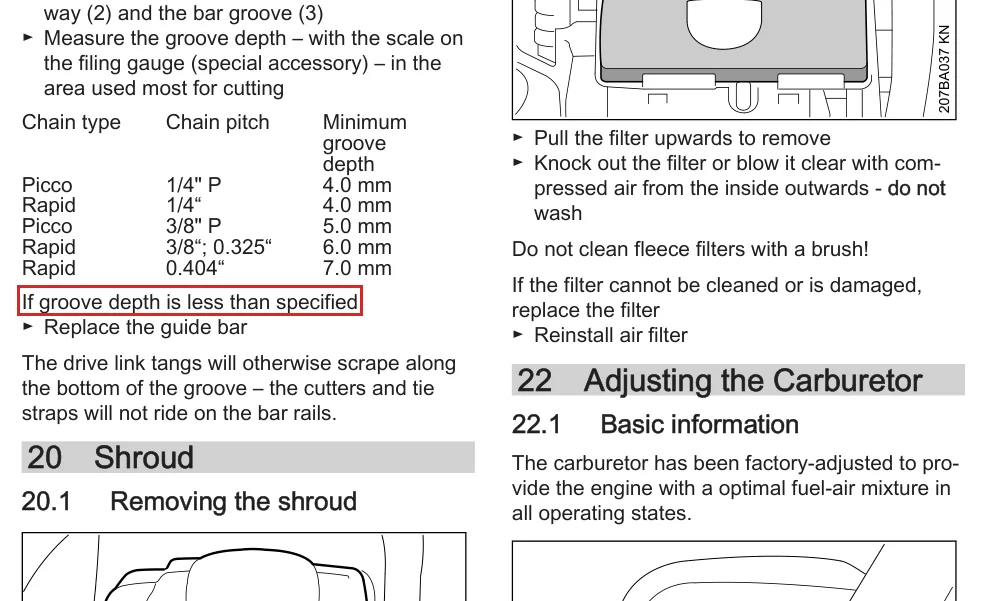
Next is the bar. STIHL’s MS 170/180 manual (p. 27) says to measure the groove with the depth scale on a filing gauge where most cutting is done, and to replace the bar below these minimums, or the drive-link tangs scrape the groove bottom and the cutters stop riding on the rails. Husqvarna’s 435/440e manual (p. 16) adds that a hollow under the bar tip comes from running a slack chain.
Two checks need no gauge. Oregon’s older dealer manual (2004, p. 79): hold a straightedge against the bar body and a cutter side plate. A good groove leaves a small gap; if the chain leans until the straightedge sits flush, replace the bar. Then file off wire edges on the rails before they chip (Oregon 2020, p. 94), and replace a bar with one rail worn low; Oregon says that most often comes from cutters hitting rocks on the ground side.
That happens on stumps cut low to the ground. Blue spots on the rails mean about 600°F (315°C) and softened steel: replace bar and chain (Oregon, p. 95). STIHL says to flip the bar every time you sharpen or change the chain; ECHO says to clean the groove and oil holes before each use (p. 42).
On a sprocket-nose bar, check the gap between the rails and the bottoms of the cutters at the tip. Oregon says to replace the nose sprocket before cutters or tie straps touch the rails (p. 89), and ties chipped nose rails to loose tension, and spread nose rails to cutting habits that twist the nose or push the drive links sideways (p. 97).
Step 5: Measure the drive sprocket
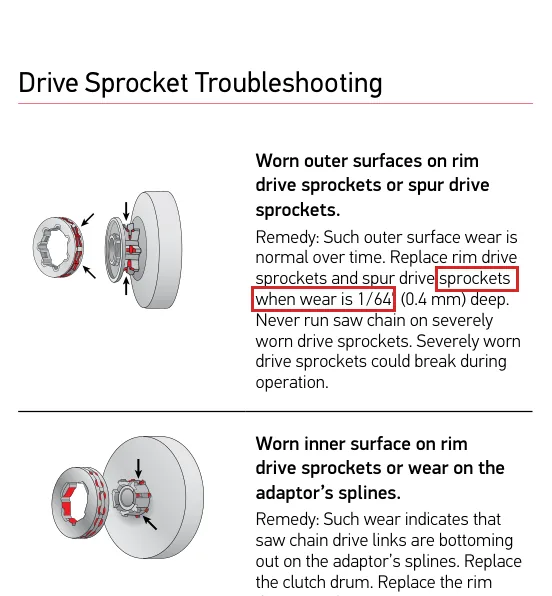
A worn drive sprocket lets the chain climb off the teeth, and a new chain will not fix it. The limits are close but not identical: ECHO’s CS-310 manual says replace at 0.5 mm (0.020 in.) of wear (p. 42), STIHL’s MS 170/180 manual says when wear marks exceed 0.5 mm or after two chains (p. 30), and Oregon says when wear reaches 1/64 in. (0.4 mm) deep (p. 146).
The replacement interval is where the makers part ways. Husqvarna’s 435/440e manual says to replace the drive sprocket “whenever you replace the chain” (p. 15); Oregon says every two chains or sooner (p. 10); STIHL’s booklet gives 4 chains to 2 sprockets to 1 bar (p. 17). All agree a new chain never goes on a worn sprocket, and Oregon adds the reverse (p. 43).
Read the drive links too. Battered tang bottoms mean the chain ran loose or jumped the sprocket (Oregon, p. 43); STIHL says to file burrs off and replace links too damaged to file (pp. 20 to 21). On saws whose sprocket is welded to the clutch drum (the 435/440e manual shows both types, p. 15), the whole drum is replaced.
What else makes a chain jump the bar?
Oregon traces most bar problems to lack of oil, incorrect tension, and habits that pinch the rails or push the drive links sideways, like twisting a pinched bar free (p. 94). ECHO’s oil test: hold the bar over a dry surface at half throttle for 30 seconds and look for a thin line of thrown oil (p. 35). Rakers matter too: Oregon ties depth gauges that were never lowered to slow cutting and extra rail wear (p. 41).
Behind the clutch cover, Oregon says a brake strap that is too tight overheats the clutch drum, and wear inside a rim means drive links are bottoming on the splines: replace drum and rim (pp. 145 to 146). If the saw also bogs, check fuel; ECHO’s CS-310 manual asks for 89-octane gas with no more than 10 percent ethanol, and our guide to gas and 2-cycle fuel for small engines covers ethanol limits.
What does the fix cost?
| Fix | Part | Price | Where and when |
|---|---|---|---|
| Retension only | None | $0 | Most first-time throws (Husqvarna lists tension first) |
| New 16 in. loop, 3/8 in. Low Profile, .050 in., 56 DL | Oregon 91PX056G AdvanceCut | $22.05 | Oregon online store, Nov. 26, 2026 |
| Replacement rim, 3/8 in. 7-tooth, standard 7 spline | Oregon Rim 3/8-7 SD7 | $11.40 | Oregon online store, Nov. 26, 2026; fits two-piece rim systems only |
| Rim sprocket system (drum and rim), 3/8 in. 7-tooth | Oregon 38470XSF | $32.27 | Oregon online store, Nov. 26, 2026 |
| 16 in. guide bar, .325 in., .050 in. | STIHL Light 04 (FARM BOSS listing) | $56.99 | STIHL USA guide bar listing, Nov. 26, 2026 |
Most fixes cost nothing or one chain; a bar plus sprocket runs about $57 to $89 at the list prices above. If the cutting itself is the job, compare crew rates in our tree trimming cost guide and tree removal cost data; for brush and saplings, see land clearing cost per acre.
How we compiled this
On Nov. 26, 2026 we read 4 operator manuals (STIHL MS 170/180, ECHO CS-310, Husqvarna 435/440e), 2 editions of Oregon’s Maintenance and Safety Manual (2004 and 2020), STIHL’s Sharp Advice booklet, 3 maker support pages and 4 maker store listings for prices. Thresholds are as printed; we converted units only. We did no testing.
Frequently asked questions
Why won’t my chain stay tight on my chainsaw?
A new chain stretches during break-in, and any chain stretches when hot. Retension cold after the first cuts; STIHL says to break a new chain in for about 3 minutes at low speed. If it keeps loosening, check the bar nuts (ECHO CS-310: 20 to 23 N·m), the adjuster pin in the bar hole, and the sprocket for wear past 0.5 mm.
How do you fix a chainsaw chain that came off?
Stop the engine, let it cool and wear gloves. Loosen the bar nuts, remove the clutch cover, and check the drive links for burrs; STIHL says to file burrs off and replace badly damaged links. Refit the chain on the sprocket first, then the bar groove, with top cutters facing the nose, and retension.
What happens if you put a chainsaw chain on backwards?
It cuts poorly or not at all, because the cutting edges trail instead of lead. ECHO and Husqvarna both say the cutters on top of the bar face forward, toward the nose. Turn the loop over and refit it.
How much slack should be in a chainsaw chain?
None on the underside of the bar. Husqvarna’s 435/440e manual says to tension until the chain does not sag from the underside yet still turns freely by hand. STIHL’s lift test: raise the chain at the top middle of the bar and the drive links should stay in the groove.
What happens if rakers are too high?
The chain cuts slowly and wears faster. Oregon lists depth gauges that were never lowered as a cause of slow cutting and extra wear on the chain and bar rails (manual p. 41), and STIHL’s booklet says a chain that chatters and jumps needs its depth gauges adjusted.
Sources
- Oregon Tool, Oregon Maintenance and Safety Manual: Saw Chain, Guide Bar and Drive Sprocket (A106971), 2020. Accessed November 2026.
- Oregon (Blount), Maintenance and Safety Manual for Saw Chain, Guide Bars, and Drive Sprockets (F/N A106971 AG 0904), 2004. Accessed November 2026.
- Oregon Products, How to Tension Chainsaw Chain, Checked Nov. 26, 2026. Accessed November 2026.
- STIHL Inc., Sharp Advice: Saw Chain, Guide Bars and Sprockets, 2010. Accessed November 2026.
- ANDREAS STIHL AG, MS 170, MS 180 Instruction Manual, 0458-207-8321-C, 2024. Accessed November 2026.
- ECHO Incorporated, CS-310 Chainsaw Operator’s Manual, X7503275305, Oct. 2023. Accessed November 2026.
- Husqvarna AB, 435, 435e, 440e Operator’s Manual, 1153135-26, Dec. 29, 2009. Accessed November 2026.
- Husqvarna, How to stop a chainsaw chain from coming off a guide bar, Checked Nov. 26, 2026. Accessed November 2026.
- Husqvarna, How to tighten a chainsaw chain: step-by-step guide, Checked Nov. 26, 2026. Accessed November 2026.
- Oregon Products, S56 AdvanceCut chainsaw chain product page, Checked Nov. 26, 2026. Accessed November 2026.
- Oregon online store, AdvanceCut Saw Chain 91PX056G, Price checked Nov. 26, 2026. Accessed November 2026.
- Oregon online store, Replacement Rims, Prices checked Nov. 26, 2026. Accessed November 2026.
- Oregon online store, Rim Sprocket Systems, Prices checked Nov. 26, 2026. Accessed November 2026.
- STIHL Inc., Guide Bars, Prices checked Nov. 26, 2026. Accessed November 2026.