The best time to fertilize lawn before or after rain is just before a light rain of 1/4 to 1/2 inch, or a day after a soaking one. Wait if 1 inch or more is forecast within 24 hours. Weed-and-feed needs 24 dry hours instead.
The best time to fertilize lawn before or after rain comes down to two numbers most advice leaves out: how many inches are forecast, and how many hours away the rain is. In a University of Georgia runoff trial, the simulated storm 4 hours after spreading carried off the most phosphorus of any storm, with a dramatic drop by the 24-hour storm (Shuman, Journal of Environmental Quality, 2002). Florida’s turf manual says urea is converted to ammonium, which soil holds, within the first 24 hours, so heavy rain 2 to 3 days later matters less (UF/IFAS GI-BMP manual, PDF p. 47). The first 24 hours are the risk window.
How much rain helps, and how much is too much
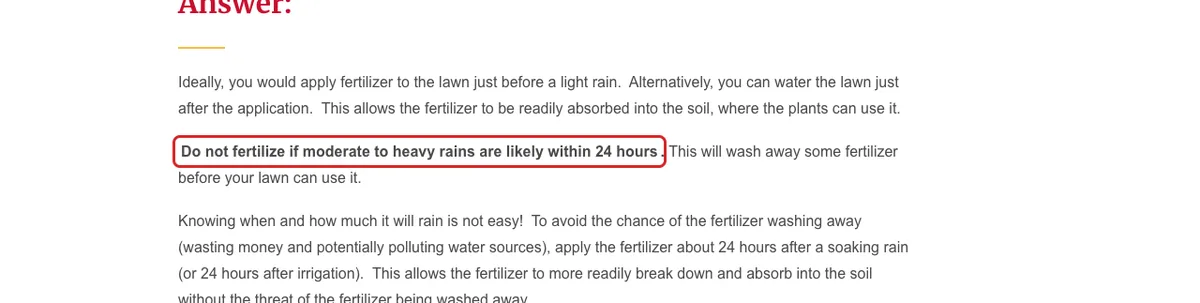
Light rain does the watering-in a label asks for. University of Florida turf specialists found that 1/8 to 1/4 inch of water is usually enough to wash granules into the thatch and soil. Unwatered urea lost 20 to 30 percent of its nitrogen as ammonia on average in field tests, and in lab work, irrigating right after application cut losses to minor amounts (Augustin and Peacock, UF/IFAS, 1986). Iowa State’s consumer horticulture specialist Aaron Steil puts it the same way: apply just before a light rain, and do not fertilize if moderate to heavy rain is likely within 24 hours (Iowa State Yard and Garden, April 2024).
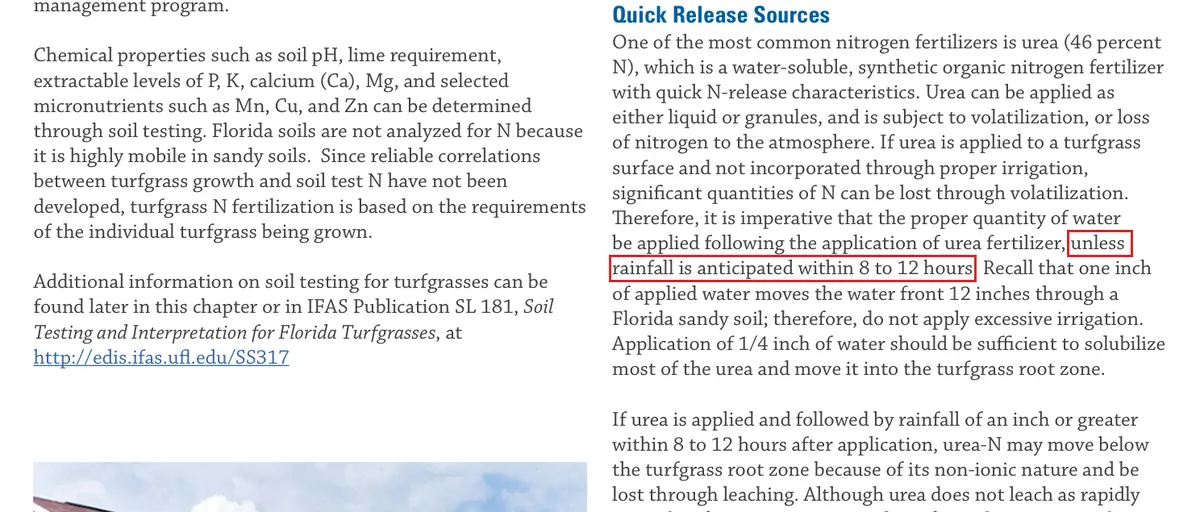
“Heavy” has numbers attached in Florida. The state’s Green Industries best management practices manual, which licensed applicators train on, says more than 1/2 inch of water after fertilizing may leach nitrogen past the roots, and that 1 inch or more within 8 to 12 hours of a urea application can carry urea-N below the root zone (GI-BMP manual, PDF pp. 47 and 61). Leon County draws its fertilizer rain delay at 1 inch in 24 hours (Leon County); Pinellas County bans application when 2 inches or more is forecast within 24 hours (Pinellas County).
Read the forecast for amount and timing, not just a rain icon. A 40 percent chance of 0.2 inch tonight is a green light for most granular lawn food; 1.5 inches from afternoon thunderstorms is not. If the forecast is dry, water in yourself: the run time for 1/4 inch on your sprinkler is in the calculator further down, and our guide to the best time of day to water grass covers measuring sprinkler output with a can.
What the runoff research measured
Turf scientists test this with rainfall simulators: spread fertilizer, rain on it at a set time, and catch what runs off. Four results decide the timing question. Watering in before the first storm matters most for phosphorus, the nutrient that feeds algae in lakes, which is why which states restrict phosphorus in lawn fertilizer overlaps so much with rain rules.
| Study | Setup | What happened | What it means for timing |
|---|---|---|---|
| Shuman 2002, Univ. of Georgia | 10-10-10 granular on Tifway bermudagrass; simulated storms of 2 in (50 mm) and 1 in (25 mm) at four intervals from 4 to 168 hours after application | Most phosphorus left in the 4-hour storm, with a dramatic drop at 24 hours. Over all storms 13.8 to 15.6% of applied P and 0.9 to 1.5% of applied nitrate N ran off. Runoff was 24.3 to 43.5% of each 2-inch storm | A downpour within hours is the worst case; one a day later loses far less |
| Carroll, Hapeman and Coale 2007, Univ. of Maryland and USDA-ARS | Urea and triple superphosphate, not watered in, on bentgrass near field capacity; 1.4 in/hr storm about 24 hours later | High N and P losses, which the authors blamed on wet soil, no watering-in and the short gap to the storm. That storm returns every 1 to 2 years at the site | Do not spread on wet soil ahead of a thunderstorm, even a day ahead |
| Shuman 2004, as summarized by Carroll et al. | Granular P watered in shortly after application, then storms | Granular P runoff losses reduced by nearly 75% | Watering in (or a light rain) before the first storm is the cheapest protection |
| Augustin and Peacock 1986, UF/IFAS | Field and lab tests of ammonia loss from urea on turf | Average 20 to 30% of N lost as ammonia; up to 59% on bare alkaline sand; 95% of losses within 7 days. In a lab study, irrigation right after application cut losses to minor amounts | No rain at all also costs nitrogen: water urea in within a day or two |
Soil moisture is the other half. Shuman found runoff volume tracked both the rainfall amount and how wet the soil already was, and his advice was to avoid applying before intense rain or when soil is very moist (abstract). A lawn where a screwdriver sinks easily and water still stands in low spots has no room left to absorb the next storm, and our page on how to tell if soil is well drained has the percolation test for those spots.
Rain rules by product: the label decides
Most lawn foods want rain or a sprinkler soon after spreading. Weed-and-feed products with 2,4-D and dicamba want the opposite: wet leaves going on, then 24 dry hours, because the granules have to stay stuck to the weed leaves. Check which kind is in the spreader before you read the forecast.
| Product type (example) | Apply to | Water it wants after | Rain to avoid | Source |
|---|---|---|---|---|
| Quick-release granular lawn food (Scotts Turf Builder Lawn Food 38-0-4) | Dry turf | Water in right after application; greening in as little as 3 days | “Do not apply if heavy rain is expected” | Scotts product page |
| Straight urea (46-0-0) and urea-based blends | Turf | 1/4 inch unless rain is expected within 8 to 12 hours; 1/8 to 1/4 inch soon after | 1 inch or more within 8 to 12 hours (leaching) | GI-BMP, PDF p. 47; UF/IFAS 1986 |
| Natural organic slow-release (Milorganite 6-4-0) | Turf | None required; rain or watering speeds release | Heavy rain (contains phosphorus, the nutrient that ran off most in the Georgia trial) | Milorganite; Shuman 2002 |
| Fertilizer plus crabgrass preventer (Scotts Turf Builder Halts with Lawn Food, pendimethalin) | Turf | 1/4 to 1/2 inch from rain or watering, immediately or within 2 to 3 days | Maker says rain after application does not affect performance; heavy-rain runoff rules still apply | Scotts product page |
| Weed-and-feed, 2,4-D and dicamba (Scotts Turf Builder Weed & Feed5, EPA Reg. No. 538-333) | Grass wet from dew or watering | None: do not water or mow for at least 24 hours | “Do not apply if rain is expected within 24 hours” | EPA label, Sept. 2026 |
| Southern weed-and-feed, atrazine (Scotts Bonus S, EPA Reg. No. 538-18) | Dry grass only | Must be “WATERED IN IMMEDIATELY” | Calm weather when rain is not predicted for 24 hours (environmental hazards section) | EPA label, March 2025 |
| Liquid hose-end lawn food | Turf | None extra: you feed and water at once | Heavy rain, which New Jersey’s required bag statement covers for every turf fertilizer | Scotts how-to |
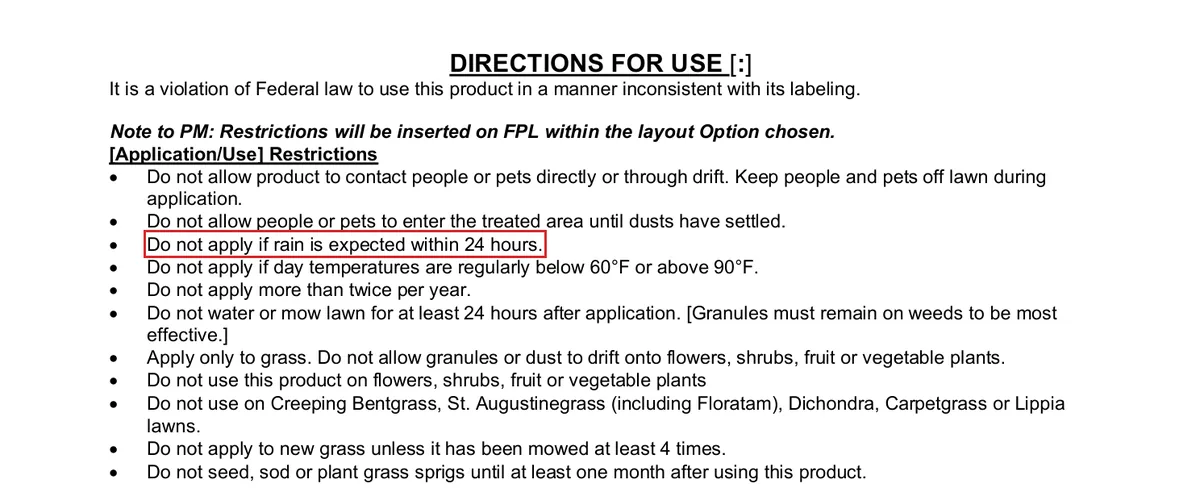
The weed-and-feed reversal trips people up because a light rain is good for the fertilizer and bad for the herbicide in the same bag. The Weed & Feed5 label lists both: apply to grass wet from dew or watering, and “Do not apply if rain is expected within 24 hours” (EPA Reg. No. 538-333). Bonus S, with atrazine that works through the soil, wants dry grass and immediate watering. Rainfastness for sprayed weed killers is covered in our guide on whether to spray weeds before or after rain, and the 13 store-bought products are compared in our lawn weed killer label comparison.
Where “not before heavy rain” is the law
In most states, the rain rule is advice on the bag. New Jersey made it law in 2011, and Florida counties wrote numeric thresholds into ordinances. Frozen-ground bans are more common; frozen ground sheds rain and snowmelt the way pavement does.
| Place | Rule | Rain or ground threshold | Binding? | Source |
|---|---|---|---|---|
| New Jersey | No fertilizer on turf when heavy rainfall is occurring or predicted, or when soils are saturated and fertilizer could move off-site | “Heavy rainfall” as defined by the State Climatologist; saturated soil | Yes, statute, everyone | N.J.S.A. 58:10A-62(a)(1), P.L.2010, c.112 |
| New Jersey | Every turf fertilizer bag without a pesticide must print “Do not apply if heavy rain is expected” | Heavy rain expected | Yes, labeling law | N.J.S.A. 4:9-15.13(c)(1) |
| Pinellas County, Fla. | No fertilizer during National Weather Service severe thunderstorm, flood, tropical storm or hurricane watches or warnings | 2 inches or more forecast within 24 hours | Yes, county ordinance | Pinellas County |
| Leon County, Fla. | Fertilizer rain delay: no fertilizer at least one day before heavy rain | 1 inch or more in 24 hours | County ordinance, per the county | Leon County |
| Florida (statewide BMP manual) | Do not apply under NWS flood, tropical storm or hurricane watch or warning, or if heavy rains are likely | Heavy rain = 2 inches (50 mm) in 24 hours, the WMO definition; 3 to 5% of Florida rain events exceed it | Training standard for licensed applicators | GI-BMP manual, PDF p. 51 |
| Maryland | No N or P on turf before March 1, after Nov. 15, or when the ground is frozen; state guidance adds no fertilizing if heavy rain is predicted | Frozen ground (statute); heavy rain (guidance) | Frozen ground yes; rain advisory | Md. Agric. §8-803.5(c); MDA guide |
| Wisconsin | No fertilizer of any kind on turf when the ground is frozen | Frozen = you cannot dig down 6 to 8 inches; snow is not a good indicator | Yes, statute | Wis. Stat. §94.643, DATCP P-DARM413 |
Florida’s ordinances are local, and a UF/IFAS review counted them in at least 35 counties and 97 more municipalities (UF/IFAS SL511, 2024). Seasonal blackout dates, such as Pinellas County’s June 1 to Sept. 30 nitrogen and phosphorus ban, belong to our guide on when to fertilize your lawn.
This page is general information, not legal advice. Fertilizer rules and labels change; read the current label on your product and confirm local ordinances with your county before applying.
After rain: when the lawn is ready again
Iowa State’s safest option is to wait about 24 hours after a soaking rain or irrigation, then spread: the soil is moist, so granules break down, and no storm is waiting to wash them off (Iowa State). That also lets the blades dry, which most granular labels want: Scotts Turf Builder Lawn Food says to apply to dry turf, and Bonus S says dry grass only.
- Check the next 24 hours: under about 1/2 inch is fine, 1 inch or more means wait (Leon County’s line), and any flood or severe thunderstorm watch means wait (Pinellas County).
- Check the soil: if water still stands or the surface squishes, wait. New Jersey bars application on saturated soil where fertilizer could move off-site (N.J.S.A. 58:10A-62).
- Check the blades: granular lawn food and atrazine weed-and-feed go on dry grass; 2,4-D weed-and-feed goes on dew-wet grass.
- Spread at the label rate, and sweep granules off the driveway and sidewalk back onto the lawn, as the NJ bag statement and Scotts’ directions require.
- Water in 1/8 to 1/4 inch the same day if no light rain is due within 8 to 12 hours, unless the label says not to (UF/IFAS).
1Is it a weed-and-feed with 2,4-D or dicamba (Weed & Feed5 type)?
YesSpread on dew-wet grass only if no rain is expected for 24 hours, and do not water for 24 hours (EPA Reg. No. 538-333).
NoGo to the next question
2Is the ground frozen, or is the soil saturated with standing water?
YesWait. Frozen ground is off limits by law in NJ, MD and WI; NJ also bars saturated soil (N.J.S.A. 58:10A-62).
NoGo to the next question
3Is a flood, severe thunderstorm, tropical storm or hurricane watch or warning in effect, or is 1 inch or more forecast within 24 hours?
YesWait at least a day after it passes (Leon County 1 inch; Pinellas County 2 inches and NWS watches).
NoGo to the next question
4Is a light rain of about 1/4 to 1/2 inch forecast within the next day?
YesSpread now on dry grass and let the rain water it in (Iowa State; UF/IFAS).
NoGo to the next question
5Did a soaking rain end about 24 hours ago, with the grass blades now dry?
YesSpread now, then water in 1/8 to 1/4 inch unless light rain is due within 8 to 12 hours.
NoDry forecast: spread on dry grass and water in 1/8 to 1/4 inch the same day (UF/IFAS). For Milorganite, watering is optional; for Bonus S, water in immediately.
How long to run the sprinkler when no rain comes
Run time is depth divided by your sprinkler’s output, times 60. A spray nozzle at 1.58 inches per hour puts down 1/4 inch in about 9.5 minutes; a rotary nozzle at 0.4 inch per hour needs about 37.5 minutes (Rain Bird and Hunter charts, via our lawn watering guide). Florida’s manual warns against going past 1/2 inch, which may leach nitrogen.
- Run time (minutes)
- 9.5
Default: 1/4 inch from a spray nozzle at 1.58 in/hr takes about 9.5 minutes. UF/IFAS says 1/8 to 1/4 inch is usually enough; Florida's GI-BMP manual warns that more than 1/2 inch may leach nitrogen. Your label overrides this tool.
| Sprinkler output | 1/8 inch | 1/4 inch | 1/2 inch |
|---|---|---|---|
| Spray nozzle, 1.58 in/hr | 5 min | 9.5 min | 19 min |
| Measured 1.0 in/hr | 7.5 min | 15 min | 30 min |
| Measured 0.5 in/hr | 15 min | 30 min | 60 min |
| Rotary nozzle, 0.4 in/hr | 19 min | 37.5 min | 75 min |
Watering in also guards against burn. Quick-release nitrogen left on wet leaves in hot weather is a common cause of scorched stripes, and our page on whether you can over-fertilize your lawn has the 1 lb of nitrogen per 1,000 sq ft limit per pass and the 1-inch flush that fixes it. For the nitrogen math behind each bag, see how to add nitrogen to lawn soil.
What popular guides say, and what the sources say
Ranking pages disagree with each other more than the sources do. One hardware-store blog says it is best to apply fertilizer when it is raining, and a magazine summary concludes it is best to fertilize after a rain. Both fit only part of the evidence: Iowa State calls a light rain ideal and 24 hours after a soaking rain the safe alternative, while Florida’s manual treats anything over 1/2 inch soon after as a leaching risk for urea. The amount decides it, which is why every row on this page carries an inch or hour figure.
How we compiled this
We read 18 primary documents in November 2026: 2 peer-reviewed or research-program runoff studies, 3 UF/IFAS and Iowa State extension publications, 4 product pages and 2 EPA-accepted pesticide labels from the makers, and 7 statutes, ordinances or state agency pages. We did not run field tests. Run times are our arithmetic from published nozzle rates. The Shuman 2004 watering-in result is cited as summarized by Carroll and colleagues because the original paper is paywalled.
Frequently asked questions
Is it okay to fertilize your lawn just before it rains?
Yes, if the forecast is a light rain of about 1/4 to 1/2 inch. That waters granules in for you. Do not spread if moderate to heavy rain is likely within 24 hours (Iowa State), or if 1 inch or more is forecast (Leon County, Fla.).
What happens if it rains right after I fertilize my lawn?
A light rain helps. A downpour within hours washes some off: in the Georgia trial, the storm 4 hours after spreading caused the largest phosphorus loss, yet nitrate N lost over all the trial’s storms was 1.5 percent or less of what was applied. Do not double the dose to make up for it.
Is 2 inches of rain too much for fertilizer?
Yes, if it falls within a day of spreading. Two inches in 24 hours is the WMO definition of heavy rain used in Florida’s manual, Pinellas County bans fertilizing when that much is forecast, and in Shuman’s trial 24.3 to 43.5 percent of each 2-inch storm ran off.
How long does lawn fertilizer need before rain?
About 24 hours for heavy rain. Phosphorus runoff dropped sharply between the 4-hour and 24-hour storms in Shuman’s trial, and urea is converted to soil-held ammonium within about 24 hours (GI-BMP manual). Weed-and-feed with 2,4-D needs 24 rain-free hours by label.
What happens if I fertilize and it doesn’t rain?
Unwatered urea loses nitrogen to the air: 20 to 30 percent on average in Florida field tests, 95 percent of it within 7 days (UF/IFAS). Water in 1/8 to 1/4 inch within a day. Milorganite does not need watering; it waits for moisture.
Sources
- Iowa State University Extension, Yard and Garden (A. Steil), Should I fertilize my lawn before or after it rains?, Last updated April 15, 2024. Accessed November 2026.
- L.M. Shuman, Journal of Environmental Quality 31(5):1710 to 1715, Phosphorus and nitrate nitrogen in runoff following fertilizer application to turfgrass (abstract), 2002. Accessed November 2026.
- USGA Turfgrass and Environmental Research Online 6(24), M.J. Carroll, C.J. Hapeman, F.J. Coale, Turfgrass Runoff Investigations: Does Plot Size Matter?, Dec. 15, 2007. Accessed November 2026.
- UF/IFAS, B.J. Augustin and C.H. Peacock, via Florida Green, Gaseous Loss of Nitrogen from Turf, Winter 1986. Accessed November 2026.
- UF/IFAS and Florida DEP, Florida-Friendly Best Management Practices for Protection of Water Resources by the Green Industries (GI-BMP manual), PDF pp. 47, 51 and 61, PDF dated January 2021. Accessed November 2026.
- UF/IFAS Extension, Reisinger, Dukes, Iannone, Unruh, Smidt, SL511, Effects of Urban Fertilizer Ordinances on Water Quality, January 2024, reviewed November 2024. Accessed November 2026.
- New Jersey State Library, P.L.2010, c.112 (N.J.S.A. 58:10A-62 and 4:9-15.13), Approved Jan. 5, 2011. Accessed November 2026.
- Pinellas County, Fla., Pinellas County Fertilizer Ordinance, Current page. Accessed November 2026.
- Leon County, Fla., Water Resource Division, Fertilizer Guidance and Fertilizer Rain Delay, Current page. Accessed November 2026.
- Maryland General Assembly, Md. Code, Agriculture §8-803.5, Current statute. Accessed November 2026.
- Maryland Department of Agriculture, Lawn Fertilizer Guide for Homeowners and Residents, Current page. Accessed November 2026.
- Wisconsin DATCP, P-DARM413, Turf Fertilizer Phosphorus Restrictions (Wis. Stat. §94.643), April 2022. Accessed November 2026.
- ScottsMiracle-Gro, Scotts Turf Builder Lawn Food 38-0-4 (SKU 23500) product page and directions, Checked Nov. 14, 2026. Accessed November 2026.
- ScottsMiracle-Gro, How to Use Lawn Fertilizer, Checked Nov. 14, 2026. Accessed November 2026.
- ScottsMiracle-Gro, Scotts Turf Builder Halts Crabgrass Preventer with Lawn Food product page, Checked Nov. 14, 2026. Accessed November 2026.
- The Scotts Company, EPA Reg. No. 538-333, Turf Builder Weed & Feed5 label, EPA PPLS, Sept. 17, 2026. Accessed November 2026.
- The Scotts Company, EPA Reg. No. 538-18, Scotts Bonus S label, EPA PPLS, March 24, 2025. Accessed November 2026.
- Milwaukee Metropolitan Sewerage District (Milorganite), When to Fertilize Lawn: Schedule and Application Rates, Checked Nov. 14, 2026. Accessed November 2026.
- Rain Bird Corporation, Spray Nozzles, 2019 turf catalog, 2019. Accessed November 2026.
- Hunter Industries, MP Rotator Nozzle: Precipitation Rates, Current page. Accessed November 2026.